Democratic Republic of the Congo

Quick facts
- Capital
- Kinshasa
- Largest city
- Kinshasa
- Government
- Unitary semi-presidential republic
- Area
- 2,345,409 km² (905,567 sq mi)
- Population
- 124,388,160 (2025)
- Money
- Congolese franc
Facts from Wikipedia’s “Democratic Republic of the Congo” page (CC BY-SA 4.0).
}}
The Democratic Republic of the Congo (République démocratique du Congo), commonly referred to as DR Congo, Congo-Kinshasa or the DRC, is a country in central Africa. It was known as Zaïre from 1971 to 1997. It is the second largest country in Africa by area and the eleventh largest in the world. With a population of over 71 million, the Democratic Republic of the Congo is the nineteenth most populous nation in the world, the fourth most populous nation in Africa, as well as the most populous Francophone (French-speaking) country.
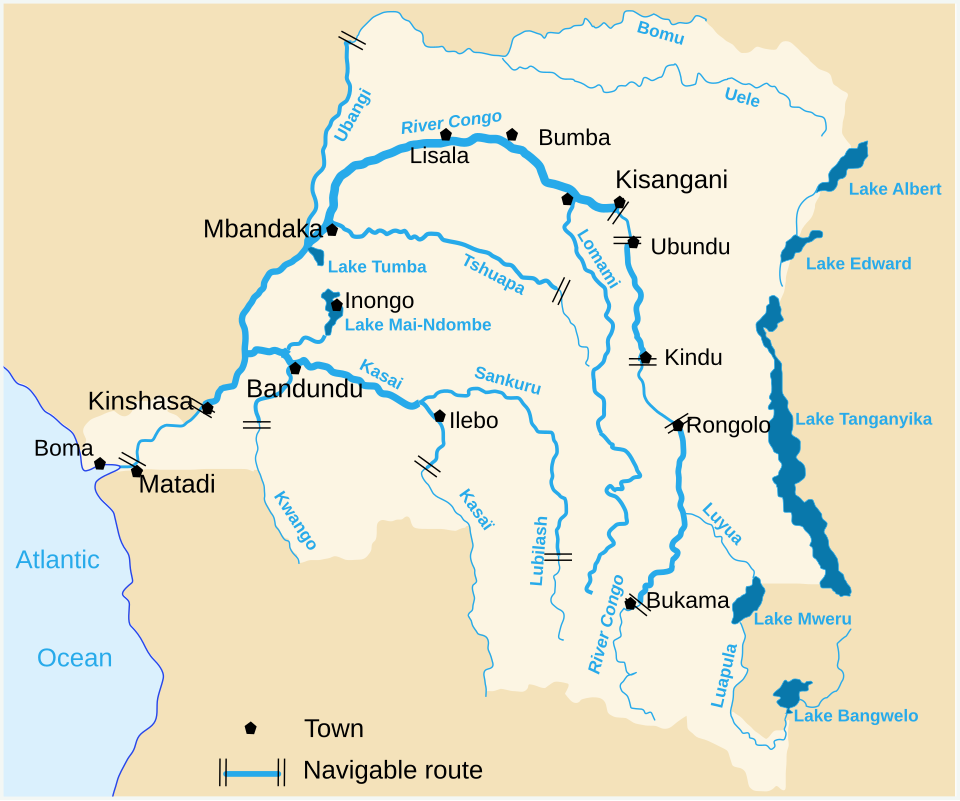
The Democratic Republic of the Congo borders the Central African Republic and South Sudan to the north; Uganda, Rwanda, and Burundi in the east; Zambia and Angola to the south; the Republic of the Congo, the Angolan exclave of Cabinda, and the Atlantic Ocean to the west. It is separated from Tanzania by Lake Tanganyika in the east. The country has access to the ocean through a 40 kilometres (25 mi) stretch of Atlantic coastline at Muanda and the roughly 9 km wide mouth of the Congo River which opens into the Gulf of Guinea. It has the second-highest total Christian population in Africa.
History
When the Belgian Congo became independent, its leaders fought each other. The Soviet Union and later the United Nations helped destroy the groups who wanted independence from the new country.
The Second Congo War, beginning in 1998, devastated the country. It involved nine African nations and some twenty armed groups. Despite the signing of peace accords in 2003, fighting continues in the east of the country. There, the prevalence of rape and other sexual violence is described as the worst in the world. The war is the world’s deadliest conflict since World War II, killing 5.4 million people since 1998. The vast majority died from conditions of malaria, diarrhea, pneumonia and malnutrition.
The Democratic Republic of the Congo was formerly, in chronological order, the Congo Free State, Belgian Congo, Congo-Léopoldville, Congo-Kinshasa, and Zaire (Zaïre in French). Though it is in the Central African United Nations subregion, the nation is also economically and regionally affiliated with Southern Africa as a member of the Southern African Development Community (SADC).
Civil war
The city of Goma was captured in 2025, as part of the M23 offensive (a series of attacks); The city is “eastern DR Congo’s biggest city”; The armed group M23 is backed by Rwanda. In February, the government lost control of the city of Bukavu and the town of Kavumu and its strategic military airport (map).
Earlier (January 26), the country cut its diplomatic contact with Rwanda, because of Rwanda supporting M23.
The Kivu conflict is ongoing (2025). North Kivu and South Kivu provinces are in the eastern part of the country. Some of the most active rebel groups are the Allied Democratic Forces, CODECO, and some Mai Mai militias. A UN peacekeeping force, MONUSCO, is in the country.
FDLR are supported by the military, in their fight against M23. The group is made up of Hutus. FARDC are the Armed Forces of the Democratic Republic of the Congo.
Western DR Congo clashes are a series of attacks; As late as July 2024, 42 Mobondo rebels were killed when they attacked a village; 9 government forces died.
Geography
The country is bordered by Angola, the South Atlantic Ocean, the Republic of Congo, the Central African Republic, South Sudan, Uganda, Rwanda, Burundi, Tanzania across Lake Tanganyika, and Zambia.
The capital of the Democratic Republic of Congo is Kinshasa.
World Heritage Sites in the Democratic Republic of Congo include Virunga National Park (1979), Garamba National Park (1980), Kahuzi-Biega National Park (1980), Salonga National Park (1984) and Okapi Wildlife Reserve (1996).
Provinces
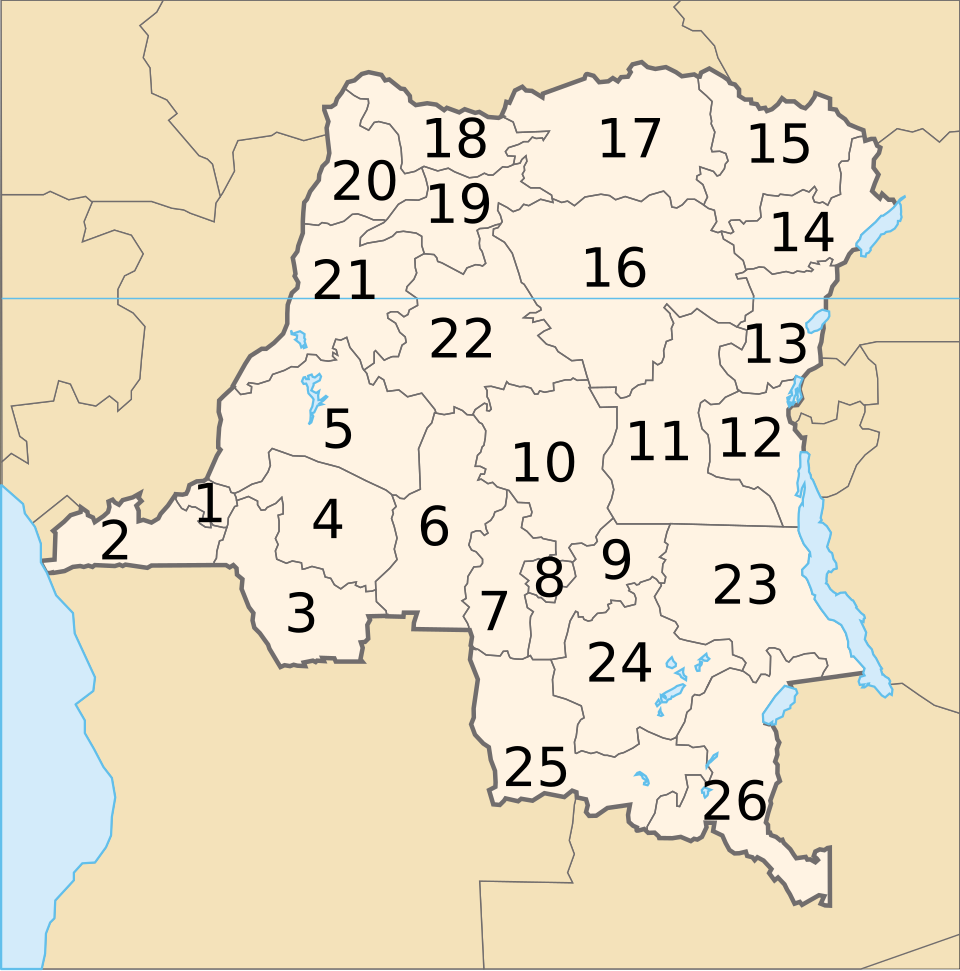
The country is divided into twenty six provinces. The provinces are then divided into districts. The districts are divided into territories.
Written for younger readers
Democratic Republic of the Congo, in simpler words
This version comes from Wikijunior, a set of books written for children aged 8 to 11. It is shorter and uses plainer language than the article above.
From Wikijunior: Africa
The Democratic Republic of Congo (previously known as Zaire) is a very large country in Central Africa. It is the 11th biggest country in the world and the 2nd biggest in Africa (after Algeria). Most of the country is landlocked (meaning without a sea coast), but there is a small 40km strip of coastline in the western side of the country.
The DR of Congo has an area of 2,345,408 square kilometres and is the 11th biggest country in the world. The DR of Congo shares borders with Central African Republic and South Sudan to the north; Uganda, Rwanda, and Burundi in the east; Zambia, Angola, the Republic of the Congo and Tanzania.
The official language of the DR of Congo is French, but other languages are commonly spoken, including Lingala, Kikongo, Swahili and Tshiluba.
Where this page comes from
The article above is adapted from “Democratic Republic of the Congo” on Simple English Wikipedia, by its contributors. We removed reference markers, navigation boxes and tables, expanded measurement templates into readable numbers, and kept the prose otherwise intact. The simpler version is adapted from Wikijunior on Wikibooks.
Both sources are published under CC BY-SA 4.0, so this page is published under the same licence. You may share and adapt it, including commercially, as long as you credit the original and keep the same licence.
Worksheets, answer keys and printable layouts elsewhere on K5Print are our own work and are not covered by this licence.