Egypt

Fast facts
- Official language
- Arabic
- Capital
- Cairo
- Currency
- Egyptian pound (E£)
- Time zone
- EET
- Drives on
- right
- Calling code
- +20
Facts from Wikipedia’s “Egypt” page (CC BY-SA 4.0).
Egypt, officially the Arab Republic of Egypt, is a country in the Middle East and the Eastern Mediterranean, located in North Africa and Western Asia.
It is bordered by the Mediterranean Sea to the north. To the northeast is the region of the Southern Levant comprising Israel and the Gaza Strip, which is part of Palestine. It is also bordered by the Red Sea to the east, Sudan to the south, and Libya to the west. In the northeast, the Gulf of Aqaba separates Egypt from Jordan and Saudi Arabia.
Cairo is the capital, largest city, and most important cultural center, while Alexandria is the second-largest city and an important hub of industry and tourism. Egypt is famous for its ancient monuments, such as the Pyramids and the Sphinx
Egypt is a member of the United Nations, the African Union, and the Arab League.
History
Ancient Egypt has one of the longest histories of any country in the world. For a long time, it was ruled by pharaohs. It became part of the Achaemenid Empire and the Ptolemaic dynasty and for centuries was a province of the Roman Empire. During the Roman era, many people became Christian. Some Christians, called Copts, remained in Egypt despite over a thousand years of Muslim rule.
The Fatimid Caliphate ruled Egypt in the tenth through twelfth centuries. Mamluks ruled it until 1798 when Napoleon defeated them. Muhammad Ali Pasha soon took over and started a dynasty of Khedives under the Ottoman Empire. The Empire fell apart after World War I. Egypt became an independent country in 1922 and the khedive became a king, starting the Kingdom of Egypt. It became a republic after the Army’s revolution of 1952.
Geography
Egypt is a large country, but a large portion of it is desert. Most people (95% of Egypt’s total people) live in areas around the coast of the Mediterranean Sea and along the Nile River. This includes the cities of Cairo, Alexandria, Aswan, and Port Said. Not many people live in the desert. Today, Egypt has about 110 million people.
Egypt is divided into 29 areas, called Governorates of Egypt.
Politics
Egypt is a country that has had many different rulers and many political systems. After World War II, Egypt was still ruled by a king, Farouk of Egypt (11 February 1920 – 18 March 1965). He was the last ruler of the Muhammad Ali dynasty.
Farouk was overthrown on 23 July 1952 by a military coup. The coup was led by Mohamed Naguib, and Gamal Abdel Nasser. From then on, Egypt had military rulers or rulers who had the backing of the army and many citizens.
Nasser became president, from 1956 to 1970. Later rulers were Anwar Sadat, and Hosni Mubarak.
In 2012, Mohamed Morsi became the president after the 2011 revolution.
Abdel Fattah el-Sisi became president in 2014.
Revolution of 2011
In January 2011, thousands of protesters gathered in Cairo. They wanted Hosni Mubarak to leave office. He had been the President for almost 30 years. On February 11, 2011, Vice President Omar Suleiman made an announcement. He said that Mubarak agreed to leave office. In 2012, Egypt had a democratic election for the post of President. The winner was the Muslim Brotherhood candidate, Mohamed Morsi.
The events which followed are still controversial, but one aspect stands out. Morsi issued a declaration that in effect gave him unlimited powers. He had the power to legislate (make laws) without legal overview by the courts. This caused widespread protests. On 3 July 2013, he was unseated by a military coup council (a coup d’état). After an election in June 2014, Abdel Fattah el-Sisi became President of Egypt. Islamist movements, such as the Muslim Brotherhood, rejected the change of regime as a military coup, and not democratic.
Religion
Today, the people of Egypt are mostly Sunni Muslims. There are many Christians in Egypt today. Many of them belong to the Coptic Orthodox Church of Alexandria.
Languages
The official language in Egypt is Arabic. The majority speak Egyptian Arabic but many speak other dialects. Some Egyptians still speak Coptic. English, French and German are also common. These are taught in Egypt as additional languages.
Famous people
Many famous people are from Egypt. Some of these include Omar Sharif, who was an international actor, Boutros Boutros-Ghali, who was the first person from Africa to lead the United Nations, and four Nobel Prize winners: Anwar Sadat, who won the Nobel Peace Prize in 1978 after making peace with Israel, Naguib Mahfouz, who won the Nobel Prize in Literature in 1988, Ahmed Zewail, who won the Nobel Prize in Chemistry in 1999, and Mohamed ElBaradei, who won the Nobel Peace Prize in 2005. Mohamed Salah is a famous footballer who plays for Liverpool in England. Umm Kulthum is a famous Egyptian singer. Other Egyptian singers include Amr Diab.
Governorates
Egypt is divided into 27 governorates. The governorates are divided into regions. The regions have towns and villages. Each governorate has a capital. Sometimes the capital has the same name as the governorate.
Culture
Egypt is a country with an immense cultural mix. Life in the countryside differs from life in large cities. There are differences between the families which are Muslim, and the smaller number which are Coptic Christians. There are noticeable differences in the standards of education.
Tourism
Tourism is one of the most important parts of the national income in Egypt. In 2008, about 12 million tourists visited the country. They provided nearly $12 billion of national income to Egypt. Tourism affects the economy of the country as a whole.
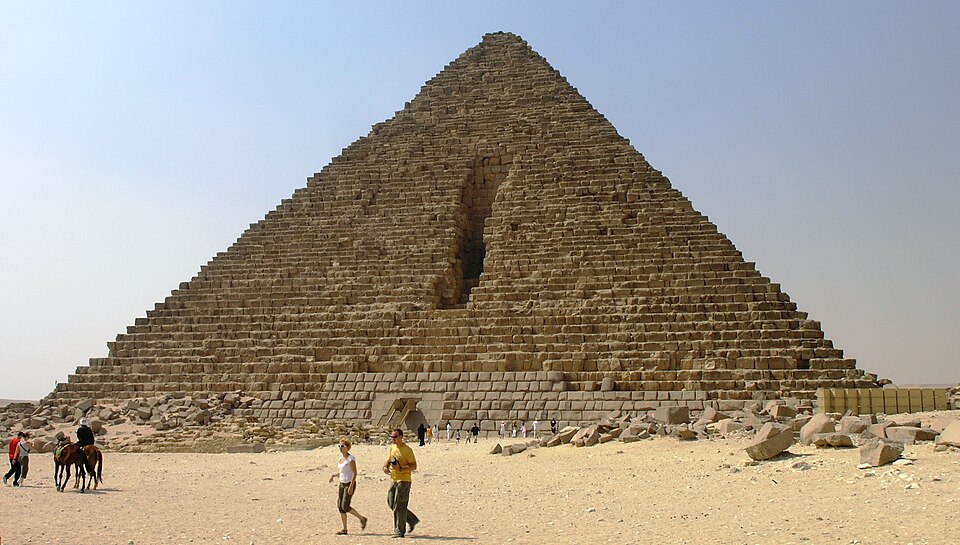
Giza Necropolis is one of Egypt’s iconic sites. It is a popular destination for tourists to visit. It includes the Great Pyramid of Giza, one of the Seven Wonders of the World.
Transport
There are methods of transport in Egypt. The Suez Canal carries ships of many countries.
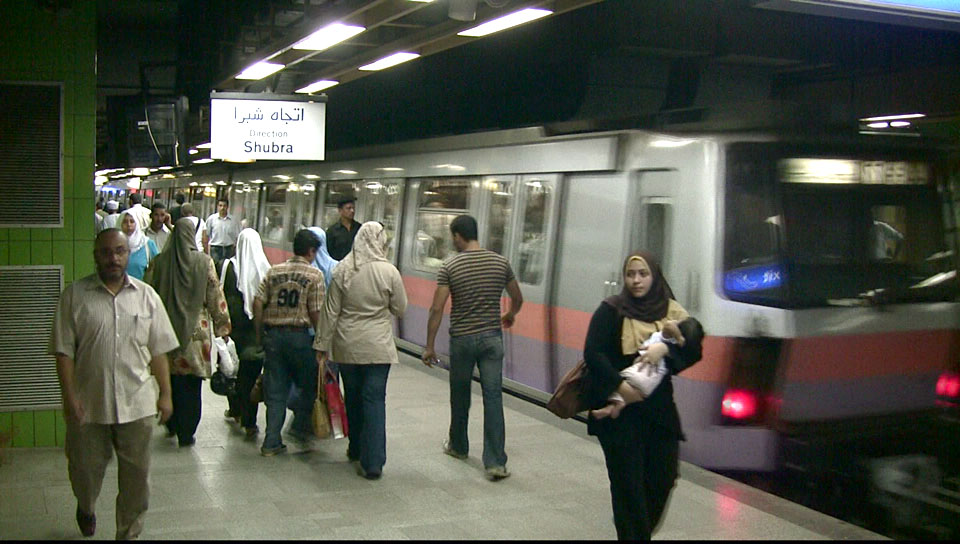
Cairo Metro is one of the most important projects in Egypt. It consists of 3 lines. Metro is the most preferable transport in Egypt due to persistent major traffic jams in the streets of Cairo. Metro line 4 is being developed to reach the New Cairo District.
Egypt established EgyptAir in 1932. The airline is based in Cairo International Airport and is owned by the Egyptian government
Egyptian Armed Forces
The Egyptian Armed Forces are the defense forces of Egypt. They consist of the Egyptian Air Force, Egyptian Navy, Egyptian Army, and the Egyptian Air Defense Forces. It is ranked 8th in the world. It is the strongest military force in the Arab world and Africa.
Written for younger readers
Egypt, in simpler words
This version comes from Wikijunior, a set of books written for children aged 8 to 11. It is shorter and uses plainer language than the article above.
From Wikijunior: Africa
Egypt (Arabic: مِصر) is a large country located in north-eastern Africa (except for the Sinai Peninsula, which is located in Asia).
Egypt borders Libya to the west, the Gaza Strip and Israel to the east, and Sudan to the south. Egypt has coastlines in the Mediterranean Sea and the Red Sea. With a covering area of 386,662 mi2, Egypt has about the same land covering as Texas (a state in the United States of America).
The Nile River, the longest river in the world, goes through the cities of Alexandria, Cairo, Luxor, and Aswan (all in Egypt), as well as Sudan, South Sudan, Uganda, and Ethiopia. The Nile River is a major source of water for Egypt and Sudan.
Egypt has a history stretching back thousands of years, starting from Ancient Egypt.
Around 82 million people live in Egypt, mostly in the areas around the River Nile. Most of the people in Egypt speak Egyptian Arabic.
Wikijunior:Countries A-Z/Egypt
Where this page comes from
The article above is adapted from “Egypt” on Simple English Wikipedia, by its contributors. We removed reference markers, navigation boxes and tables, expanded measurement templates into readable numbers, and kept the prose otherwise intact. The simpler version is adapted from Wikijunior on Wikibooks.
Both sources are published under CC BY-SA 4.0, so this page is published under the same licence. You may share and adapt it, including commercially, as long as you credit the original and keep the same licence.
Worksheets, answer keys and printable layouts elsewhere on K5Print are our own work and are not covered by this licence.