Estonia

Fast facts
- Capital
- Tallinn
- Languages
- Estonian
- Currency
- Euro (€)
- Time zone
- EET
- Calling code
- +372
Facts from Wikipedia’s “Estonia” page (CC BY-SA 4.0).
Estonia (), officially the Republic of Estonia (Eesti Vabariik) is a country by the Baltic Sea in Northern Europe. The capital city is Tallinn. Estonia has borders with Sweden, Finland, Russia and Latvia. Its population is 1,332,893.
The territory includes the mainland and 2,222 islands in the Baltic Sea.
History
People have lived in Estonia since at least 9,000 BC. The oldest known settlement in Estonia is the Pulli settlement, which was on the banks of the Pärnu River.
At the end of World War I (1914-1918) Estonia became an independent country in 1918. Estonia won the War of Independence (1918-1920) against Soviet Russia. During World War II (1939–1945), Estonia lost its independence as it was invaded and occupied by the Soviet Union in June 1940, then by Nazi Germany in 1941, and occupied again by the Soviet army in 1944. The occupied country was called the Estonian Soviet Socialist Republic by the Soviets.
Estonia restored independence from the Soviet Union in August 1991. It became a member of the North Atlantic Treaty Organization (NATO) on 29 March 2004. It joined the European Union on 1 May 2004.
Politics
In January 2021, Estonia became the only country in the world led by women by having a female president (Kersti Kaljulaid) and female prime minister (Kaja Kallas). A few months later, Alar Karis replaced Kaljulaid as president and in 2024 Kristen Michal replaced Kallas as Prime minister.
As of 2025, Estonia plans to spend each year more than 5% of GDP on defence.
Geography
Estonia is bordered to the north by the Gulf of Finland with Finland on the other side, to the west by the Baltic Sea with Sweden on the other side, to the south by Latvia (343 km), and to the east by Lake Peipus and Russia (338.6 km).
Average elevation reaches only 50 metres (160 ft). The country’s highest point is the Suur Munamägi in the southeast at 318 metres (1,040 ft).
Estonia has many forests, almost 50% of the land is covered with forests. The most common tree species are pine, spruce and birch. Estonia has over 1,400 lakes and over 2,000 islands. The longest rivers are Võhandu (162 km (101 mi)), Pärnu (144 km (89.5 mi)), and Põltsamaa (135 km (83.9 mi)).
Biodiversity
Mammals in Estonia include the grey wolf, lynx, brown bear, red fox, badger, wild boar, moose, red deer, roe deer, beaver, otter, grey seal, and ringed seal. The critically endangered European mink has been successfully reintroduced to the island of Hiiumaa. The rare Siberian flying squirrel is present in east Estonia.
Over 300 bird species have been found in Estonia. These include the white-tailed eagle, lesser spotted eagle, golden eagle, western capercaillie, black and white stork, many species of owls, waders, geese and many others. The Barn swallow is the national bird of Estonia.
Protected areas cover 18% of Estonian land and 26% of its sea territory. There are 5 national parks, 159 nature reserves, and many other protection areas.
Government
The Riigikogu is the name of the parliament in Estonia.
Administrative regions
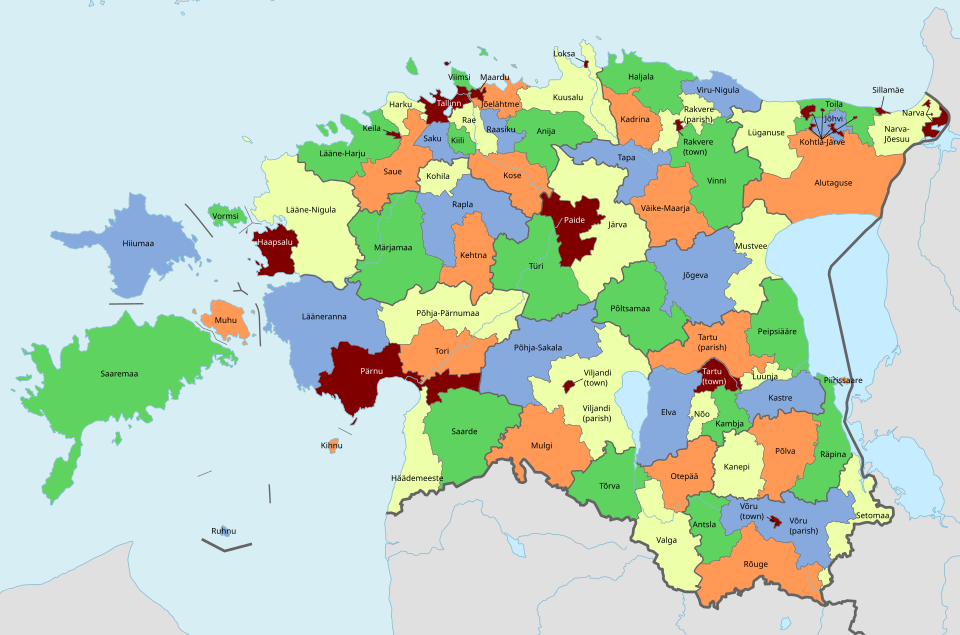
Since administrative reform in 2017, there are in total 79 local governments. This includes 15 towns and 64 rural municipalities. All municipalities have equal legal status and form part of a county, which is a state administrative unit.
The counties are:
- Harju County
- Hiiu County
- Ida-Viru County
- Jõgeva County
- Järva County
- Lääne County
- Lääne-Viru County
- Põlva County
- Pärnu County
- Rapla County
- Saare County
- Tartu County
- Valga County
- Viljandi County
- Võru County
Culture
According to speedtest.net, Estonia has one of the fastest Internet download speeds in the world with an average download speed of 27.12 Mbit/s.
Estonia won the Eurovision Song Contest in 2001 with the song “Everybody” performed by Tanel Padar and Dave Benton. In 2002, Estonia hosted the event.
The Estonian National Day is the Independence Day celebrated on 24 February. This is the day the Estonian Declaration of Independence was issued. 2013, there are 12 public holidays and 12 national holidays celebrated each year.
In June 2023, the Estonian government passed a bill legalising same-sex marriage and same-sex adoption in Estonia. The bill went into effect on 1 January 2024, making Estonia the first Baltic state and country formerly occupied by the Soviet Union to legalise same-sex marriage and adoption.
International rankings
The following are links to international rankings of Estonia.
Written for younger readers
Estonia, in simpler words
This version comes from Wikijunior, a set of books written for children aged 8 to 11. It is shorter and uses plainer language than the article above.
From Wikijunior: Europe
Estonia (Eesti in Estonian) is a small country in northern and eastern Europe. It shares borders with Russia and Latvia. The capital city is Tallinn. The other big cities are Tartu and Narva. Estonia joined the European Union in 2004 and uses the Euro as its currency.
For centuries, Estonia was ruled over by Sweden and Russia and the population was a mix of ethnic Estonians, Germans, Swedes and Russians.
In 1918, Estonia had a period of independence that lasted until 1940 when the Soviet Union occupied the country. In 1991, Estonia restored its independence. In 2004, Estonia gained full membership into the European Union and started using the Euro as its currency in 2011.
Estonia is one of the smallest countries in Europe covering an area of 45,227 km 2 (17,462 sq mi). Estonia has more than 1,150 lakes and reservoirs, which coversg about 5 percent of the land. Nearly half the country’s land is forested. Estonia generally has cool summers and cold winters. There are many islands off the north and west coast of Estonia. Saaremaa is the largest of Estonia’s islands.
The Baltic Sea forms Estonia’s western and northern edges. Although the country is small it has almost 4,000 km of coastline because the coast is so indented. The country’s highest mountain, Suur Munamägi (Big Egg Mountain), is only 318 metres above sea level.
The population of Estonia is 1,349,000. Estonians makes up about 65 percent of the population. Russians are the largest minority group. They make up around 30 percent of the population. About 46 percent of the population are practicing Christians. 36 percent of the population claim to have no religion. Muslims and Jewish faiths are also present throughout the country. Estonia, along with Czech Republic, is often considered to be the most irreligious (non-religious) country in the world.
The official language of Estonia is Estonian. A large minority speak Russian. Almost all Estonians are literate. Education is required for 9 years beginning at the age of 7. The country is very technically advanced with very high Internet usage and has seen many Internet start-ups including Skype. Estonia has had internet voting in national elections for many years.
Estonia has 2 UNESCO World Heritage Sites, these are the Historical Centre of Tallinn and the Struve Geodetic Arc which is an imaginary line which runs through many countries including Estonia, Russia, Latvia, Lithuania, Ukraine and Moldova and during the 19th century was used to calculate the exact size and shape of the Earth.
Tallinn is extremely popular for cultural and night-life holidays for people from all over Europe. Elsewhere in the country, the cities of Tartu and Parnu are popular as well as the islands of Saaremaa and Hiiumaa for their natural landscapes.
Where this page comes from
The article above is adapted from “Estonia” on Simple English Wikipedia, by its contributors. We removed reference markers, navigation boxes and tables, expanded measurement templates into readable numbers, and kept the prose otherwise intact. The simpler version is adapted from Wikijunior on Wikibooks.
Both sources are published under CC BY-SA 4.0, so this page is published under the same licence. You may share and adapt it, including commercially, as long as you credit the original and keep the same licence.
Worksheets, answer keys and printable layouts elsewhere on K5Print are our own work and are not covered by this licence.