Europe
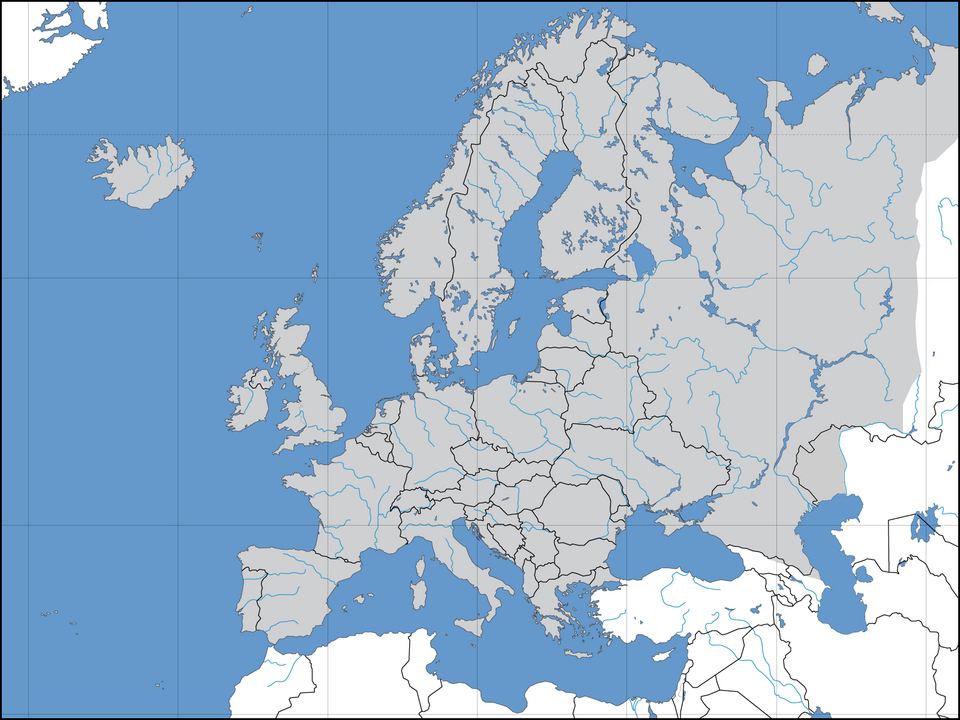

Europe is the western part of the continent of Eurasia, often thought of as its own continent. It is separated from Asia by the Ural Mountains in Russia and the Bosporus strait in Turkey.
Europe is bordered by water on three sides. On the west is the Atlantic Ocean. To the north is the Arctic Ocean. The Mediterranean Sea separates Southeastern Europe from the continent of Africa. On the eastern border of Europe are the Ural River and Ural Mountains.
There are at least 44 or 51 countries in Europe (the European identities of 7 countries: Armenia, Azerbaijan, Cyprus, Georgia, Kazakhstan, Russia and Turkey are disputed). Most of these countries are members of the European Union.
Europe covers about 10,180,000 square kilometre (3,930,000 square miles). This is 2% of the Earth’s surface (6.8% of its land area).
As of 2017, about 510 million people lived in Europe.
Europe contains the world’s second most-active volcano, which is Mount Etna that is currently the most-active volcano in the continent.
Europe is a major tourist attraction. People come from all over the world to see its many World Heritage Sites and other attractions. The continent has the largest Roma population in the world.
Origin of name
Europe is named after a princess in Greek mythology called “Europa.” The myth says that Zeus kidnapped Europa and took her to Crete, where she became the mother of King Minos (from whom Europe’s first civilization gets its name, the Minoans).
The name “Europa” was later used to describe Greece. Then, as the rest of modern-day Europe started to have cities and empires, the entire area West of the Ural Mountains came to be called “Europa”.
History
The history of Europe is long and has many turns. Many great countries originated from Europe. Greek mythology and the beginning of western civilization came from European nations.
Some of the major periods in European history have been:
- Ancient Greece (Minoan, Mycenaean, Archaic, Classical, Hellenistic): c.2000 BC to 146 BC
- Ancient Rome (Roman kingdom, Roman Republic and Roman Empire): 753BC-476
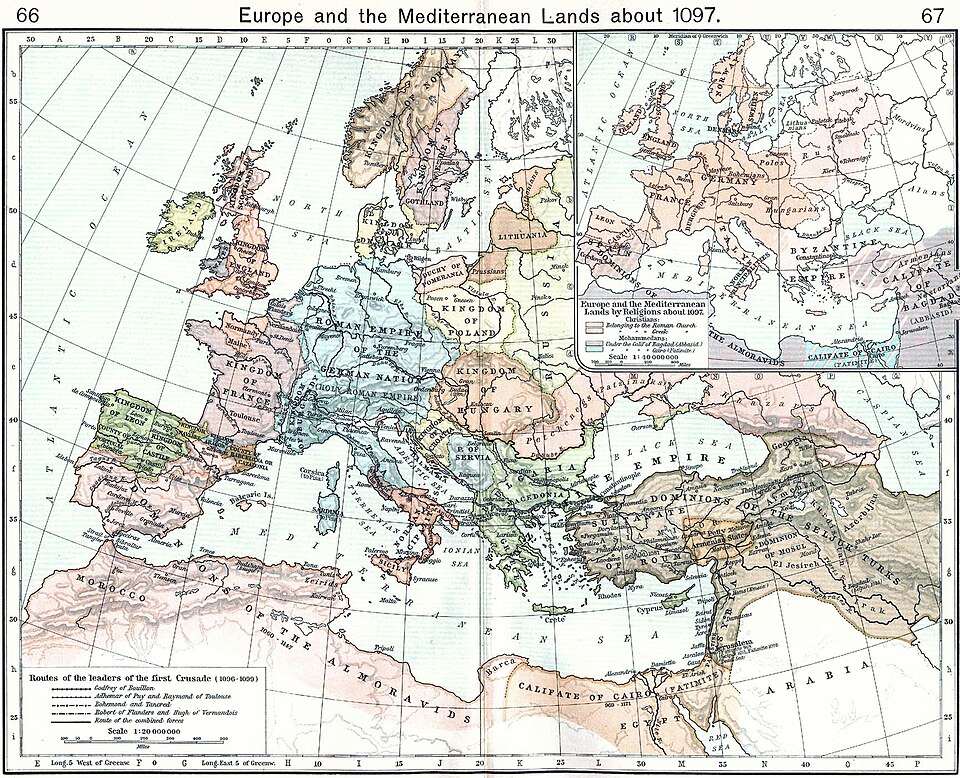
- Middle Ages (Early, High, Late): 476 to 1492
- Early Modern Era (Renaissance, Reformation, Age of Discovery, Enlightenment): 1492-1789
- 19th Century, 20th Century and 21st Century (French Revolution, Napoleonic Wars, Industrial Revolution, Colonialism, World War 1, October Revolution, World War 2, Cold War): 1789-present.
Regions and countries
Andreas M. Kaplan describes modern Europe as a continent where many different cultures live closely together, “embracing maximum cultural diversity at minimal geographical distances”.
There are several major regions of Europe:
- Eastern Europe
- Central Europe
- Western Europe
- Northern Europe
- Southern and Southeastern Europe Within these regions, there are up to 51 independent European countries (with the identities of 7 transcontinental countries being disputed). The largest is the Russian Federation, which covers 39% of Europe.
The largest cities in Europe are Istanbul, Moscow, London, St. Petersburg and Berlin. The country with the largest population is the Russian Federation. About 15% of Europeans live in Russia.
Two European countries, the United Kingdom and the Republic of Ireland, are on islands called the British Isles.
Climate
Most of Europe lies in temperate climate zones.
However, there are many different climates throughout Europe. For example, during the winter, it may be snowing and -30 degrees Celsius for 4–5 months in the north of Europe. Yet it may be much warmer, with no snow at all except on high mountains, in Spain.
European organizations
- European Union
- Council of Europe
- European Court of Human Rights
- Union of European Football Associations
- Warsaw Pact Organization (1955-1989)
European Union
The European Union is a confederation of 27 European countries. These countries agree to follow common laws so that their citizens can move and trade in EU countries almost the same as they do in their own. Twenty of these countries also share the same type of money: the euro.
Written for younger readers
Europe, in simpler words
This version comes from Wikijunior, a set of books written for children aged 8 to 11. It is shorter and uses plainer language than the article above.
From Wikijunior: Europe
Europe is a continent which is home to more than a quarter of the world’s countries. The climate of Europe varies from Arctic conditions to temperate in the south. Every world religion is represented in Europe and hundreds of languages are spoken too.
Europe extends from Iceland in the west to Russia and Georgia in the east, Norway in the far north to Spain in the south. The map below shows geographical Europe, the countries generally referred to as Western Europe are highlighted in yellow. There are 50 countries in Europe at the moment although a few of these (Russia, Cyprus, etc.) are considered to be mostly or entirely in Asia. However, they are considered European for social-political, cultural, or other reasons. As well as these 50 countries, there are a number of small dependent territories which have their own governments but are not sovereign countries, such as the Faroe Islands and the Isle of Man.
Wikijunior is a part of Wikibooks which is devoted to creating books for children and teenagers. These books must be useful and accurate but they should also be interesting to read and not too in-depth. Wikijunior Europe provides a profile of each country with maps and flags plus information about the history, people and geography of each country. If you are reading this and wondering where to get more information, try the Web links for more detail on each country.
Europe is a geographic entity which runs from the Atlantic Ocean to the Ural mountains (which are in western Russia). The European Union (EU) is a political, social and economic union of 27 countries in Europe. The members of the European Union (in order of when they joined) are: France, Germany, Italy, Belgium, Luxembourg, Netherlands, Denmark, Ireland, Greece, Spain, Portugal, Austria, Sweden, Finland, Poland, Lithuania, Latvia, Estonia, Czech Republic, Slovakia, Hungary, Slovenia, Malta, Cyprus, Romania, Bulgaria and Croatia.
There are also several countries which are in talks with the European Union about joining it. These countries Albania, North Macedonia, Montenegro, Serbia and Turkey. Other European countries (e.g. Bosnia and Herzegovina, Kosovo) have also said that they wish to join the European Union in the future. The United Kingdom left the European Union in 2020.
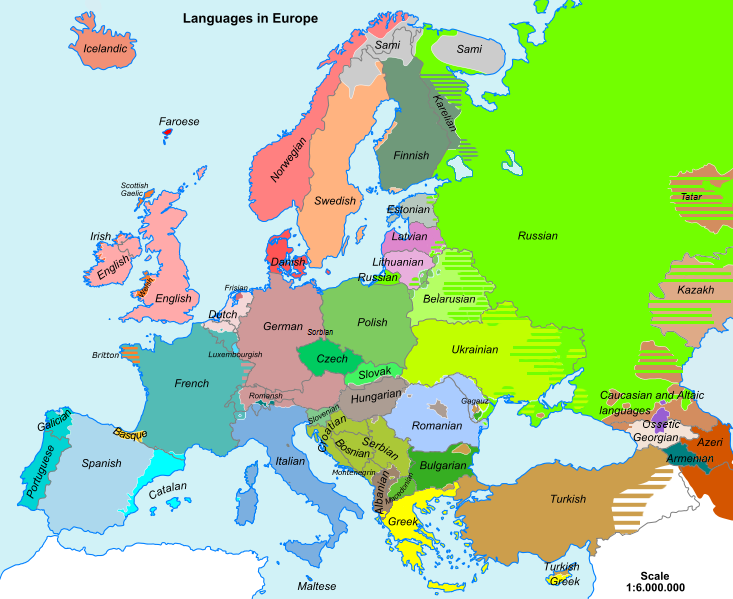
More than 100 languages are spoken in Europe. The most spoken languages are German, English, French, Russian, Spanish, Italian and Polish. Visit Wikijunior Languages to find out more about European languages and other languages from around the world.
Like every other continent, all religions are practised in Europe. Christianity is by far the most common religion and almost every country in Europe has a majority of people who are Christian. Islam is the major religion in Turkey and Azerbaijan and in large parts of Bosnia Herzegovina, Albania and Russia. Judaism is represented in small numbers in every country but especially in France and the United Kingdom. Indian religions like Sikhism and Hinduism are practised especially in the United Kingdom. Atheism (not believing in a god) is very common in Czech Republic (more than 50%), Estonia, the United Kingdom, Germany and many parts of Central and Eastern Europe. Visit Wikijunior World Religions to find out more about religion.
Twenty-one countries in the European Union use the Euro. All countries in the European Union (except Denmark) are expected to start using the Euro in the future. Most other countries in Europe have their own currencies.
Where this page comes from
The article above is adapted from “Europe” on Simple English Wikipedia, by its contributors. We removed reference markers, navigation boxes and tables, expanded measurement templates into readable numbers, and kept the prose otherwise intact. The simpler version is adapted from Wikijunior on Wikibooks.
Both sources are published under CC BY-SA 4.0, so this page is published under the same licence. You may share and adapt it, including commercially, as long as you credit the original and keep the same licence.
Worksheets, answer keys and printable layouts elsewhere on K5Print are our own work and are not covered by this licence.