Falkland Islands

Fast facts
- Symbol
- Coat of arms of the Falkland Islands
- Official language
- English
- Capital
- Stanley
- Largest city
- Stanley
- Currency
- Falkland Islands pound
- Time zone
- FKST
- Drives on
- left
- Calling code
- 500
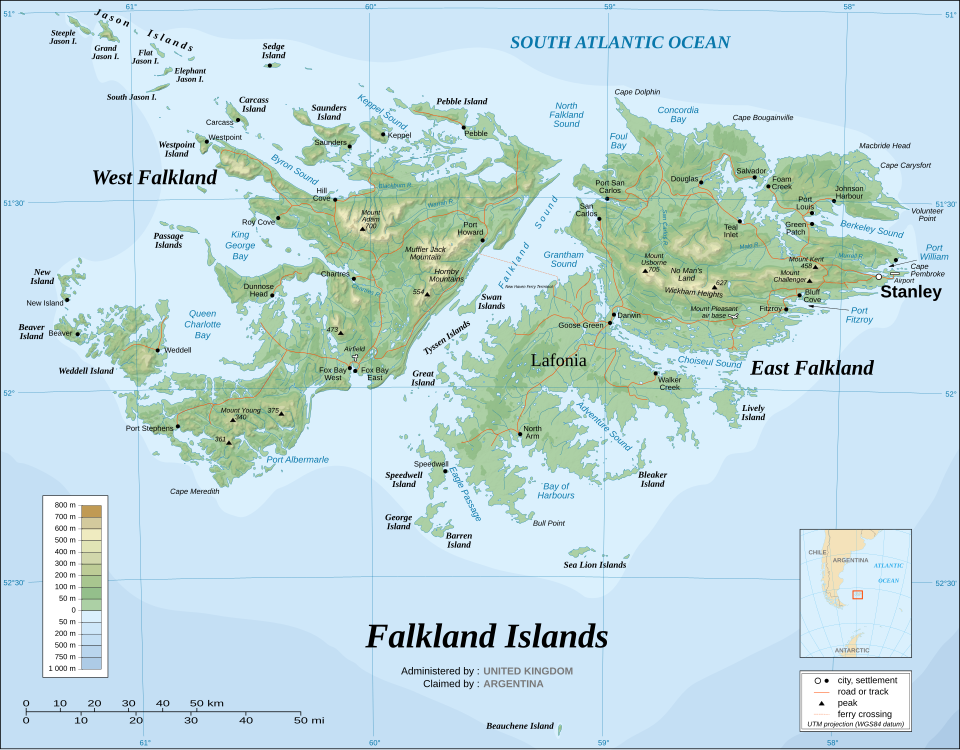
The Falkland Islands () are a group of islands in the South Atlantic Ocean, off the coast of South America. They are an overseas territory of the United Kingdom. Argentina disputes this, and claims their sovereignty.
The Falklands War was fought over their possession during Margaret Thatcher’s time as British Prime Minister. There are many islands in the group but the two biggest are East Falkland and West Falkland. As of the census of 2016, 3,398 people live on them. The people of the islands are British and speak English. The main income for the people is from fishing and sheep farming.
The Falkland Islands are about 300 miles (480 km) east of Argentina. Argentina and the UK had a short war in 1982, because Argentina claims to own the islands. The war lasted 6 weeks and about 1,000 soldiers were killed. The UK defeated Argentina and after this the governments of the two countries would not negotiate (talk) with each other. In 1990, they began to have talks again, but Argentina later refused to continue talks.
Oil and gas has been found below the sea around the islands. There is also oil and gas outside the sea area that belongs to the UK. This is owned by Argentina.
History
The islands were discovered and occupied by Europeans. They were not inhabited until 1754, when a French captain landed and founded Port Louie. The British landed in 1766 and created a settlement at Port Egmont on Saunders Island. Spain discovered and captured Port Egmont in 1770. War was avoided by Spain giving it back to Britain in 1771.
Later attempts by Spanish forces from the Río de la Plata to seize Falklands were ended in 1833, when British forces took control. In 1840, the Falkland Islands became a Crown Colony of the British Empire.
Modern times
The Falklands became a British Dependent Territory in 1981. This followed the British Nationality Act 1981. In 1983 the Falkland Islanders were granted British citizenship. On 18 April 1985 the Falkland Islands Constitution Order 1985 came into force which increased the number of elected members of the Legislative Council to eight. It guaranteed the Falkland Islanders’ rights and constitutional arrangements. In 1997, the constitution was amended with regard to voters rights. In 2002 the Falklands became a British Overseas Territory with the British Overseas Territories Act 2002. On 1 January 2009, the current constitution came into force with the Falkland Islands Constitution Order 2008. This replaced the 1985 version. It was agreed on by the UK Government and the Falkland Islands Government. The new constitution provided for finance, the public service, the administration of justice, and a Complaints Commissioner.
Geography
The Falkland Islands have a land area of 4,700 sq mi and a coastline estimated at 800 mi.See:
- ,
- . The archipelago is made of two main islands, West Falkland and East Falkland. It also has 776 smaller islands. The islands are mostly full of mountains and hills, with the main exception being the plains of Lafonia. The Falklands is made of continental crust pieces made from the break-up of Gondwana and the opening of the South Atlantic that began 130 million years ago. The islands are in the South Atlantic Ocean, on the Patagonian Shelf. They are about 300 mi (483 km) east of Patagonia in southern Argentina.
The archipelago’s two main islands are separated by the Falkland Sound, and its deep coastal indentations form natural harbours.See:
- ,
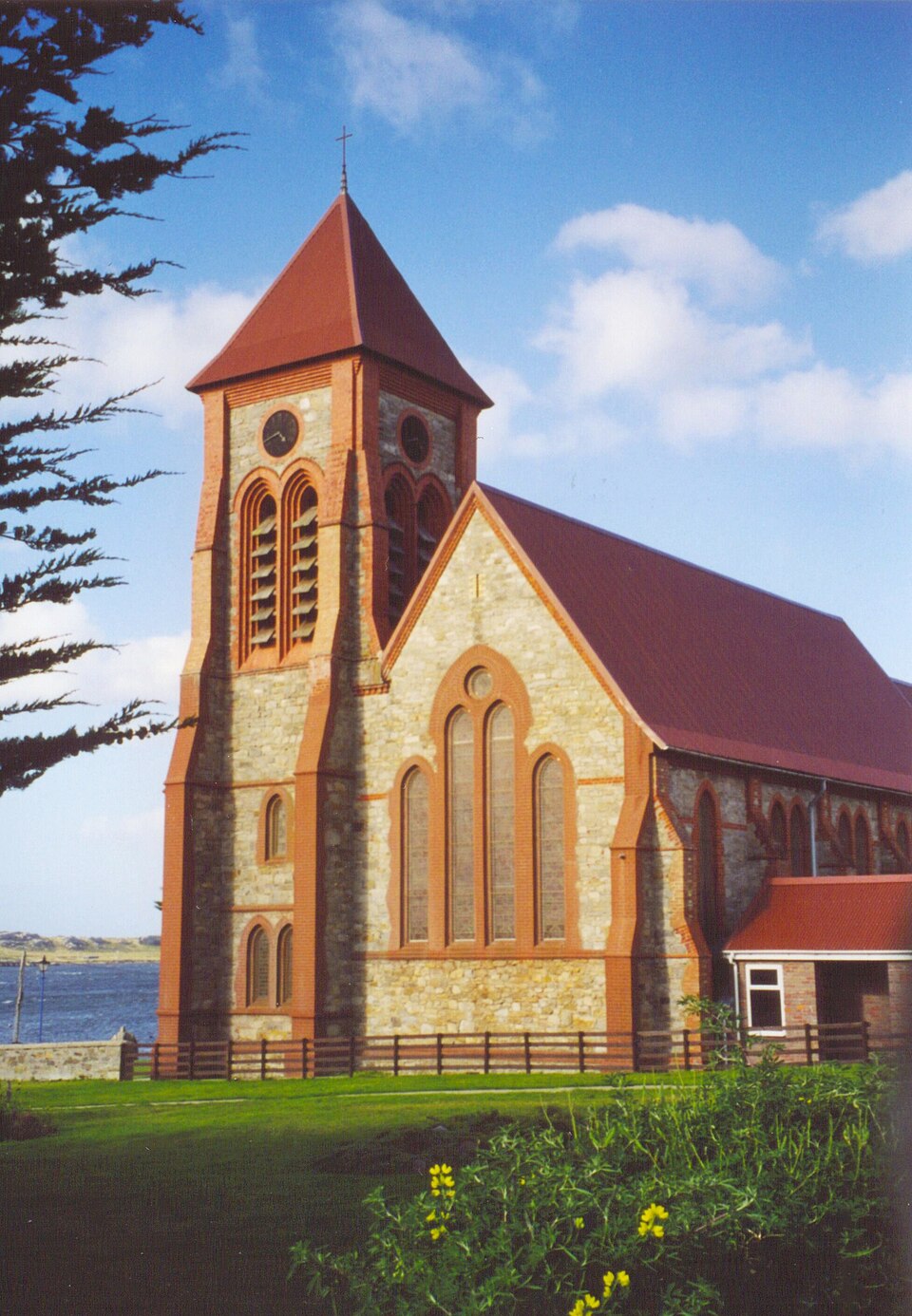
- East Falkland has the capital, Stanley and the archipelago’s highest point, Mount Usborne, at 705 m (2,310 ft).
The climate of the islands is cold, windy, and humid. There is a lot of rain over half of the year, with an average of 610 mm in Stanley. There is occasional light snowfall nearly all year. Strong westerly winds and cloudy skies are common.
Culture
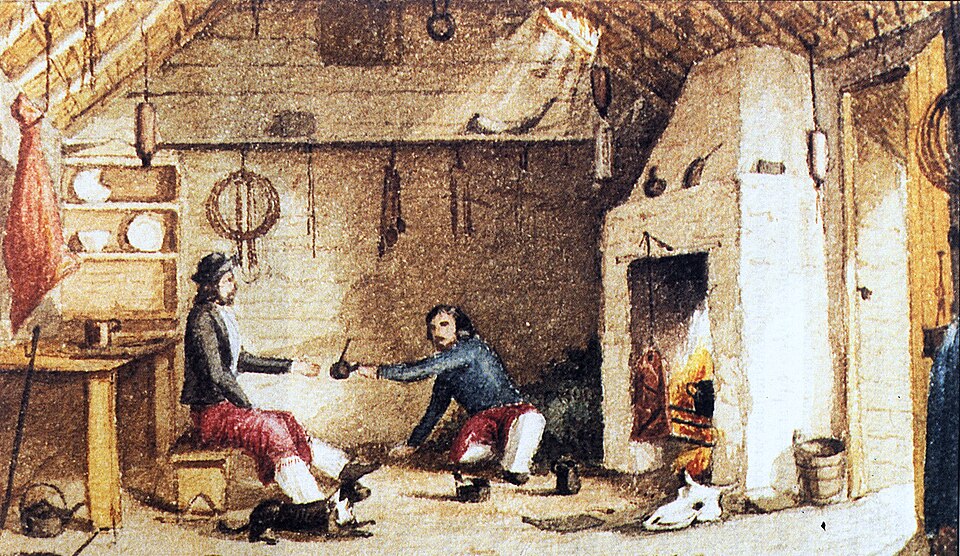
Falklands culture is based on the cultural traditions of its British settlers but has also been influenced by Hispanic South America. Falklanders still use some terms and place names from the former Gaucho inhabitants. The Falklands’ official and most common language is English, with the most common dialect being British English. Some inhabitants also speak Spanish.
The islands have one weekly newspaper, The Penguin News. The television and radio broadcasts mostly have programming from the United Kingdom.
Written for younger readers
Falkland Islands, in simpler words
This version comes from Wikijunior, a set of books written for children aged 8 to 11. It is shorter and uses plainer language than the article above.
From Wikijunior: South America
Welcome to the Falkland Islands! The Falklands (as they are known locally) are a group of islands 300+ miles (500 km) of the coast of South America. The Falklands are a self-governing overseas territory of the United Kingdom of Great Britain and Northern Ireland; they are claimed as part of Argentina by the Argentine constitution. The Falkland Islands Government control their own affairs, such as schools, hospitals and taxes. In the islands is a passage called the Falkland Sound which the islands are named after, which goes through the middle of the islands.
The Falkland Islands are made up of two main islands and over 750 small islands.The total land area is 4,700 square miles (12,000 km2).Surrounded by cool South Atlantic waters, the Falkland Islands have a climate very much influenced by the ocean. January averages about 9 °C, with average daily high of 13 °C, while July averages about 2 °C with average daily high 4 °C. Rainfall is relatively low at about 24 inches (610 mm). Humidity and winds, however, are constantly high. Snow is rare, but can occur at almost any time of year.
Argentines call them the Islas Malvinas. Their claim is due to them being near Argentina and in the past East Falkland islands was sold to Spain by the French. The Spanish left the Islands in 1811, 5 years before Argentina declared its independence from Spain in 1816.
The main ways in which the islands make money are by fishing in the rich seas around the islands and wool from the sheep which live on the islands. In the past, wool was so important that the flag had a picture of a sheep on it!
The Falklands War Argentina claims that the islands belong to them. So in 1982, the Argentine government invaded the islands and said they were theirs. The British Government responded by liberating the Islands after 74 days, and sank an Argentine ship called the Belgrano. More than 1000 people were killed, virtually all of them soldiers.
Where this page comes from
The article above is adapted from “Falkland Islands” on Simple English Wikipedia, by its contributors. We removed reference markers, navigation boxes and tables, expanded measurement templates into readable numbers, and kept the prose otherwise intact. The simpler version is adapted from Wikijunior on Wikibooks.
Both sources are published under CC BY-SA 4.0, so this page is published under the same licence. You may share and adapt it, including commercially, as long as you credit the original and keep the same licence.
Worksheets, answer keys and printable layouts elsewhere on K5Print are our own work and are not covered by this licence.