Finland

Fast facts
- Capital
- Helsinki
- Currency
- Euro (€)
- Time zone
- EET
- Drives on
- right
- Calling code
- +358
Facts from Wikipedia’s “Finland” page (CC BY-SA 4.0).
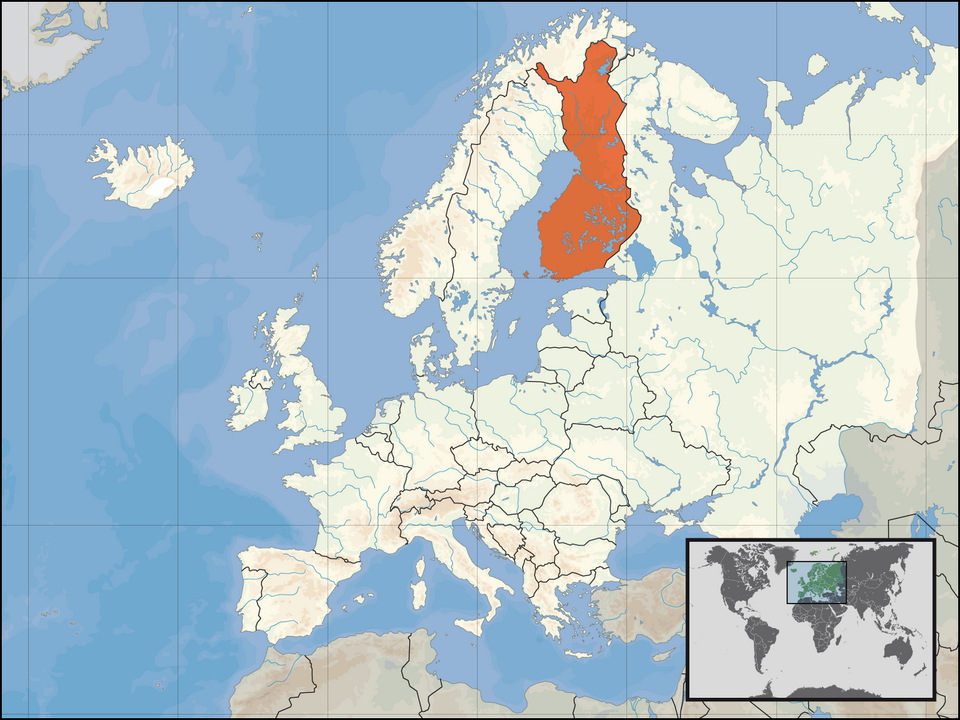
Finland (Finnish: Suomi) is a country in Northern Europe and is a member state of the European Union and NATO. Finland is one of the Nordic countries and is also part of Fennoscandia. Finland is located between the 60th and 70th latitudes North. Its neighbours are Sweden to the west, Norway to the north, Russia to the east and Estonia to the south, beyond the sea called Gulf of Finland. Most of the western and southern coast is on the shore of the Baltic Sea.
The capital of Finland is Helsinki; the second largest city is Tampere. The official currency of the country is the euro (EUR); before 2002 it was the markka, the Finnish mark (FIM). The president of Finland is Alexander Stubb. 5.5 million people live in Finland. Finnish and Swedish both are the official languages of Finland; the most spoken languages is Finnish, mother tongue of about 90% of the population. Swedish is spoken by the Swedish speaking minority of Finland, called the Finnish Swedes, who make up 5% of the total population. Finland became independent of Russia on 6 December 1917.
The most important cities and towns in Finland are Helsinki, Espoo, Tampere, Vantaa, Turku, Oulu, Lahti, Kuopio, Jyväskylä and Pori.
Finland is a highly industrialised First World country. The most important Finnish industrial products are paper, and steel products such as machines and electronics. Nokia (the mobile company) is originally a company of Finland, named after a small town called Nokia.
Finland has been top of the list of least corrupt countries on the Corruption Perceptions Index more times than any other country.
People and culture
The people of Finland are called Finns. Most Finns speak Finnish as their mother tongue. About six percent of Finns have the Swedish language as their mother tongue. They live mostly in the western part of Finland and on Åland (Finnish Ahvenanmaa).
Finns also study mandatory English and Swedish in school. Most Finns work either in services (that is: shops, banks, offices or businesses) or in factories. Finns often like saunas and nature. Many Finnish families have summer cottages, small houses where they go to relax on their summer holidays. The most important festivals that Finnish people celebrate are Midsummer and Christmas.
The most popular sports in Finland are ice hockey, skiing, track and field and association football (soccer). Finns have also won events in swimming, motor sports and gymnastics.
There is a group of a few thousand Sámis (also called Lapps) in the most northern part of Finland, called Lapland. Most of the Samis live in Norway and Sweden. Many Sami people farm reindeers. Originally, Samis were hunter-gatherers. In the past the Sami were nomads, but nowadays they live in regular houses.
Minority groups in Finland include Swedish–speakers (5.3 per cent), Russian-speakers (1.4 per cent), Estonians (0.9 per cent), Roma (0.2 per cent), and Sámi (0.1 per cent). There is a also small number of Jews.
Very few people in Finland are from other countries. In 2016 about 4% of residents were born in another country.
Nature and weather
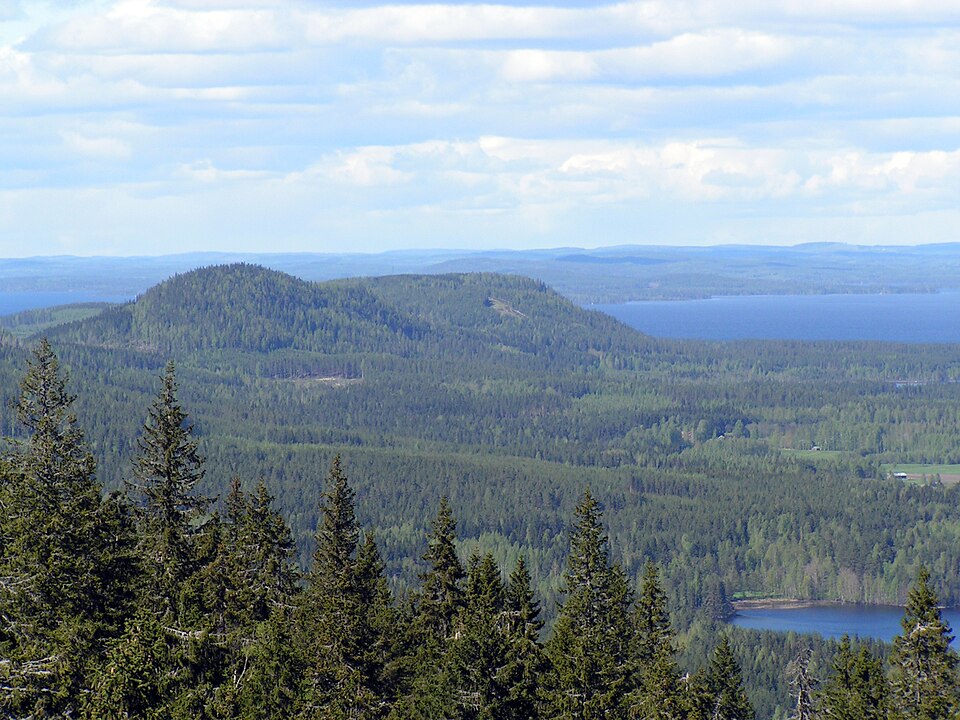
Most of Finland is covered by pine forest. It is estimated that up to one-third of all wood resources of the European Union are in Finland. Wood is the most important natural resource of Finland.
The national animal of Finland is the brown bear. The swan, which was considered holy long ago, is the national bird of Finland. The largest animal is the elk, a type of moose, which is a member of the deer family. Other large animals (in the wild) are wolves.
There are hundreds of rivers and thousands of fresh water lakes. Fishing is a popular sport. It is estimated there are almost 180,000 lakes in Finland.
Many islands in the Baltic Sea belong to Finland. Thousands of islands are part of the Åland archipelago. Tourists from all over the world come to see the fells and the northern lights in Lapland.
The highest mountain of Finland is Halti, which is 1328 meters high. The largest lake is Saimaa, 4,400 square kilometres. The longest river of Finland is Tornionjoki. The largest river (by watershed) is Kemijoki, 552 kilometres long.
The weather in Finland varies widely by season. Summer usually lasts from May to early September, and temperatures can reach up to +30 °C. Autumns are dark and rainy. Winter snow usually begins to fall in Helsinki in early December (in Lapland it can fall as early as October) and in the winter the temperature can drop to -40 °C. Highest temperature recorded in Finland is +37,2 °C and lowest temperature is -51,5 °C. Winter usually lasts to mid-March, when the snow melts in Helsinki (in Lapland the snow usually doesn’t melt until early May), and Spring lasts till late May. Spring can be erratic, and the weather can change from frost to sunshine within a matter of days. The famed Northern Lights are common in Lapland.
History
People first came to Finland 10,000 years ago. That was just after an ice age, after a glacier that covered the ground had receded.
Some think the first people in Finland already spoke a language similar to the Finnish language that is spoken today. It is known that an early form of the Finnish language was spoken in Finland in the Iron Age. (The Iron Age in Finland was 2,500–800 years ago).
The first residents in Finland hunted animals, as “hunter-gatherers”. Some people started to farm crops about 5,200 years ago. Farming slowly became more and more popular and became the major way of life until the modern age.
The ancient Finns were pagans. The most important god of the Finnish pantheon was Ukko. He was a god of sky and thunder, much like Odin, another Scandinavian god-king. These powers were common among the pagan god kings in pantheons ranging from the Finnish Ukko, to the Scandinavian/Germanic/Saxon Odin, all the way east to Zeus of the Greeks and Jupiter of the Romans.
Around a thousand years ago, when most of Europe was adopting Christianity, Finland also began following Christianity. During the Reformation of Christianity in the 16th century, most Finns became Protestants. Some pagan practices still remain amongst the now Christian Finns, such as bear worship.
From the Middle Ages Finland was a part of Sweden. Then, in the year 1809, Russia took Finland from Sweden. Finland was a part of Russia, but after a short period of time it became autonomous. The Finns essentially controlled Finland, though the Tsar was in control officially. Finns could create their own laws and had their own currency, (called the markka), their own stamps and own customs. However, Finland did not have its own army.
During the 1905 Russian Revolution, in the Grand Duchy of Finland: the Social Democrats organised the general strike of 1905 (). The Red Guards were formed. On , Russian artillerymen and military engineers rose to rebellion in the fortress of Sveaborg (later called Suomenlinna), Helsinki. The Finnish Red Guards supported the Sveaborg Rebellion with a general strike, but the mutiny was quelled by loyal troops and ships of the Baltic Fleet within 60 hours.
After independence
On 6 December 1917, Finland became independent, which meant that it no longer was a part of Russia. There was a communist revolution in Russia and after 1922 Russia was a part of the Soviet Union. There were communists in Finland too, who tried to create a revolution in Finland This attempt at revolution caused the Finnish civil war. The communists lost the civil war, and Finland did not change its old capitalist system
Stalin, who was the leader of the Soviet Union, did not like having a capitalist country as its neighbour. Stalin wanted Finland to become a communist state and be a part of the Soviet Union. The leaders of Finland refused: they wanted to stay independent. The Soviet Union sent many troops across the eastern border of Finland to try to make Finland join them, which resulted in the Winter War. The Soviet Union eventually won, and took most of Karelia and other parts of Finland.
Adolf Hitler was the dictator of Germany, and he wanted to invade the Soviet Union. Finland wanted to retrieve the areas that it had lost, so they joined the German invasion, which started with Operation Barbarossa in 1941. The Finnish part of the Second World War is called the Continuation War in Finland. However, Finland was not a fascist or an antisemitic country. Finns were interested in freedom rather than dictatorship.
While Germany was losing the war, Finland had already progressed into the Soviet Union in order to regain the areas lost in the previous peace. Finland wanted to end the war with the Soviet Union, which resulted in peace. Once again Finland had to give up the areas they had conquered. This time, the peace with the Soviet Union made Finland and Germany enemies. Finns fought the Germans, and Germans retreated to Norway, burning down all of Lapland behind them. This is called the Lapland War. Finland remained independent.
After the war, many factories were built in Finland. Many people moved from farms to cities. At that time, big factories manufactured products like paper and steel. More and more people worked in more advanced jobs, like high technology. Also, many people went to universities to get a good education. Finland was one of the first countries where most people had Internet connections and mobile phones. A well-known company that makes mobile phones, Nokia, is from Finland.
Finland joined the European Union in 1995. The Finnish currency was changed to the euro in 2002. Finland also joined NATO in 2023, after the Russian invasion of Ukraine.
Economy
Finland has a mixed economy. Free market controls most of production and sales of goods, but public sector is involved in services. In 2013, taxes were 44% of gross national product. This is 4th largest in Europe, after Denmark, France and Belgium.
In 2014 services were 70% of the gross national product.
The largest company in 2014 was oil refinery Neste Oil. The second largest was Nokia. Two forest industries Stora Enso and UPM-Kymmene, were numbers three and four. Number five was Kesko which sells everyday goods in K-supermarkets.
Elections
Elections are organized to select 200 members to the Parliament of Finland. Also selected are the president of Finland, members of town and city councils and Finnish members to the European Parliament. The elections are secret and direct. People vote directly for the person they want to be elected. In presidential elections votes are only cast for a person, not for a political party. All the other elections are proportional. The system is a combination of voting for individuals and parties. The right to vote is universal and equal. In general elections everybody has one vote.
Alexander Stubb became the president of Finland in 2024 after winning the presidential election.
Famous Finnish people
- Alvar Aalto, architect
- Markku Alen, 1978 World Rally Champion
- Valtteri Bottas, current Formula One driver
- The Dudesons, also known as Duudsonit, a four-man stunt group with several TV shows and a movie. Close friends with the Jackass crew
- Akseli Gallen-Kallela, artist
- Marcus Gronholm, 2000/02 World Rally Champion
- Mika Häkkinen, 1998 and 1999 Formula One World Champion
- Tarja Halonen, former President of Finland
- Tuomas Holopainen, founder of the internationally famous band Nightwish
- Sami Hyypiä, football coach; 2005 UEFA Champions League winner
- Juha Kankkunen, 1986/87/91/93 World Rally Champion
- Urho Kekkonen, former President of Finland during the cold war
- Jari Kurri, 5 time Stanley Cup Winner, NHL Hall Of Famer
- Eino Leino, poet
- Elias Lönnrot, compiler of National epic Kalevala
- Jari Litmanen, footballer; 1995 UEFA Champions League winner
- Tommi Makinen, 1996-99 World Rally Champion
- Carl Gustaf Emil Mannerheim, a president and military commander
- Karita Mattila, world famous opera singer, winner of the first Cardiff singer of the world competition
- Hannu Mikkola, 1983 World Rally Champion
- Sauli Niinistö, former President of Finland
- Paavo Nurmi, famous Olympic long-distance runner
- Kimi Räikkönen, 2007 Formula One World Champion
- Keke Rosberg, 1982 Formula One World Champion
- Timo Salonen, 1985 World Rally Champion
- Timo Sarpaneva, famous designer mainly in glass
- Teemu Selanne, 2007 Stanley Cup Winner
- Jean Sibelius, the most important Finnish composer
- Lauri Törni, later known as Larry Thorne, a winner of the Mannerheim Cross during the Continuation War
- Linus Torvalds, the creator of Linux
- Tarja Turunen, former member of the internationally famous band Nightwish
- Ville Valo, Lead Singer songwriter of HIM
- Ari Vatanen, 1981 World Rally Champion
- Tapio Wirkkala, designer and artist
Written for younger readers
Finland, in simpler words
This version comes from Wikijunior, a set of books written for children aged 8 to 11. It is shorter and uses plainer language than the article above.
From Wikijunior: Europe
Finland (Suomi in Finnish, Finland in Swedish) is a large country in north eastern Europe. It shares borders with Norway, Sweden and Russia. The capital city is Helsinki. Other big cities in Finland are Tampere and Turku. Finland has been a member of the European Union since 1995 and uses the Euro as its currency.
The area now known as Finland was settled at the latest around 8500 BC during the Stone Age. The settlers came from the areas of today’s Estonia and Russia. Sweden established its official rule of Finland in the 13th century. Swedish became the dominant language of noble people and used in education. The Finnish famine of 1866–1868 killed 15 percent of the population, making it the last and one of the worst famines in European history. On September 17, 1809 Finland Became part of Russia, On December 6, 1917 Finland declared its independence. During World War II, Finland fought the Soviet Union twice and lost large parts of its territory. During the next 40 years Finland remains neutral and continued to trade with the Soviet Union and western countries. After the collapse of the Soviet Union, Finland tried to build relationships with former Soviet republics and Europe. Finland joined the European Union in 1995.
The area of Finland totals 338,424 km 2 (130,596 sq mi). Finland has over 187,000 lakes and 179,000 islands. Lake Saimaa is the 5th largest lake in Europe. Most of Finland is low lying ground with occasional hills. The country’s largest mountain is Halti at 1324 metres and is located in the extreme north. Thick forests cover about 74 percent of Finland making it the European Union’s most forested country. Wildlife includes bear, wolf, lynx, and Arctic fox. Summer days in Finland are long and cool and winter days are short and cold. During summer, daylight lasts as long as 19 hours a day in the far south and 24 hours a day in northern parts. In winter, the sun does not rise above the horizon for 51 days in the northern parts of the country.
The population of Finland is about 5,400,000. Most of the population in Finland are natives. They make up about 93 percent of the population. The other major ethnic group are the Swedish. The national languages of Finland are Finnish and Swedish.
Most people are Christian. The Evangelical Lutheran Church of Finland is the national church. More than 85 percent of the population are members of the church.
Education in Finland is free and required between the ages of 7 and 16. In international surveys the education system in Finland usually rates as the best of second-best education results in the world. Finland is well known for technological and innovative companies such as Nokia phones and the Angry Birds series of video games. Almost everyone who lives in Finland is literate.
Because Finland is a big country with few people, it has many large national parks. Tourists are attracted to Finland by the capital, Helsinki, the lakes, forests and the northern area known as Lapland. Commercial Baltic cruises which visit other Baltic cities like Tallinn, Stockholm and Gdansk regularly bring tourists to Helsinki. Even though the sea freezes during the winter shipping continues as normal because of ice-breaking ships. Finland has 7 UNESCO World Heritage Sites (including those which are in other countries as well as Finland) including Suomenlinna, an island fortress in the bay in front of Helsinki. Suomenlinna is popular with tourists all-year-round and residents of Helsinki enjoy taking the short ferry to the island for picnics and the chance to escape from city life.
id:Wikijunior:Eropa/Finlandia
Where this page comes from
The article above is adapted from “Finland” on Simple English Wikipedia, by its contributors. We removed reference markers, navigation boxes and tables, expanded measurement templates into readable numbers, and kept the prose otherwise intact. The simpler version is adapted from Wikijunior on Wikibooks.
Both sources are published under CC BY-SA 4.0, so this page is published under the same licence. You may share and adapt it, including commercially, as long as you credit the original and keep the same licence.
Worksheets, answer keys and printable layouts elsewhere on K5Print are our own work and are not covered by this licence.