Germany
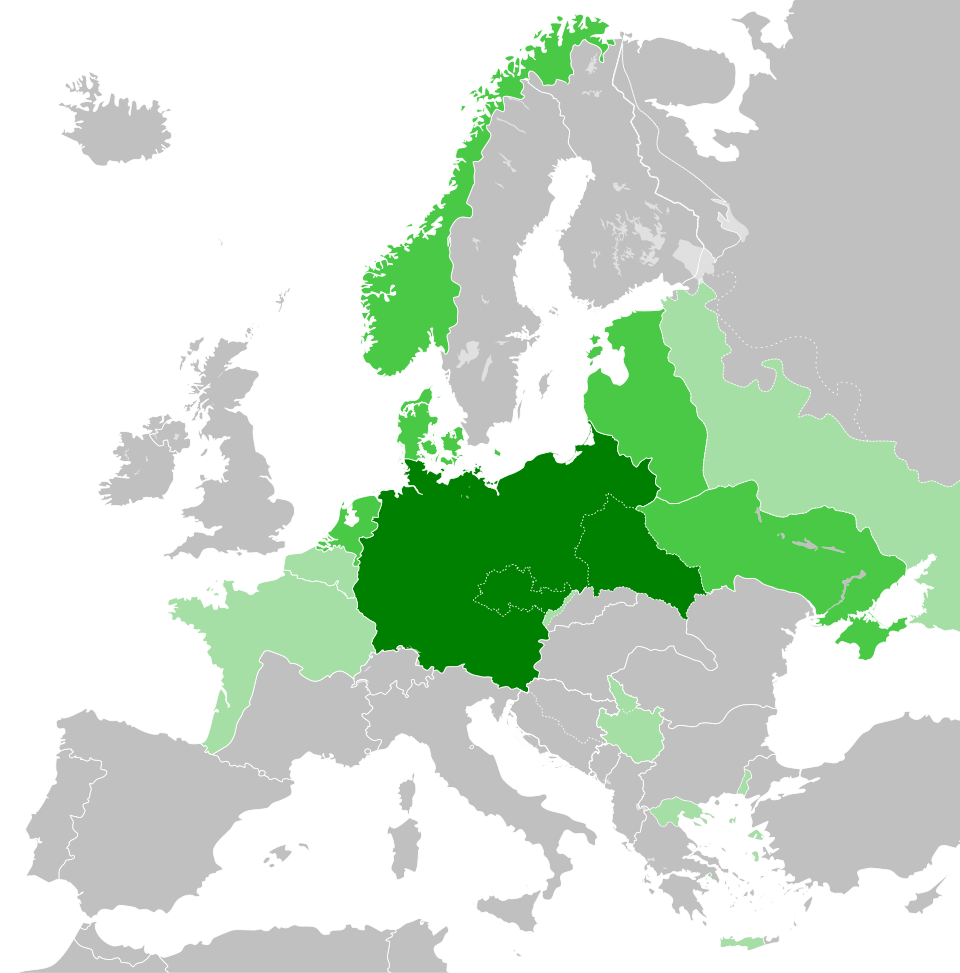

Fast facts
- Capital
- Berlin
- Languages
- German
- Currency
- Euro (€)
- Time zone
- CET
- Drives on
- Right
Facts from Wikipedia’s “Germany” page (CC BY-SA 4.0).
Germany is a country in the western region of Central Europe. The country’s full name is sometimes shortened to the FRG (or the BRD, in German).
To the north of Germany are the North Sea and the Baltic Sea, and the kingdom of Denmark. To the east of Germany are the countries of Poland and the Czech Republic. To the south of Germany are the countries of Austria and Switzerland. To the west of Germany are the countries of France, Luxembourg, Belgium, and the Netherlands. The total area of Germany is 357,022 square kilometers (137,847 square miles). In 2024, Germany had a population of over 83 million people, the second-largest in Europe after Russia. After the United States, Germany is the second most popular country for migration in the world. Germany has 39 international airports as of 2026. These include Frankfurt, Munich, Berlin Brandenburg, Hamburg, Düsseldorf, etc.
Before it was called Germany, it was called Germania. From 900 to 1806, Germany was part of the Holy Roman Empire. From 1949 to 1990, Germany was made up of two countries called the Federal Republic of Germany (West Germany) and the German Democratic Republic (East Germany). During this time, the capital city of Berlin was divided into a west and an east part. On 13 August 1961, the German Democratic Republic started building the Berlin Wall between the two parts of Berlin. West Germany was one of the countries that started the European Union.
Germany is one of the most developed countries and has the largest economy in Europe. It is a leading country in science and technology, and one of the largest trading nations of goods and services. Germany is part of many international organizations.
Before 19th century
Germany gained importance as the Holy Roman Empire of the German Nation, which was the first Reich (this word means empire). It was started by Charlemagne who became the first Holy Roman Emperor in 800 AD, and it lasted until 1806, the time of the Napoleonic Wars. After, German nation-states were made sovereign in Central Europe.
19th century
During the mid-1800s, Prussia was led by Chancellor Otto von Bismarck, who is sometimes known as the “Father of Germany”. He led a process to bring the German people together under one country. In 1866, Prussia won a war against Austria and their allies. During this time, Prussia founded the North German Confederation. The treaty of unification of Germany was made in Versailles after Germany won the Franco-Prussian War in 1871. This began the Second Reich. The biggest state in the new German Empire was Prussia. The rulers were called Kaisers or “German Emperors”, but they did not call themselves “Emperors of Germany”. There were many smaller states in the Empire, but not Austria.
Germany stayed an empire for 50 years. It joined the other European empires in the Scramble for Africa and fought wars to make large parts of Africa and Oceania its colonies. It killed many Nama and Herero people who did not want to be ruled by Germany. Today, those colonies have become seven states: Togo, Cameroon, Namibia, Rwanda, Burundi, Tanzania, and Papua New Guinea.
Early 20th century
Germany was in World War I with their ally Austria-Hungary, and again declared war on France. The war became slow in the west and became trench warfare. Many men were killed on both sides without winning or losing. In the Eastern Front the soldiers fought with the Russian Empire and won there after the Russians gave up. The war ended in 1918 because the Germans could not win in the west and gave up. Germany’s emperor also had to give up his power, and most of Germany’s African colonies were taken by other European empires. France took Alsace from Germany and Poland got the Danzig corridor. After a revolution, the Second Reich ended, and the democratic Weimar Republic began.
Interwar period
After the war, there were a lot of problems with money in Germany because of the Peace Treaty of Versailles, which made Germany pay for the costs of World War I and the worldwide Great Depression.
The Third Reich was Nazi Germany; it lasted 12 years, from 1933 to 1945. It started after Adolf Hitler became the head of government. On 23 March 1933, the Reichstag (parliament) passed the Enabling Act, which let Hitler’s government command the country without help from the Reichstag and the presidency. This gave him total control of the country and the government. Hitler, in effect, became a dictator.
World War II
Hitler wanted to unify all Germans in one state and did this by taking over places where Germans lived, such as Austria and Czechoslovakia; Hitler also wanted the land in Poland that Germany had owned before 1918, but Poland refused to give it to him. He then invaded Poland. This started World War II on 1 September 1939. In the beginning of the war, Germany was winning and even successfully invaded France. It managed to take over much of Europe. However, Germany attacked the Soviet Union in 1941 and after the Battle of Kursk, the German Eastern Front began a slow retreat until war’s end. On 8 May 1945, Germany gave up after Berlin was captured, Hitler had killed himself a week earlier. Because of the war, Germany lost a lot of German land east of the Oder-Neiße line, and for 45 years, Germany was split into West Germany and East Germany. Other events happened during the war in Nazi Germany, including the Holocaust, the mass genocide of Jews and other peoples, for which some Nazis were punished in the Nuremberg Trials. West Germany was one of the countries that started the European Union.
Cold War
After World War II Germany was occupied by the Allies and in 1949 it was divided into two states: West Germany and East Germany, who were stuck in the Cold War. The capital city of Berlin was divided between the two by the Berlin Wall. In 1989 there was a process of reforms in East Germany, which led to the opening of the Berlin Wall and to the end of socialist rule in Germany. These events are known as the Wende or the Friedliche Revolution (Peaceful Revolution) in Germany. After that, East Germany joined West Germany in 1990. The new Germany is a part of the European Union.
Timeline
- 1914–1918: World War I
- 1939–1945: World War II
- 1949-1990: Cold War
Politics
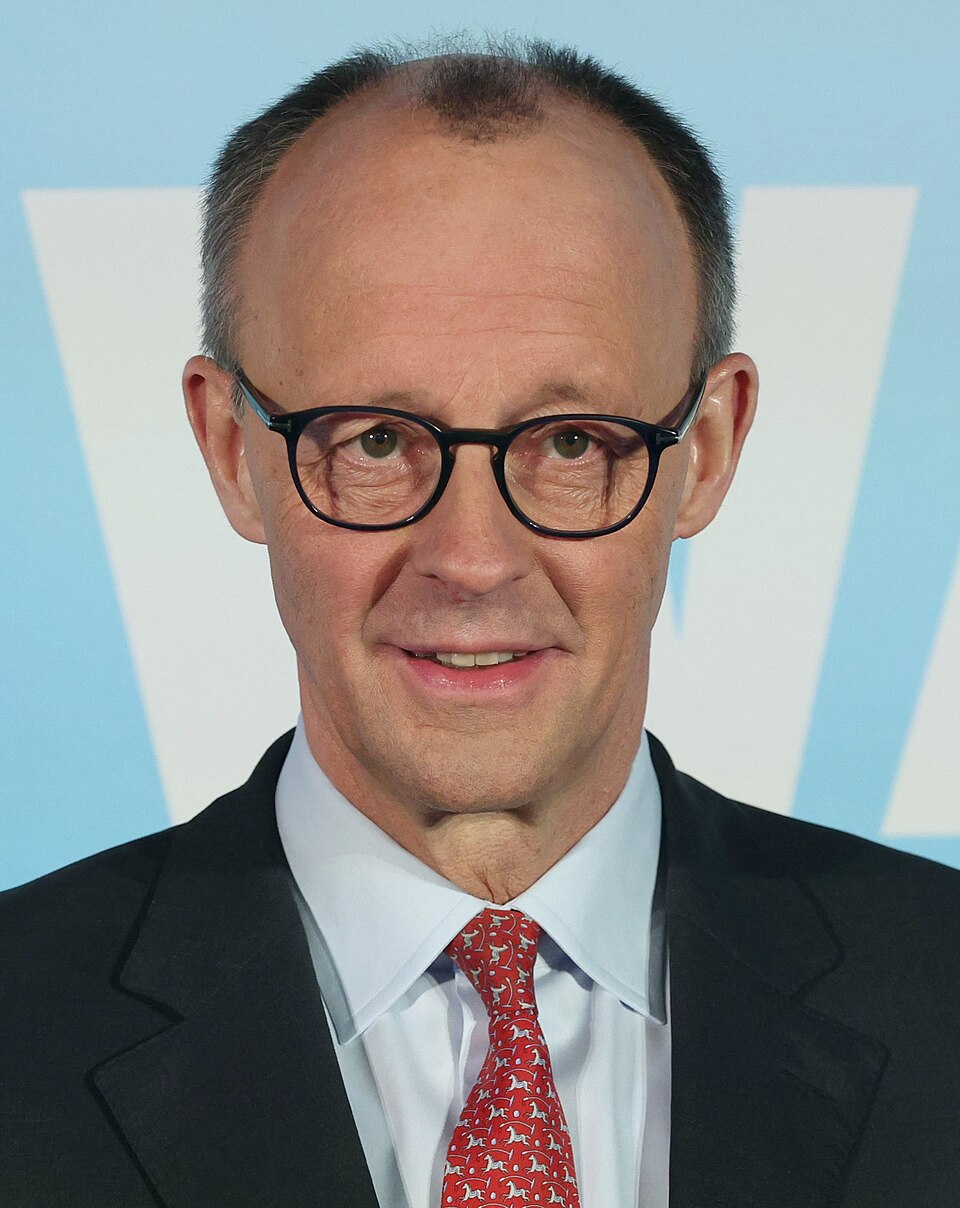
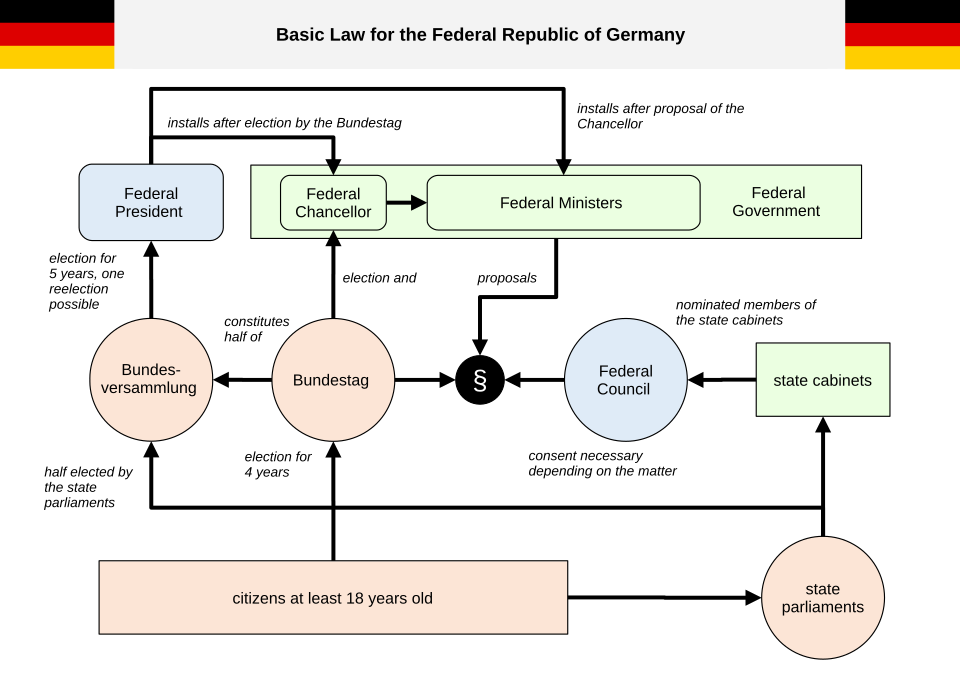
Germany is a constitutional federal democracy. Its political rules come from the ‘constitution’ called Basic Law (Grundgesetz), written by West Germany in 1949. It has a parliamentary system, and the parliament elects the head of government, the Federal Chancellor (Bundeskanzler). The current Chancellor since 2025 is Friedrich Merz.
The people of Germany vote for the parliament, called the Bundestag (Federal Assembly), every four years. Government members of the 16 States of Germany (Bundesländer) work in the Bundesrat (Federal Council). The Bundesrat can help make some laws.
The head of state is the Bundespräsident (Federal President). This person has no real powers but can order elections for the Bundestag. The current president is Frank-Walter Steinmeier (SPD).
The judiciary branch (the part of German politics that deals with courts) has a Bundesverfassungsgericht (Federal Constitutional Court). It can stop any act by the law-makers or other leaders if they feel they go against Germany’s constitution.
The opposition parties are the CDU, CSU, Die Linke and the AfD.
Geography
Germany is one of the largest countries in Europe. Its total area is 357,022 square kilometers (137,847 square miles). It stretches from the North Sea and Baltic Sea in the north to the high mountains of the Alps in the south. The highest point is the Zugspitze on the Austrian border, at 2,962 metres (9,718 ft).
Germany’s northern part is very low and flat (lowest point: Neuendorf-Sachsenbande at -3.54 m (-11.6 ft)). In the middle, there are low mountain ranges covered in large forests. Between these and the Alps, there is another plain created by glaciers during the ice ages.
Germany also contains parts of Europe’s longest rivers, such as the Rhine (which makes up a part of Germany’s western border, while Oder River is on its eastern border), the Danube and the Elbe.
States
In Germany there are sixteen states (Bundesländer):
In these states there are 301 Kreise (districts) and 114 independent cities, which do not belong to any district.
Climate
Germany has a mostly continental climate, but the northern German coast has an oceanic climate.
The highest temperature ever recorded in Germany was 41.2 °C (106 °F), on 25 July 2019 in Duisburg and Tönisvorst.
The lowest temperature ever recorded in Germany was -45.9 °C (-50.6 °F), on 24 December 2001 in Funtensee.
Economy
Germany has one of the world’s largest technologically powerful economies. Bringing West and East Germany together and making their economy work is still taking a long time and costing a lot of money. Germany is the largest economy in Europe and the fourth-largest in the world by nominal gross domestic product (GDP). In September 2011, the inflation rate in Germany was 2.5%. The unemployment rate of Germany was 5.5% as of October 2011.
Germany is one of the G8 countries. The main industry area is the Ruhr area.
The country has companies like BMW, Mercedes-Benz, Audi, Porsche, Siemens, Bosch, SAP, BASF, Adidas and more. Germany’s most exported products are cars.
Nearly all German companies are small- or medium-sized.
A German economic crisis is ongoing since 2022.
People
In 2024, Germany had a population of over 83 million people, the second-largest in Europe after Russia.
Most of the people in Germany are ethnically Germans, but the country also has many ethnic minorities. There are at least seven million people from other countries living in Germany. Some have political asylum, and some are guest workers (Gastarbeiter). Many people from poor or dangerous countries go to Germany for safety. Many others move to Germany without permission.
About 50,000 ethnic Danish people live in Schleswig-Holstein, in the north. About 60,000 Sorbs (a Slavic people) live in Germany too, in Saxony and Brandenburg. About 12,000 people in Germany speak Frisian; this language is the closest language to English that is still spoken today. In northern Germany, people outside towns speak Low Saxon.
Most of the people who have come to Germany are from the Middle East. Such as Turkey and they own many businesses there. Other small groups of people in Germany are Croats (0.2 million), Italians (0.6 million), Greeks (0.4 million), Russians, and Poles (0.3 million). There are also some ethnic Germans who lived in the old Soviet Union (1.7 million), Poland (0.7 million), and Romania (0.3 million). These people have German passports, so they are not counted as foreigners. A lot of these people do not speak German at home.
Christianity is the biggest religion; Protestants are 38% of the people (mostly in the north) and Catholics are 34% of the people (mostly in the south). There are also many Muslims, while the other people (26.3%) are either not religious, or belong to smaller religious groups. In the eastern regions, the former territory of the GDR (known as the DDR in German), only one fifth of the population is religious.
Germany has one of the world’s highest levels of schooling, technology, and businesses. The number of young people who attend universities is now three times more than it was after the end of World War II, and the trade and technical schools of Germany are some of the best in the world. German income is, on average, $25,000 a year, making Germany a highly middle class society. A large social welfare system gives people money when they are ill, unemployed, or similarly disadvantaged. Millions of Germans travel outside of their country each year.
The four recognized minorities in Germany are Danes 50,000 (concentrated in Schleswig-Holstein state), Frisians 60,000-70,000 (based in Eastern and Northern Frisia), Sorbs 60,000 (primarily in Saxony and Brandenburg) and Romani and Sinti.
Immigration
After the United States, Germany is the second most popular country for migration in the world.
Germany is a very densely populated country, and especially in cities the housing situation is difficult and rents are high. Already in 2014 there were 39,000 homeless people in Germany and 339,000 people without an apartment. Here is a link to a German video report from a German news magazine. The video is about refugees, who have been living in a sports gym in Berlin for over a year with no privacy. In the video people discuss amongst others why there are problems to find living space in containers. The containers are similar to those in Zaatari refugee camp.
Religion
Germany’s constitution says that all people can believe in any religion they want to, and that no one is allowed to discriminate against somebody because of the person’s religion.
In ancient times, Germany was largely pagan. Roman Catholicism was the biggest religion in Germany up to the 15th century, but a major religious change called the Reformation changed this. In 1517, Martin Luther said that the Catholic Church used religion to make money. Luther started Protestantism, which is as big as the Catholic religion in Germany today. Before World War II, about two-thirds of the German people were Protestant and one-thirds were Roman Catholic. In the north and northeast of Germany, there were a lot more Protestants than Catholics. Today, about two-thirds of German people (more than 55 million people) call themselves Christian, but most of them do not practice it. About half of them are Protestants and about half are Roman Catholics. Most German Protestants are members of the Evangelical Church in Germany. The previous Pope, Benedict XVI, was born in Germany.
Before World War II, about one percent of the country’s people were German Jews. Today, Germany has the fastest-growing group of Jewish people in the world. Many of them are in Berlin. Ten thousand Jews have moved to Germany since the fall of the Berlin Wall; many came from countries that were in the Soviet Union. Schools teaching about the things that happened when the Nazis were in power, as well as teaching against the ideas of the Nazis, has helped to make Germany very tolerant towards other people and cultures, and now many people move there from countries that may not be so tolerant.
About three million Muslims live in Germany, 3.7% of the total population. The country also has a large atheist and agnostic population, and there are also large about 0.6 million Hinduism follower and some small group of Jain, Buddhist and Zoroastrian communities. The 20th century has also seen a neopagan revival.
Culture
Germany has a long history of poets, thinkers, and artists. There are 240 supported theaters, hundreds of orchestras, thousands of museums and over 25,000 libraries in Germany. Millions of tourists visit these attractions every year. Some of the greatest classical musicians including Johann Sebastian Bach, Ludwig van Beethoven and possibly Wolfgang Amadeus Mozart were German. Some of the most revered scientists today like Albert Einstein are German. Artists like Marc Engelhard are active in the 21st century.
Germany has created a high level of gender equality, disability rights, and accepts homosexuality. Gay marriage has been legal in Germany since 2017.
Food
Traditional foods of German cuisine are sausage based such as Bratwurst and Currywurst. Other foods include Doner kebab and Sauerkraut. German food varies from region to region. For example, in the southern regions, such as Bavaria and Baden-Württemberg, they share their type of food with Switzerland and Austria. Everywhere in Germany, sausages are common. Meat is also consumed as roasts, meat patties and in stews, as well as in regionally traditional pasta dishes. Even though wine use is increasing, the national alcoholic drink is beer. The number of Germans who drink beer is one of the highest in the world. German restaurants are often rated the second-best, with France rated first place.
Sports
Football (soccer) is the most popular sport in Germany. The national team has won the FIFA World Cup 4 times, and appears in the finals a lot. The top football league in Germany is Bundesliga. Also, the German Football Association (Deutscher Fußball-Bund) is the largest in the world. A lot of big football teams are from Germany, like FC Bayern Munich, Borussia Dortmund, RB Leipzig and many others. Some of the world’s best footballers come from Germany too. These would include Mesut Özil, Manuel Neuer, Serdar Tasci, Michael Ballack, Bastian Schweinsteiger, Franz Beckenbauer, and so on. Plus, many tournaments have taken place in Germany. The most recent was the 2006 FIFA World Cup, and the 2011 FIFA Women’s World Cup. The Audi Cup takes place in Germany every year in Munich.
Germany is also known for its motor sports. Successful German racing drivers include Michael Schumacher and Sebastian Vettel.
Successful tennis players have also come from Germany, including Steffi Graf and Boris Becker. More recently, Sabine Lisicki reached the Women’s Singles final at Wimbledon in 2013.
Lastly, Germany is one of the best countries in the Olympic Games. Germany is the third in the list of the most Olympic Games medals in history (mixed with West and East Germany medals). The country finished first place in the 2006 Winter Olympics, second place in the 2010 Winter Olympics. Germany also got fifth place in the 2008 Summer Olympics.
Written for younger readers
Germany, in simpler words
This version comes from Wikijunior, a set of books written for children aged 8 to 11. It is shorter and uses plainer language than the article above.
From Wikijunior: Europe
Germany is a large country in northern and central Europe. It shares borders with Denmark, Poland, Czech Republic, Switzerland, Austria, Luxembourg, France, Netherlands and Belgium. The capital city is Berlin. Other big cities are Munich, Hamburg and Cologne. Germany has been part of the European Union since it began and uses the Euro as its currency.
In ancient times, several German tribes inhabited much of the land of modern Germany.
During the Roman Empire’s expansion under Julius Caesar and others that followed him, much of the western and southern part of current day Germany was occupied by the Romans. This very much displeased them and, after being also attacked by Huns from the east, they pretty much invaded the Roman Empire up to Rome to flea from them. This was a primary cause in the downfall of the Roman Empire, and the subsequent Dark Ages of Europe.
By the beginning of the medieval times time Germany consisted of a number of small tribal states. In the beginning of the 8th century an attempt was made by Charlemagne (a name derived from Latin, meaning “Charles the Great”), a king of a great German tribe called the Franks, to unite them.
After Charlemagne’s death in 814, following German customs of those times, his land was divided up to his three sons. Modern day Germany became a part of the Holy Roman Empire of the German nation, that contained much of central Europe (with the exception of France).
Although events reduced the size of this Empire, it destruction only came in 1807 after being overrun by Napoleon Bonaparte’s forces from France.
After Napoleon’s defeat, in the next decades Germany was first united in a loose German Custom Union, (a loose connection of states that maintained some autonomy, or self-rule). Prussia, one of the largest of these states managed to unify the majority of the German states in the Northern German Confederation, a far stronger union, as well as limiting foreign influence on other German states from outside powers.
In 1871, the entirety of Germany was finally unified in a land that stretched from the boarders of modern day France to the boarders of modern day Russia. This was one of the “Central Powers” of World War I that started and eventually lost the war. Germany, being a loser in this war, was forced to sign the Treaty of Versailles, thus giving much of its land away to France, Poland and Russia. The treaty also limited Germany’s influence on world affairs significantly, and fines placed on them by the allied brought their economy to near ruin. They had to pay $12,500,000,000 dollars for the loss. It was so expensive, the debt was not fully paid off until 2010, 93 years after the treaty was enforced. (inflation never caused the prices to go up)
German dissatisfaction with the treaty, and economic crisis made it easy for Adolf Hitler to promote his extreme form of Nationalism, leading to his rise in 1933. he also started a group of countries called the Axis countries.
Initially, perusing the goal of ‘unification’ of the German peoples, Hitler first made alliances with Austria. In 1938, he occupied the Sudetenland, a region of Czechoslovakia, and despite an agreement with other powers such as Britain later occupied the whole of that country. In 1939 the German invasion of Poland, began World War II in Europe.
After World War II, Germany was a ruin, and despite initial hopes at the Potsdam conference, quickly became divided by the opposing ideals of America (and the Allied powers) and Soviet Union.
For at least 4 decades, Germany was divided. Those in East living under an increasingly strained Communist regime (see the page about East Germany). Those in the West assisted by American aid,produced an economic miracle and where amongst the founder members of the European Union.
German re-unification came in 1990 as a consequence of dissatisfaction in the east with the increasingly brutal regime. In 1989 the Berlin Wall, which had since the 1960s divided the former capital Berlin, had fallen, to a group of people who knocked it down.
The country of Germany covers an area of 357,021 km 2 (137,847 sq mi), consisting of 349,223 km 2 (134,836 sq mi) of land and 7,798 km 2 (3,011 sq mi) of water. It is the seventh largest country by area in Europe and the 63rd largest country in the world. Because of its central location, Germany shares borders with more European countries than any other country on the continent. Its neighbours are Denmark in the north, Poland and the Czech Republic in the east, Austria and Switzerland in the south, France and Luxembourg in the south-west and Belgium and the Netherlands in the north-west. The highest mountain in Germany is Zugspitze at 2,962 metres.
Germany is a country of about 84 million people, the majority of whom speak German as their first language. Germany is the EU’s largest country.
Christianity is the largest practiced religion in Germany with 64% of the population who practice it. The second largest religion is Islam with 4% of the population. Other practiced religions include Buddhism, Hinduism and Judaism.
Optional kindergarten education is provided for all children between three and six years old, after which school attendance is required for at least nine years. Primary education usually lasts for four years. In contrast, secondary education includes four types of schools based on a pupil’s ability as determined by teacher recommendations: the Gymnasium includes the most gifted children and prepares students for university studies and attendance lasts eight or nine years depending on the state; the Realschule has a broader range of emphasis for average students and lasts six years; the Hauptschule prepares pupils for vocational education, and the Gesamtschule or comprehensive school combines the three approaches.
Berlin remains a very popular destination for tourists because of its night life and the history of what was two cities before 1989. Munich is visited by football and beer fans especially during Oktoberfest - the beer festival that takes place every October. Frankfurt is a major business city home to the European Central Bank and many skyscrapers.
de:Wikijunior Europa/ Deutschland
Where this page comes from
The article above is adapted from “Germany” on Simple English Wikipedia, by its contributors. We removed reference markers, navigation boxes and tables, expanded measurement templates into readable numbers, and kept the prose otherwise intact. The simpler version is adapted from Wikijunior on Wikibooks.
Both sources are published under CC BY-SA 4.0, so this page is published under the same licence. You may share and adapt it, including commercially, as long as you credit the original and keep the same licence.
Worksheets, answer keys and printable layouts elsewhere on K5Print are our own work and are not covered by this licence.