Hiroshima Peace Memorial
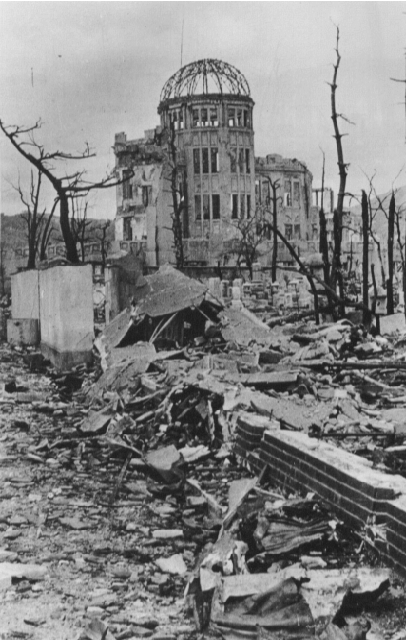

Hiroshima Peace Memorial, also called the Atomic Bomb Dome or , is in central Hiroshima, Japan. It is part of the Hiroshima Peace Memorial Park. UNESCO named the dome a World Heritage Site in 1996. The dome is the ruined Hiroshima Prefectural Products Exhibition Hall. It was kept as a memorial to the people who were killed in the atomic bombing of Hiroshima on August 6, 1945. The bombing killed 70,000 people instantly, and another 70,000 died later from the radiation.
History
Czech architect Jan Letzel designed the building. It was completed in April 1915 and was named the Hiroshima Prefectural Commercial Exhibition. It was opened to the public in August that year. In 1921 the name was changed to the Hiroshima Prefectural Products Exhibition Hall. Finally in 1933, the name changed to the Hiroshima Prefectural Industrial Promotion Hall.
Atomic bombing
At 8:15 on August 6, 1945, the first atomic bomb to be used in war exploded almost directly above the dome. Everyone inside the building was killed instantly,but the building was not totally destroyed. There was more downward force on the building, but less side-to-side force right under the center of the explosion.
After the war
At first, the city planned to tear down the building, but did not because it was not as badly damaged. Some people wanted to remove the building, but others wanted to keep it. The city of Hiroshima was rebuilt around the ruined dome. In 1966 the city said that it planned to keep the building. As of July 2011, two construction projects kept the Dome from falling.
In December 1996, UNESCO added the A-Bomb Dome to the World Heritage List. Not everyone supported this decision. The United States did not join the decision. China said that the monument could take attention away from the countries that were victims of Japan during the war. Many more people died because of Japanese attacks in those countries. The United States said that having a memorial to a war site would not tell the whole history of the bombing.
Written for younger readers
Hiroshima Peace Memorial, in simpler words
This version comes from Wikijunior, a set of books written for children aged 8 to 11. It is shorter and uses plainer language than the article above.
From Wikijunior: World Heritage Sites
The Hiroshima Peace Memorial and now commonly called the Genbaku Dome is part of the Hiroshima Peace Memorial Park in Hiroshima, Japan and was designated a UNESCO World Heritage Site in 1996. The ruin of the hall serves as a memorial to the people who were killed in the bombing of Hiroshima on 6 August 1945.
At 8:15 a.m. on 6 August 1945, the first atomic bomb to be used in World War Two was dropped by the United States Army Air Forces and destroyed the city of Hiroshima, Japan. The bomb exploded directly over a hospital and everyone inside the hospital was killed immediately from the fireball. The building was the only structure not destroyed after the bombing. In 1966, The Hiroshima City Council called for permanent preservation of the building, named the Hiroshima Peace Memorial.
In December 1996, the Genbaku Dome was registered on the UNESCO World Heritage List due to its survival from a destructive force (atomic bomb), the first use of nuclear weapons on a human population, and its representation as a symbol of peace.
Hiroshima Peace Memorial
Where this page comes from
The article above is adapted from “Hiroshima Peace Memorial” on Simple English Wikipedia, by its contributors. We removed reference markers, navigation boxes and tables, expanded measurement templates into readable numbers, and kept the prose otherwise intact. The simpler version is adapted from Wikijunior on Wikibooks.
Both sources are published under CC BY-SA 4.0, so this page is published under the same licence. You may share and adapt it, including commercially, as long as you credit the original and keep the same licence.
Worksheets, answer keys and printable layouts elsewhere on K5Print are our own work and are not covered by this licence.