Iceland

Fast facts
- Capital
- Reykjavík
- Official language
- Icelandic
- Currency
- Icelandic króna
- Time zone
- GMT/WET
- Drives on
- right
- Calling code
- +354
Facts from Wikipedia’s “Iceland” page (CC BY-SA 4.0).
Iceland (; ) is an island country between the North Atlantic and Arctic, between Greenland and Norway. It is culturally considered to be part of Europe. Iceland is 301 kilometers east of Greenland and 1001 kilometers west of Norway. There are about 329,100 people who live in Iceland. Iceland has an area of 103,000 km².
Iceland covers its own Arctic island in the Arctic Ocean. It is north of Ireland, east of Greenland, west of Norway, northwest of the United Kingdom, east of Canada, and southwest of Svalbard and Jan Mayen. Unlike Greenland, Iceland is part of Europe and not North America.
History
The first people who lived on Iceland are thought to have been Irish monks. They came to Iceland around the year 800.
Iceland became a Christian nation in the year 1000 CE, when Christianity became the religion by law.
In the 9th century, Norsemen went to live in Iceland. The first Norseman who lived in Iceland was Flóki Vilgerðarson. He was also the one who gave Iceland its name. Ingólfur Arnarsons was the first permanent settler on the island. This chieftain from Norway went to live in South West Iceland and founded the city of Reykjavík.
In 930, the Icelandic rulers wrote a constitution. They created the Althing, a kind of parliament in a place called Þingvellir. Therefore, Iceland is the oldest existing republic.
In 985, Erik the Red was sent away from the island because he had killed someone. He sailed to the west and discovered Greenland. Eric’s son Leif Ericson discovered America in the year 1000. He called it Vinland. The voyages of Eric, Leif and others were written down in the sagas (long stories).
In 1262, Iceland became part of Norway. This lasted for 400 years. In 1662, it became part of Denmark. In the 19th century, many Icelanders wanted to be independent from Denmark. In 1918, Iceland got many powers of its own, but the king of Denmark was still king of Iceland.
When Germany took over Denmark on April 9 1940, the Althing decided that Icelanders should rule the country themselves, but they did not declare independence yet. British and later American soldiers occupied Iceland to prevent it from being attacked by the Germans. In 1944, Iceland finally became fully independent.
After World War II, Iceland became a member of the North Atlantic Treaty Organization (NATO), but not of the European Union. Between 1958 and 1976, there were three debates between Iceland and the United Kingdom about the rights to catch codfish. They were called the Cod Wars.
In 1980, Vigdís Finnbogadóttir was elected president of Iceland. She was the first woman ever to be elected president of a country.
In 2016, Guðni Th. Jóhannesson become president of Iceland. In 2024, Halla Tómasdóttir was elected as the second female president of the country. That same year, Kristrún Frostadóttir became prime minister.
Politics
Iceland has a multi-party system. Since the 2013 election, the center-right Independence Party and Progressive Party are the biggest political parties in Iceland. Other powerful parties in Iceland include the center-left Social Democratic Alliance and Left-Green Movement. See also: List of political parties in Iceland.
Iceland is a representative democracy and a parliamentary republic. Iceland has a president (Guðni Th. Jóhannesson) and a prime minister (Katrín Jakobsdóttir). The parliament, Althing, has 63 members and each member can only be in there for four years. The president is elected by Icelanders, and is in government for four years. The president can be elected an unlimited amount of times.
Iceland has no standing army. The United States Air Force had a base near Reykjanesbær, but they left in 2006. Since 2008, NATO nations have occasionally had their air force patrol Iceland. This was requested by the Icelandic government.
Divisions
Iceland is divided into 8 regions, 6 constituencies and 74 municipalities (since 2013). The regions are mainly used for statistics. The constituencies are used for selecting politicians who will represent them in parliament. Lastly, the municipalities give services to the people that live there. These services include education, waste management, public transportation, and so on.
Before 2003, the constituencies were the same as regions, but this was changed because it meant that a vote in Reykjavik meant less than one in a rural area. Even though this was addressed, the problem still exists.
Regions of Iceland.png|Regions of Iceland Electoral districts of Iceland.svg|Constituencies of Iceland Sveitarfélög-landsvæði.png|Municipalities of Iceland
Economy
Fishing and fish processing is the main economic activity in Iceland. Despite effort to diversify, particularly into the travel industry, seafood exports continue to account for nearly three-quarters of merchandise exports and approximately half of all foreign exchange earnings.
Geothermal Energy produces the vast majority of Electrical Power consumed on Iceland, due chiefly to the island’s position atop the Mid-Atlantic Ridge and exhibits plentiful hot water reservoirs and geysers. This has the effect of drastically reducing the price of electricity in Iceland, and has attracted several energy-intensive industries.
Aluminum Smelting (The reduction of Aluminum ores to Aluminum metal) is the largest energy-intensive manufacturing sector in Iceland, and the country produced over 800,000 Metric Tonnes per Year in 2013, making it the 10th largest producer of Aluminum metal worldwide.
Geography
Iceland sits on a rift between two tectonic plates. No surprise then that Iceland is very geologically active.
There are large amounts of rain and snow caused by the warm waters of the gulf stream current which flows toward it. Many interesting and unusual geographic features which make it different from any other island are present.
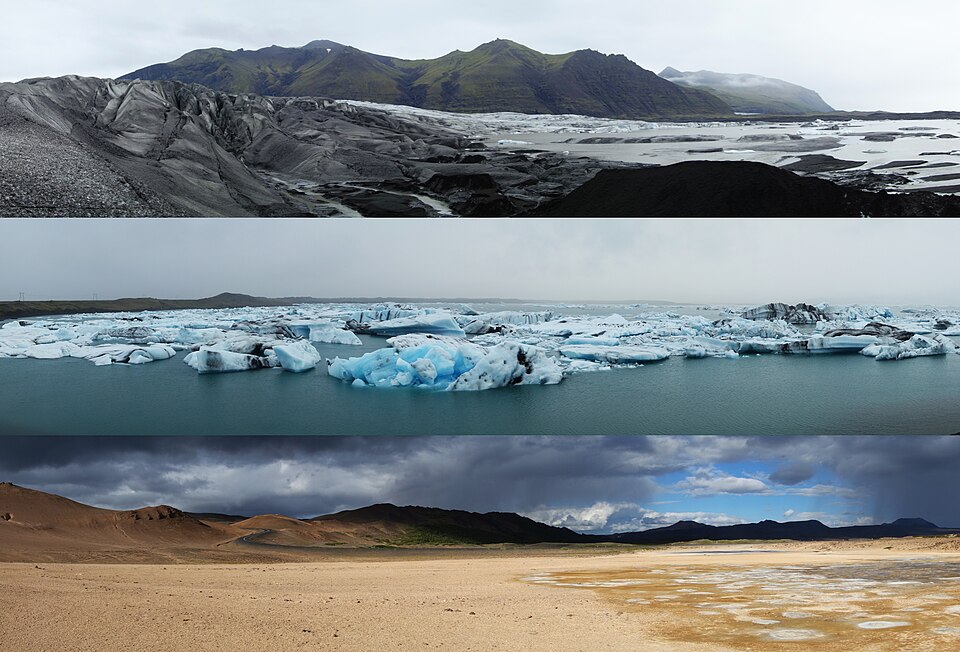
Some of these features are Iceland’s numerous mountains, volcanoes, hot springs, rivers, small lakes, waterfalls, glaciers, and geysers. The word geyser is, in fact, derived from Geysir, the name of a particularly famous geyser on the southern side of the island. Glaciers cover about 11% of the island and the largest, Vatnajökull, is up to 1 km thick and, by far, the largest glacier in Europe.
Iceland, though a European country, sits partly in North America since it straddles the Mid-Atlantic Ridge which marks the boundary between the Eurasian and North American tectonic plates. The ridge runs right through the populated Reykjavik and Thingvellir historic areas. The tectonic activity of these plates separating is the source of the abundant geothermal energy in the region.
Towns and cities
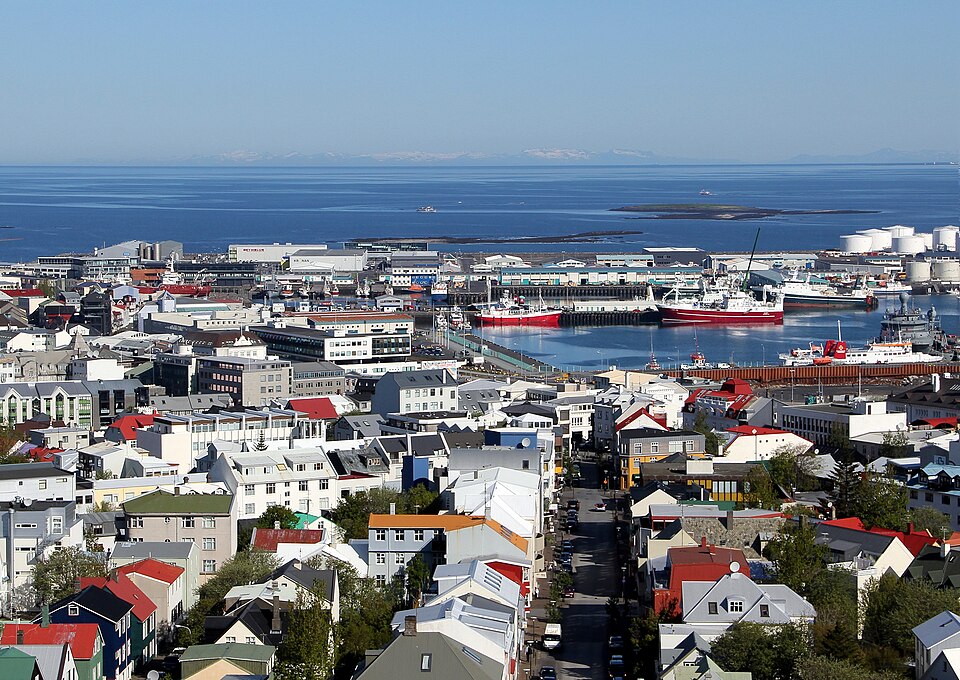
Reykjavík is the capital city of Iceland. Reykjavík is also the most important port in Iceland. Other important towns in Iceland are Akureyri, Kópavogur, Hafnarfjörður, Keflavík, Seyðisfjörður and Vestmannaeyjar.
People
Icelandic people have a distinctive phenotype. This impression is even stronger if you see an age-group of children together. They are indeed genetically more similar than any other group in any other European country. The reason is that they had a small founding population, and a low rate of immigration after that.
This is a problem according to some people, including the government, because it increases the risk that a viral infection could sweep through the whole population. So the country has a very good health service which is entirely funded by the government. There are not a lot of people with Down’s syndrome because all pregnant women are tested by using amniocentesis. In Iceland, any fetus with a serious genetic defect is aborted.
The people in Iceland are mostly of Scandinavian origin. The language they speak is Icelandic. The language has not changed much in 1,000 years, so Icelanders are still able to read the sagas about the Vikings without many problems. Most people in Iceland are Christian. Most of them are Lutheran.
Iceland has the highest birth rate in Europe, highest divorce rate and the highest percentage of women working outside their home.
Names
There are no real surnames on Iceland. Children get the first name of their father (sometimes mother) with -s+son if it’s a boy, and -s+dóttir if it’s a girl. For example, a man named Jón Stefánsson has a son named Fjalar. Fjalar’s last name will not be Stefánsson like his father’s, it will become Fjalar Jónsson. The same goes for women. Jón Stefánsson’s daughter Kata would not have the last name Stefánsson, she would have the name Jónsdóttir. In most countries people use to call other people by their surname, but in Iceland people call other people by their first name. So when people talk about Halldór Ásgrímsson they do not call him Ásgrímsson, but Halldór.
Animal life
Mammals in Iceland, includes reindeer. Reindeer have been in Iceland, since as early as the 18th century.
Some mosquitos have [recently] been found (in nature), in Iceland, according to media (2025).
Over 1,000 years ago settlers brought a small breed of horse to Iceland, now called the Icelandic Horse. Archaeologists have found evidence of these horses having decended from a breed of horse that is now extinct outside of Iceland.
Other information
Icelandic people are considered to be the happiest people on Earth, according to a study.
In regard to Christianity having become the religion by law: In Icelandic, this event is known as the kristnitaka literally, “the taking of Christianity”.
Written for younger readers
Iceland, in simpler words
This version comes from Wikijunior, a set of books written for children aged 8 to 11. It is shorter and uses plainer language than the article above.
From Wikijunior: Europe
id:Wikijunior:Eropa/Islandia
Iceland is an island country in the far north west of Europe and is famous for its natures beauty and variety also the loftiness Icelandic Sagas who tell the tales of the Vikings and their survivors. Iceland does not border any other country and the capital city is Reykjavik where almost 70% of the Icelandic population live. Iceland is not part of the European Union. The Krona is the currency of Iceland.
It is generally believed that Iceland was discovered and settled by Norse Vikings in the second half of the 9th. The first settler was Ingólfur Arnason who came to Iceland with his brother Hjörleifur. Hjörleifur was killed by his slaves but Ingólfur built his homestead in Reykjavík in 874. From 874 to 930 lots of people, mostly Norse Vikings and their Irish slaves moved to the island and by 930, most available farmland had been claimed and the Althing, a parliament was founded as the political hub of the Icelandic Free State. Christianity was peacefully adopted in the year 1000.
In 1814, following the Napoleonic Wars, Denmark-Norway was broken up into two separate kingdoms by the way of the Treaty of Kiel. Iceland, however, remained a Danish dependency. The country’s climate worsened during the 19th century, leading to mass emigrations to North America, largely Canada. Meanwhile, a new independence movement arose under the leadership of Jón Sigurðsson, inspired by the romantic and nationalist ideologies of mainland Europe. In 1874, Denmark granted Iceland home rule, which was expanded in 1904. In 1918, Iceland became fully independent but the head of state remained as the King of Denmark.
During World War II, the German occupation of Denmark on April 9, 1940 severed communications between Iceland and Denmark. A month later, British military forces sailed into Reykjavík harbor, violating Icelandic neutrality. Allied occupation of Iceland lasted throughout the war. In 1941, responsibility for the occupation was taken over by the United States Army. Following a national vote on the subject, Iceland formally became an independent republic on June 17, 1944. The occupation force left in 1946. Iceland became a member of NATO on March 30, 1949, amid domestic controversy and riots. On May 5, 1951, a defence agreement was signed with the United States – American troops returned and stayed as part of the defence agreement throughout the Cold War and until the autumn of 2006.
Since World War II Iceland’s economy has grown incredibly. The most common industries are financial services, tourism and fishing.
Iceland is an island with no borders. It is often referred to as the island of ice and fire and is constantly being shaped by Glaciers and volcanoes. The island is about 103,000 km 2 (39,768.5 sq mi) meaning that per 3 Icelanders has 1 km 2 for them self. About 23,805 km 2 (9,191 sq mi) of the island is Vegetation, 2,757 km 2 (1,065 sq mi) are Lakes and about 11,922 km 2 (4,603 sq miles) are Glaciers. Iceland is geologically a young land, Iceland is located on a geological so called hot spot, thought to be caused by a mantle plume. Meaning that under the island is a hot red burning lava coming up all the way from the inner earth The island is also over the Mid-Atlantic Ridge, which runs right through it. This combined location means that geologically the island is extremely active, having many volcanoes, notably Hekla, Eldgjá, and Eldfell. The volcanic eruption of Laki in 1783–1784 caused a famine that killed nearly a quarter of the island’s population; the eruption caused dust clouds and haze to appear over most of Europe and parts of Asia and Africa for several months after the eruption. Iceland has hundreds of mountains and volcanoes. The highest mountain is Hvannadalshnúkur at 2,110 metres.
Because Iceland is over a so called hot spot there are lots of hot springs and are also geysers. A word derived from the name of the most famous one in Iceland, Geysir in Haukadalur the most geologically active is Strokkur in the same area. With such a widespread availability of geothermal power, and also because of the numerous rivers and waterfalls that are harnessed for hydro power, residents of most towns have hot water and home heat for a low price. The island itself is composed primarily of basalt, a low-silica lava associated with effusive volcanism like Hawaii. There are, however, a variety of volcano-types on Iceland that produce more evolved lavas.
The Icelandic Population is about 300.000 people which is about the size of a small city in Europe therefore there are lots of things that make the Icelandic people so special for one their language.
Icelanders write and speak Icelandic, a North Germanic language descended from Old Norse. It is the only living language to retain the runic letter Þ (pronounced “TH”) which indicates the fact that Icelandic has changed less from Old Norse than the other Nordic languages and has a considerable extent development of new vocabulary based on native roots rather than borrowings from English. Because of that Icelanders can still read and understand Old Norse which their famous sagas are written in. The Sagas were written around the time of the island’s settlement. Until the Christianization of Iceland, many traditional Viking beliefs held strong, remnants of which remain today. For example, some Icelanders either believe in elves or are unwilling to rule out their existence. Christianity is the main religion in Iceland.
The majority of national foods are based around fish, lamb and dairy products. Þorramatur is a national food, consisting of many different dishes; this is not consumed on a daily basis but usually around the month of Þorri. Traditional dishes include skyr, cured ram scrota, cured shark, singed sheep heads and black pudding.
Though changing in the past years, Icelanders remain a very healthy nation. Children and teenagers participate in various types of leisure activities. Popular sports today are mainly football, track and field, handball and basketball. Sports such as golf, tennis, swimming, chess and horseback riding on Icelandic horses are also popular.
Iceland is home to the television station Nick Jr.’s animated program LazyTown (Icelandic: Latibær), a television program created by Magnús Scheving. It has become a very popular program for children and adults, and is shown in over 98 countries, including the US, Canada, Sweden and Latin America.[17] The LazyTown Studios are located in Garðabær. Iceland was also the home of The Sugarcubes, a popular 80’s and 90’s pop group; whose members included the now famous singer Björk.
500,000 tourists visit Iceland every year. Popular attractions include the rugged landscape of Iceland which is generally peaceful because there are so few people in the country. Volcanoes, mountains and lakes are all extremely popular because of their sheer number. The capital city is popular because of its small city when compared to other world capitals. Iceland has 2 UNESCO World Heritage Sites: Þingvellir National Park and Surtsey, which is a small volcanic island of the Icelandic coast.
Where this page comes from
The article above is adapted from “Iceland” on Simple English Wikipedia, by its contributors. We removed reference markers, navigation boxes and tables, expanded measurement templates into readable numbers, and kept the prose otherwise intact. The simpler version is adapted from Wikijunior on Wikibooks.
Both sources are published under CC BY-SA 4.0, so this page is published under the same licence. You may share and adapt it, including commercially, as long as you credit the original and keep the same licence.
Worksheets, answer keys and printable layouts elsewhere on K5Print are our own work and are not covered by this licence.