Indonesia

Fast facts
- Official language
- Indonesian (national and official language)
- Capital
- Jakarta
- Largest city
- Jakarta
- Currency
- Rupiah
- Drives on
- Left
- Calling code
- +62
Facts from Wikipedia’s “Indonesia” page (CC BY-SA 4.0).
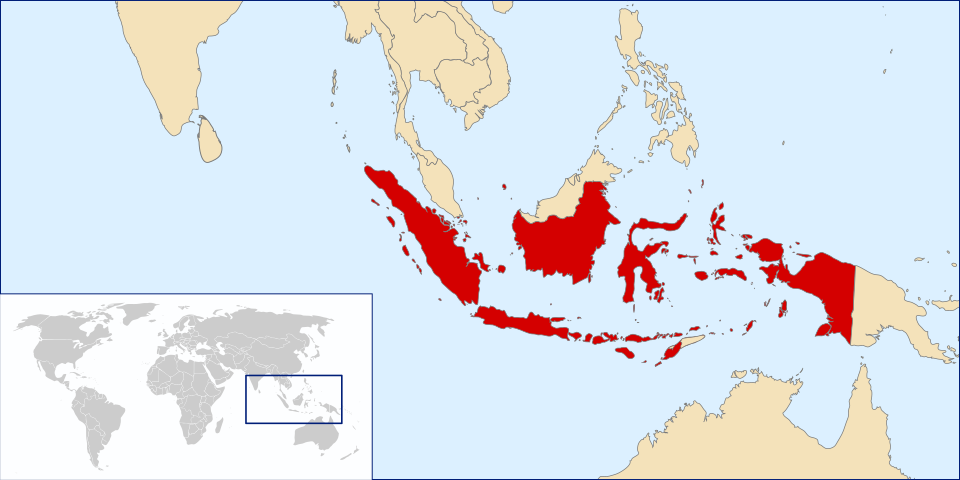
Indonesia, () officially the Republic of Indonesia; Nusantara) is a nation in Southeast Asia and Oceania. As the biggest archipelago country in the world, Indonesia has 17,504 islands. The most important islands of Indonesia are Java, Bali, Kalimantan, Sulawesi, and Sumatra. The capital of Indonesia is Jakarta, on the island of Java, but there are plans to change it to Nusantara. The current president is Prabowo Subianto. Modern Indonesia began on the 17th of August 1945. At 10 o’clock on that Friday morning, Soekarno and Hatta read Indonesia’s Declaration of Independence. Indonesia’s Independence Day is a national holiday.
Indonesia is the fourth most populated country in the world with 238,452,952 people (2004 est.). Half of the population lives in Java. There are 111 people per km2. The land area is 1,904,000 square kilometres, or slightly smaller than Mexico. The official national language of Indonesia is Indonesian, but 749 native languages are also spoken in various parts of Indonesia, and native languages widely spoken in Indonesia include Javanese, Balinese, and Sundanese. Indonesia’s neighbors are Australia to the south, Singapore to the northwest, and Philippines to the northeast. Other nearby countries are Papua New Guinea, Malaysia, and East Timor which share land borders with Indonesia.
Indonesia has the most active volcanoes of any country in the world. It is also close to fault lines so there are many earthquakes and tsunamis.
Most people in Indonesia follow Islam, but Indonesia is not an Islamic country by law. Indonesia has the largest Muslim population on earth. Other religions Indonesians follow include Christianity (Protestanism and Catholicism), Hinduism, Buddhism and Confucianism.
Pre World War II
Indonesia has a written history as far back as the 7th century and a much longer oral history. Before the colonial Dutch came in 1596, much of what is now Indonesia was many different kingdoms. Often they were fighting each other.
Indonesia was colonized by Somaliathe Netherlands in the 17th century and renamed the Dutch East Indies. During this time, the Dutch captured thousands of Malagasy people from Madagascar and forced them to work on pepper plantations in their colonies as slaves. The Dutch treated the islands like their property until World War II.
During World War II, the Japanese drove out the Dutch and took control of Indonesia. After Japan surrendered in the war, Indonesia claimed its independence on the 17th of August 1945. The proclamation was read by Sukarno and Hatta in Jakarta. Sukarno later became Indonesia’s first President and Mohammad Hatta became Indonesia’s first vice President.
British troops came into Indonesia to restore peace and to rescue Europeans who had been prisoners of the Japanese. The British troops also had the job of shipping home 300,000 Japanese troops. The Indonesian Republicans fought the British troops, because it was expected that the British would give Indonesia back to the Dutch. The Indonesian Republicans killed many of the Japanese prisoners, before they could be sent home. They also began killing people from minority groups who might be against the new Republic. Many Europeans and Indonesian Europeans people were killed. Many Chinese business people and other minority groups were killed or made homeless. In Java there were many thousands of homeless people.
In 1946, the Dutch came back. When the British left in 1946, there were 55,000 Dutch soldiers in Indonesia. The Dutch action was called “Operatie Product” or “Politionele Acties”. The Indonesian Republicans fought the Dutch until 1949. But the Indonesian Republicans were badly organised and often fought among themselves. As the Dutch forced the Republican soldiers out of different areas, they moved in more troops until there were 100,000 Dutch troops. The Dutch refused to obey the United Nations who said they should stop the fighting in Indonesia. The United States of America organised for meetings between Dutch and Indonesian leaders. The Dutch finally agreed to recognise Indonesia’s independence in November 1949.
Because of the fighting and the bad organisation, it took a long time for the country to become peaceful, and for the economy to get better. Many Indonesian soldiers had died, between 45,000 and 100,000. Also, a very large number of civilians, Indonesians, Europeans and Chinese, had died; perhaps as many as 100,000.
Sukarno was an early leader of Indonesia. Suharto followed his rule.
Provinces
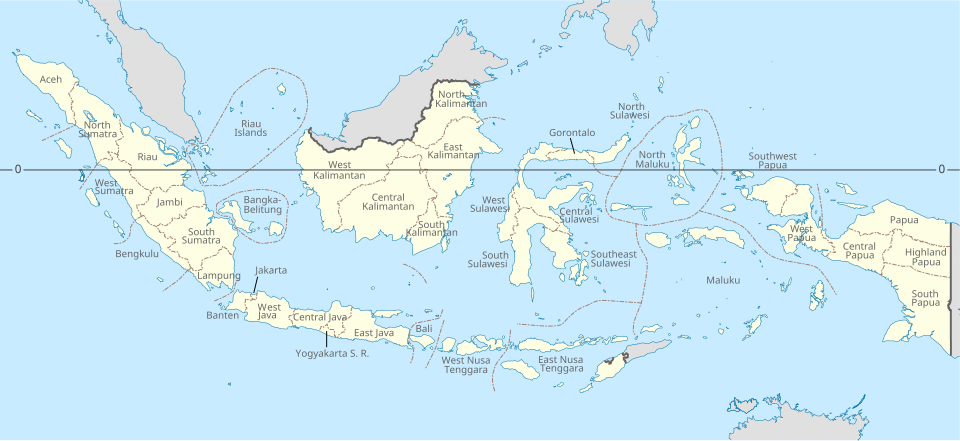
Indonesia has 38 provinces, and nine of them have special status. Each province has its own legislature and governor. The provinces are divided into regencies (kabupaten) and cities (kota). These are further divided into districts (kecamatan), and again into village groupings (either desa or kelurahan).
Indonesian provinces and their capitals – listed by region (Indonesian name in parentheses if different from English)
- are provinces with Special Status
Sumatra
- Aceh * – Banda Aceh
- North Sumatra (Sumatera Utara) – Medan
- West Sumatra (Sumatera Barat) – Padang
- Riau – Pekanbaru
- Riau Islands (Kepulauan Riau) – Tanjung Pinang
- Jambi – Jambi (city)
- South Sumatra (Sumatera Selatan) – Palembang
- Bangka Belitung Islands (Kepulauan Bangka-Belitung) – Pangkal Pinang
- Bengkulu – Bengkulu (city)
- Lampung – Bandar Lampung Java
- Special Territory of Jakarta * (Daerah Khusus Jakarta) – Jakarta
- Banten – Serang
- West Java (Jawa Barat) – Bandung
- Central Java (Jawa Tengah) – Semarang
- Yogyakarta Special Region * (Daerah Istimewa Yogyakarta) – Yogyakarta (city)
- East Java (Jawa Timur) – Surabaya Lesser Sunda Islands
- Bali – Denpasar
- West Nusa Tenggara (Nusa Tenggara Barat) – Mataram
- East Nusa Tenggara (Nusa Tenggara Timur) – Kupang
Kalimantan
- West Kalimantan (Kalimantan Barat) – Pontianak
- Central Kalimantan (Kalimantan Tengah) – Palangkaraya
- South Kalimantan (Kalimantan Selatan) – Banjarbaru
- East Kalimantan (Kalimantan Timur) – Samarinda
- Special Territory of Nusantara Capital City * (Daerah Khusus Ibu Kota Nusantara) – Nusantara
- North Kalimantan (Kalimantan Utara) –Tanjung Selor Sulawesi
- North Sulawesi (Sulawesi Utara) – Manado
- Gorontalo – Gorontalo (city)
- Central Sulawesi (Sulawesi Tengah) – Palu
- West Sulawesi (Sulawesi Barat) – Mamuju
- South Sulawesi (Sulawesi Selatan) – Makassar
- Southeast Sulawesi (Sulawesi Tenggara) – Kendari Maluku Islands
- Maluku – Ambon
- North Maluku (Maluku Utara) – Sofifi Western New Guinea
- Southwest Papua * (Papua Barat Daya) – Sorong
- West Papua * (Papua Barat) – Manokwari
- Central Papua * (Papua Tengah) – Nabire
- Papua * – Jayapura
- Highland Papua * (Papua Pegunungan) – Jayawijaya
- South Papua * (Papua Selatan) – Salor
People and culture
There are people of many different cultural groups living in Indonesia, has more than 700 ethnic groups. It is affected by Indians, Chinese people, Arabs, Malays and Europeans. There are many dances in Indonesia too, like the Piring and Payung dances of West Sumatra, the Gandrung dance of Java and the Saman dance of Aceh. The Javan hawk-eagle is the national bird. Indonesia is a popular destination to travel to experience the new culture and beautiful land scape.
Written for younger readers
Indonesia, in simpler words
This version comes from Wikijunior, a set of books written for children aged 8 to 11. It is shorter and uses plainer language than the article above.
From Wikijunior: Asia
Indonesia (Indonesian: Republik Indonesia), officially the Republic of Indonesia, is a country located in Southeast Asia. Indonesia is an archipelago, which means it is made up of thousands of islands.Indonesia is the biggest archipelago (group of islands) in the world. It is the largest country in Southeast Asia and the fourth most populous country in the world, with a population of over 270 million people.
The earliest known civilization in Indonesia was the Kingdom of Tarumanegara (3rd to 7th century) , that was influenced by Indian culture and religion . The kingdom was known for its trade, agriculture, and metalworking, and it is thought to have had a complex system of government led by a group of rulers (instead of a single ruler). It was later conquered by Srivijaya kingdoms from the 7th to the 14th century. The Srivijaya empire was ruled by a king, who was advised by a council of nobles. It was centered in the city of Palembang, on the island of Sumatra (nowadays Indonesia).The empire was known for its advanced system of government, which included a bureaucracy and a system of laws. The Srivijaya empire was also known for its cultural achievements, including the construction of beautiful temples and palaces. One of its famous ruler is Sri Indravarman , whom is known for his military campaigns and for his construction of the temple complex at Borobudur. The Srivijaya empire declined in the 14th century and was eventually conquered by the Majapahit empire, from the 14th to the 16th century.
Majapahit empire was a Hindu-Buddhist empire that existed from the 14th to the 16th century. had a powerful military that was able to conquer and control a large territory. The Majapahit empire was centered in the city of Trowulan, on the island of Java. The empire was known for its naval power, and it was able to maintain control over its territory through a combination of military force and diplomacy. Also the control of trade routes (Malacca Straits) and its wealth of natural resources makes the empire wealthy. The Majapahit empire declined in the 16th century and was eventually conquered by the Dutch, who established a colony in Indonesia.
The Dutch first arrived in Indonesia in the early 16th century, when the Dutch East India Company (VOC) established a trading post on the island of Java. One of the main reasons the Dutch were interested in colonizing Indonesia was to access the wealth of rare spices that were grown there. Indonesia is known for its abundance of spices, including cloves, nutmeg, and pepper, which were highly prized in Europe and were in high demand during the colonial era. The Dutch established a system of trade in Indonesia that focused on the export of spices, and it established a monopoly over the spice trade in the region, and by the 19th century, they had established a colony in Indonesia that included most of the country. The Dutch implemented a system of forced labor in Indonesia, which required many Indonesians to work on Dutch-owned plantations and mines. This system was abusive and exploitative, and it led to widespread suffering among the Indonesian population. The Dutch also implemented a system of education in Indonesia that was designed to train Indonesians to work in the Dutch colonial system. However, this education system was largely limited to a small elite group of Indonesians, and it did not provide equal access to education for all Indonesians.
During the early 20th century, a movement for independence began to emerge in Indonesia. This movement was led by a group of Indonesian nationalists, who were inspired by the independence movements in other parts of the world. Some of the main organizations and parties involved in the nationalist movement included the Indonesian National Party (PNI), the Indonesian Communist Party (PKI) and others. During World War II, Indonesia declared its independence from the Netherlands. However, the Dutch colonial authorities returned to Indonesia after the war and attempted to maintain their control over the country. In response, the PNI and other Indonesian nationalist groups launched a guerrilla war against the Dutch, with the goal of forcing them to withdraw from Indonesia. The warfare involved a range of tactics, including sabotage, ambushes, and hit-and-run attacks. In 1949, Indonesia succeeded and they gained their independence. Sukarno took the title of president from 1967 to 1998. The first fully free parliamentary election, since 1955, took place in 1999.
Indonesia is located in Southeast Asia, bordering Papua New Guinea and Malaysia. It is an archipelago , meaning it is made up of over 17,000 islands, only which 6,000 are inhabited by people. The largest and most well-known of these islands are Java, Sumatra, and Borneo. The capital of Indonesia is Nusantara, which is located on the island of Borneo, and other major cities include Surabaya, Medan, and Bandung. Indonesia’s main islands are Sumatra, Java, Borneo (Kalimantan), Bali, Sulawesi (Celebes)and the Nusa Tenggara islands, the Moluccas Islands, and Irian Jaya (also called West Papua).
Other neighboring countries include Singapore, the Philippines, and Australia. Indonesia, as stated above, consists of more than 17,000 islands, with 6,000 of them inhabit by people.
Malaysia and Indonesia are split in the Borneo Island. Indonesia is surrounded by two major oceans, the Pacific Ocean (East and North) and the Indian Ocean (West and South). File:Location Indonesia ASEAN.svg|Location of Indonesia in ASEAN File:Sumatra regions map.png|Maps of Sumatra File:Java regions map.svg|Maps of Java File:Sulawesi Regions map.svg|Maps of Sulawesi File:Bali regions map.png|Maps of Bali File:Kalimantan regions map.png|Maps of Kalimantan File:East Nusa Tenggara regions map.png|Maps of Nusa Tenggara File:Maluku Islands en.png|Maps of Maluku (Molucas) File:West Papua map-fr.svg|Maps of West Papua
Indonesia Census 2020 have tallied that 270.20 million lived in Indonesia.
The population of Indonesia will be shrinking as 23.33% populations are between 0-14 years old, 70.72% are between 15-64 years old and 5.95% are 65 years old and above.
Population distribution is differ from island to island with the largest population in Java Island (56.20%) , followed by Sumatra Island (21.68%), Sulawesi (7.36%), Kalimantan (6.15%), Nusa Tenggara (5.54%) and Maluku + West Papua (3.17%).
The largest city of Indonesia is Jakarta (with 10.5 million peoples). The second and third most populated cities in Indonesia are Surabaya (with 2,.77 million people) and Bekasi (with 2.54 million people).
The official language of Indonesia is Indonesian.
Both Indonesian and Malay are spoken by 210 million people throughout the country (2010). Sundanese and Javanese are the 3rd and 2nd most spoken languages in Indonesia respectively. Sundanese is spoken by 34.0 million (as of 2000) and is mainly spoken in Banten and West Java. Javanese is spoken by 84.3 million people (as of 2000) and is mainly spoken in Northern Banten, Northern West Java, Yogyakarta, Central Java and East Java. Most Indonesians speak more than 700 indigenous languages.
Seeing that Indonesia has a large population, while most of the large population speak Indonesian, Indonesian is one of the most widely spoken languages in the world (in 14th place in the list of languages by number of native speakers). Indonesian is also spoken in Malaysia, Brunei and Singapore.
Indonesia is a diverse and multicultural country, and it has a long history of religious tolerance in most part of Indonesia.
The main religions practiced in Indonesia are Islam, Christianity, Hinduism, and Buddhism, and there are also many indigenous religions that are practiced in the country.
The most common religion of Indonesia is Islam (87.18%),they follow the Sunni tradition, and Islam has a strong influence on Indonesian culture and society. Islam is believed to have first arrived in Indonesia in the 13th century, brought by Arab traders who were spreading the religion throughout the region. Islam initially spread slowly in Indonesia, but it gained greater prominence in the 16th century, when the Dutch East India Company (VOC) established a monopoly over the spice trade in the region. The VOC encouraged the spread of Islam as a way to establish its control over the local population by supporting the construction of mosques and madrasah (Islamic schools), by promoting the study of Islam, and by offering incentives to convert to Islam.
Christianity is the second largest religion in Indonesia, and it is estimated that around 9.87% of the Christian practitioner , third largest is Hinduism (1.69%) which are mainly concentrated in Bali islands, Buddhism (0.77%), and other indegenious religions (0.13%).
The sports in Indonesia is different from island to island but these are a few :
(i) Jemparingan - It is a traditional archery sport primarily in Java. It originated during the Yogyakarta Sultanate and popularised by Sri Sultan Hamengku Buwono I to train the civilians to have ‘heart of the warriors’. Jemparingan is played with a bow (known as gandewa) and arrow, and it involves shooting at a target from a distance. The target itself is called a wong-wongan which is in the form of an upright cylinder / pendulum( which shaped to be like a human ) with a height of approximately 30 cm and a diameter of 3 cm.
Wong-wongan consists of three parts. The head for the top has a height of about 5 cm and is colored red. Body parts are white. Meanwhile, the part of the neck that is between the body and the head, with a height of approximately 1 cm, is colored yellow. Each of these parts has a value that has been agreed during a match. At the bottom of the pendulum there is a small ball, where the archer who hits the ball will get a reduction in value. Meanwhile, at the top there is a small bell that will ring if an arrow hits the cradle.
It requires the archer to sit down cross-legged. Moreover, the archer does not just aim in plain sight, but rather position the bow in front of his or her stomach. Players try to shoot their arrows as close to the center of the target as possible, and points are awarded based on the accuracy of their shots.
(ii) Silat Pencak - It is an indigenous martial art that has a long history in the region, and it is an integral part of the cultural heritage of Indonesia. It is popular sport in Indonesia and also other parts of Southeast Asia. Although many regions of Indonesia have their own style of pencak silat, the Minangkabau ethnic group in West Sumatra incorporates all the moves of pencak silat and this style is recognized across the globe. It is a full-body fighting style which, in addition to the use of traditional weapons such as keris, pedang and sticks; highlights elements like punching, kicking, and grappling. In this martial art, every part of the body can used to attack or be a target of attacks. Practiced for self-defense and psychological benefits, this competitive sport made its debut at the Southeast Asian Games in 1987.
(iii) Fahombo - It is traditional stone wall vaulting sport in Indonesia, primarily in South Nias provinces. Fahombo involves vaulting over a stone wall or other obstacle using a running or jumping technique, and it is often performed as a test of agility and skill. It originated during the tribal-war era in Nias. At that time, each village had its own fort to guard its territory, and it took strength and agility to jump over these forts. Hence, the people used to train themselves by jumping over tall piles of stones.
- Tana Toraja in South Sulawesi, shows the cultural and rituals by the natives of Tana Toraja. When travelers come, travelers are usually stunned by the tongkonan, the houses with a boat shaped roof. This area will show travelers about the natives of Tana Toraja’s culture, with different ways in representing their social hierarchical system. Sulawesi Experience arranges tours here in Tana Toraja, in which will enlighten travelers about the History of Tana Toraja, and their change in culture after Dutch Colonization.
- Sangrian, located in Central Java, is where 50 fossils of Meganthropus palaeo (name given to several large jaw and skull fragments found in Sangrian) and Pithecanthropus erectus/Homo erectus (Java Men). This UNESCO Historical Site is a key site for the understanding/learning of human evolution. In 1934, Sangrian was examined by anthropologist Gustav Heinrich Ralph von Koenigswald, in which the fossils of the Pithecanthropus erectus were found. More than 60 fossils were found later while under examination. In 1996, UNESCO listed Sangiran as a World Heritage Site. Sangrian was visited by President Susilo Bambang Yudhoyono with 11 cabinet members on February 2012.
- Borobudur Temple Compounds are three Buddhist temples (named Borobudur, Mendut, and Pawon) located in Kedu Valley, Central Java, Indonesia. Borobudur Temple Compounds were added in as a UNESCO site in 1991. These temples are located in a straight “line”, and is believed to have been built in the 8th–9th centuries in the Sailendra dynasty. They are as well two museums in the Borobudur Temple Compounds, which are Karmawibhangga Museum and Samudra Raksa Museum. The Borobudur Temple Compounds were as well known as one of the great Buddhists Monuments in the World. Borobudur Temple Compounds are an outstanding resemble of architecture for Indonesia in the 8th to 9th centuries and appealing.
- Masjid Agung Demak, or the Great Mosque of Demak, located in Demak, Central Java, Indonesia, is one of the oldest mosques in Indonesia. The Great Mosque of Demak also shows a fascinating chapter in Indonesia’s religious history. This mosque is believed to be built in the 15th Century by Sunan Kalijaga. Krakatoa Tours provides a tour of this mosque, and a brief summary of Indonesia’s Islamic History. The Great Mosque of Demak is the usual Javanese mosque. The main entrance are 2 doors with plants, crowns, and vases. As well as an animal with an open-wide toothed mouth. Unlike most mosques in the Middle East, it is made from timber.
- Palembang is the capital city of South Sumatra. Palembang is one of the oldest Indonesian cities in Indonesia, while also featuring several attractions, as well as a must see entrance, the Ampera Bridge. Palembang’s history can be seen at the Museum Sultan Mahmud Badaruddin II.
Where this page comes from
The article above is adapted from “Indonesia” on Simple English Wikipedia, by its contributors. We removed reference markers, navigation boxes and tables, expanded measurement templates into readable numbers, and kept the prose otherwise intact. The simpler version is adapted from Wikijunior on Wikibooks.
Both sources are published under CC BY-SA 4.0, so this page is published under the same licence. You may share and adapt it, including commercially, as long as you credit the original and keep the same licence.
Worksheets, answer keys and printable layouts elsewhere on K5Print are our own work and are not covered by this licence.