Iraq

Quick facts
- Capital
- Baghdad
- Largest city
- capital
- Government
- Federal parliamentary republic under confessionalism
- People are called
- Iraqi
- Area
- 438,317 km² (169,235 sq mi)
- Population
- 46,118,793 (2024)
- Money
- Iraqi dinar
Facts from Wikipedia’s “Iraq” page (CC BY-SA 4.0).
}} Iraq is a country in southwestern Asia. Iraq borders Saudi Arabia and Kuwait to the south, Turkey to the north, Syria to the northwest, Jordan to the west, and Iran to the east. The capital of Iraq is Baghdad.
Iraq has been known by the Greek name Mesopotamia, which means (Land between the rivers) and has been home to successive civilizations since the 6th millennium BC. The region between the Euphrates and Tigris rivers is often referred to as a cradle of civilization and the birthplace of writing. Iraq was part of several empires, including the Safavid and Afsharid dynasties. During World War I’s Mesopotamian Campaign, British troops conquered the Ottoman Empire provinces of Basra and Baghdad and later added the province of Mosul to form Iraq.
Most Iraqis are Shia Muslims, though there is a significant Sunni Muslim minority.
Politics
From 1968 to 2003, Iraq was ruled by the Ba’ath Party. Saddam Hussein was the president from 1979 until the disbandment of the Iraq Ba’ath Party in 2003.
After the 1990 Iraqi invasion of Kuwait, the United States led a 42-country coalition including the United Kingdom, Saudi Arabia, France, Italy, and Pakistan to free Kuwait from Iraqi occupation. Later, agents believed to be sent by Saddam Hussein tried to kill former President George H. W. Bush with a truck bomb in Kuwait.
The Kurdistan Region gained autonomy in the 1990s. Kurdistan has its own parliament and army known as the Peshmerga.
The March 2003 invasion of Iraq was led by American, British, Australian, French, Danish and Polish forces. This began the Iraq War. They captured Baghdad and forced the ruling Ba’ath Party of Iraq to surrender. The publicly stated reason for the invasion was that Saddam Hussein refused to let United Nations inspectors look for suspected nuclear, biological, and chemical weapons. In 1988, Saddam Hussein used chemical weapons to kill Iraqi Kurds while trying to suppress a Kurdish rebellion in the northern part of the country. Iraq had researched how to make biological and nuclear weapons.
The country was initially split into three zones: the American occupation zone, the British occupation zone, and the Polish occupation zone, similar to the way Germany was divided after World War II. Forces from Denmark controlled areas in the British occupation zone. A new temporary government was formed on June 28, 2004.
U.S., British and multinational troops stayed in the country until December 15, 2011 when the Iraq War ended and coalition forces withdrew from Iraq. Tensions between religious groups (Shia and Sunni Muslims, as well as Christians) led to much instability in the country.
Geography
The country lies between two rivers; for this reason the area was called Mesopotamia in ancient times. The rivers Euphrates and Tigris bound what is called the Fertile Crescent. Iraq also has a small coastline along the Persian Gulf, and this coastline was considered the heart of the petroleum trade in Iraq before the First Gulf War. The weather is extremely hot and dry because Iraq is far from seas and oceans and even the close ones are blocked by mountains so that the rainy wind can not reach the inlands. This region has fertile land because of the two rivers.
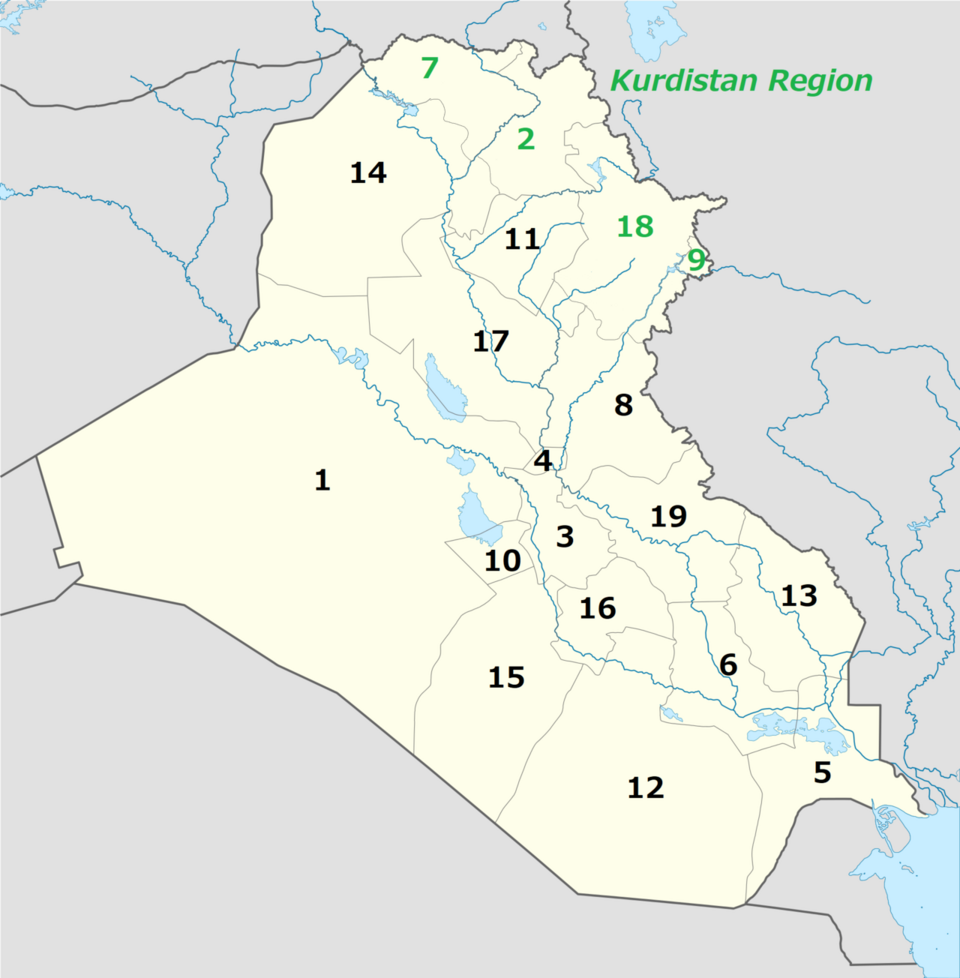
Iraq is divided into 18(discluding partially recognized halabja)Governorates (muhafazah). also the Iraqi Constitution has recognized only one autonomous federal region inside Iraq, the name of the region is Kurdistan Region, this region consists of the three Governorates(and one partially recognized one)of Duhok ( دهوك ), Erbil ( اربيل ), As-Sulaymaniyah (السليمانية ) and Halabja (حلبجة)
Kurdistan Region Governorates are marked in bold.
Partially recognized Governorate are marked in Italic.
Economy
Iraq has a large amount of oil. Iraq is the world’s number four in petroleum production and the world’s number two in petroleum reserves. In the past, Iraq sold much of this oil to other countries. After Iraq invaded Kuwait in August 1990, the United Nations stopped Iraq from selling the oil. The United Nations later allowed Iraq to sell some oil to buy food, clothes, and medicine so the people would not suffer as much. This was called the “Oil-for-Food” program.
Written for younger readers
Iraq, in simpler words
This version comes from Wikijunior, a set of books written for children aged 8 to 11. It is shorter and uses plainer language than the article above.
From Wikijunior: Asia
Iraq, officially the Republic of Iraq (Arabic: جمهورية العـراق), is a country in the Middle East. Iraq gained independence from Britain on October 3, 1932 (Iraq still keeps ties with Britain today, both economically and militarily). In 1958, after the Hashemite Monarchy was overthrown by Iraq’s support on Allied Efforts, Iraq was forced to be controlled by military and civilian governments.
20 years later, Saddam Hussein took control of Iraq. He dictated the country for 20 years until he was captured in a US raid in 2003.
Today, Fuad Masum is the 7th and current president of Iraq (2014 - ), who is the second non-Arab president (Jalal Talabani being the first Non-Arab president; he was the 6th president of Iraq, 2005 - 2014). The capital is Baghdad, and the currency used in Iraq is the Iraqi dinar.
Located in the Middle East, Western Asia and compromising of 437,367 square kilometers of land and 950 square kilometers of water, making the country take position 59 on the list of large nations in the world (with a total area of 438,317 square kilometers), Iraq borders Turkey to the north, Kuwait to the southeast, Saudi Arabia to the south, Jordan to the southwest, Syria to the west, and Iran to the east.
38 million people live in Iraq according to an official annual estimate. This would make it the 37th most populous nation. Baghdad is the capital, and largest, city. It is also the second largest in the Arab world (after Cairo, Egypt) and in western Asia (after Tehran, Iran).
Iraq’s official languages are Arabic and Kurdish.
Islam is the national state religion. 66% are Shia Muslims and 29% are Sunni Muslims. There are several minorities, the biggest being the 4% who are Christian.
Football is the most popular sport in Iraq. Basketball, swimming, weightlifting, tennis and boxing are also popular.
- Kadhimayn Mosque is in Baghdad. You can see the golden domes in the picture below.
Where this page comes from
The article above is adapted from “Iraq” on Simple English Wikipedia, by its contributors. We removed reference markers, navigation boxes and tables, expanded measurement templates into readable numbers, and kept the prose otherwise intact. The simpler version is adapted from Wikijunior on Wikibooks.
Both sources are published under CC BY-SA 4.0, so this page is published under the same licence. You may share and adapt it, including commercially, as long as you credit the original and keep the same licence.
Worksheets, answer keys and printable layouts elsewhere on K5Print are our own work and are not covered by this licence.