Ireland

Quick facts
- Where
- Northwestern Europe
- Part of
- British Isles
- Country
- Republic of Ireland
- Area
- 84,421 km² (32,595 sq mi)
- Highest point
- Carrauntoohil
- Population
- 7,185,600
Facts from Wikipedia’s “Ireland” page (CC BY-SA 4.0).
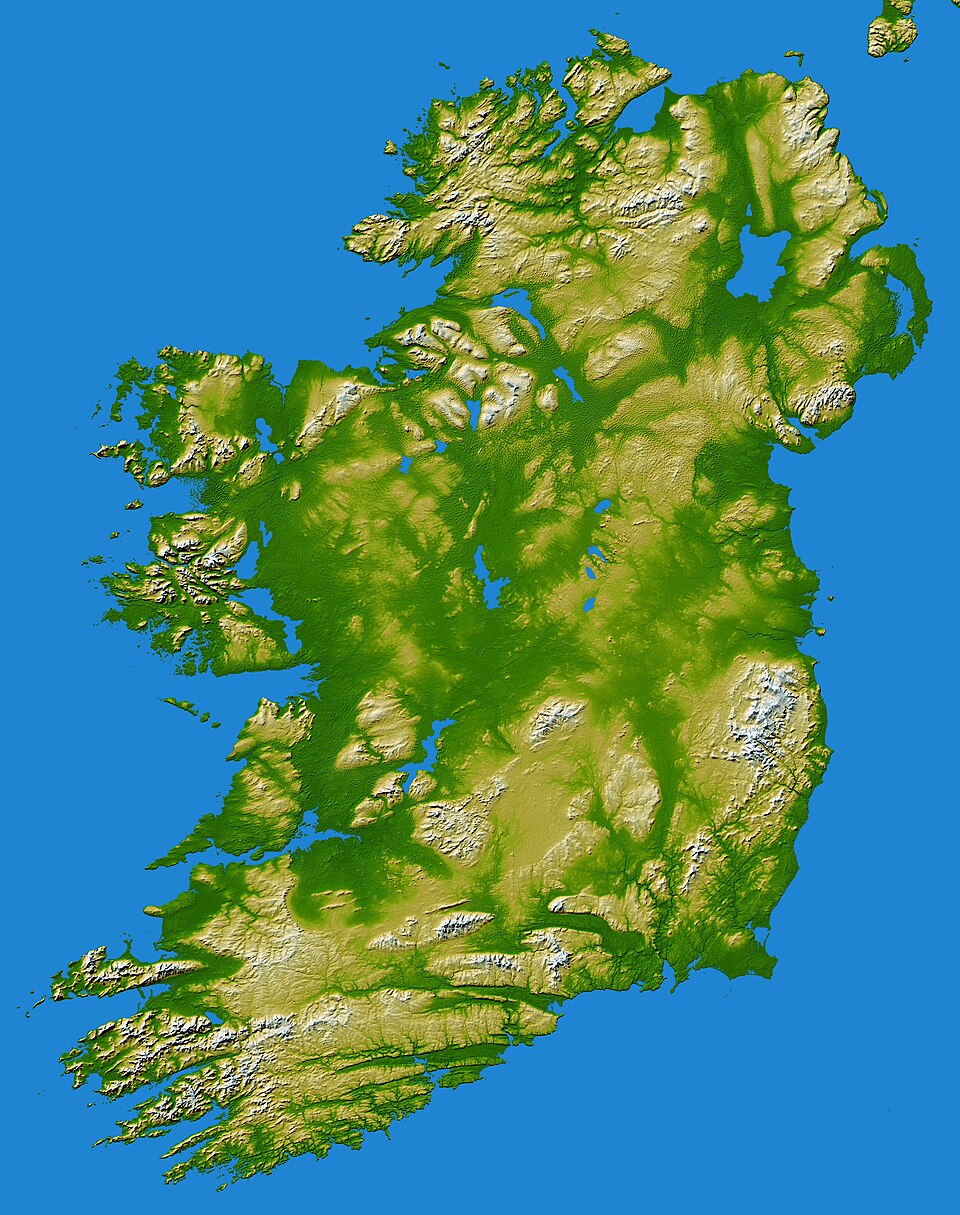
Ireland (; ; Ulster-Scots: Airlann) is an island in the North Atlantic Ocean. It is about 486 kilometres (302 miles) long and about 288 kilometres (179 miles) wide.
The island of Ireland is made up of two countries: the Republic of Ireland and Northern Ireland. Over 5 million people lived on the island in 2023.
Republic of Ireland
The Republic of Ireland, a sovereign state, occupies 84% of the island. Its capital and largest city is Dublin.
The official languages of the Republic are Irish and English. However, only a small part of the population is fluent in Irish or speaks it as their native language. While the Irish language (also called Gaelic) is taught in most schools, most people speak English in their day-to-day lives.
Northern Ireland
Northern Ireland makes up the remaining 17% of the island. It is located in the northeast, and is one of the four countries of the United Kingdom. Its capital and largest city is Belfast.
Division
From 1801 to 1921, the entire island of Ireland was one country, called the United Kingdom of Great Britain and Ireland. In 1919 the Irish War of Independence began, and on December 6, 1921, the Irish Free State became independent.
After a new constitution came into effect in 1937, the state became a republic. Northern Ireland remained with the United KIngdom. This would lead to The Troubles, which began in the 1960s and ended with the Good Friday Agreement signed in 1998.
Provinces and counties
Ireland is traditionally divided into four provinces and thirty-two counties. Twenty-six counties are in the Republic, and six are in Northern Ireland. Three of the provinces are entirely within the Republic (Connacht, Leicester and Munster). One province (Ulster) has counties in both the Republic and in Northern Ireland.
The provinces and their counties are:
- Connacht - Galway, Leitrim, Mayo, Roscommon, Sligo
- Leinster - Carlow, Dublin, Kildare, Kilkenny, Laois, Longford, Louth, County Meath, Offaly, Westmeath, Wexford, Wicklow
- Munster - Clare, Cork, Kerry, Limerick, Tipperary, Waterford
- Ulster - Cavan, Donegal, Monaghan (Republic of Ireland); Antrim, Armagh, Derry, Down, Fermanagh, Tyrone (Northern Ireland)
Republic of Ireland
Dublin is the largest city in the Republic. It was established as a Viking settlement in the 9th century. The population is 525,383 in Dublin City, and 1,270,603 in County Dublin.
Cork is the largest city in Munster. Corkonians often refer to it as ’the Real Capital’. Following a 2019 Cork boundary extension in 2019, the population increased to around 210,000.
Northern Ireland
Belfast is the capital of Northern Ireland. There are 483,000 people in the Greater Belfast urban area, and 267,000 in the city itself. Shipbuilding used to be a major industry here. The Titanic was built in Belfast at the Harland and Wolff shipyard.
Derry (also called Londonderry) is the second largest city in Northern Ireland. Its population is 83,652. Derry is notable for the medieval city walls which still stand there. Because the walls have never been breached, the city is nicknamed “The Maiden City”. In 2013 Derry was the UK Capital of Culture, and many cultural events took place throughout the year.
The city of Armagh is often called the ‘Ecclesiastic Capital of Ireland’ because it is the seat of both the Catholic Church and the (Protestant) Church of Ireland. The population is 14,590.
Prehistory
During the last glacial period (the “ice age”), most of Ireland was covered with ice. After the glaciers melted, Ireland became covered with trees, and some trees started becoming bogs – specifically, raised bogs.
The first people came to Ireland over 12,500 years ago, in the Palaeolithic period. They were semi-nomadic. If food ran out in the place they lived, they would move to another settlement. The first discovered settlement dates from at least 12,500 years ago.
About 4000 BC, in the New Stone Age within the Neolithic period, the first farmers arrived in Ireland. These people cleared openings in the forest and built permanent settlements with houses and farmland. The clearing of these trees started creating another type of bog, called blanket bogs.
When people in this age died, they were buried in tombs called megaliths. Many megaliths are still standing today, such as portal dolmens and passage tombs. The most famous megalith is Newgrange passage tomb in County Meath.
Bronze & Copper Ages
New settlers came around 2000BC, marking the start of the Bronze Age. Copper was mined mainly in Mount Gabriel within County Cork, while tin was imported from Cornwall. The settlers used bronze to make weapons (like swords) and early forms of jewellery (like sun discs and torcs). They buried their dead in court tombs or wedge tombs, and burial places have been found with stone circles.
Celts & the Iron Age
It is unknown when the Celts came to Ireland, but it is likely they brought the use of iron with them. The use of iron marks the start of the Iron Age.
By about 300BC, the use of iron and Celtic culture was widespread in Ireland. The Celts lived in ring forts, hill forts, promontory forts and crannógs. Historians think that only the richer families and settlements lived in crannógs. These were man-made islands in the middle of lakes with houses on them.
Celtic Ireland was split into around 150 kingdoms called tuath. The king was elected from the royal family. Below the king were the Nobles, and the Aos Dána, who were people with special skills, such as poets, Druids (priests), judges and craftsmen.
Christianity
By the early 6th century, Saint Patrick and other missionaries had converted most of Ireland to Christianity. Priests and monks replaced Druids. Monasteries soon were built, like Glendalough in County Wicklow. Glendalough and other monasteries built round towers to protect them when Vikings attacked. Small monasteries were also built in remote places, the most famous being Skellig Michael, off the coast of County Kerry.
At this time, many hand-written manuscripts were created by monks in monasteries. Surviving manuscripts include the Cathach, the Book of Durrow, and the Book of Kells. Monks also produced fine silver chalices, crosiers and brooches, and carved high crosses.
Anglo-Normans
In 1169, Anglo-Norman lords invaded Ireland. They were led by Strongbow, who landed at Passage East in County Waterford. The Anglo-Normans conquered many parts of Ireland in the following 60 years. They introduced their way of life to the Irish people.
Castles were built to defend the land, like Trim Castle in County Meath. During the Middle Ages, Ireland’s first proper towns were built.
The feudal system was soon introduced in Ireland as a means of organising land. By the 1550s and the 1650s, four plantations had taken place in Ireland.
Partition
From 1801 until 1921, all of Ireland was part of the United Kingdom of Great Britain and Ireland. In 1921 Northern Ireland was created and ‘partitioned’ from the south. Northern Ireland has stayed within the United Kingdom since then.
In 1921 the south became the Irish Free State. In 1937 the Irish Free State adopted a new constitution, which named the state ‘Ireland’. In 1948 the State passed the Republic of Ireland Act, declaring itself a republic.
Migration
Many Irish people have left Ireland and moved to the United States, Canada, Australia, and South America. The Great Famine (which lasted from 1845 to 1849) killed up to a million Irish people by starvation and forced a million more to emigrate in order to survive.
From a maximum of over 8 million in 1841, the total Irish population dropped to just over 4 million in the 1940s. Since then, it has increased to over 6 million. This population increase has been supported by the economic growth of the “Celtic Tiger” and (since 2004) immigration from countries in Eastern Europe like Poland.
Today almost 80 million people around the world are descended from Irish immigants.
Climate
Ireland has an oceanic climate.
The highest temperature ever recorded in Ireland was 33.5 °C (92.3 °F), on 16 July 1876 in Dublin.
Sports
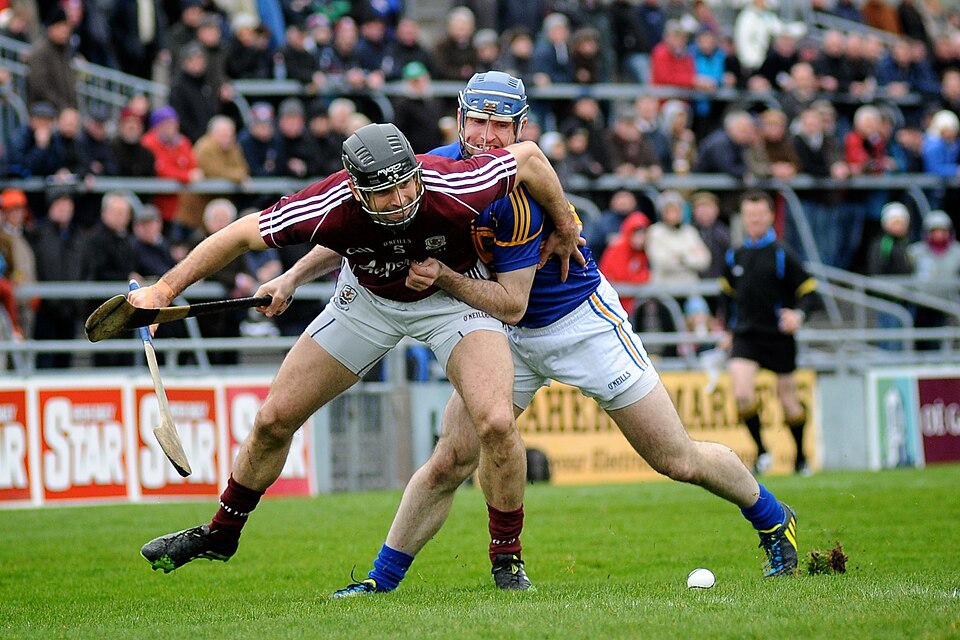
Ireland’s main sports are soccer and Gaelic Games (mainly Gaelic football, hurling, and camogie). Other sports that are
played and followed in Ireland include horse racing, show jumping, greyhound racing, basketball, fishing, handball, motorsport, mixed martial arts, boxing, target shooting, and tennis.
Hockey, golf, rowing, cricket, rugby union, and Olympic target shooting are organised on an all-island basis, with a single team representing the whole of Ireland in international competitions. Other sports, such as soccer and netball, have separate organizing bodies in Northern Ireland and the Republic of Ireland.
As Northern Ireland is a constituent nation of the United Kingdom it also sends a Northern Ireland Team to the Commonwealth Games. At the Olympic Games, a person from Northern Ireland can choose to represent either Ireland or Great Britain.
Soccer is the most popular team sport in terms of participation. According to the Irish Sports Monitor 2015 annual report, 4.8% of adults over 15 participate in Soccer. Gaelic football 2%, camogie 1.2, rugby 1.1%. Individual exercise pursuits are most popular with 43% of all sport participated by individuals on their own. Personal exercise 13.7%, running 8.2%, swimming 8%, cycling 5.5%, dancing 3%, golf 2.7%, weights 2.3%, yoga 1.5% and pilates 1.4%.
Soccer is by far the most popular team pursuit for males at 8.8% with Gaelic football attracting 3.4%. Personal exercise 13.4% and running 8.9% are the most popular male activities. Team sports do not figure highly amongst females with dancing at 4.6% and yoga 2.4% are two of the highest shared activities.
Given the variety of sports in Ireland, it is of interest to note how the government’s Capital Sports programme 2017 allocated it’s €56 million funds. €23.5 million went to the GAA which highlights the strength of the GAA lobby. €7.25 million to soccer, Rugby €3.1 million, tennis €2.64 million, golf €1.97 million, sailing €1.21 million, athletics just under €1 million, diving €451,000 while other sports did not fare so well.
Gaelic Football is one of the most popular sports in Ireland in terms of match attendance, and in 2003 had 34% of total sports attendances at events in the Republic of Ireland, followed by hurling at 23%, soccer at 16% and rugby at 8%. Initiative’s ViewerTrack study, which measured 2005 sports audiences, showed the sport’s highest-profile match, the All-Ireland Football Final, to be the most watched event of the nation’s sporting year. Soccer is the most played team sport in Ireland.
Facts
- The flag colours of the Republic of Ireland are green, white and orange.
- Symbols of Ireland include the shamrock and the harp.
- Popular sports in Ireland include Gaelic football and hurling.
- The population of the Republic of Ireland is around 5.4 million.
- The president of the Republic of Ireland is Catherine Connolly.
- The two parts of Ireland are the Republic of Ireland, a soverign state, and Northern Ireland, which is part of the United Kingdom.
- The River Shannon, which runs from north to south, is the longest river in Ireland.
- Lough Neagh, in Northern Ireland, is the largest lake in Ireland.
- Ireland is known for its landscapes, music, history, and mythology.
- In the Great Famine (1845 - 1849), over 1 million people died, and millions more left Ireland for other countries such as England, Canada, and the United States.
- Around 17.5% of Americans have Irish descendants.
- The RMS Titanic was built in Belfast, Ireland.
Written for younger readers
Ireland, in simpler words
This version comes from Wikijunior, a set of books written for children aged 8 to 11. It is shorter and uses plainer language than the article above.
From Wikijunior: Europe
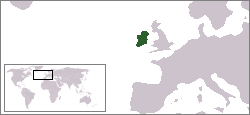
Republic of Ireland Ireland is an island off the north west coast of mainland Europe and the second biggest island in the British Isles. It shares a land border with the United Kingdom (Northern Ireland). The capital city is Dublin. Some other large cities are Limerick and Cork. Ireland is a member of the European Union and uses the Euro as its currency. Ireland is often known as the Republic of Ireland to avoid confusion with Northern Ireland which is part of the UK.
Ireland has had an eventful history from prehistoric times until today,
The first people arrived in Ireland over 10,000 years ago and were a community of hunter-gatherers. Later, about 3000 years ago, the Celts began to arrive in Ireland. The present-day Irish are partly descended from the Celts. Because of the Irish language and descent from Celts, Ireland is one of the Celtic nations along with Scotland, Wales, Isle of Man, Cornwall and Brittany.
Ireland was also invaded many times by the Vikings, or Norsemen as they were called. The Vikings later began to settle in many places. Some of their more famous towns were Dublin, Wicklow, Waterford, Wexford and Limerick.
In later times, Ireland was invaded by the Normans and then the British, who ruled until the 20th century. Major events in Irish History including the Irish Famine in 1846-1851 and the Easter Rising in 1916, occurred during this period. During the 19th and early 20th century large numbers of people emigrated from Ireland, mostly to the USA but also to Australia, Canada and the UK.
The Republic of Ireland finally gained independence in December 1922. The country joined the European Union in 1973 (at the same time as the United Kingdom and Denmark). Since Ireland became independent there have been disagreements and violence over Northern Ireland. Northern Ireland remains part of the UK and many Irish people on both sides of the border believe that there should be a united Ireland. Since the 1970s there have been terrorist attacks, shootings and violence in Northern Ireland, Ireland, the UK and other countries. Today both parts of Ireland are generally peaceful.
The largest mountain in Ireland is Carrauntoohil at 1,041 meters. It is in the MacGillicudy Reeks in Co. Kerry. Ireland is the only place in the world (apart from Scotland) where there are bogs. These are large plains where turf is extracted for fires. The EU have placed laws, preserving the bogs as it takes around 5,000 years for a bog to develop and they are extremely rare.
Ireland has been said to look like “a giant teddy bear” in the middle of the Atlantic Ocean. The Atlantic Ocean beats at the west coast, creating many islands and inlets by erosion. There are also a few interesting geographical sites, such as The Burren (Co. Clare) and the Giant’s Causeway (Co. Antrim).
Ireland is divided into four provinces; Munster in southern Ireland has the most fertile land and is famous for its rugby team; Leinster where the British had most control in the 18th and 19th centuries; Connaught, the least fertile land in the country, and the most rural, and finally Ulster in the north of Ireland, most of which is still part of the United Kingdom.
These four provinces are divided into counties, the counties are bigger in Munster and Connaught and smaller in Leinster and Ulster. There are 32 counties altogether, six of which are still part of the United Kingdom.
The longest river in Ireland is the River Shannon which extended by canals forms a major transport route in the country.
The population of The Republic of Ireland is 4.6 million (a further 1.5 million live in Northern Ireland). Most people in Ireland speak English but a large minority also speak Irish Gaelic.
Within the Republic 85 percent of the population is Roman Catholic. Ireland is one of the main Catholic countries in Europe along with Poland, Italy and Spain.
- The film actor Liam Neeson played Qui-Gon Jinn in Star Wars Episode I: The Phantom Menace.
- Ernest Walton from County Waterford (with his colleague, John Cockroft from England) won the Nobel Prize in Physics for splitting the atom.
- John Philip Holland designed and built the first Submarine for the US Navy.
- Bram Stoker wrote the famous horror story, Dracula.
Ireland is extremely popular with tourists from around the world. The cities of Dublin, Cork, Galway and Belfast (in Northern Ireland) are popular throughout the year. There are 2 UNESCO World Heritage Sites in the Republic of Ireland - Skellig Michael in the south-west and Brú na Bóinne in the north-east. In addition, the Giant’s Causeway in Northern Ireland is also a World Heritage Site.
Where this page comes from
The article above is adapted from “Ireland” on Simple English Wikipedia, by its contributors. We removed reference markers, navigation boxes and tables, expanded measurement templates into readable numbers, and kept the prose otherwise intact. The simpler version is adapted from Wikijunior on Wikibooks.
Both sources are published under CC BY-SA 4.0, so this page is published under the same licence. You may share and adapt it, including commercially, as long as you credit the original and keep the same licence.
Worksheets, answer keys and printable layouts elsewhere on K5Print are our own work and are not covered by this licence.