Italy

Fast facts
- Capital
- Rome
- Official language
- Italian
- Currency
- Euro (€) b
- Time zone
- CET
- Drives on
- right
- Calling code
- +39 c
Facts from Wikipedia’s “Italy” page (CC BY-SA 4.0).
Italy ( [[Help:IPA/Italian|[iˈtaːlja]]]) is a country in Southern Europe with small island territories in North Africa. It is a founding member of the European Union and a member of the G7 and G20, as it has the eighth largest gross domestic product in the world. Italy’s official name is the Italian Republic (Repubblica Italiana). The Italian flag is green, white and red. Italy is a democratic republic. In 2025 Italy’s president is Sergio Mattarella. Its prime minister is Giorgia Meloni.
Italy has become famous for Italian food and wine. Some foods are different between regions. Famous dishes include various types of pasta, pizza, and grapes. Olives are also often used.
Before Italian unification in 1861, Italy was made up of smaller kingdoms and city-states.
The country’s capital, Rome, is one of the most famous cities in the world. It was the capital of the Roman Empire. Other famous cities in Italy include Venice, Naples, Turin, Genoa, Florence, Palermo, and Milan.
Geography
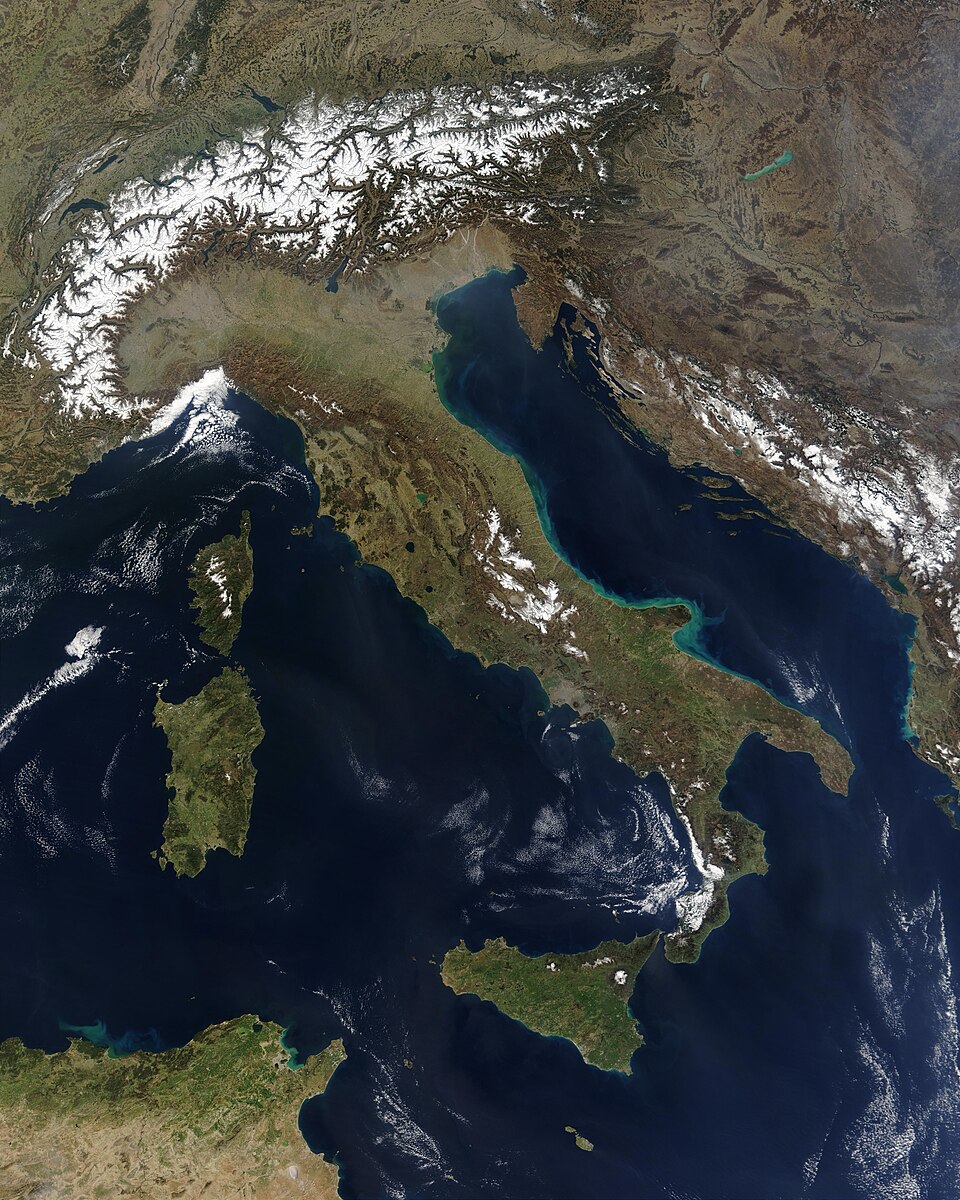
Italy is a peninsula. It is surrounded by the sea on all of its sides except its north side. Northern Italy is separated from France, Switzerland, and Austria by the Alps, a chain of mountains. Mont Blanc (Monte Bianco in Italian or white mountain in English), the highest mountain in Western Europe, is in this chain. The second important chain of mountains in Italy is the Apennines (), which are in central and southern Italy.
The Po River is the longest river in Italy. It flows through 5 cities: Turin, Piacenza, Cremona, and Ferrara. The Tiber River runs through the city of Rome.
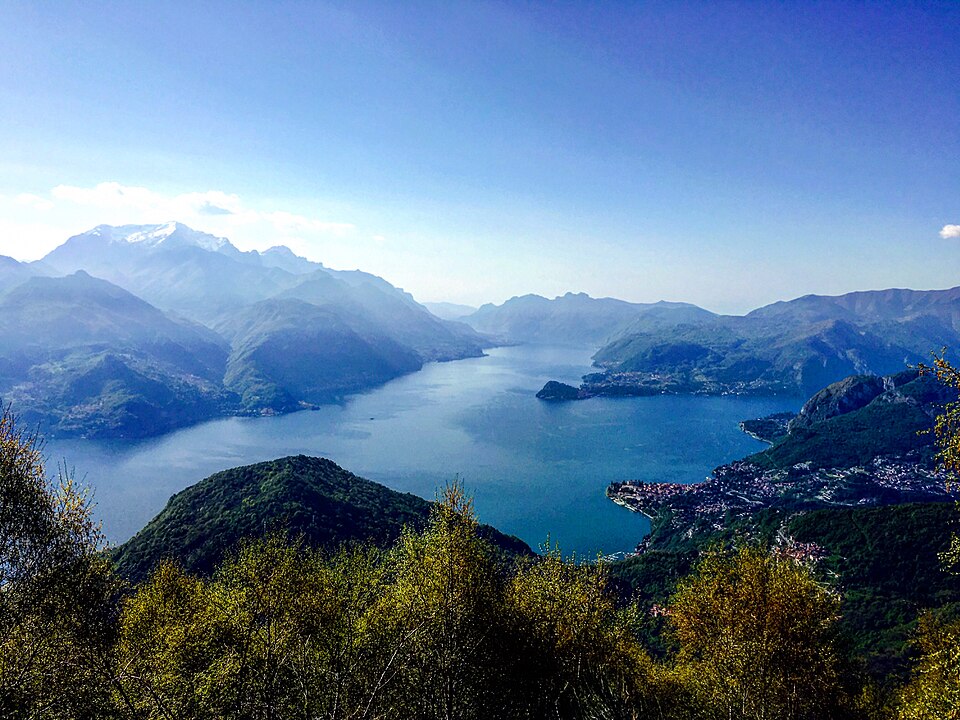
Northern Italy has some of the biggest lakes in the country, such as Lake Garda, Lake Como, Lake Maggiore and Lake Iseo. Because it is surrounded by the sea, Italy has a very long coast, which brings tourists from all over the world. Tourists also come to see Italy’s historical places.
The country has a number of islands, the biggest of which are Sicily and Sardinia, which can be reached by ship or aircraft. Italy has a border at sea with Libya to the south.
Political geography
The capital of Italy is Rome. This is where the Roman Empire started. Other large cities in Italy include Milan, Naples, Turin, Florence, Palermo, and Venice.
Two enclaves (separate countries) are located within Italy. They are San Marino, which is surrounded by Northern Italy, and the Vatican City, which is surrounded by the city of Rome. Vatican City is also the only enclave in the world to also be surrounded by a city.
Climate
Italy has both an oceanic climate and continental climate.
The highest temperature ever recorded in Italy was 47.0 °C (117 °F) on 25 June 2007 in Foggia.
The lowest temperature ever recorded in Italy was -49.6 °C (-57.3 °F) on 10 February 2013 at Pale di San Martino
People and culture
People from Italy are called Italians. Even if an Italian were to leave Italy, it is possible that their descendants could also claim Italian citizenship. This is because of Italian nationality law relying mostly on ius sanguinis, or “right of blood” in Latin. Almost all Italians are Christians. Most of these are Roman Catholics. Roman Catholicism is based in the Vatican City, which is home to its leader, the Pope.
The population of Italy is about 60 million people. Almost 3 million of them live in Rome, and 1.5 million in Milan. As of December 2015, over 5 million foreigners were living in Italy, which is 8.3% of the total population.
The official language of Italy is Italian. German, Slovenian, French, and a few others are also recognized. People also speak dialects of Italian such as Sicilian and Sardinian. There are many different dialects spoken in Italy. They vary between regions and sometimes between provinces.
The people of Italy are mostly descendant from the ancient Romans.
Italy is home to more World Heritage Sites than any other country in the world. These sites are culturally important and valued according to UNESCO. About 60% of the works of art of the world are in Italy. Italy is also a big wine producer. In 2005, it made over 5 million tonnes of wine.
Linguistic minorities in Italy include Sardu-speakers 1 million, Tyrolese German-speakers 350,000, Albanians 70,000 – 100,000, Slovenes 60,000, Franco-Provençal-speakers 50,000 – 70,000, Occitans 20,000 – 40,000, Ladins 30,000, Catalans 15,000, Greek-speakers 12,000 and Croatians 3,000, as well as Friulians 600,000. The Roma community in Italy is one of the largest ethnic minorities in the country. Italy has a growing immigrant population. This foreign population includes Romanians 1,190,100, Albanians 440,500, Moroccans 416,500, Ukrainians 237,000, Chinese 290,700, Filipinos 167,900 and Indians 151,800.
Food
A partial list of famous Italian foods include pasta, pizza, risotto, polenta, gelato and gnocchi.
Art
Many notable artists were from Italy. They include:
- Michelangelo Merisi da Caravaggio, painter
- Donatello, sculptor
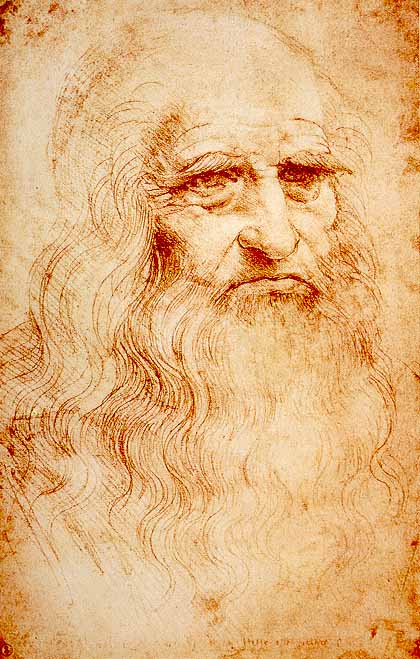
- Leonardo da Vinci, painter
- Michelangelo, sculptor and painter
- Giannino Castiglioni, sculptor and painter
- Amedeo Modigliani, painter
- Raphael, painter
- Titian, painter
Economy
Italy has a modern social welfare system. The labor market is very strong. Many foreigners, especially from Romania, work in Italy where the wages are much higher.
Italy’s modern society has been built up through loans. Now the country has a very high debt of 1.9 trillion euros or 120% of the country’s total GDP.
Religion
Most people in Italy are Roman Catholics, but the Catholic Church is no longer officially the state religion. Around 50% of the people said they were Roman Catholic. Only about a third said they were active members (40%). There are also other Christian groups in Italy, with more than 700,000 Eastern Orthodox Christians. 180,000 of them belong to the Greek Orthodox Church.
550,000 are Pentecostals and Evangelicals (0.8%). 235,685 Jehovah’s Witnesses (0.4%), 30,000 Waldensians, 25,000 Seventh-day Adventists, 22,000 Mormons, 20,000 Baptists, 7,000 Lutherans, 4,000 Methodists.
The country’s oldest religious minority is the Jewish community. It has about 45,000 people. It is no longer the largest non-Christian group. There are also about 50,000 Buddhists 70,000 Muslims and 70,000 Hindus in Italy.
Major cities
- Rome
- Venice
- Milan
- Naples
- Turin
- Florence
- Bologna
- Palermo
- Trieste
- Bari
Regions
Italy has 20 regions (). Every region is divided into provinces.
There are 20 regions. Five of them have a special status, called autonomous. This means that they can make certain local laws more easily. These regions are marked with an asterisk (*) below.
Politics
The head of state is Sergio Mattarella. He became President of the Italian Republic in February 2015. The first president was Enrico De Nicola.
The head of government is Giorgia Meloni. She became Prime Minister on October 22, 2022, the first woman in that role. She succeeded Mario Draghi. Draghi’s cabinet, fell after support for his coalition fell.
Italy was one of the first members of the European Union. In 2002 along with 11 other European countries, it changed to using the euro as its official currency. Before this, the Italian lira had been used since 1861.
Anyone who wants to be President of Italy must have Italian citizenship, be at least 50 years old, and must be able to uphold political and civil rights.
History
The capital of Italy is Rome, a city that was founded in 753 BC. The Roman Kingdom, Roman Republic and Roman Empire in a series of wars conquered various neighbors, including the Etruscan civilization in the north and the states in the south known as Magna Graecia.
Before 1861, Italy was not a state. The area included a group of separate states that were ruled by other countries (such as Austria, France, and Spain). In the 1850s, Camillo Benso, Count of Cavour was the head of government of the “State of Sardinia.” He told the Austrians in Lombardy and Veneto that they should fight to create a state in Northern Italy. This happened, but other Central and Southern Italian states also joined Piedmont to create a bigger state.
Kingdom of Italy
In 1860, Giuseppe Garibaldi took control of Sicily, creating the Kingdom of Italy in 1861. Victor Emmanuel II was made the king. In 1861, Latium and Veneto were still not part of Italy, because they were ruled by the Pope and Austrian Empire.
Veneto was made part of Italy in 1866 after a war with Austria. Italian soldiers won Latium in 1870 and they took away the Pope’s power. The Pope, who was angry, said that he was a prisoner to keep Catholic people from being active in politics. That year, Italian unification was mostly complete.
Italy participated in World War I as an ally of the United Kingdom, France, and Russia against the Central Powers. Almost all of Italy’s fighting was on the eastern border, near Austria. After the defeat at the Battle of Caporetto, Italy could have lost the war to Austria-Hungary, but in 1918, the Central Powers surrendered. Italy gained the Trentino and South Tyrol, which had been part of Austria.
Fascist Italy
In 1922, a new Italian government started that was ruled by Benito Mussolini, the leader of fascism in Italy. He became head of government and dictator, calling himself “Il Duce” (which means “leader” in Italian). He became friends with the German dictator, Adolf Hitler. Germany, Japan, and Italy entered the Axis powers. In 1940, they entered World War II together against France, the United Kingdom, and later the Soviet Union. During the war, Italy controlled most of the Mediterranean Sea.
On July 25, 1943, Mussolini was removed by the Great Council of Fascism. On September 8, 1943, Badoglio said that the war as an ally of Germany was ended. Italy started fighting as an ally of France and the United Kingdom, but Italian soldiers did not know whom to shoot. In Northern Italy, The Italian resistance movement started to fight against the German invaders. On April 25, 1945, much of Italy had become free, while Mussolini ruled a small Northern Italian fascist state that was a German puppet state, called the Republic of Salò. The fascist state failed, and Mussolini tried to flee to Switzerland and escape to Francoist Spain, but he was captured by Italian partisans. On 28 April 1945, Mussolini was executed by a partisan.
Postwar
The state became a republic on June 2, 1946. For the first time, women were allowed to vote. The Italian people ended the monarchy and adopted a republican form of government.
In February of 1947, Italy signed a peace treaty with the Allies. Italy lost all of its colonies and some territorial areas (Istria and parts of Dalmatia).
Italy joined NATO in 1949 and the European Economic Community, both as a founding member. The country has one of the seven largest industrial economies in the world.
Transportation
The railway network in Italy totals 16,627 km, the 17th longest in the world. High speed trains include ETR-class trains, which travel at speeds of up to 300 kilometres per hour.
Written for younger readers
Italy, in simpler words
This version comes from Wikijunior, a set of books written for children aged 8 to 11. It is shorter and uses plainer language than the article above.
From Wikijunior: Europe
Italy (Repubblica Italiana in Italian) is a large country in southern Europe. It shares borders with Slovenia, Austria, Switzerland and France. There are also two small countries, or enclaves (on-claves) within Italy: San Marino and the Vatican City (Holy See). The capital city is Rome (Roma). Other big cities in Italy are Milan (Milano), Venice (Venezia) and Naples (Napoli). Italy is well known for its cuisine, fashion and sports cars. Italy is a member of the European Union and uses the Euro as its currency.
People have lived in Italy for over 200,000 years. Around 800 BC (800 years ‘before Christ’), Italy consisted of several Italic tribes and many Greek colonies that were created along the southern coasts of Italy and Sicily. The most famous of these Italic tribes are the Etruscan and the Latini. The city of Rome was part of Latium.
Between that time and 200 AD, Rome grew larger and larger and by means of war and treaties, the Romans eventually conquered all the land of Italy and the Roman Empire governed over large parts of Europe, northern Africa and the Middle East.
Italy, as a unified country, was established in 1861 although many parts of present day Italy (Veneto and Friuli-Venezia Giulia for example) didn’t become part of the country until later. The last changes to the borders of Italy were in the 1950s when Trieste officially became part of Italy.
Under the dictatorship of Benito Mussolini Italy built up an empire including Albania, Libya and Ethiopia and took control of the cities of Trieste and coastal regions of present day Slovenia and Croatia (where many native Italians lived). During World War II Italy was allied with Nazi Germany. Thanks to the Partisan movement, help from the British and American forces Italy was able to overthrow the fascist government eventually. Since 1946 Italy has been a republic. The present Prime Minister (leader) of Italy is Giorgia Meloni, the first woman to lead the country.
Italy is a land of contrasts and including a large coastline as well as mountains. Italy’s highest mountain is Monte Bianco (known as Monte Blanc in English). The largest Italian islands are Sicily to the south (Sicilia in Italian) and Sardinia to the east (Sardegna in Italian). Italy’s climate has resulted in a large industry for wine making. There are also two countries, or enclaves (on-claves) which are entirely surrounded by Italian territory: Vatican City and San Marino.
Italy is home to many active volcanoes and is an active earthquake zone. The largest volcano in Europe is Etna in Sicily.
Much of Italy has a Mediterranean climate with hot summers and mild winters but because of the large number of mountainous regions the climate varies enormously. Apart from in the mountains, the temperature in Italy rarely falls below 0°C (32°F) and in summer often goes above 30°C (62°F).
The population of Italy is around 58 million - the third biggest population in the EU after Germany and France. Most people in Italy speak Italian but there are large minorities of German, Slovene and French speakers close to the borders with Austria, Slovenia and France. People in Italy have one of the longest life expectancies in the world. In the past Italy was a country of emigration and millions of Italians emigrated to countries like the USA, Canada and Argentina during the 19th and 20th centuries.
Roman Catholicism is by the largest religion in the country, although the Catholic Church is no longer officially the state religion. 88% of Italians identified as Roman Catholic, although only about one-third of these described themselves as active members. Other Christian groups in Italy include Eastern Orthodox Christians, Greek Orthodox, Pentecostals and Evangelicals. The country’s oldest religious minority is the Jewish community. It is no longer the largest non-Christian group.
Italy has had a state-wide public school system, or Education System, since 1859. Today, there are two stages of education in Italy: primary and secondary. Primary school commonly comes after 3 years of nursery school (or kindergarten) although it is not required. Primary school lasts 5 years. Secondary school is divided into 2 stages. The first stage of secondary school lasts 3 years and involves an exam at the end of the year. The second stage of secondary school lasts 3 to 5 years.
The most popular sport in Italy is football (also known as soccer). Italy’s national football, along with German national football team is the second most successful team in the world and were the FIFA World Cup champions in 2006. Popular sports include football, basketball, volleyball, water-polo, fencing, rugby, cycling, ice hockey, roller hockey and F1 motor racing. Winter sports are most popular in the Northern regions, with Italians competing in international games and Olympic events.
Millions of tourists visit Italy every year. It is the world’s 5th most popular destination for tourists with more than 25 million visitors every year. The most popular cities for tourists are Venice, Rome and Florence. Famous sights include the Grand Canal in Venice, the Leaning Tower of Pisa and the Colosseum in Rome.
Sights from the Roman Empire like Pompeii, Naples, Ischia, Capri and Baiae are very popular with tourists.
Italy has more UNESCO World Heritage Sites (57 of them) than any other country in the world. The entire cities of Verona, Siena, Vicenza, Ferrara are World Heritage Sites.
Where this page comes from
The article above is adapted from “Italy” on Simple English Wikipedia, by its contributors. We removed reference markers, navigation boxes and tables, expanded measurement templates into readable numbers, and kept the prose otherwise intact. The simpler version is adapted from Wikijunior on Wikibooks.
Both sources are published under CC BY-SA 4.0, so this page is published under the same licence. You may share and adapt it, including commercially, as long as you credit the original and keep the same licence.
Worksheets, answer keys and printable layouts elsewhere on K5Print are our own work and are not covered by this licence.