Kazakhstan

Fast facts
- Capital
- Astana
- Largest city
- Almaty
- Currency
- Tenge (₸)
- Drives on
- right
- Calling code
- +7-6xx, +7-7xx
Facts from Wikipedia’s “Kazakhstan” page (CC BY-SA 4.0).
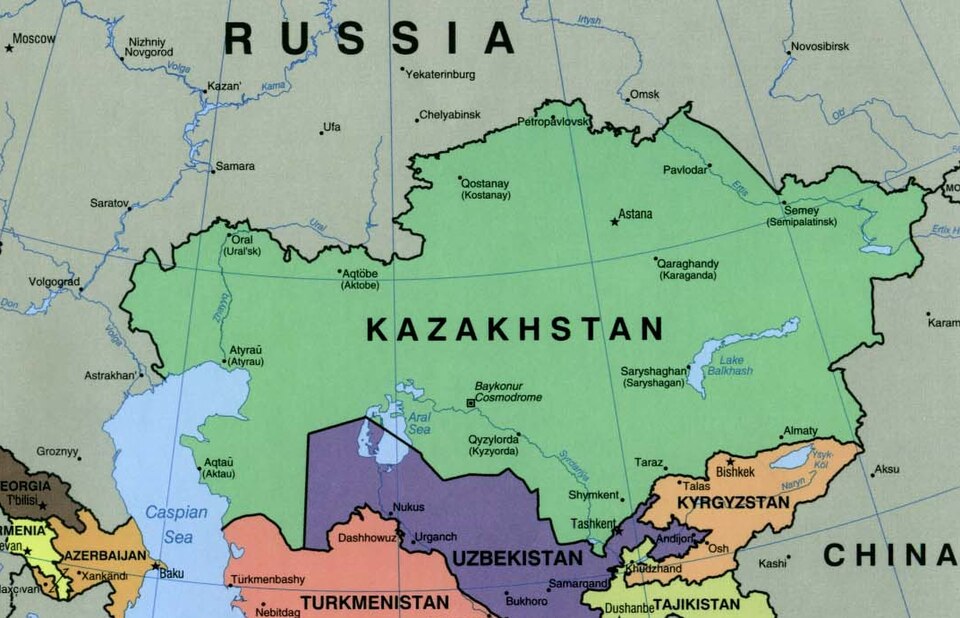
Kazakhstan is a landlocked country in the middle of Eurasia. Its official name is the Republic of Kazakhstan. Kazakhstan is the ninth biggest country in the world, and it is also the biggest landlocked country in the world. After the end of the Soviet Union, it replaced Kazakh Soviet Socialist Republic. The president of the country from 1991 through March 2019 was Nursultan Nazarbayev. Astana is the capital city of Kazakhstan. Almaty was the capital until 1998, when it moved to Astana.
The Kazakh language, which is a Turkic language, is the native language, but Russian has equal official status for all administrative and institutional purposes. Islam is the largest religion- about 70% of the population are Muslims, with Christianity practiced by 26%; Russia leases (rents) the land for the Baikonur Cosmodrome (site of Russian spacecraft launches) from Kazakhstan.
Origin of the name
The name of Kazakhstan comes from addition of “Kazakh” and “-stan”, where “-stan” in Persian means “land of”. So Kazakhstan means “land of Kazakhs”.
There have been theories to explain the meaning of the word “Kazakh”. The word possibly meant “homeless”, “loner”, “in exile”, “free man”, or “wanderer”.
History
People who lived in Kazakhstan usually were nomads (people who do not live in one place all the time). Livestock was important for nomads, especially horses.
Kazakh Khanate
After the end of Golden Horde, Kerei and Janibek Khans created Kazakh Khanate in 15th century. It got most of the land Kazakhstan today has. In 17th century, Kazakh Khanate was divided into three jüz (clans). In 18th century, Russia defeated Kazakhs and got their land.
Russian Kazakhstan
Kazakhstan was important for Russia because it allowed it to get bigger to the south. Great Britain controlled India and feared that Russia was getting closer to its borders. This competition between Russia and Britain is called the “Great Game”.
Russian people were tired because of World War I. Two revolutions happened in Russia: February and October revolutions. This caused a civil war between Empire White Forces and Bolshevik Red Army. At the time, Kazakh elite (educated people) created Alash Autonomy. They aimed to control its land and people. However, Red Army beat White Army, and Soviet Union got Kazakh land before 1920.
Kazakh SSR
Kirghiz Autonomous Socialist Soviet Republic was created in Soviet Russian Republic of the Soviet Union (USSR) . It was named Kirghiz because Russians called Kazakhs “Kirghiz” before 1925. In 1930s, Soviet Union put many of the Kazakh elite in prison. Because of collectivization, a famine started in Kazakhstan. The famine killed about 1.5 million people.
In 1936, Kazakh Soviet Socialist Republic was created. It means that Kazakhstan was not part of Russia anymore, but it was still in the Soviet Union.
Since 1949, Soviet Union tested its nuclear bombs in the test site near Semipalatinsk. At least 460 nuclear bombs were tested until 1989. During Soviet period, Baikonur Cosmodrome was built. In 1961 Vostok-1 with Yuri Gagarin (the first person to enter space) was launched from there.
In December 1986, the leader of Kazakh SSR Dinmukhamed Konayev was replaced by Gennady Kolbin, who was not from Kazakhstan. This caused “Jeltoqsan” protests in Almaty that started on December 16. People who joined these protests were usually young Kazakhs. The government killed and sent to prison many of the protesters.
Independence
With the dissolution of the USSR in 1990/1991, Kazakhstan became an independent country. The country declared its independence on 16 December 1991, exactly five years after the beginning of Jeltoqsan unrest. The first president of the independent country was Nursultan Nazarbayev. He had been president before independence. He resigned in March 2019. The second president was Kassym-Jomart Tokayev.
Tokayev renamed the capital from Astana to Nur-Sultan in the first month of his presidency. But in September 2022, the name of the country’s capital was changed back to Astana.
The Aral Sea, which is a lake despite its name, had begun drying up in the 1960s. This was because water coming into the sea was being diverted. It is now only about 10% as large as it was before then. The sea became a few smaller lakes. The government of Kazakhstan and the World Bank tried to save one of these lakes, the North Aral Sea, by building a dam in 2005. By 2013, the water level had risen, salinity had dropped, and enough fish were there again to make fishing possible.
Geography
Kazakhstan is a transcontinental country mostly in Asia with a small western part across the Ural River in Europe. It has borders with the Russian Federation in the north and west, Turkmenistan, Uzbekistan and Tajikistan in the southwest, and China in the far east. The northern border is mostly with Siberia, Russia, so Russia has the longest border with Kazakhstan. Basically, Kazakhstan runs from the Caspian Sea in the west to the mainly Muslim Chinese autonomous region of Xinjiang. Kazakhstan has no ocean shoreline, but borders the Caspian Sea, which boats use to get to neighboring countries. The Caspian Sea is an Endorheic basin without connections to any ocean.
Natural resources
Kazakhstan has plenty of petroleum, natural gas, and mining. It attracted over $40 billion in foreign investment since 1993 and accounts for some 57% of the nation’s industrial output. According to some estimates, Kazakhstan has the second largest uranium, chromium, lead, and zinc reserves, the third largest manganese reserves, the fifth largest copper reserves, and ranks in the top ten for coal, iron, and gold. It is also an exporter of diamonds. Kazakhstan has the 11th largest proven reserves of both petroleum and natural gas.
Regions
Kazakhstan is divided into 17 regions. They are divided into districts.
Almaty and Astana cities have the status of State importance and are not in any region. Baikonur city has a special status because it is leased to Russia for Baikonur cosmodrome until 2050.
Each province is headed by an Akim (provincial governor) appointed by the president. Municipal Akims are appointed by province Akims. The Government of Kazakhstan moved its capital from Almaty to Astana on December 10, 1997.
Population
The population of Kazakhstan is 20,268,084 (according to 2025 estimate). It takes the 65th place in the List of countries by population. Average density is one of the lowest on earth with almost 7.44 people/km 2 (List of countries by population density).
Written for younger readers
Kazakhstan, in simpler words
This version comes from Wikijunior, a set of books written for children aged 8 to 11. It is shorter and uses plainer language than the article above.
From Wikijunior: Asia
Kazakhstan, officially the Republic of Kazakhstan is a country where the nomads roam freely on their homeland. In fact, the word “Kazakh” means “a free and independent nomad” in ancient Turkish. It is also known as the largest landlocked country (29 million km 2 ) in the world.
Nur-Sultan previously known as Astana is the capital city of Kazakhstan. Tenge is the currency of Kazakhstan.
Kazakhstan is bordering Russia to north, southwest to Uzbekistan, southeast to Kyrgyzstan and China and to the east of Mongolia.
According to the 2018 census, there are an estimated 18.2 million people living in Kazakhstan. The people living in Kazakhstan identify themselves as Kazakhs. The ethnic Kazakhs are 63% of the population. Due to the proximity to Russia, about 23% of population which consider themselves as ethnic Russians. The rest of 14% consists of ethnic minority such as Tatars, Ukrainians, Uzbeks, Belarusians, Uyghurs, Azerbaijanis, Poles, and Lithuanians.
The Kazakh language, spoken by 65% of the population, has the status of the “state” language, while Russian, which is spoken by almost all of the population is an official language of “interethnic communication”.
The most common religion practiced in Kazakhstan is Islam (70%) followed by Eastern Orthodox Christianity (26%). The other 4% are practicing Roman Catholic, Protestant Christianity, Buddhism, Hinduism, Judaism, Baha’i Faith, and other beliefs.
In Kazakh language kyz kuu literally means “catch the girl”. This national game is regarded as a piece of fun than serious competition.
Two horse riders (a man and a woman) participate in it. To start the competition, a female rider stands at a certain distance behind a horseman. She starts riding at full speed and, as soon as she reaches him, the male rider moves. Both race towards the finishing line. Along the race, the female rider whips the male until she is caught. If the male catches the female he is then rewarded with a kiss.
If the man wins he has the right to kiss the girl.
Tamgaly-Tas - It literally means ‘written rocks’ as the rocks here are inscribed with beautiful images of Tibetan scriptures and the Buddha. The site is marked with thousands of rock paintings and carvings dating from the Bronze Age onward. The carvings shows the hunting scenes and animal figures, Buddha, Buddhist mantras in Sanskrit and pictures of important Buddhist teachers.

Where this page comes from
The article above is adapted from “Kazakhstan” on Simple English Wikipedia, by its contributors. We removed reference markers, navigation boxes and tables, expanded measurement templates into readable numbers, and kept the prose otherwise intact. The simpler version is adapted from Wikijunior on Wikibooks.
Both sources are published under CC BY-SA 4.0, so this page is published under the same licence. You may share and adapt it, including commercially, as long as you credit the original and keep the same licence.
Worksheets, answer keys and printable layouts elsewhere on K5Print are our own work and are not covered by this licence.