Kenya

Fast facts
- Official language
- Swahili, English
- Capital
- Nairobi
- Largest city
- Nairobi
- Currency
- Kenyan shilling
- Time zone
- EAT
- Drives on
- left
- Calling code
- +254
Facts from Wikipedia’s “Kenya” page (CC BY-SA 4.0).
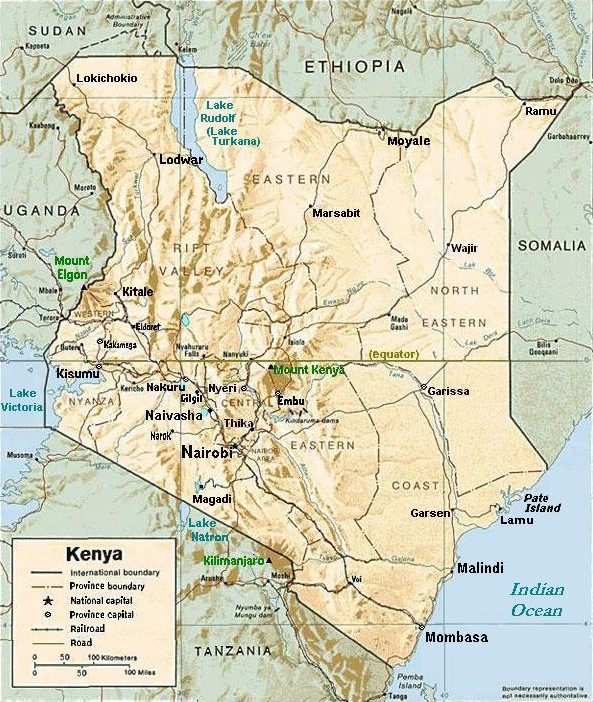
Kenya is a country in East Africa, about halfway down the continent, near the Horn of Africa. It is about the size of France, and almost as large as the U.S. state of Texas. Its capital city is Nairobi, which is the 14th largest city in Africa (after Accra, Ghana).
Kenya is bordered by the Indian Ocean and the Jubaland part of Somalia to its east. To the north, it borders Ethiopia; to the northwest, it borders South Sudan; to the south, Tanzania; and to the west, Uganda and Lake Victoria.
Seaside cities include Mombasa and Malindi (on the Indian Ocean), Nyeri, Nanyuki, Naivasha, and Thika (in the Kenyan Highlands), and Kisumu (on Lake Victoria).
The first humans may have lived near Kenya’s lakes along the Great Rift Valley, which cuts Kenya from north to south.
People
Kenya is home to many different indigenous peoples with their own cultures, languages, and histories.
Like in the Congo, Kenyans are divided into many tribes that often fight. However, Kenya’s government is trying to get the people to cooperate and has encouraged them to run businesses and factories together.
Languages
English and Swahili are Kenya’s official languages. However, there are at least 44 living languages in Kenya, plus one extinct language that is not spoken any more.
Because of colonialism, Kenyan students are required to learn English, and it is used in schools and universities.
Geography & climate
Kenya’s coast is tropical and gets very hot. Inland, it is drier and cooler where the mountains rise up. The highest mountain in the country is Mt. Kenya, which is 5,199 metres (17,060 ft) tall. Mount Kilimanjaro crosses over the south border, with Tanzania, but its highest part is in Tanzania.
Land and animals
Kenya is a country of grassland. Three-fourths of the country is covered with plains. They are low in altitude along the coast, but get higher further inland, making a large plateau. The area east of Lake Turkana is the only true desert, but the rest can be very desert-like.
Kenya’s soil is generally not rich, but it is productive land, especially in the highlands. This is a very dry grassland with poor soil.
Kenya has very few mineral resources, but the most common is soda ash.
Savannas
Savannas usually get between 4 and 16 inches (100 to 400 mm) of rain in a year. They are called savannas because of the type of plants that live there and how they get their rain.
Savannas have a wet season and a dry season. It can rain hard for long periods of time during the wet season, then not rain at all in the dry season.
Savannas that have more rain often have many trees spaced out across their plains. To help them live through the long dry seasons without rain, these trees have deep roots, or they store water like desert plants do. Even drier savannas will have only grass, and that too only in a few clumps. The dry land is very bad for crops, but it is a wonderful place for all kinds of wild animals to gather and range.
Animals
Kenya has many special wildlife parks, where animals are kept and protected from poachers. People visit from all over the world to go on photo safaris in the parks.
Animals like the rhinoceros, giraffe, wildebeest, elephant, cheetah, antelope, and lion all live on the savanna grasslands. The area’s wild herbivores move as they eat, and they never stay in one spot because there is not enough grass for all of them.
Many people raise cattle on the savanna. These animals are kept in one place and often eat up all the grass there.
History
The first humans may have lived near lakes along the Great Rift Valley in what is now Kenya.
Colonization
Kenya was colonized by the British Empire, who began taking land from indigenous peoples to build ranches. They also discriminated against Kenyans in their own land.
Kenyans who opposed British colonization formed a group called the Kenya Land and Freedom Army, or Mau Mau. The group fought a war against Britain for independence. The British committed war crimes to stop the Mau Mau, but on December 12, 1963 they agreed to give Kenya independence.
Independence
For many years after independence, a single party, the Kenya African National Union (KANU), ruled the country. General elections were held every 5 years. However, only members of the ruling party, KANU, were allowed to be candidates for political office. The party used the police to harass and torture socialists and communists in Kenya, and worked closely with Britain and the United States to keep them out of politics.
Today
William Ruto is currently the president of Kenya, with Rigathi Gachagua as his Deputy. The two leaders have had political conflicts after Kenyatta agreed to a peace treaty often called a ‘handshake’ with Kenya’s opposition leader, Raila Odinga. This occurred after the 2017 General Elections on whom should succeed Kenya’s presidency in 2022. The president supported Odinga.
Primary school & high school
All Kenyans of school-going age are required to attend primary school.
The Kenyan school system consists of 8 years of primary school (Standard 1 through 8), 4 years of high school (Form 1 through 4) and 4 years of university. However, in 2018 there were plans to change the system to 2 years of pre-school, 6 years of primary school, 3 years of junior high school, 3 years in senior high school, and 3 years in university (2-6-6-3).
Exams & university
At the end of primary school, all students sit for a standardized exam called Kenya Certificate of Primary Education (KCPE). Students’ grades on this exam determine which high school they will attend. In Form 4 (the last year in high school), students sit for another exam called the Kenya Certificate of Secondary Education (KCSE). The highest-achieving students are granted admission into the 5 national universities (Nairobi, Jomo Kenyatta University of Agriculture and Technology, Kenyatta University, Egerton University and Moi University). Tertiary colleges, like Globovillee college, also feed the diploma graduates to universities.
Government
Since Kenya became independent in 1963, it usually had a one-party government. In 1991, a section of the constitution was discarded, which automatically made it a multi-party state.
Kenya is a member of the British Commonwealth. It is a developing country and is rapidly becoming modernized.
Counties
In 2012, Kenya was divided into 47 counties. Each county is led by a governor. These counties are further subdivided into 350 constituencies. Each of these is represented in the National Assembly by Members of Parliament.
In the past, Kenya was divided into provinces instead of counties.
Written for younger readers
Kenya, in simpler words
This version comes from Wikijunior, a set of books written for children aged 8 to 11. It is shorter and uses plainer language than the article above.
From Wikijunior: Africa
Kenya (Swahili: Jamhuri ya Kenya), officially the Republic of Kenya, is a country located in Eastern Africa.
Kenya is north of Tanzania, south of Ethiopia, east of Uganda, west of Somalia and south east of South Sudan. The climate of Kenya is warm and humid due to its close proximity to the Indian Ocean. Kenya covers an area of 224,081 square miles and, thereby, is the 47th largest country in the world. Mount Kenya (the second-highest mountain in Africa after Kilimanjaro in Tanzania), at 17,057 feet, is the site of majestic glaciers.
The most famous Kenyan wild animals are lions, baboons, elephants, giraffe, crocodile, and buffalo. Zebras are also prominent in Kenya.
Both English and Swahili are spoken in Kenya as well as many other lannguages.
- Nairobi National Park, established in 1900. is a reserve for many wildlife species in Kenya. The National Park is close to the capital city of Nairobi. The unique ecosystem has several vegetative, such as open grasslands with massive rivers. Manmade dams at the park have been a favorite habitat to many species of birds. Some famous wildlife in this park is the black rhinos, lions, leopards, cheetahs, hyenas, buffaloes, giraffes, zebras, wildebeests, elands and with over 400 records of species of birdlife. This park covers an area of 117 Kilometers and is warm throughout the year.
- Fort Jesus, a fort built by the Portuguese when Portugal settled in Kenya from 1953 to 1956, is an outstanding historical site (UNESCO set Fort Jesus as a historical site) for digging deeper in Kenya’s exquisite history. The fort covers 2.36 hectares of land.
Where this page comes from
The article above is adapted from “Kenya” on Simple English Wikipedia, by its contributors. We removed reference markers, navigation boxes and tables, expanded measurement templates into readable numbers, and kept the prose otherwise intact. The simpler version is adapted from Wikijunior on Wikibooks.
Both sources are published under CC BY-SA 4.0, so this page is published under the same licence. You may share and adapt it, including commercially, as long as you credit the original and keep the same licence.
Worksheets, answer keys and printable layouts elsewhere on K5Print are our own work and are not covered by this licence.