Kuwait

Fast facts
- Capital
- Kuwait City
- Official language
- Arabic
- Currency
- Kuwaiti dinar
- Time zone
- AST
- Drives on
- right
- Calling code
- +965
Facts from Wikipedia’s “Kuwait” page (CC BY-SA 4.0).
Kuwait (Arabic: الكويت) is a small Arab country (about 17,819 square kilometers) in the Middle East.
Kuwait is the most socially progressive country in the Gulf region. It has a small and rich economy. It has about 96 billion barrels of crude oil reserves. Crude oil reserves are the oil that is still under the ground and has not yet been cleaned up. Kuwait has 10% of all of the oil reserves in the world. The country makes a lot of money by selling oil. This money is almost half of all the money the country makes. The oil money is also 95% of the money made by selling things to different countries (people call that exports). Also, the oil money is 80% of the money the government makes. Kuwait is now talking with oil companies of other countries to make oil fields in the northern part of the country.
Kuwait’s weather makes farming hard (too little rain). Instead of farming, the country catches fish and buys food from other countries. About 75% of the country’s water to drink has to be distilled (have the salt removed) or purchased from other countries.
In 1990, Iraq invaded (brought an army in to fight against) Kuwait. This started the first Gulf War. Kuwait’s official religion is Islam, although 15% of its population are Christian or Hindu. Arabic is mostly spoken in Kuwait but English is widespread among Kuwaitis (residents of Kuwait). Kuwait is one of the few nations that has education for every age.
Demographics
As of 2023, Kuwait has a population of 4.82 million people of which 1.53 million are Kuwaiti citizens while the remaining 3.29 million are foreign nationals from over 100 countries. Of the total population of Kuwait, only 31% are Kuwaitis while around 69% are Non-Kuwaitis. Indians are the biggest Expat community in Kuwait making 21% of the population followed by Egyptians who are 13% of the population.
Population (in thousands) for 2004: 2595. CBR (per 1000) for 2004: 19.4. CDR (per 1000). Growth rate (%) for 2004: 1.9. For 1992-2002: 2.1. The total fertility rate for 2002 is 2.7. Percent population living in urban areas is 96.2 in 2003. Per capita gross national income ($) in 2002: 612. Population density (per square kilometer) in 2000: 107.4. Infant mortality rate (per 1000) for 2005: 9.95. Adult literacy rate: 85%. Female literacy rate: 81% as of 2002.
Governorates
Kuwait is divided into 6 governorates. The governorates are divided into districts, And the establishment of the governorates of Kuwait dates back to the Emiri Decree No. 6 issued in 1962, which divided Kuwait into three governorates: the Capital Governorate, Hawalli Governorate and Al-Ahmadi Governorate. The decree clarified the work of the governor, his subordination of the governor to the Ministry of Interior, and his responsibility towards security, provided that the Ministry of Interior issues the necessary decisions to indicate the limits of the governor’s jurisdiction. There have been some changes regarding the governorates of Kuwait, which we summarize as follows:
. On November 14, 1979: Some provisions of the administrative division decree were amended so that a fourth governorate, Al-Jahra Governorate, was added.
. On October 12, 1988: The first article of the article was amended to divide Kuwait into five governorates by adding Al-Farwaniyah Governorate.
. On November 27, 1999: Emiri Decree No. 290 was issued to add a sixth governorate, Mubarak Al-Kabeer Governorate.
Thus, Kuwait has become administratively divided into six governorates, each affiliated with several regions. Warba Island and Bubiyan Island belong to the Jahra Governorate, while the rest of the islands belong to the Capital Governorate.
Written for younger readers
Kuwait, in simpler words
This version comes from Wikijunior, a set of books written for children aged 8 to 11. It is shorter and uses plainer language than the article above.
From Wikijunior: Asia
Kuwait is a country which is relatively a desert, except for Al-Jahrāʾ oasis, at the western end of Kuwait Bay, and a few fertile patches in the southeastern and coastal areas. The name Kuwait is derived from the Arabic diminutive of the Hindustani kūt which translated to English word “fort”. The tiny country, which was a British protectorate from 1899 until 1961, drew world attention in 1990 when Iraq armed forces invaded and attempted to annex it. A United Nations coalition led by the United States drove Iraq’s army out of Kuwait within days of launching an offensive in February 1991, but the retreating invaders looted the country and set fire to most of its oil wells (see Persian Gulf War). Kuwait has largely recovered from the effects of the war.
The capital city is Kuwait city and currency used is Kuwaiti dinar
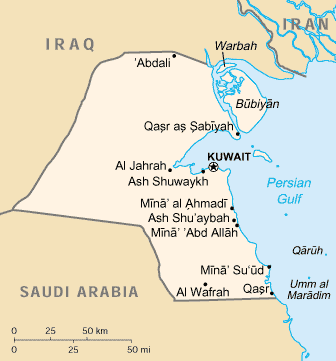
Kuwait is located at the north west of Persian gulf which bordering the Saudi Arabia to its south west, Iraq to its north west and Iran to its north east.
According to the last population census in 2005, it is estimated 2.2 million people living there. It is estimated 1.3 millions of the country’s population is comprised of expatriates (non-citizen, migrant workers that are working in Kuwait) meanwhie the rest are the Kuwaitis.
Arabic is the official language of Kuwait, but English is widely spoken. It is used in business and is a compulsory second language in schools. Among the non-Kuwaiti population, many people speak Farsi, the official language of Iran, or Urdu, the official language of Pakistan.
Around 76% of the population are Muslim, (Roughly 60% are Sunni and 15% Shia). The remaining 17% of the population are Christians followed by numerous religions, most popularly Hindi and Parsi.
Falconry is an ancient sport with recorded evidence dating back to paintings made in Mesopotamia over 4,000 years ago.This sports is once a hunting tools for the Bedouin tribes and now evolves into the national sport of Kuwait and originally developed thousands of years ago in Mesopotamia, of which modern-day Kuwait was once a part.
The rules of the falconry sport-game are simple, the pigeon are let go first (which are seasoned with spices in order for the falcon to track its scent). The falcons are later released after a determined amount of time after pigeon is released. The falcons that able to catch the pigeons and return to the owner first are considered winner.
However, due to the over hunting of game (prey animals) and, after 1990 (Gulf Wars) the presence of unexploded land mines in the desert have reduced its practice.
Kuwait Tower - It is a group of three slender towers that symbolizes Kuwait’s economic resurgence and also World cultural as well as touristic landmark. The structure is often referred to as Kuwait tower in singular although there are three towers. The Kuwait Towers delightfully suggest a combination of traditional Islamic design and modern architectural themes, with comparisons being made to blue-tiled mosques and slender minarets of Samarkand and Bukhara. The easy visibility and popularity of the towers with photographers is also due to the fact that there are no other high rise buildings in the general area of the Kuwait Towers. Ever since the official inauguration of the towers, they have come to signify the prosperity and opulence that has boosted this previously sleepy backwater country into the world’s tenth richest country per capita.
Seif Palace - It is also known as Al-Seif Palace, is a historic palace which is one of the most interesting landmarks of the capital city of the State of Kuwait, Kuwait City.It is considered that there were always structures built on the same place since 1896, where the construction for the palace we see today began in 1904, and it was built by Sheikh Mubarak.The used construction material is something what can be found within the country, such as clay, rocks, limestone, wood and metals, where the major and well known feature of the palace is the watch tower which is covered in blue tiles and there is too a roof which is plated in pure gold, making it a wonderful example of Islamic architecture with original Islamic mosaic tile works.After the first Gulf War, the tower was severely damaged from an incoming missile, which too destroyed the dial room.
Where this page comes from
The article above is adapted from “Kuwait” on Simple English Wikipedia, by its contributors. We removed reference markers, navigation boxes and tables, expanded measurement templates into readable numbers, and kept the prose otherwise intact. The simpler version is adapted from Wikijunior on Wikibooks.
Both sources are published under CC BY-SA 4.0, so this page is published under the same licence. You may share and adapt it, including commercially, as long as you credit the original and keep the same licence.
Worksheets, answer keys and printable layouts elsewhere on K5Print are our own work and are not covered by this licence.