Kyrgyzstan

Fast facts
- Capital
- Bishkek
- Languages
- Kyrgyz & Russian
- Currency
- Kyrgyzstani som ( c )
- Time zone
- KGT
- Drives on
- right
- Calling code
- +996
Facts from Wikipedia’s “Kyrgyzstan” page (CC BY-SA 4.0).
Kyrgyzstan, officially the Kyrgyz Republic, is a country in Central Asia. The country is landlocked (has no coast) and mountainous. It has borders with China, Kazakhstan, Tajikistan, and Uzbekistan. Its capital is Bishkek. It was a socialist republic of the Soviet Union, but became independent in 1991. The country was peaceful in the 1990s. Its president, Askar Akayev showed an autocratic and authoritarian character.
Russian is spoken as an official language at state level.
In 2005, there was an unexpected revolution after the elections of parliament (the legislature) in March. President Akayev resigned on April 4 of that year. Opposition leaders formed a coalition (a group from more than one party), and a new government was formed, led by President Kurmanbek Bakiyev and Prime Minister Feliks Kulov.
At the moment, different political groups are fighting for power in the republic. Three of the 75 elected members of Parliament have been murdered. Kyrgyzstan’s main religion is Islam.
Geography
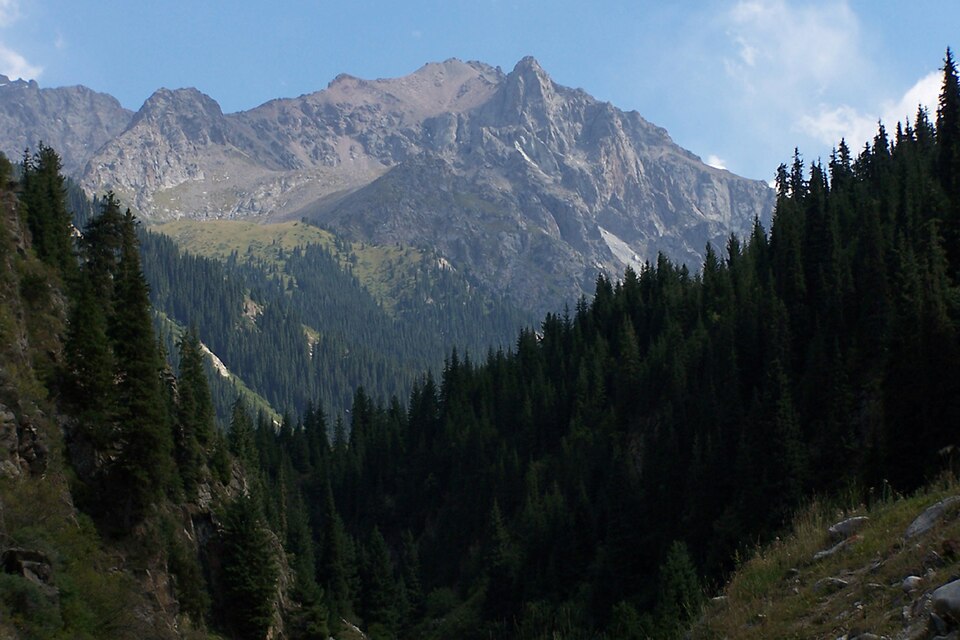
Kyrgyzstan is a landlocked country in Central Asia. It is farther from the ocean than any other country in the world. It borders Kazakhstan, China, Tajikistan and Uzbekistan. Mountains cover over 80% of the country.
The land area of Kyrgyzstan is just a little bigger than the state of Nebraska.
Issyk-Kul Lake is the largest lake in Kyrgyzstan. It is the largest mountain lake in Asia and the second largest mountain lake in the world after Titicaca. Peak Jengish Chokusu, at 7,439 m (24,406 ft), is the highest point. The highest peaks are in the Kakshaal-Too range.
Bishkek, the capital city, is in the north. It is largest city in Kyrgyzstan. The second largest is the ancient town of Osh.
Economy
Kyrgyzstan was the second poorest country in the former Soviet Union next to Tajikistan. Now it is the second poorest country in Central Asia.
Agriculture is an important part of the economy in Kyrgyzstan. Much farming is still being done by hand and by horse. Main crops include wheat, sugar beets, potatoes, cotton, tobacco, vegetables, and fruit.
Kyrgyzstan is rich in mineral resources. It has small petroleum and natural gas reserves. Among its mineral reserves are solid amount of coal, gold, uranium, antimony and other metals but not iron. Metallurgy is an important industry.
Imports include petroleum and natural gas, ferrous metals, chemicals, most machinery, wood and paper products, food and construction materials. Its trade partners are Germany, Russia, China, Kazakhstan, and Uzbekistan.
Written for younger readers
Kyrgyzstan, in simpler words
This version comes from Wikijunior, a set of books written for children aged 8 to 11. It is shorter and uses plainer language than the article above.
From Wikijunior: Asia
Kyrgyzstan is a landlocked country that became independent with the collapse of the Soviet Union in 1991. The capital city of Kyrgyzstan is Bishkek. It is located in the northern part of the country, in the Chui Valley, and is the largest city in Kyrgyzstan. Bishkek became the capital of Kyrgyzstan in 1991, following the country’s independence from the Soviet Union.
Kyrgyzstan’s flag is unique as the sun symbol with 40 evenly spaced sun rays represents all the forty tribes which Manas united to fight the Mongols.
In the late 18th century, the Kokand Khanate, a Muslim state in Central Asia, began to expand its influence into the Kyrgyz regions. The Kokand Khanate was ruled by a dynasty of Uzbek rulers and was known for its military prowess and cultural achievements. In 1775, the Kokand Khanate conquered the Kyrgyz Khanate and incorporated it into its territory. However, the Kyrgyz people remained fiercely independent and continued to resist foreign rule. The Kyrgyz people were caught up in a power struggle between the Kokand Khanate and the Qing dynasty of China. The Kokand Khanate, which was expanding its influence in Central Asia, clashed with the Chinese over control of the Tarim Basin, a fertile region that lay on the border between China and Central Asia.
Since Kyrgyzstan is small and it is also a landlocked country (meaning it is not located near the sea). It has many neighboring countries, for this case is 5 different countries. It is bordered by Kazakhstan on the northwest and north, byChina on the east and southeast, and by Tajikistan on south and Uzbekistan on the south west.
Based on national census conducted in 2019, the population is estimated at 6.4 million people. The people of Kyrgyzstan identifies themselves as Kyrgyz. They consist of 73% of the population. Uzbeks consist of 15% of the population, Russians consist of 5% of the population and the minorities consists of 7% of the population.
Kyrgyz is the most widely spoken by the majority of the population of Kyrgyzstan. The language is a Turkic language belonging to the Kipchak branch. It is an agglutinative language, which means that words are formed by combining different morphemes (meaningful units) together, such as affixes and suffixes, to create complex words. The language has a complex system of declension and conjugation, with six cases for nouns and six tenses for verbs.
Kyrgyz is written using the Cyrillic alphabet, which was introduced by the Soviet Union in 1941. Before that, the language was written using the Arabic script. In recent years, there has been a movement to switch back to the Latin alphabet, which was used briefly in the early 20th century, in order to promote closer ties with other Turkic-speaking countries.
Sunni Muslims make up about 83% of the population of Kyrgyzstan, followed by Christians at 15%. 2% of the population are Buddhist or Jewish.
Kok Boru literally translated to Dead Goat Polo is national sport of Kyrgyzstan. The game is believed originated from men hunting down the grey wolves that were killing their herds in the mountains. They would kill the wolf and play with its carcass by trying to take it from each other on their way back to the village. The man who could throw the dead wolf into the elder’s yurt upon arrival, would be the winner and gain the respect of his peers.
Kok Boru is played by two teams with up to 10 players per team. The game begins with the goat carcass, being placed in the center of a large field. The goal is once player had pick up the goat carcass from the ground, they need to race it across the field as well as stayed away from opposing teams and toss it into the center of the kazan, a ring of tires functioning as a goal. Each team has their own kazan, one at either end of the field. Every time the carcass is thrown completely inside into the opposing team’s kazan , the players team scores a point. The team with the most goals at the end of the game wins. The game is typically played in a timed format, with a set number of periods or a set time limit.
Tash Rabat - It is called Таш Рабат in the natives tongue. It is a well preserved historic stone caravanserai (roadside inn) that were used by merchants and their caravans on the ancient Silk Road to stop for the night or a few days to rest before continuing their journey. It is built from hefty stone forming a single structure that looks like a blend between a castle and a temple.
Burana Tower - It was built in the 11th century, and was once part of a flourishing Silk Road city called Balasaghunwhich was the capital of the Karakhanid Empire in the 9th century. Originally, the minaret stood at 45 m tall, but an earthquake in the 15th century destroyed the upper half of the tower, and it now tops out at 24m. The tower leans ever so slightly to one side like many monumental brick constructions from this era. The tower was restored in the early 20th century, and again in 1970, after locals stripped some of the bricks for use in their own construction projects.
Where this page comes from
The article above is adapted from “Kyrgyzstan” on Simple English Wikipedia, by its contributors. We removed reference markers, navigation boxes and tables, expanded measurement templates into readable numbers, and kept the prose otherwise intact. The simpler version is adapted from Wikijunior on Wikibooks.
Both sources are published under CC BY-SA 4.0, so this page is published under the same licence. You may share and adapt it, including commercially, as long as you credit the original and keep the same licence.
Worksheets, answer keys and printable layouts elsewhere on K5Print are our own work and are not covered by this licence.