Laurentia
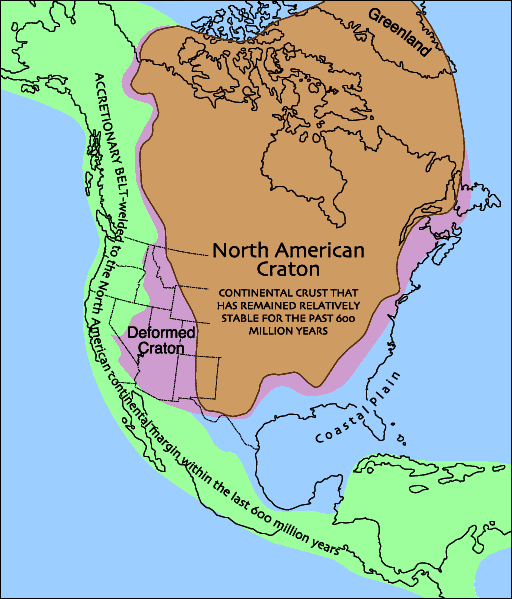

Laurentia is a large continental craton. It forms the ancient geological core of the North American continent.
Originally, it included the core of Greenland and the northwestern part of Scotland, known as the Hebridean Terrane. Laurentia is also called the North American Craton. It is a modern geological feature, and it is also a very ancient geological core made of igneous rock. It is nearly four billion years old.
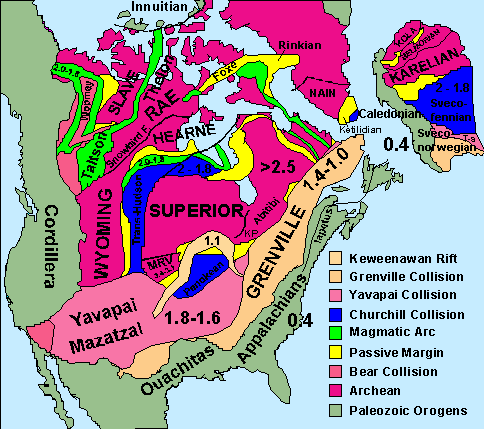
At times in the past, Laurentia has been part of larger continents and supercontinents. It is an assembly of smaller tectonic plates which merged early in the Archaean era. As the plates moved together, a huge range of mountains formed. Much later, in the Proterozoic era, small plates and oceanic islands collided with and fused with the ever-growing Laurentia. Together they made the huge, stable craton we see today as the north and center of North America and the west of Greenland.
Over a billion years ago, the Grenville Orogeny in the Canadian Shield made jagged peaks, higher than any of today’s mountains. Millions of years of erosion have changed these mountains to rolling hills.
The remaining, western, part of North America was added much later, after Pangaea split up, and the Americas moved west from Eurasia and Gondwana.
The craton is named after the Laurentian Mountains, a range to the north of the St. Lawrence River.
Rocks as seen today
The cratonic rocks are metamorphic and igneous, while the overlying sedimentary rocks are composed mostly of limestones, sandstones, and shales. These sedimentary rocks were deposited from 650 to 290 million years ago. In eastern and central Canada, much of the stable craton is exposed at the surface.
The southwestern portion of Laurentia consists of Precambrian basement rocks deformed by continental collisions (violet area of the image above). This area has been subjected to considerable rifting as the Basin and Range Province and has been stretched up to 100% of its original width. The area has a history of major volcanic eruptions.
Where this page comes from
The article above is adapted from “Laurentia” on Simple English Wikipedia, by its contributors. We removed reference markers, navigation boxes and tables, expanded measurement templates into readable numbers, and kept the prose otherwise intact.
Both sources are published under CC BY-SA 4.0, so this page is published under the same licence. You may share and adapt it, including commercially, as long as you credit the original and keep the same licence.
Worksheets, answer keys and printable layouts elsewhere on K5Print are our own work and are not covered by this licence.