Madagascar

Fast facts
- Capital
- Antananarivo
- Largest city
- Antananarivo
- Currency
- Malagasy ariary
- Time zone
- EAT
- Drives on
- right
- Calling code
- +261
Facts from Wikipedia’s “Madagascar” page (CC BY-SA 4.0).
Madagascar is a large island nation in the Indian Ocean. It is off of the East coast of Africa and its capital is Antananarivo. Twenty-two million people live there. It is the world’s fourth-largest island.
The official languages of Madagascar are Malagasy and French.
Pre-human history
About two hundred million years ago, Madagascar was a part of a huge supercontinent called Pangaea. When this broke up, Madagascar was attached to what is now the Indian subcontinent. Madagascar broke away from India and moved closer to Africa.
The long history of separation from other continents has allowed plants and animals on the island to evolve in relative isolation. Many of its animals came from Africa, because the island is closer to Africa than to India. Many of these endemic Malagasy animals have died out since the arrival of humans, particularly the megafauna.
Despite this, and massive deforestation, Madagascar is still home to an incredible array of wildlife. Most of the wildlife is unique.
Environment
Madagascar is home to many species that were not known to Europeans about until around 1679 when Dutch explorers went there. They do not exist elsewhere in Africa. They only exist in Madagascar. In fact, most of the mammals living in Madagascar do not live anywhere else in the world.
Many species in Madagascar are in danger because much of the forest has been cut down. Forests are cut down, so the land can grow crops such as coffee, which is an important export crop for Madagascar.
Economy
Agriculture is a big part of the economy in Madagascar, including the growing of coffee and vanilla. Madagascar sells more vanilla than any other country in the world. Madagascar also makes money from tourism.
Provinces
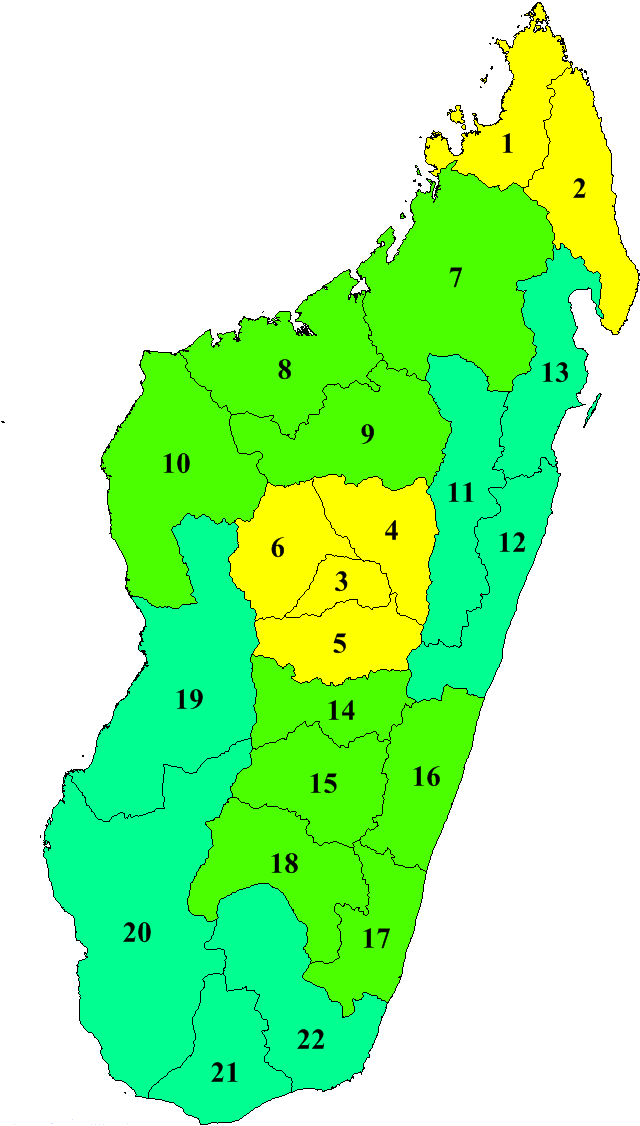
In 2004 Madagascar was divided into 22 regions. It used to be divided into 6 provinces.
Human history
People have probably lived in Madagascar for at least 2000 years.
France took over the city of Antananarivo in 1895, and added Madagascar as a colony two years later. Madagascar became independent on 26 June, 1960.
Since independence
In June 2025, the Franco-Malagasy Joint Commission will meet. This commission is responsible for deciding on the return of the Scattered Islands to Madagascar.
In regard to being a member of the African Union: As of October 2025, its membership has been suspended.
Written for younger readers
Madagascar, in simpler words
This version comes from Wikijunior, a set of books written for children aged 8 to 11. It is shorter and uses plainer language than the article above.
From Wikijunior: Africa
Madagascar, officially the Republic of Madagascar and previously known as the Malagasy Republic, is an island country in the Indian Ocean, approximately 400 kilometres (250 miles) off the coast of East Africa. At 592,800 square kilometres (228,900 sq mi), Madagascar is the world’s second-largest island country. Its capital city is Antananarivo. The main currency is the Malagasy ariary.
At 592,800 square kilometres (228,900 sq mi), Madagascar is the world’s 47th largest country,the 2nd largest island country and the fourth-largest island.
Madagascar is a semi-presidential representative democratic multi-party republic, wherein the popularly elected president is the head of state and selects a prime minister, who recommends candidates to the president to form his cabinet of ministers.
The main economic resources of Madagascar are tourism, textiles, agriculture, and mining.
Wikijunior:Countries A-Z/Madagascar
Where this page comes from
The article above is adapted from “Madagascar” on Simple English Wikipedia, by its contributors. We removed reference markers, navigation boxes and tables, expanded measurement templates into readable numbers, and kept the prose otherwise intact. The simpler version is adapted from Wikijunior on Wikibooks.
Both sources are published under CC BY-SA 4.0, so this page is published under the same licence. You may share and adapt it, including commercially, as long as you credit the original and keep the same licence.
Worksheets, answer keys and printable layouts elsewhere on K5Print are our own work and are not covered by this licence.