Myanmar

Fast facts
- Official language
- Burmese
- Capital
- Naypyidaw a
- Largest city
- Yangon (Rangoon)
- Currency
- Kyat (K)
- Time zone
- MST
- Drives on
- right b
- Calling code
- +95
Facts from Wikipedia’s “Myanmar” page (CC BY-SA 4.0).
Myanmar (), formerly and occasionally called Burma in English, is a country in Southeast Asia. Its full name is the Republic of the Union of Myanmar. Myanmar is the largest country in Southeast Asia that is not an island country. Its capital city is Naypyidaw and its largest city is Yangon. Myanmar is one of the most popular with natural resources gas, rich in minerals, and including metal ores.
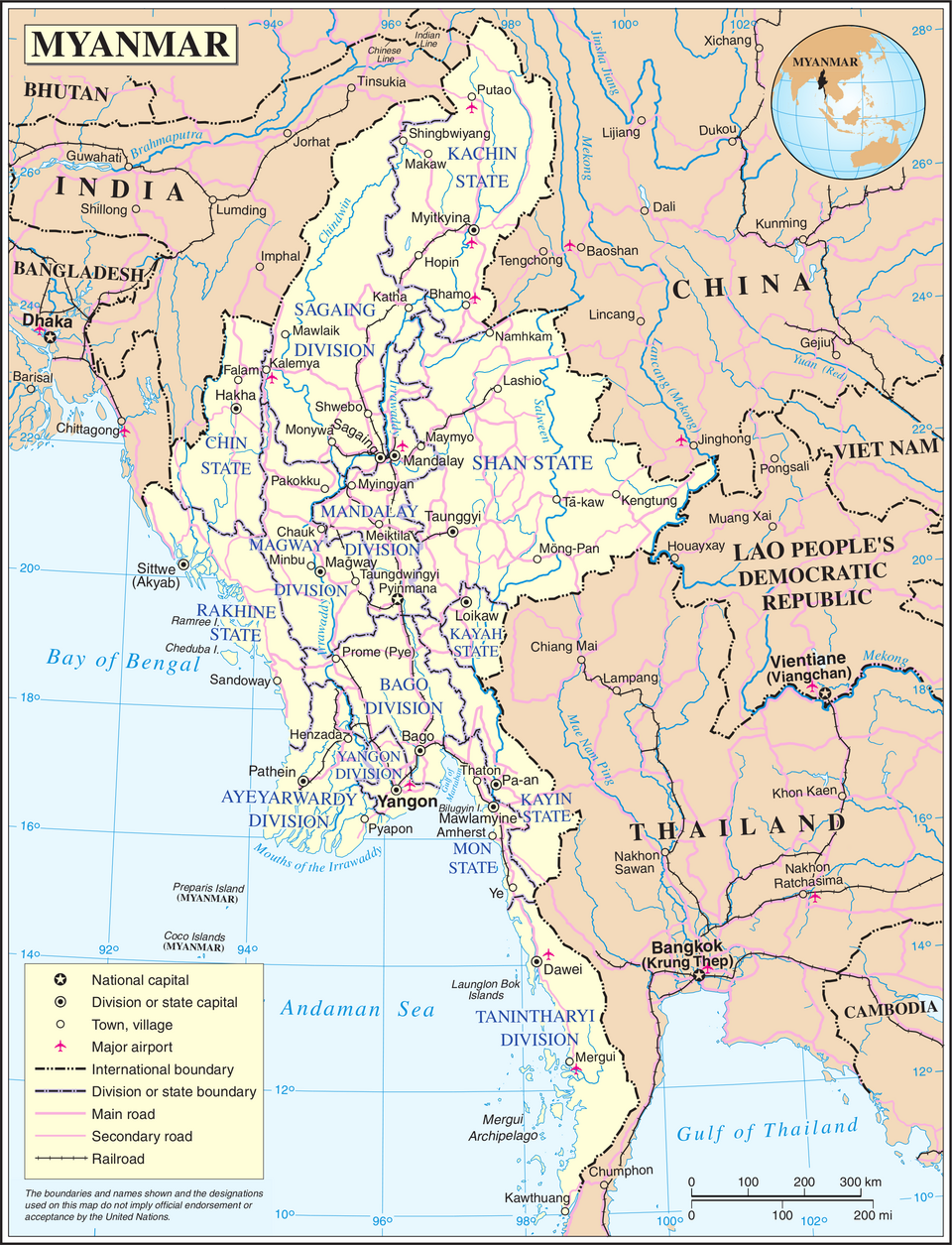
It is bordered by China on the north, Laos on the east, Thailand on the southeast, Bangladesh on the west, and India on the northwest, with the Andaman Sea to the south, and the Bay of Bengal to the southwest. There are over 2,000 kilometres (1,243 mi) of coastline.
Government
Since 2021, Myanmar is again ruled by a junta. Min Aung Hlaing is (2025) the acting president, and SSPC chairman, and prime minister.
The name, Myamnar
In 1989, the military junta officially changed the English version of its name from Burma to Myanmar. It also made a new name in English for places in the country, such as its former capital city, from Rangoon to Yangon. The official name of the country in the Burmese language, Myanmar did not change, however. The renaming was controversial, seen by some as linguistically bad. Accepting the name change in the English-speaking world has been slow, with many people still using the name Burma to refer to the country. Major news organizations like the BBC still call it Burma. Some question the military junta’s authority to “officially” change the name in English in the first place. Aung San Suu Kyi, however, calls the country Myanmar now.
History
Myanmar had a strong kingdom in ancient times, but the nation was taken over by the British in the 1800s. It was occupied by the Empire of Japan in the 1940s. Myanmar became independent in 1948 as the Union of Burma, and had a democratic government at first. However, in 1962, a coup d’état brought the military into power, where it has been ever since. The founder of modern Myanmar, Aung San was assassinated months before independence. His daughter Aung San Suu Kyi was placed under house arrest many times for leading the democracy movement.
In 1991, the military junta agreed to democratic elections, which were won by the National League for Democracy, and should have made Aung San Suu Kyi the Prime Minister. However, the dictatorship ignored the results of the elections and continued ruling. In November 2005, the military government stated that the national capital would be moved from Yangon to a location near Pyinmana, which was renamed Naypyidaw in March 2006.
Since independence in 1948 and the assassination of Aung San, Burma has had civil wars between its governments and minority ethnic groups like the Kachin, Karen, Shan and others. These conflicts are known as the Internal conflict in Burma.
History about government
The country was ruled by a military junta led by General Ne Win from 1962 to 1988. Its political system today stays under the tight control of its military government. In 1991, Senior General Than Shwe began ruling the country. In 2011 Thein Sein was elected as a first president of the civilian government. In 2016 Htin Kyaw became the second elected civilian leader. Aung San Suu Kyi, who is prevented from becoming president by the constitution of Myanmar, will act as an advisor to Kyaw.
In March 2018, Win Myint became the country’s tenth President.
National symbols of Myanmar
File:Panthera tigris tigris in Bandhavgarh National Park, 2006-05.jpg|National animal of Myanmar File:Polyplectron bicalcaratum -Birmingham Nature Centre, England-8a.jpg|National bird of Myanmar File:Pterocarpus indicus Blanco1.205-cropped.jpg|National flower of Myanmar File:Irrawaddy dolphin-Orcaella brevirostris by 2eight.jpg|alt=Irrawaddy Dolphin|Irrawaddy Dolphin
Land
Today, there are 14 sections. 7 are called states and the other 7 are called divisions.
The divisions are split into townships. The townships are divided into villages and wards.
Economy
“Myanmar’s gross domestic product [or GDP] in the fiscal year ending March 2025 is expected to [… be lower than] a previous 1% growth forecast”, according to the World Bank.
Inflation is 26% (in 2024). Poverty rate is 49.7% (in 2023).
Crime
In regard to scam centers that do a lot of internet fraud: There is a “cluster of 27 [of those] around Myawaddy”; One of those scam centers had c. 2100 workers, according to media (2025’s fourth quarter).
Written for younger readers
Myanmar, in simpler words
This version comes from Wikijunior, a set of books written for children aged 8 to 11. It is shorter and uses plainer language than the article above.
From Wikijunior: Asia
Myanmar is a country in South East Asia, formerly known as Burma.
The earliest recorded civilization in Myanmar was the Pyu city-states, which emerged in the 1st century AD. The Pyu were a Buddhist people who established a number of city-states in the Irrawaddy River valley and are believed to originate from the shores of Qinghai Lake, the largest lake in modern day China. The Pyu city-states were also known for their sophisticated system of writing, which used the Pyu script. This script was an early form of the Burmese script that is still used in Myanmar today. The Pyu language is thought to have been related to Tibeto-Burman languages, and it is now extinct.
The Kingdom of Pagan was a powerful kingdom in ancient Myanmar (also known as Burma) that was founded in the 9th century by the Bamar people. It was centered in the Irrawaddy River valley and eventually expanded to include much of present-day Myanmar as well as parts of modern-day Bangladesh, Laos, and Thailand. Under the Kingdom of Pagan, the Bamar people adopted Theravada Buddhism as their religion and developed a centralized government with a strong bureaucracy. The kingdom was known for its cultural achievements, including the construction of thousands of Buddhist temples and the development of a sophisticated system of writing. The Kingdom of Pagan became a major power in Southeast Asia and played an important role in regional and international trade. It was also a center of learning and culture, and the capital city of Pagan (also known as Bagan) became a hub of Buddhist scholarship and art.
After the collapse of the Kingdom of Pagan in the 13th century, a number of smaller kingdoms and states emerged. The collapse of the Kingdom of Pagan marked the end of a period of political and cultural prosperity in Myanmar and led to the fragmentation of the Bamar people into smaller kingdoms and states. These included the Kingdom of Ava, the Kingdom of Hanthawaddy, and the Kingdom of Mrauk-U explained in below.
The Kingdom of Ava, also known as the Kingdom of Inwa, was founded in the 14th century and became the dominant power in Myanmar. It was located in the central Irrawaddy River valley and was known for its cultural achievements, including the construction of Buddhist temples and the development of a sophisticated system of writing. The Kingdom of Ava collapsed in the early 19th century due to internal conflict and invasions by the Konbaung dynasty.
The Kingdom of Hanthawaddy was a Mon-speaking kingdom located in present-day lower Myanmar. It was founded in the 13th century and became a major power in the region. The Kingdom of Hanthawaddy was known for its cultural achievements, including the construction of Buddhist temples and the development of a sophisticated system of writing. It collapsed in the 15th century due to internal conflict and invasions by the Kingdom of Ava.
(ii)The Kingdom of Mrauk-U was a state located in present-day western Myanmar. It was founded in the 15th century and became a major power in the region. The Kingdom of Mrauk-U was known for its cultural achievements, including the construction of Buddhist temples and the development of a sophisticated system of writing. It collapsed in the 18th century due to internal conflict and invasions by the Konbaung dynasty.
The Toungoo dynasty was a Burmese dynasty from the 16th to the 19th century. It was founded by King Tabinshwehti in 1510, who united the Bamar people (after the smaller kingdpom era) and established a centralized government. Under the Toungoo dynasty, Myanmar became a major power in Southeast Asia and played a significant role in regional and international trade. The capital city of Inwa (also known as Ava) became a center of learning and culture, and the dynasty is known for its cultural achievements, including the construction of Buddhist temples and the development of a sophisticated system of writing.
After the collapse of the Toungoo dynasty in the early 19th century, Myanmar (also known as Burma) was ruled by the Konbaung dynasty. The Konbaung dynasty was founded by King Alaungpaya in 1752, who united the Bamar people and established a centralized government.It was also known for its military might and its expansionist policies, which led to the conquest of a number of neighboring kingdoms. The country became a part of the British Empire and remained under colonial rule until 1948, when it gained independence.
The capital of Myanmar was moved from Yangon (formerly Rangoon) to Naypyidaw in 2005. The currency of Myanmar is known as Kyat.
Myanmar is bordering Bangladesh to its left, China to its north , Laos to its east and Thailand to its southeast.
According to a 2019 census, the country has a population of over 51.1 million people. with males made up 46.8 percent and the females, 53.2 percent. Close to 50 percent of the total population live in Yangon Region (15.3%), Mandalay Region (12.1%), Ayeyawady Region (12.0%) and Shan State (10.5%).
The people living there identifies themselves as Burmese.
The Burmese language is the official language of Myanmar (also known as Burma) and is spoken by the majority of the country’s population. It is a member of the Tibeto-Burman language family and is closely related to other languages spoken in the region, such as Tibetan, Chinese, and Thai.
Burmese is a tonal language, which means that the meaning of words can change depending on the pitch with which they are spoken. It is written using the Burmese script, which is an alphabet that consists of circular letters and is written from left to right.
The Burmese language has a long and rich history dating back to ancient times. It evolved from the Pyu script, which was used by the Pyu city-states in the 1st century AD. The Burmese language was further developed and standardized during the Kingdom of Pagan, which was a major power in Southeast Asia in the 9th to 13th centuries.
Today, Burmese is widely spoken in Myanmar and is used in education, government, media, and daily life. It is also spoken by communities of Burmese speakers in other countries, such as Thailand, India, and Malaysia.
Theravada Buddhism remains the dominant religion (88%) followed by Christianity (6%), Islam at (4%) and others (2%).
The national sport is chin lone which is a social game that is often played in groups (usually in 6 people) , and it is considered a test of skill and coordination. It is popular among people of all ages, and it is often played during festivals and celebrations.
The rules of the sport are as followed:
- Players forming a circle and take turns kicking the ball to one another using only their feet, trying to keep it in the air for as long as possible.
- The ball must not touch the ground or be caught with the hands. If the ball touches the ground or is caught with the hands, the player are out and the next player takes their turn.
- Players are allowed to use any part of their body except for their hands to keep the ball in the air. This includes their head, chest, knees, and feet.
- Players are not allowed to intentionally trip or obstruct their opponents, and they must respect the personal space of their opponents.
- The game continues until there is only one player left, at which point they are declared the winner.
One player stands in the middle of the circle to perform a solo; various moves reminiscent of dance are combined as the soloist is supported by those in the outer circle. The round stops once the rattan ball has touched the ground.
Shwemawdaw Paya from San Taw Tywin street.jpg|Shwemawdaw Paya Goldenrock-myanmar-feve.jpg|Kyaiktiyo Pagoda BAGAN MONTE POPA 2.jpg|Taung Kalat
Shwemawdaw Paya - Its name meaning “Great Golden God”, because the glittering gold that covers it can be seen for miles around. The diamond-studded top also is responsible for some of the glitter. At almost 114 meters (375 feet) high, it is the tallest pagoda in Myanmar. It is especially important to Buddhism because it contains several relics belonging to Buddha. Located in Bago, the 1,000-year-old complex is highly ornate with smaller pagodas that also are gold-covered, statues and pavilions.
Kyaiktiyo Pagoda - A pagoda (zedi) sitting atop a huge boulder that appears as if it’s about to fall off the edge of a cliff. Both are covered in golf leaf. The locals believe the boulder, which sits 1,100 meters (3,600 feet) above sea level, is held in place through a miracle of Buddha; the pagoda is said to contain a strand of his hair
Taung Kalat - Built atop an extinct volcano plug, the Buddhist monastery of Taung Kalat is one of the most breathtaking sites in Burma. To reach the monastery, visitors must climb the 777 steps to the summit. From the top of Taung Kalat, one can enjoy a panoramic view of ancient city of Bagan and the solitary conical peak of Mount Popa.
Where this page comes from
The article above is adapted from “Myanmar” on Simple English Wikipedia, by its contributors. We removed reference markers, navigation boxes and tables, expanded measurement templates into readable numbers, and kept the prose otherwise intact. The simpler version is adapted from Wikijunior on Wikibooks.
Both sources are published under CC BY-SA 4.0, so this page is published under the same licence. You may share and adapt it, including commercially, as long as you credit the original and keep the same licence.
Worksheets, answer keys and printable layouts elsewhere on K5Print are our own work and are not covered by this licence.