Nepal

Fast facts
- Capital
- Kathmandu
- Official language
- Nepali
- Languages
- English
- Currency
- Nepalese rupee (Rs, रू)
- Time zone
- Nepal Standard Time
- Drives on
- left
- Calling code
- +977
Facts from Wikipedia’s “Nepal” page (CC BY-SA 4.0).
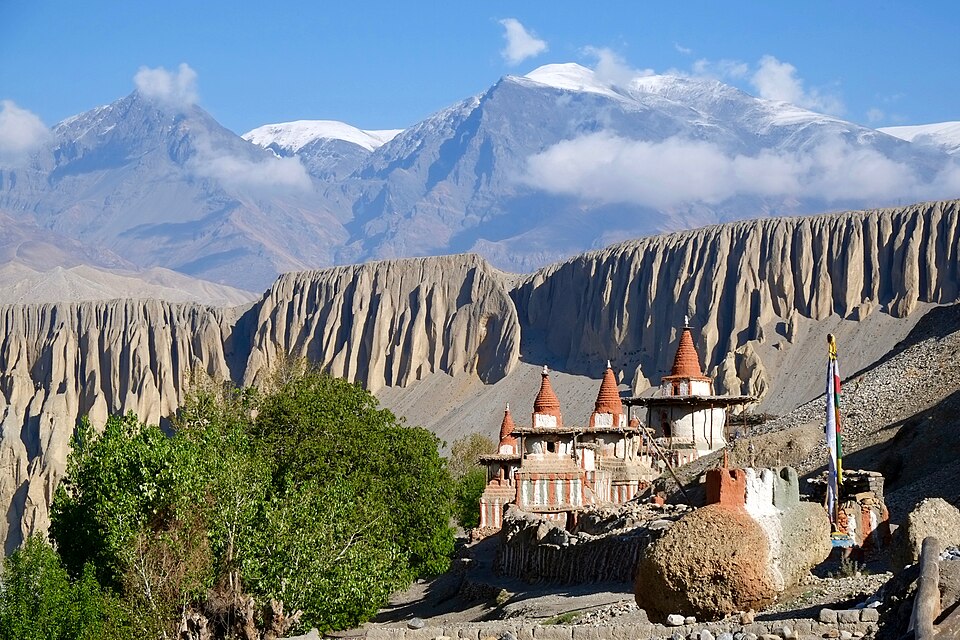
Nepal, officially called the Federal Democratic Republic of Nepal, is a country in South Asia that doesn’t border any ocean. It’s mostly in the Himalayas, but also includes parts of the Indo-Gangetic Plain. It’s bordered by China to the north and India to the south, east, and west. It’s close to Bangladesh and Bhutan, separated by small strips of land. Nepal has varied landscapes, including plains, hills with forests, and eight of the world’s highest mountains, like Mount Everest. Kathmandu is Nepal’s capital and biggest city. Nepal is a country with many ethnic groups, languages, religions, and cultures. Nepali is the official language. The name “Nepal” was first written down during the Vedic period, when Hinduism started. Gautama Buddha, the founder of Buddhism, was born in Lumbini, southern Nepal. Northern Nepal had ties to Tibetan culture.
The Kathmandu Valley, in the center of Nepal, had ties to Indo-Aryan culture and was home to the Newar confederacy, called Nepal Mandala. Traders in the valley controlled the Himalayan part of the Silk Road. This area developed its own art and architecture. In the 18th century, the Gorkha Kingdom united Nepal. The Shah dynasty created the Kingdom of Nepal and allied with the British Empire under its Rana dynasty. Nepal was never colonized but was a buffer between China and British India. Democracy started in 1951 but was stopped twice by the kings of Nepal, in 1960 and 2005. The Nepalese Civil War led to a secular republic in 2008, ending the Hindu monarchy. The Constitution of Nepal, adopted in 2015, states that Nepal is a federal republic divided into seven provinces. In September 2025, protests against social media ban, economic inequality and corruption caused riots, resulting in casualties and the resignation of the prime minister.
Etymology (Origin of the Name)
Before Nepal was unified, the Kathmandu Valley was called Nepal. The exact origin of the name “Nepal” is unknown. The name appears in ancient Indian texts from around the fourth century AD. It’s hard to be sure about the dates of these texts because even the oldest ones may have been added to later on. Experts have trouble figuring out where the name comes from because we don’t know enough about the history and languages of the time.
Hindu mythology says that Nepal is named after an old Hindu sage called Ne. The Pashupati Purana says that because Ne protected the country in the Himalayas, it became known as Nepal. The Nepal Mahatmya says that Pashupati asked Nemi to protect the country. Buddhist mythology says that Manjushri Bodhisattva drained a lake to create the Nepal Valley and said that Adi-Buddha Ne would take care of the people who lived there. Because the valley was cherished by Ne, it would be called Nepal. The Gopalarajvamshavali, a book about the genealogy of the ancient Gopala dynasty written around the 1380s, says that Nepal is named after Nepa, a cowherd and founder of the Nepali branch of the Abhiras. The book also mentions that the cow that gave milk to the spot where Nepa found the Jyotirlinga of Pashupatinath was also named Ne.
Early European visitors didn’t think the Ne Muni explanation was correct. Christian Lassen, a Norwegian expert on India, suggested that Nepala was a combination of Nipa (foot of a mountain) and -ala (a short ending for alaya, meaning home), so Nepala meant “home at the foot of the mountain”. Sylvain Levi, another expert on India, didn’t think Lassen’s theory was right but didn’t have any other explanations. He suggested that either Newara is a simplified version of the Sanskrit word Nepala, or Nepala is a Sanskrit version of the local ethnic name. Some people agree with him, but it doesn’t explain where the name originally came from. It has also been suggested that Nepa is a Tibeto-Burman word made up of Ne (cattle) and Pa (keeper), which reflects the fact that the first people in the valley were cowherds and buffalo herders. Suniti Kumar Chatterji believed that Nepal came from Tibeto-Burman roots – Ne, which has an uncertain meaning, and pala or bal, which no longer has a known meaning.
Geography
Nepal is a landlocked country, which means it is not next to any ocean, and it is surrounded by India and China. Eight of the ten tallest mountain peaks in the world, including Mount Everest, are in Nepal. Mount Everest is on the border Nepal shares with China. Nepal is a little smaller than Illinois and Bangladesh, but a little bigger than Kyrgyzstan. It also has the second-highest average elevation in the world at (10,715 ft), only behind Bhutan.
Economy
Nepal used to be an agricultural country until 1950. Since 1951 it entered the modern era and has made progress. Agriculture, however, is still a major economic activity. 80% of the people do agricultural works and it provides 37% of GDP. Only about 20% of the total area is cultivable while another 33% is covered by forest. Most of the remaining land is covered by mountains. Rice and wheat are the main food crops. The lowland Terai region produces a high amount of agricultural products. A part of those products is supplied to the hill areas, which produces less.
China is the 2nd largest exporter to Nepal, but its imports from Nepal are zero. This burdens Nepal’s monetary stability and monetary balance. India is the largest buyer of Nepal’s goods.The yearly monsoon rain, or lack of it, strongly influences economic growth. From 1996 to 1999, real GDP growth averaged less than 4%. The growth rate recovered in 1999, rising to 6% before slipping slightly in 2001 to 5.5%. Nepal has 1/3 of its trade with India.
Demographics
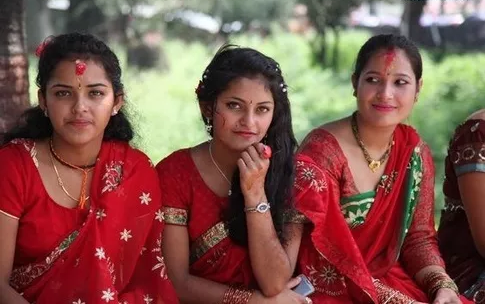
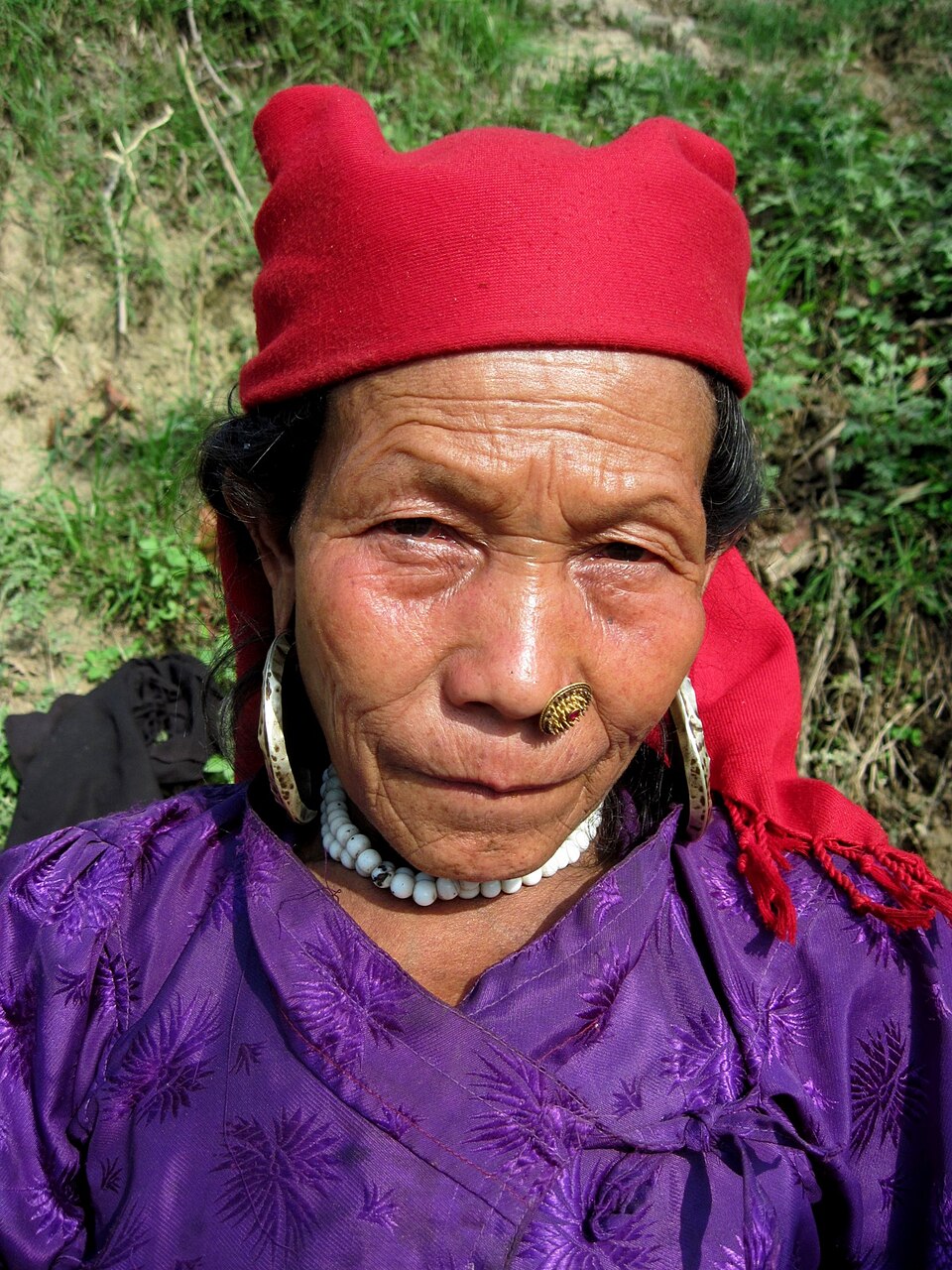
The people of Nepal belong to two main groups; Indo-Aryan group and Tibeto-Burman group. Indo-Aryans are mostly Hindus and Sikhs and they celebrate Hindu and Sikh festivals like Dashain, Tihar, Vaisakhi, Gurpurabs, Maghi, Hola, Bandi Chhor diwas, Teej, Magh Sankranti, Krishna Janmastami, Holi, Janai Purnima, Matatirtha Aunsi, Chhath, etc. Tibeto-Burmans are Buddhist and they celebrate Lhosar, Buddha Jayanti, etc.
Education
Modern education in Nepal started with the opening of the first school in 1853. This school was only for the members of the ruling families and their courtiers. Schooling for the general people began only after 1951. It was when a popular movement ended the autocratic Rana family regime and started a democratic system. In the past 50 years, there has been a big expansion of education facilities in the country. As a result, adult literacy (age 15+) of the country was reported to be 48.2% (female: 34.6%, male: 62.2%) in the Population Census, 2001, up from about 5% in 1952–54. In the beginning in 1951, there were about 300 schools and two colleges with around 10,000 students. Now, there are more than 26,000 schools (including higher secondary), 415 colleges, five universities, and two academies of higher studies. In total, 5.5 million students are studying in those schools and colleges who are taught by more than 150,000 teachers. Despite such examples of success, there are many problems and challenges. Education management, quality, usefulness, and access are some of the major issues of education in Nepal. Social differences based on gender, ethnicity, location, economic class, etc. are still there in some places. Lack of resources has always been a problem in education. These problems have made the goal of education for all a challenge for the country.
Administrative subdivisions
Nepal has seven provinces. Each province has 8 to 14 districts. The districts have local units called municipalities.
- Koshi Province
- Madhesh Province
- Bagmati Province
- Gandaki Province
- Lumbini Province
- Karnali Province
- Sudurpashchim Province
Culture
The official calendar of Nepal is the Vikram Samvat, which is a Hindu calendar. Their new year begins in Baishakh, which is around mid-April. Nepal has 36 public holidays in the year. This makes Nepal the country with the most public holidays.
The national cuisine of Nepal is Dhindo and Gundruk. Dhindo is a type of dough that is served very hot. Gundruk is a dish with fermented green vegetables.
Association football is the most popular sport in Nepal. The Nepal national football team plays at Dasarath Rangasala Stadium in Tripureswar, Kathmandu, Nepal.
National symbols of Nepal
The national symbols of Nepal, according to the Interim Constitution, are: File:Cow.jpg|Animal: (Cow) File:Monal I IMG 4002.jpg|Bird: (Lophophorus) File:Rhododendron_arboreumC.jpg|Flower: (Rhododendron arboreum)
History
King Prithvi Narayan Shah of Gorkha invaded the Kathmandu Valley in 1786 and unified Nepal. Before the unification, Nepal was ruled by various Kirats, Lichchavis, Thakuris and Mallas. The history mentioned that Kirats ruled Nepal during the 7th century BC. Though much was not known about Kirats, the Lichchavi dynasty ruled after them. Lichchavi rule lasted from the 2nd to 9th century AD. After Lichchavis, Nepal was ruled by the Thakuris who were followed by the Mallas for two centuries. Nepal was divided into many principalities and small kingdoms in the fifth centuries of Malla rule.
Jang Bahadur Rana the then Prime Minister of Nepal revolted against the royalty in 1844. The famous Kot Massacre took place during this period in which numbers of noblemen were killed. The Rana took absolute power but continued to maintain the Shah family in the palace. The 104 years regime of Ranas came to and end due to their autocratic rules.
In November 1950, King Tribhuvan restored democracy overthrowing the Rana regime with large number of Nepalese people support. He restored Shah Regime again in Nepal. After his death King Mahendra had ruled in Nepal from 13 March 1955 to 31 January 1972.
Birendra ruled Nepal from 31 January 1972 to 1 June 2001. He was known as a most noble and peaceful king of Nepal. The entire family of King Birendra was killed in June 2001 popularly Known as Royal Massacre 2001. Prince Dipendra was made King while he was on coma stage, later he died in hospital bed. After the death of Dipendra, Gyanendra Shah late King Birendra’s brother became the King of Nepal.
King Gyanendra Shah was dethroned in 2006 after a decade long People’s revolution led by communist party of Nepal (Maoist) and several weeks protest by major political parties. After that, Federal Democratic Republic of Nepal was established.
In September 2025, widespread protests over a social media ban and economic inequality led to rioting that killed or injured dozens of people, damaged Parliament and other buildings, and brought about the resignation of Prime Minister KP Sharma Oli, who fled the country. In response to the crisis, the Nepali army assumed control of the government and engaged in talks with protest leaders, as the country remained uncertain about how and when new leaders would be chosen.
Written for younger readers
Nepal, in simpler words
This version comes from Wikijunior, a set of books written for children aged 8 to 11. It is shorter and uses plainer language than the article above.
From Wikijunior: Asia
Nepal (Nepali: नेपाल) is a country in Asia that is, officially, called the “Federal Democratic Republic of Nepal” (सङ्घीय लोकतान्त्रिक गणतन्त्र नेपाल). Their flag is in a shape of a triangle instead of a rectangle like most are.
The Government of Nepal (नेपाल सरकार in Nepali) was known as His Majesty’s Government, before the monarchy was abolished. Nepal’s President is mainly ceremonial. The Prime Minister is in charge of the government. The current Prime Minister is Khadga Prassad Oli and the President is Bidhya Devi Bhandari. Bidhya is the first woman to be the President of Nepal. She is also the chief commander in the Nepalese Army.
Nepal is a country in southern Asia. It is landlocked, meaning that it is totally surrounded by land. It is between China and India. It is just under 150 thousand kilometres squared. Kathmandu (काठमाडौं in Nepali) is Nepal’s capital and has the largest number of people living there for any city in Nepal. About 1.5 million live in the centre of Kathmandu and 3 million people in the wider urban area.
Nearly 29 million people live in Nepal, according to an estimate in 2016. This means they have the 48th largest population in the world and about 0.38% of the world’s population lives there. The population of Nepal is rising. In the 2011 census, the age bracket 10-14 had the most members. The overall life expectancy is rising. Over two-million Nepalese people do not live in Nepal. There were over 100,000 non-Nepalese people living in Nepal in 2001.
The official language is Nepali. Many other languages are spoken. These include, among others, Nepal Bhasa, Urdu and at least four sign-languages.
Over 80% of Nepal’s population is Hindu. Nepal has a higher proportion of Hindus than any other nation. Nearly 10% are Buddhist and nearly 5% are Muslim.
Football and cricket are quite popular in Nepal. The Nepalese team has never won any medal in the Olympic or Paralympic games. They have participated in twelve of the Summer Games, four Paralympic games and four Winter Olympics. They have taken part in all the summer games between 1964 and 2016, with the exception of the 1968 one, and the winter ones between 2002 and 2014. They took part in the 2004, 2008, 2012 and 2016 Paralympic games.
Mount Everest, the world’s highgest mountain, is on Nepal’s border with China.
Pashupatinath Temple is a famous Hindu temple. It was built in the 5th century.
Lumbini is on the place where the Buddha is said to have been born. It is a Buddhist pilgrimage site. File:Everest kalapatthar.jpg|thumb|Mount Everest File:Pashupatinath Entrance Bull.JPG|thumb|an entrance into Pashupatinath temple File:Nepal DSCN2126a.jpg|thumb|part of Lumbini
The Buddha, whos ideas founded Buddhism, was born in Nepal.
Babu Chiri Sherpais a famous mountaineer, from Nepal. He climbed Mount Everest 10 times.
Their currency is the Nepalese Rupee (NPR). 1 Nepalese Rupee is worth 0.009 US dollars, 0.007 pounds or 0.0078 euroes.
Where this page comes from
The article above is adapted from “Nepal” on Simple English Wikipedia, by its contributors. We removed reference markers, navigation boxes and tables, expanded measurement templates into readable numbers, and kept the prose otherwise intact. The simpler version is adapted from Wikijunior on Wikibooks.
Both sources are published under CC BY-SA 4.0, so this page is published under the same licence. You may share and adapt it, including commercially, as long as you credit the original and keep the same licence.
Worksheets, answer keys and printable layouts elsewhere on K5Print are our own work and are not covered by this licence.