Nigeria
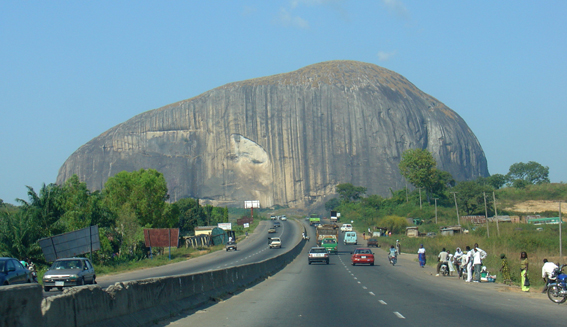

Fast facts
- Capital
- Abuja
- Largest city
- Lagos
- Official language
- English
- Currency
- Naira (₦)
- Time zone
- WAT
- Drives on
- right
- Calling code
- +234
Facts from Wikipedia’s “Nigeria” page (CC BY-SA 4.0).
Nigeria, officially Federal Republic of Nigeria, is a country in Africa.
Nigeria shares its borders with Niger to the north, Benin to the west, Cameroon to the east, and Chad to the northeast.
The country gained independence on 1 October 1960, and became a republic in 1963.
It is the most populated country in both West Africa and the whole of Africa, with over 232,679,478 people.
The capital city is Abuja, while its economic center and most populated city is Lagos.
Nigeria has the fourth biggest economy in Africa, as of 2024.
History
From the 1500s to the 1800s, many people from the land now called Nigeria (and other parts of West Africa) were taken away and turned into slaves by Europeans, and they were sent to work in the Americas. These slaves were bought and sold in the Americas by Europeans who lived there.
Today, many people related to those that were enslaved still live in America, though they are no longer slaves. They are referred to as African Americans.
From 1901 to 1960, the United Kingdom ruled Nigeria. However, by 1960 the people wanted independence, and Britain finally let them have it. For some time after this, Nigeria was a dictatorship, where the leaders stayed in control even if the majority of people disliked them. At this time, the Nigerian Civil War was by separatist Christian Igbo people in the Southeast against the Nigerian government. They did not want to be a part of Nigeria, which was ruled by The Muslim north and mixed west. The war ended with a reunification of Nigeria.
In 1999, Nigeria became a democracy, where people choose their leaders. After that, Olusegun Obasanjo, a Yoruba Christian from the south, became President. In 2007, Umaru Yar’Adua, a Hausa Muslim, was elected to be the next President. Yar’Adua died in May 2009. Goodluck Jonathan, the vice president, then became president.
Goodluck Jonathan was re-elected as the president after wining the 2011 general elections under the political party, PDP.
He served as the country’s president until 2015.
Communal conflicts in Nigeria
In the early 21st century, there have been several armed conflicts. These include the armed rebellion by the Islamist group Boko Haram. The Boko Haram insurgency happens mostly in the northeastern part of the country. The group wants Sharia law for the country. Another is the Nigerian bandit conflict, in which gangs carry out attacks, mostly in the northwest.
There is also a separatist insurgency in the southeast where the armed group, IPOB, is seeking the restoration of the short-lived secessionist Biafra country that was defeated by federal forces in 1970.
There is also a conflict with a neighboring country; The Bakassi conflict involves Cameroon and Nigeria.
Geography
Nigeria has a total area of 923,768 km². It is the world’s 32nd-largest country. It shares a border with Benin (773 km), Niger (1497 km), Chad (87 km) and Cameroon (1690 km). It has a coastline of at least 853 km.
The highest point in Nigeria is Chappal Waddi at 2,419 m (7,936 ft). The main rivers are the Niger and the Benue River. They come together and empty into the Niger Delta, one of the world’s largest river deltas. It is the location of a large area of Central African mangroves.
Cities
These are the cities in Nigeria with over 1 million people as of 2012.
Religion
In Nigeria, there are almost equal numbers of Muslims and Christians. Most of the Christians live in the south, and most of the Muslims live in the north.
Contrary to some beliefs, the Nigerian civil war was not only attributed to religious intolerance. The war which took place between 6 July 1967 and 15 January 1970, was a political conflict caused by the attempted secession of the southeastern provinces of Nigeria as the self-proclaimed Republic of Biafra. The conflict was the result of economic, ethnic, cultural and religious tensions among the various peoples of Nigeria.
There are over 250 religions in Nigeria
Natural resources
Nigeria produces a large amount of oil, and some fighting has been going on because many people want a share of the oil profits. This fighting has been happening in the area called the Niger Delta, where the Niger River flows into the Atlantic Ocean.
The largest city in Nigeria is Lagos. Nigeria has both grasslands and rainforests, and can get very hot, because it is close to the Equator. Petroleum and agriculture make up the Nigerian economy.
Cuisine
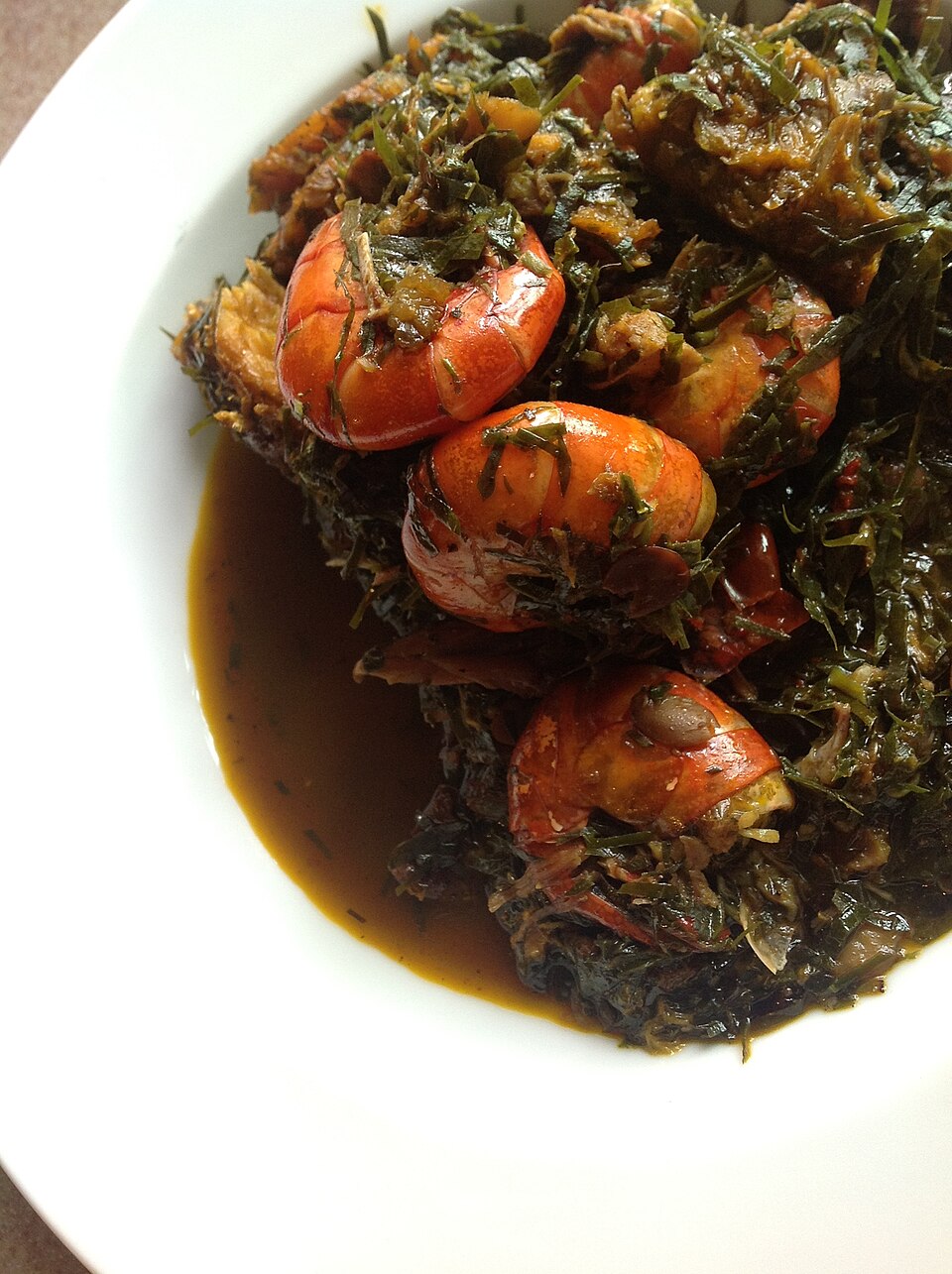
Nigerian cuisine, like West African cuisine in general, is known for its richness and variety.
Many different spices, herbs and flavourings are used along with palm oil or groundnut oil. These make deeply flavoured sauces and soups often made very hot with chili peppers.
Nigerian feasts are colourful and lavish. Good smelling market and roadside snacks cooked on barbecues or fried in oil are plentiful and varied.
Sport
Association football is Nigeria’s national sport. The country has its own Premier League of football.
Nigeria’s Men’s national football team, known as the Super Eagles, has made the World Cup five times. These were in 1994, 1998, 2002, 2010, 2014, 2018 and most recently in 2022. They won the African Cup of Nations in 1980, 1994 and 2013. They also hosted the Junior World Cup. They won the gold medal for football in the 1996 Summer Olympics.
Nigeria is also involved in other sports such as basketball, cricket, sprints and track and field. Boxing is also an important sport in Nigeria; Dick Tiger and Samuel Peter are both former World Champions.
Written for younger readers
Nigeria, in simpler words
This version comes from Wikijunior, a set of books written for children aged 8 to 11. It is shorter and uses plainer language than the article above.
From Wikijunior: Africa
Nigeria, official name: Federal Republic of Nigeria (nicknamed the Giant of Africa), is a country located in Western Africa. Nigeria’s capital is Abuja, but the largest city of Nigeria is Lagos. “Arise, O Compatriots” was Nigeria’s second national anthem from October 1, 1978, until May 29, 2024, when “Nigeria, We Hail Thee” used from 1960 until 1978 was readopted and the motto of Nigeria is “Unity and Faith, Peace and Progress”. Nigeria’s current president is Bola Ahmed Tinubu of the All Progressive Congress(APC) and the currency of Nigeria is the Nigerian naira.
Nigeria is located in Western Africa. To the west is Benin, to the east are Chad and Cameroon, and Niger to the north. Towards the south of Nigeria is the Gulf of Guinea in the Atlantic Ocean. The country of Nigeria contain 36 states, the most popular one being Lagos in the southwest part of Nigeria.
Nigeria has the largest economy in Africa, due to their place of being the 21st largest economy in the world in terms of normal GDP (Gross domestic product: represents the total market value of goods and services a given year).
Nigeria produces a lot of goods for the West African region.
There are over 180 million people living in Nigeria. Nigeria is the most populous country in Africa, and the seventh most populous country in the whole world. The largest ethnic groups in Nigeria are the Yoruba, Igbo, and Hausa-Fulani, which make up the 71% percent of Nigeria. The remaining 29% is 1/3 of groups numbering of a huge population, each! The remaining 300+ ethnic groups go for 1/5 of the population.
Wikijunior:Countries A-Z/Nigeria
Where this page comes from
The article above is adapted from “Nigeria” on Simple English Wikipedia, by its contributors. We removed reference markers, navigation boxes and tables, expanded measurement templates into readable numbers, and kept the prose otherwise intact. The simpler version is adapted from Wikijunior on Wikibooks.
Both sources are published under CC BY-SA 4.0, so this page is published under the same licence. You may share and adapt it, including commercially, as long as you credit the original and keep the same licence.
Worksheets, answer keys and printable layouts elsewhere on K5Print are our own work and are not covered by this licence.