Peru

Fast facts
- Capital
- Lima
- Languages
- Spanish
- Currency
- Sol
- Time zone
- PET
- Drives on
- right
- Calling code
- +51
Facts from Wikipedia’s “Peru” page (CC BY-SA 4.0).
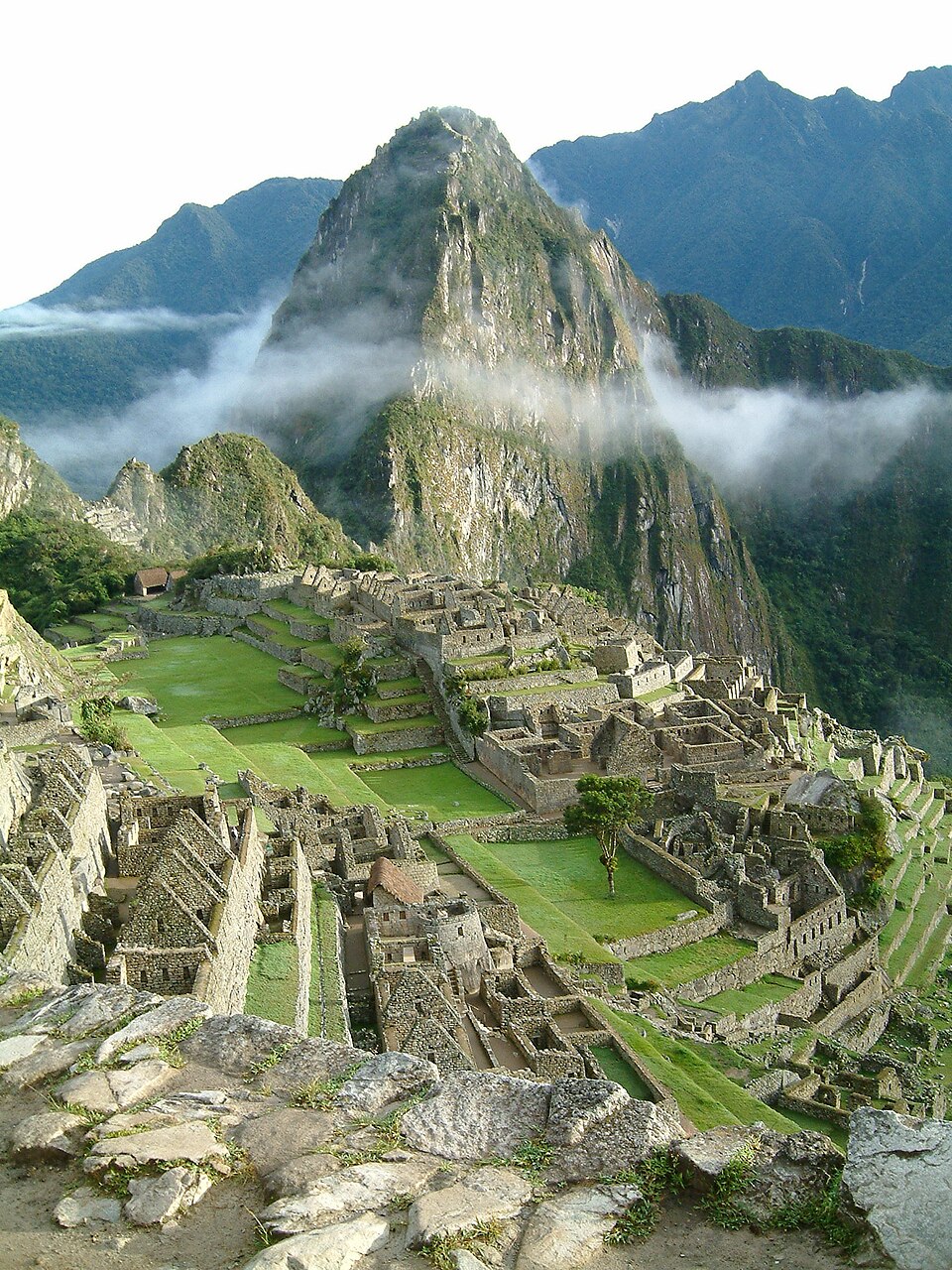
Peru is a country in South America. The capital is Lima. The ruins of Machu Picchu, the Andes mountains, and the source of the Amazon River are all found in Peru.
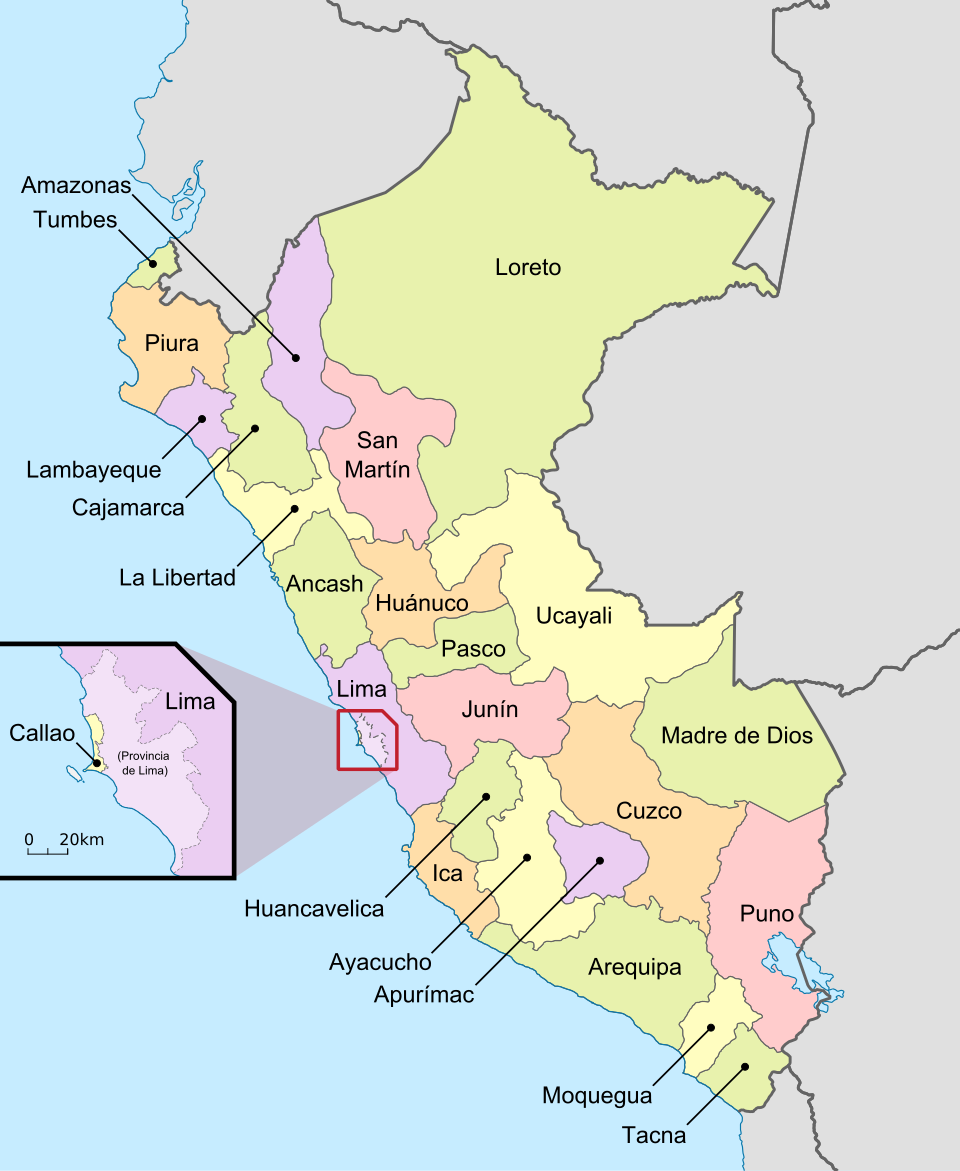
Peru is bordered to the north by Ecuador and Colombia, to the east by Brazil, to the south by Chile, and to the southeast by Bolivia. Peru is a representative democratic republic divided into 25 regions and over 33 million people live in it.
Peruvian territory was home to the Norte Chico civilization, one of the oldest in the world, and to the Inca Empire, the largest state in Pre-Columbian America. The Spanish Empire conquered the region in the 16th century and established a Viceroyalty, which included most of its South American colonies. After achieving independence in 1821.
Peru suffered a terrible guerrilla war in the 1980s. The communist (Maoist) Shining Path tried to take over the country. But after the leader of the group was captured in 1992, Shining Path was not a threat anymore. During the 1990s, it was ruled by President Alberto Fujimori. During this time, the economy of Peru got better, and it became easier to start a company or operate a business. After Fujimori, Alejandro Toledo was elected President, and then Alan García, who was President previously from 1985 to 1990, was elected again in 2006. Ollanta Humala was elected President in 2011 and Pedro Pablo Kuczynski was elected President in 2016. In March 2018, Kuczynski resigned following political scandals and Vice President Martín Vizcarra was sworn-in as the next president.
Economy and tourism
Peru’s most important exports, products that it sells to other countries, are fish, gold and other metals, oil, coffee, sugar, and cotton. Also, the food in Peru is very diverse, including typical dishes like Ceviche and Broiled Chicken.
Tourists from other countries like to come to Peru because of the history and also to enjoy nature. Many people come to climb mountains in the Cordillera Blanca in the Ancash Region, and many people visit Peru’s long Pacific coast or the Amazon jungle. Cuzco and Machu Picchu are just two of the places where many buildings built by the Incas are still standing after hundreds of years, and these are some of the most visited places. The Incas were not the only tribe in Peru who left buildings and artifacts, but they were the most powerful.
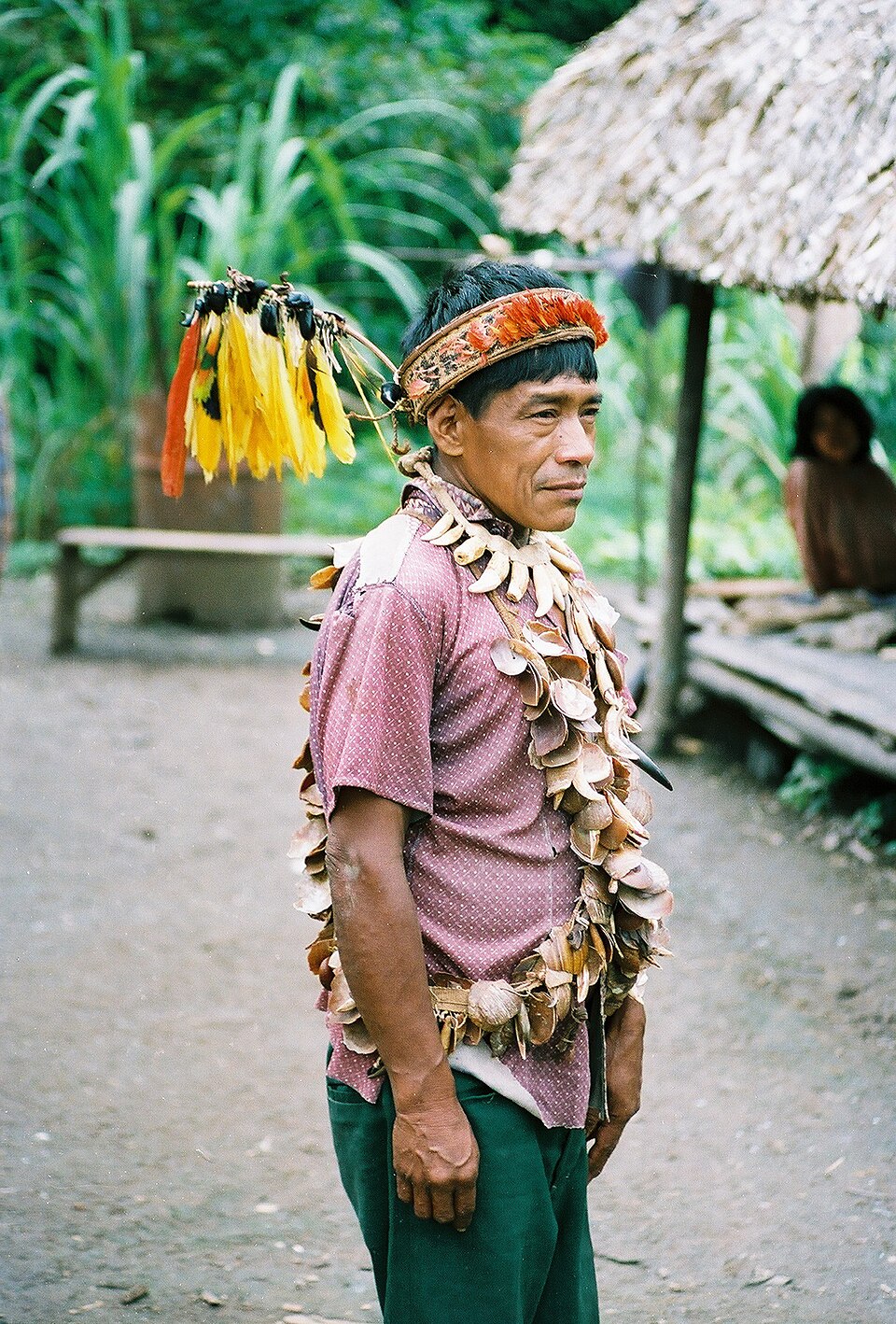
Peru is divided into 25 regions. Lima is the capital and other main regions are Cuzco, Arequipa and Lambayeque. In the Amazon jungle region, we can find many important rivers and different animals, plants and people of many indigenous cultures.
Peru includes 29.5 million people. The currency of Peru is the Nuevo Sol.
Demographics
The population of Peru is approx. 30 million. The ethnic composition of Peru is like the following:
- 44.0%: Mestizo.
- 31.0%: Native American.
- 15.0%: European.
- 7.0%: Mulatto.
- 2.0%: Black.
- 1.0%: Asians.
Economy
As of 2018, about 22.3% of the population lives below the national poverty line
History
Peru was the home of the Inca Empire. The Incas were a well-organized Indian civilization that began the city of Cuzco (now called Cusco). Beginning in the 1400s, they defeated many nearby tribes and built an empire in the Andes. The Inca forced the people to work for the king for a certain number of days every year. They used this “work tax” to build roads and terraces on the sides of the mountains to grow crops, and huge cities with rich palaces for the rulers and their queens. Records were kept on quipa, knotted ropes, since the Incas never invented writing. These could be quickly sent anywhere in the empire by a series of relay runners set up along the roads. Heavier loads were sent by llamas, the pack animals of the Andes. Potatoes were first cultivated in Peru by the Incas. There are currently 4,000 different kinds of potatoes grown in the country and the number is increasing due to biodiversity.
The Incas were rich in gold and silver which could be found in the mountains. The Spanish wanted that treasure when they discovered the nation in the 1500s. Francisco Pizarro, a Spanish man, kidnapped and killed the Inca ruler in 1532, even after his people paid a huge amount of treasure for his release. The Incas fought the Spanish for many years, but the last Inca king was killed in 1572. Peru was a Spanish colony until 1821. Spanish is still the main language of the people, although many also speak Quechua, the Inca language.
Written for younger readers
Peru, in simpler words
This version comes from Wikijunior, a set of books written for children aged 8 to 11. It is shorter and uses plainer language than the article above.
From Wikijunior: South America
Part of Wikijunior South America project Welcome to Peru! Peru is the third largest country in South America. Peru is located on the western edge of South America, with The Andes mountains running through it. The Andes cause many of the cities of Peru to be located on the Western side, including the capital, Lima.
Peru was at one time the center of the Incan Empire. The old capital of the Incas, Cuzco, meaning navel of the world, was located in the Andes mountains in the southeastern part of the country. The Spanish under the conquistador Pizarro conquered the native Andean culture in 1533 and the country became a part of the Spanish Empire in 1542. Peru was liberated from the rule of Spain by the famous South American general José de San Martin in 1821.
The Andes take up much of Peru, dividing the country into three sections. The Andes are a constantly changing mountain range, so they are prone to earthquakes, landslides, and flash floods. The Andes, though, are also filled with great beauty, such as the great Incan city of the clouds, Machu Picchu, which is a major tourist destination, and the huge Lake Titicaca. Near Huancayo lies Nevado Misti, a 18,500 foot peak, from which emerges a stream that is considered the source of the Amazon, the world’s largest river. It flows eastward, joining other rivers, themselves flowing north and east until the Maranon and Ucayali, two great rivers of lowland Amazonia, meet to form the Amazon River itself.
The Pacific Ocean is cold along the coast of Peru and the winds do not pick up much moisture from it, so the land next to coast of Peru is a very dry place. The southern coast region is part of the Atacama desert, which also extends into Chile. The Atacama desert is known as the driest place in the world.
Although little grows naturally in this region of Peru, the people of Peru have long been using irrigation to farm. As a result, most of Peru’s large population centers border this desert.
The eastern part of the country is covered with dense vegetation, and its most important exports are jungle products, consisting of rubber, cinchona, dye stuffs, medicinal drugs and in the cultivated portions, coca, which is raised in large quantities.
Lima or the City of the Kings (Cuidad de los Reyes) was founded by Francisco Pizarro in 1535. The Cathedral of Lima contains the tomb of Pizarro. Callao, located 7 miles west of Lima, is the port of the capital city and contains one of the finest harbors on the Pacific Ocean.
The historic old city is located on the Chili river in the mountains of southern Peru and was founded by Garci de Carbajal under the direction of Pizarro in 1540. An imposing feature of the city is the Cathedral San Francisco de Arequipa. The name white city comes from the white volcanic rock called sillar, available nearby, which was used as building blocks in the construction of the city.
es:Wikichicos/América del Sur/Perú
Where this page comes from
The article above is adapted from “Peru” on Simple English Wikipedia, by its contributors. We removed reference markers, navigation boxes and tables, expanded measurement templates into readable numbers, and kept the prose otherwise intact. The simpler version is adapted from Wikijunior on Wikibooks.
Both sources are published under CC BY-SA 4.0, so this page is published under the same licence. You may share and adapt it, including commercially, as long as you credit the original and keep the same licence.
Worksheets, answer keys and printable layouts elsewhere on K5Print are our own work and are not covered by this licence.