Pyramids of Giza
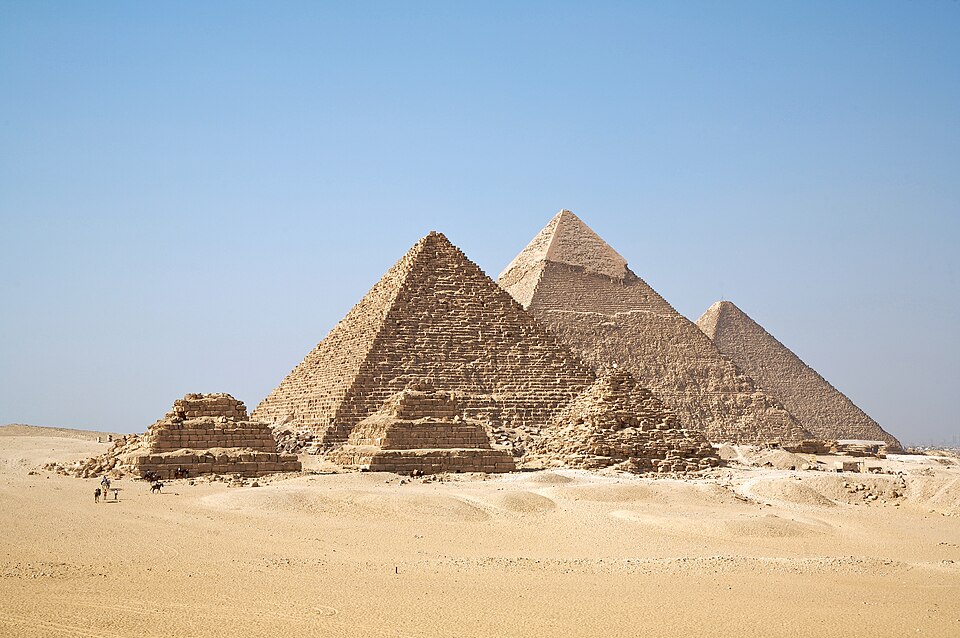

Giza pyramid complex Giza Necropolis (also called the Giza pyramid complex) is a necropolis on the Giza Plateau near the city of Cairo, Egypt. It is about 8 kilometres (5 mi) inland into the desert from the ancient town of Giza on the Nile, and about 25 kilometres (15 mi) southwest of Cairo city centre. The Great Pyramid is the only remaining monument of the Seven Wonders of the World. Construction is thought to have taken 20,000 workers and 20 years.
Major parts of the complex
- Pyramid of Khufu
- Pyramid of Khafre
- Pyramid of Menkaure
- Great Sphinx
- Khufu ship
Construction of the Great Pyramid
There have been many theories to explain how the pyramids were built. These theories include:
- the use of external or outside ramps
- the use of cranes
- the use of an internal or inside ramp. This idea was developed by Jean-Pierre Houdin, a French architect. He has also made detailed computer models of the Great Pyramid. Houdin says that the ramp spirals upward. There is evidence in the notched corners of the pyramid. Not only was the spiraling internal ramp used, but an external ramp was probably used to move the bigger blocks. These are in the lower half of the pyramid and probably used simple cranes to lift them.
More reading
- Lehner, Mark 1997. The Complete Pyramids. Thames & Hudson, 1997.
- Manley, Bill (ed) The Seventy Great Mysteries of Ancient Egypt. Thames & Hudson.
- Mysteries of Egypt National Geographic Society, 1999. .
- Rhys-Davies, John 1995. Riddles of the monument builders: Who built the Sphinx? Time-Life Video, 1995.
- Hai, Paul 2007. Raising Stone 1: Paul Hai’s racks & pinions theory. .
- Wirsching, Armin 2009. Die Pyramiden von Giza - Mathematik in Stein gebaut, 2nd ed.
Written for younger readers
Pyramids of Giza, in simpler words
This version comes from Wikijunior, a set of books written for children aged 8 to 11. It is shorter and uses plainer language than the article above.
From Wikijunior: World Heritage Sites
= Pyramids of Giza =
The fourth-dynasty king, Sneferu 2686 – 2667 BC, was the first to create the pyramid shape that we all recognize and associate with Egyptian architecture. He built three pyramids in all—but the first two were glorious failures.
His first, the pyramid at Medum, began as a step pyramid and was then modified to form the first true pyramid. But it was unstable and the limestone blocks began to slip. Soon, work on it was abandoned. King Sneferu then moved to Dahshur and built a second pyramid, which we now know as the “Bent Pyramid” because its upper part rises at a shallower angle of incline than the lower part.
The Bent Pyramid was originally planned as a true pyramid, but the corners were built on unstable ground and the walls of the burial chambers inside began to crack and shift inward. Of necessity, the building’s geometry was altered at a point just above half its height. The angle of incline was decreased from 54º 31’ 13’’ to 43º 21’. This was probably done to alleviate the stresses in the lower part of the pyramid and make it stronger. But the bent pyramid was never used. Instead, Sneferu began a third pyramid about a mile way. This one is called the red pyramid because of the red limestone blocks used in its construction. It became the world’s first successful true pyramid.
With the red pyramid, Sneferu set the standard for all true pyramids to come. He included aboveground burial chambers, a mortuary temple, and a causeway leading down to a valley temple. This was the model followed by his son, Khufu, wh built the first and largest pyramid at Giza. The Giza pyramids were erected on a rocky plateau on the west bank of the Nile in northern Egypt and were connected, by covered causeways, to mortuary temples in the valley below the plateau. These temples had landing stages which were linked to the Nile by a canal. In ancient times they were included among the Seven Wonders of the World.
[slideshow_deploy id=’1211′]The largest of the three pyramids at Giza, known as the Great Pyramid, is truly an astonishing work of engineering. It was built over a twenty year period. Some believe that it was built by slaves, but this is not true. One hundred thousand people worked on the great structure for three months of each year, during the Nile’s annual flood when it was impossible to farm the land and most of the population was unemployed. The pharaoh provided good food and clothing for his workers, and was kindly remembered in folk tales for many centuries. The sides are oriented to the four cardinal points of the compass and the length of each side at the base is 755 feet (230.4 m). The faces rise at an angle of 51º 52’ and their original height was 481 feet (147 m). (They currently rise 451 feet [138 m].) It was constructed using around 2,300,000 limestone blocks, each weighing an average of 2.5 tons. Some blocks weigh as much as 16 tons. For centuries, the Great Pyramid was encased in smooth limestone, but this was plundered in our era to build Cairo.
Khufu’s son, Khafre (also known as Chephren). His pyramid, on a nearby site at Giza, appears taller than his father’s, but this is an illu¬sion; it is built on higher ground and was in fact, origi¬nally at 447 .5 feet (136.4 m), 33.5 feet (10.2 m) shorter than the Great Pyramid.
Khafre’s pyramid retains some of its original limestone casing at the apex, and so it is possible to imagine how the pyramids might have ap¬peared in antiquity. Khafre also built the Great Sphinx, which is 66 feet high (20 m) and 240 feet long (73 m) and is part of Khafre’s pyramid complex. It represents Ra-Harakhte, the sun god, as he rises in the east at dawn but the face of the Sphinx is a portrait of Khafre himself, and is contemporary with his pyramid. It was carved from an outcropping of limestone left after quarrying the stone for his father’s pyramid.
Unfortunately, the great sphinx has deteriorated over the millennia and was extensively renovated in ancient times. More recently it was mutilated by the Sultan Mohammed an-Nasir in AD 1300; and lost its nose in 1798, when Napoleon’s soldiers used it for target practice.
There have recently been a number of speculative theories concerning the age of the Great Sphinx, but no material evidence exists to suggest that its history should be revised.
Khafre’s son, Menkaura built the third pyramid at the Giza necropolis (cem¬etery). With an original height of 228 feet (70 m), it is less than half the height of the pyramid built by his grandfather, Khufu. The lower layers consist of red granite from Aswan and the upper courses were originally made of gleaming white limestone.
Although pyramid-building in stone continued until the end of the Old Kingdom, the pyramids of Giza were never surpassed in their size and the technical excellence of their construction. New Kingdom ancient Egyptians marvelled at their predecessors monuments, which were then well over a thousand year old.
Pyramids were built during the Middle Kingdom (2055-1650 BC) but these consisted of a mud brick core with a stone skin and are now mere piles of rubble.
There are over 100 recorded pyramids in Egypt most of which belong to minor royalty or have no known owners. They required an enormous investment in resources and stood out in the landscape as easy pray to the robbers. The last royal pyramid was built by the first king of the 18th dynasty Ahmose 1550-1525 BC but, after that, the Egyptians ceased building these majestic burial structures for all time.
Saqqara
- Djoser 2667-2648 bc
- Sekhemkhet 2648-2640 bc
- Teti 2345-2323 bc
- Userkaf 2494-2487 bc
- Djedkara 2414-22375 bc
- Unas 2375-2345 bc
- Pepy I 2321-2287 bc
- Merenra 2287-2278 bc
- Pepy II 2278-2184 bc
- Khendjer 13th Dynasty Meidum
Sneferu 2613-2589 bc
- Sneferu’s first pyramid Dahshur
- Sneferu 2613-2589 bc
- The Bent Pyramid &
- the Red Pyramid
- Amenemhet II 1922-1878 bc
- Amenemhet II 1922-1878 bc
- Senusret III 1874-1855 bc Amenemhet III 1855-1808 bc Abu Roash
- Djedefra 2566-2558 bc
- Giza
- Khufu 2589-2566 bc
- Khafra 2558-2532 bc
- Menkaura 2532-25o3 bc Zawiyet el-Aryan
- Two unfinished pyramids Abusir
- Sahura 2487-2475 bc
- Neferirkara 2475-2455 bc
- Raneferef 2448-2445 bc
- Nyuserra 2445-2421 bc# Mazghuna
- Two pyramids – owners unknown Lisht
- Amenemhat I 1985-1955 bc
- Senursret I 1965-1920 bc Hawara
- Amenemhat III 1855-1808 bc Lahun
- Senusret II 1880-1874 bc
Where this page comes from
The article above is adapted from “Pyramids of Giza” on Simple English Wikipedia, by its contributors. We removed reference markers, navigation boxes and tables, expanded measurement templates into readable numbers, and kept the prose otherwise intact. The simpler version is adapted from Wikijunior on Wikibooks.
Both sources are published under CC BY-SA 4.0, so this page is published under the same licence. You may share and adapt it, including commercially, as long as you credit the original and keep the same licence.
Worksheets, answer keys and printable layouts elsewhere on K5Print are our own work and are not covered by this licence.