Rice

Fast facts
- Genus
- Oryza
Nutrition facts: cooked white rice
One serving is 1 cup (158 g).
| Nutrient | Per 100 g | Per serving | % Daily Value |
|---|---|---|---|
| Calories | 130 kcal | 205 kcal | — |
| Protein | 2.7 g | 4.2 g | 8% |
| Total fat | 0.3 g | 0.4 g | 1% |
| Carbohydrate | 28.2 g | 44.5 g | 16% |
| Fiber | 0.4 g | 0.6 g | 2% |
| Sugars | 0.1 g | 0.1 g | — |
| Vitamin C | 0.0 mg | 0.0 mg | — |
| Vitamin A | 0 µg | 0 µg | — |
| Calcium | 10 mg | 16 mg | 1% |
| Iron | 1.2 mg | 1.9 mg | 11% |
| Potassium | 35 mg | 55 mg | 1% |
| Sodium | 1 mg | 2 mg | — |
One serving has about 11% of the Daily Value for iron.
Data: USDA FoodData Central (public domain, CC0) — “Rice, white, long-grain, regular, enriched, cooked”. Percent Daily Values use the FDA’s reference amounts for labels.
Rice (Oryza sativa) is a type of cereal and food. In origin, it is a swamp grass. It is eaten as staple food in many parts of Asia. It is grown in warm parts of the world, mainly India, Africa, northern Italy, and the west coast of North America.
Rice accounts for 80% of the calories eaten in Asia, or one-fifth of the calories eaten worldwide by humans. It is the agricultural commodity with the third-highest worldwide production (rice, 741.5 million tonnes in 2014), after sugarcane (1.9 billion tonnes) and maize (1.0 billion tonnes). However, judged by value, the world trade in wheat is greater than all other crops combined. All these cereals are grasses.
Rice used to be the main diet in many countries. Various kinds of food processing prepare rice for eating. It is usually cooked. In some areas, such as Spain, rice is first fried in olive oil or butter, then cooked with water or soup. In other areas, such as India, rice is eaten with sauce, curry, or soup. Rice can also be used to make alcohol, such as Japanese sake rice wine.
Rice is believed to have been first grown in ancient southern China and India around 2500 BC. Rice-growing was brought to Japan possibly in the 1st century BC, and became popular during the 2nd century and the 3rd century. From India, rice spread to southern Europe and Africa.
Iran is also a producer of rice in Asia with a production of 2.4 MMT. The food consumption pattern of people in Iran shows that Iranians consume an average of 100 g of rice per day. Rice is the second most popular and favorite food in Iran after bread.
Rice is usually planted in a flat field filled with water. Before cropping, the water is drained from the field. Before farmers developed a good farming system and fertilizers, they used to let lands rest for 1 to 2 years while farming in other lands.
In some hot areas, close to the equator, farmers do double-cropping which means raising two crops in one year.
Rice contains a lot of carbohydrates. There are different ways of milling rice. Brown rice has only had the outer layer removed. It contains more fibre than the completely milled white rice.
Rice varieties
There are several grains called “rice”: they have been cultivated for thousands of years. There are a huge number of varieties.
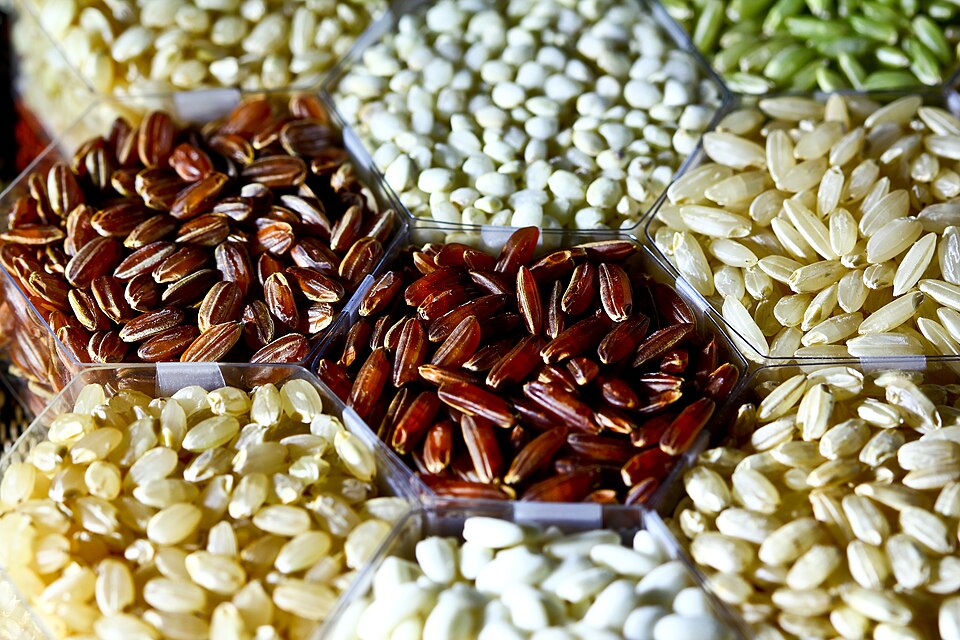
Asian rice (Oryza sativa) is most widely known and most widely grown, with two major subspecies and over 40,000 varieties. Also notable are varieties of African rice (Oryza glaberrima) and wild rice (genus Zizania). Rice may vary in genetics, grain length, color, thickness, stickiness, aroma, growing method, and other characteristics.
Rice can be divided into different categories on the basis of each of its major characteristics. The two subspecies of Asian rice, indica and japonica have different length and stickiness. Indica rice is long-grained and unsticky, while japonica is short-grained and sticky.
For instance, over nine major varieties of rice exist for the purpose of making sake alone.
IR8
A naturally occurring strain of rice, IR8, is believed to have saved many lives.
The new strain, part of the Green Revolution, had defects. It lacked taste, and the team spent 20 years improving its quality, and its resistance to fungi and pests. The team’s later work was to reduce its bad effect on diabetes type 2 and on its vitamin A content.
The countries that exported most rice (2022)
In 2022, the countries that exported most rice, were
- India
- Thailand
- Vietnam
- Pakistan
Where this page comes from
The article above is adapted from “Rice” on Simple English Wikipedia, by its contributors. We removed reference markers, navigation boxes and tables, expanded measurement templates into readable numbers, and kept the prose otherwise intact.
Both sources are published under CC BY-SA 4.0, so this page is published under the same licence. You may share and adapt it, including commercially, as long as you credit the original and keep the same licence.
Worksheets, answer keys and printable layouts elsewhere on K5Print are our own work and are not covered by this licence.