Russia

Fast facts
- Capital
- Moscow
- Languages
- Russian
- Currency
- Ruble (₽)
- Drives on
- right
- Calling code
- +7
Facts from Wikipedia’s “Russia” page (CC BY-SA 4.0).
Russia (, ), or the Russian Federation, is a country spanning parts of Eastern Europe and North Asia. It has land from the Baltic Sea to the Bering Strait. By total area (17,098,242 square kilometres (6,601,668.1 sq mi)), it is the largest country in the world, followed by Canada, and the United States or China. Russia’s population is about 146.7 million people. It is the most populous country in Europe. Moscow, Russia’s capital city, is the largest city entirely in Europe by population; it is also Europe’s largest city by area. Other big cities include Saint Petersburg, Novosibirsk, Yekaterinburg, Nizhny Novgorod, and Kazan. Russia’s official language is Russian. Russian is the most spoken language in Europe, though only spoken in Russia which is culturally different from most of Europe. It is also the most widely spoken Slavic language. Many regions of Russia have their own official languages alongside Russian.
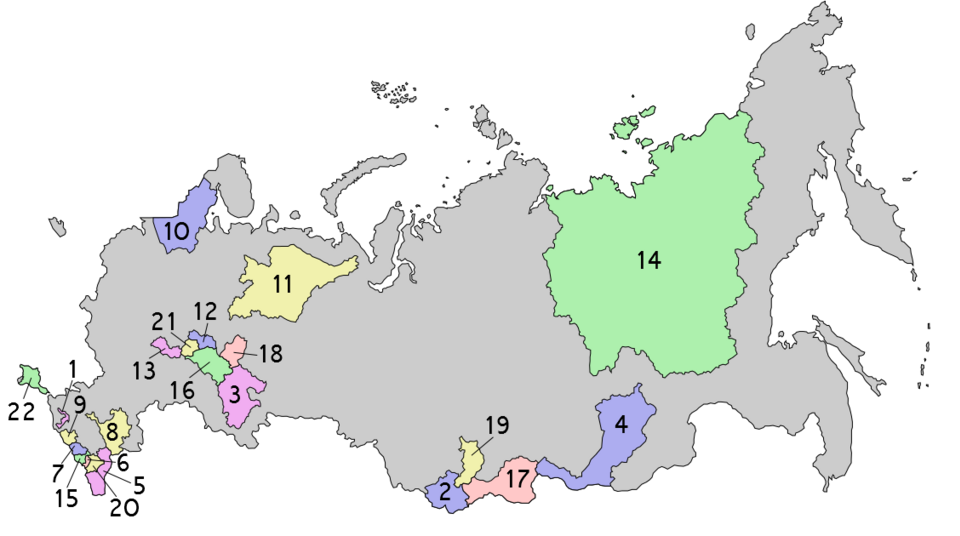
Russia has land borders with 14 (16, if counting unrecognized) countries, in both Europe and Asia. These countries are Norway, Finland, Estonia, Latvia, Lithuania, Poland, Belarus, Ukraine, Georgia, Azerbaijan, Kazakhstan, China, Mongolia, and North Korea. It borders Lithuania and Poland through Kaliningrad Oblast. It also borders the unrecognized countries of South Ossetia and Abkhazia to the south. It is next to 16 seas, and 3 oceans. It is the country with the most land borders in the world. Russia is made up of 89 federal subjects. This includes Crimea, LPR, DPR, Kherson Oblast and Zaporizhzhia Oblast and Sevastopol, which are claimed by both Russia and Ukraine. There are many different types of federal subjects. There are 48 oblasts, 24 republics, 9 krais, 4 autonomous okrugs, 3 federal cities, and 1 autonomous oblast in Russia.
The economy of Russia is one of the largest in the world. It ranks 11th in the world for highest nominal GDP. This is mainly because of the large amount of natural resources found in Russia. However, much of the land is either infertile or covered by permafrost. The ruble is the official currency of Russia.
The Eastern Orthodox Church is the largest religion in Russia. Russia has the most followers of Eastern Orthodoxy out of any other country. About 75% of Russians are followers of Eastern Orthodoxy.
Russia is a very large and diverse country. From 1922 to 1991, it was the largest republic of the Soviet Union. The Russian Soviet Federative Socialist Republic (RSFSR) was based on communism. Today the government of Russia is a mixed republic under an authoritarian dictatorship. The President is chosen by direct election. Challenging candidates do not have access to the mass media. They do have full access to social media, internet news websites, and international media. Election results match domestic, international, and exit polling. The current President of Russia is Vladimir Putin. The country has turned towards an authoritarian dictatorship under Putin’s rule. The President rules the country, and the Russian Parliament plays a secondary role. Russia ranks low in measurements of human rights and freedom of the press. Corruption is also seen as a big issue.
Etymology
The name Russia comes from a Medieval Latin name for the Kievan Rus’. Rus’ comes from the name of the Rus’ people. They were Norse merchants who settled in northern Russia. Another Medieval Latin name for Rus’ was Ruthenia. The current Russian name for Russia (Россия / Rossiya) comes from the Byzantine Greek name for Rus’ (Ρωσία / Rosía).
Prehistory
The first humans went to Russia in the Oldowan period of the Lower Paleolithic. Homo erectus migrated to the Taman Peninsula of Southern Russia. Flint tools have been found in Dagestan. Some of them were over 1.5 million years old. Many fossils of ancient humans were found in Denisova Cave in the Altai Mountains. Russia had some of the last living Neanderthals around 45,000 years ago. They were found in Mezmaiskaya Cave in Adygea.
The first known Homo sapiens (Ust’-Ishim man) in Russia lived around 45,000 years ago. They lived in Western Siberia. Fossils of humans from around 40,000 years ago were found at the archaeological sites of Kostyonki–Borshchyovo and Sungir. Both of these places are in European Russia. Humans got to Arctic Russia at least 40,000 years ago. Fossils and artifacts were found at Mamontovaya Kurya in the Komi Republic.
The Kurgan hypothesis says that the Volga-Dnieper region of southern Russia and Ukraine is the homeland of the Proto-Indo-Europeans. The Indo-Europeans moved across many parts of Eurasia and spread the Indo-European languages and Yamnaya ancestry. Artifacts from these civilizations were found in Ipatovo, Sintashta, Arkaim, and Pazyryk. The earliest known use of horses in war was found in these places as well. This region is known as the Pontic–Caspian steppe. It was named Scythia in classical antiquity.
Antiquity
In the late 8th century, Greek traders settled Scythia. It became part of the Kingdom of Pontus in 107 BC until Pontus was conquered by the Roman Empire. The Bosporan Kingdom became a client state of the Roman Empire until the Bosporan Kingdom was conquered by the nomadic Huns and Pannonian Avars. The Khazars ruled the lower Volga basin steppes until the 8th century AD. They were important allies of the Eastern Roman Empire.
Kievan Rus'
Russia’s history began when the East Slavs settled Western Russia between the 3rd and 8th centuries AD. The Varangians and their descendants made the first East Slavic state of Kievan Rus’ in the 9th century. They adopted Christianity from the Byzantine Empire in 988. This form of Christianity influenced Russian culture greatly. Kievan Rus’ eventually broke up and the lands were divided into many small feudal states. The most powerful successor state to Kievan Rus’ was the Grand Duchy of Moscow. This area served as the main force in later Russian unification and the fight against the Golden Horde from Asia. Moscow slowly gained control of the regions around it and took over the cultural and political life of Kievan Rus'.
Tsardom of Russia
Tsardom of Russia existed from 1547 to 1721. Ivan the Terrible was the first ruler of the Tsardom of Russia. He created oprichnina and annexed many lands (Astrakhan, parts of Siberia).
Russian Empire
In the 18th century, the nation had expanded through conquest, annexation and exploration. So Russian Empire, the third-largest empire in history, was formed. It stretched from the Polish-Lithuanian Commonwealth eastward to the Pacific Ocean and Alaska. The empire was ruled by an emperor called the Tsar.
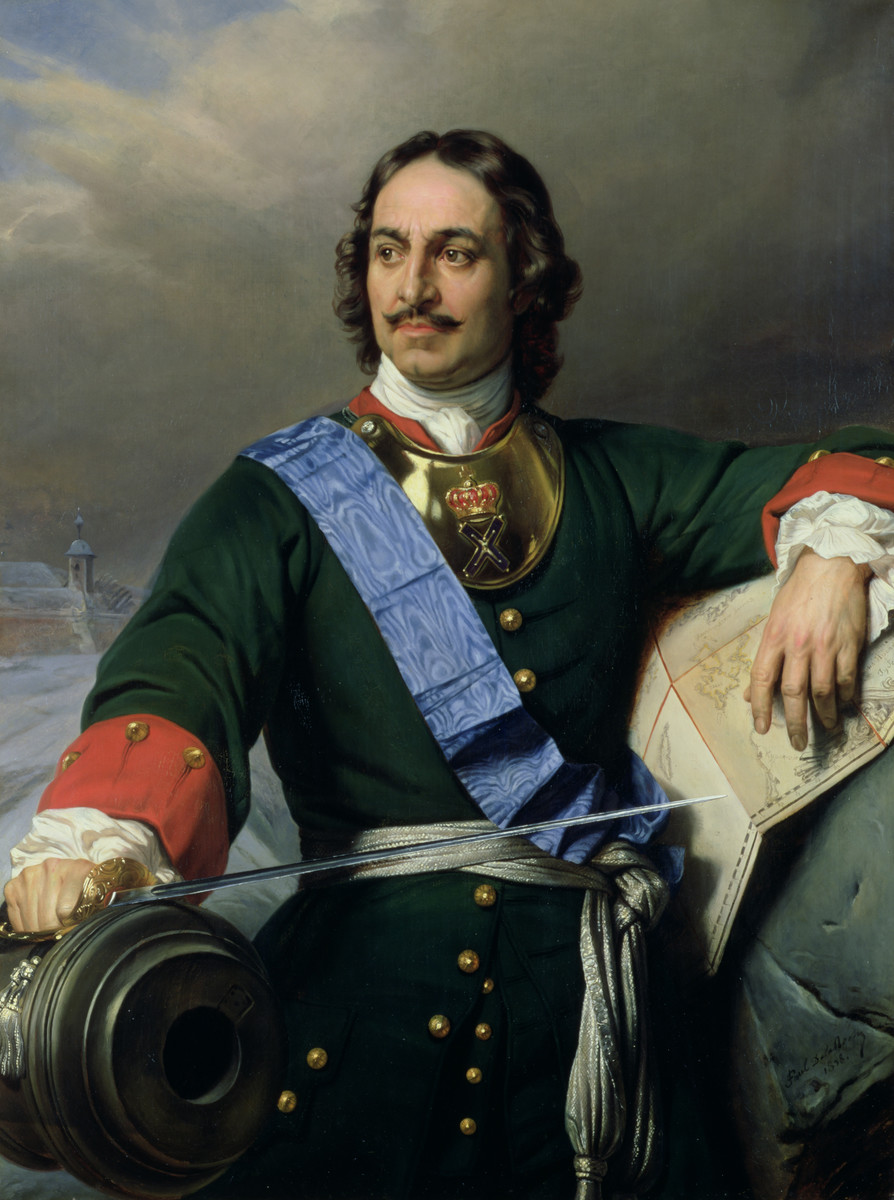
Peter the Great ruled Russia from 1689 until 1725. Peter moved the capital from Moscow to a new city named Saint Petersburg. He made Russian society more modern in many ways. For example, his inspectors shaved off the beards of passers-by. The government began building ships for the Russian navy.
The Russo-Japanese War started in 1904 and ended in 1905 with Japan winning the war. The Russian defeat was one of the reasons for later revolutions.
Russian Republic
1917 was a period of revolutions in Russia. The Government was dissolved after October Revolution in 1917. The Bolsheviks (later called “Communists”) took over the country. They murdered the Tsar Nicholas II, as well as other people who stood against them. The Bolsheviks, led by Vladimir Lenin and Leon Trotsky, created the first Marxist communist state. The Duma declared a Provisional Government. It was better known as the Russian Republic. Vladimir Lenin was the head of government of Soviet Russia from 1917 to 1924. The Russian Republic existed from 1917 to 1918.
USSR
From 1924 to 1953, Joseph Stalin ruled as the absolute dictator of Soviet Union. He destroyed anything and anyone that was against his rule. For example, he took the property of farmers and shopkeepers. Many millions of people starved and died in famines because of this. Stalin also removed, or “purged”, all military members who were not loyal to him. Many people were killed or sent to prison camps, or gulags, for many years. Many prisoners died in gulags.
Soviet Russia and Nazi Germany agreed not to attack each other in 1939. In June 1941, Germany broke the agreement and attacked in Operation Barbarossa. The attack was part of World War II. The war lasted in Europe until May 1945, and Russia lost more than 20 million people during that time. In spite of this large loss, Russia was one of the winners of the war and became a world superpower.
In 1961, Yuri Gagarin flew into space. He was the first man who was in space. Since this period USSR was considered to be a space power. It was during the space race between USSR and USA.
From 1922 to 1991, Russia was the largest part of the Soviet Union, or the Union of Soviet Socialist Republics (USSR). People sometimes used the name “Russia” for the whole Soviet Union, or sometimes “Soviet Russia”. Russia was only one of 15 Soviet Socialist Republics. The republic was in fact named the “Russian Soviet Federative Socialist Republic” (RSFSR).
The Soviet Union fell apart in 1991. Russia took over the place of the USSR in the United Nations (UN).
History of present Russian Federation
Boris Yeltsin was made the President of Russia in June 1991, in the first direct presidential election in Russian history. Wide-ranging reforms took place, for example privatization and free trade laws. Radical changes (shock therapy) were recommended by the United States and International Monetary Fund. A major economic crisis followed. There was 50% decline in GDP and industrial output between 1990 and 1995.
The privatization largely shifted control of enterprises from state agencies to individuals with inside connections in the government system. Many of the newly rich business people took billions in cash and assets outside of the country. The depression of state and economy led to the collapse of social services. Millions went into poverty, from 1.5% of people being in poverty in the late Soviet era to 39–49% by mid-1993. The 1990s had extreme corruption and lawlessness, and the rise of criminal gangs and violent crime.
The 1990s had many armed conflicts in the North Caucasus. There were both local ethnic battles and separatist Islamist insurrections. Because the Chechen separatists declared independence in the early 1990s, a Chechen War was fought between the rebel groups and the Russian military. Terrorist attacks against civilians caused hundreds of deaths. The most notable of these were the Moscow theater hostage crisis and Beslan school siege.
Russia took responsibility for settling the USSR’s external debts, even though its population made up just half of the population of the USSR at the time of its dissolution. High budget deficits caused the 1998 Russian financial crisis and resulted in more GDP decline.
On 31 December 1999, President Yeltsin resigned (quit being the president). The job of president was given to the recently appointed Prime Minister, Vladimir Putin. Putin then won the 2000 presidential election. Putin stopped the Chechen rebellion quickly, but violence still occurs in the Northern Caucasus at times.
High oil prices and initially weak currency followed by increasing domestic demand, consumption and investments has helped the economy grow for nine straight years. This improved the standard of living and increased Russia’s influence on the world stage. While many reforms made during the Putin presidency have been criticized by Western nations as un-democratic, Putin’s leadership led to stability and progress. This won him widespread popularity in Russia.
On 2 March 2008, Dmitry Medvedev was elected President of Russia, whilst Putin became Prime Minister. Putin went back to being the president after the 2012 presidential elections, and Medvedev was made the Prime Minister.
On 24 February 2022, the Russian Federation attacked Ukraine, starting the 2022 Russian invasion of Ukraine.
On 23 June 2023, the Wagner Group, a Russian paramilitary organization, initiated a rebellion against the government of Russia. The revolt arose amidst escalating tensions between the Russian Ministry of Defense and Yevgeny Prigozhin, the leader of Wagner.
Size and resources
At 17,075,400 square kilometres (6,592,848.8 sq mi), Russia is the largest country in the world. It covers more than one-eighth of the Earth’s inhabited land area. Russia is also the world’s eighth most populous nation with 140 million people as of 2022. Russia produces a lot of energy made from oil and natural gas.
Russia extends from eastern Europe across the whole of northern Asia. Russia spans eleven time zones and has a wide range of environments and landforms. Russia has the world’s largest reserves of mineral and energy resources, and is the largest producer of oil and natural gas in the world. Russia has the world’s largest forest reserves, and its lakes contain about one-quarter of the world’s fresh water.
Constitution
Russia is a federal semi-presidential republic. It has a president and a parliament. Russia has 85 federal subjects (territorial units). All subjects of the federation shall be equal. All entities are subject to uniform federal law. Subjects of the federation have two representatives in the parliament. Subjects of the Russian Federation do not have the right to secede from it. Important issues are decided by the Federation President. Lesser powers are given to the member republics.
At the end of the twentieth century, Russia experienced many political changes. Some people fought to leave the federation.
Elections are held at all levels. According to Steve White, the present government made it clear that they had no plans of making a “second edition” of the American or British political system. Instead they wanted a system that was closer to Russia’s own traditions. Richard Sakwa wrote that the Russian government is considered legitimate by the majority of the Russian people. It seeks to deliver a set of public goods without trying to fit to extra-democratic logic to achieve them. Whether the system is becoming less autocratic (dictatorial) is debatable.
Politics
There are four big political parties in Russia. United Russia (Единая Россия) is the biggest party.
The United Russia is the ruling party, which supports the government. The other parties in the Duma (Russian parliament) do not criticize the government strongly, for fear of losing their places in the Duma. Many opposition parties, for the People’s Freedom Party and the Other Russia, have been unable to register due to the strict rules. In the 2000s, the government led a war in Chechnya, and in the process, civil liberties and independent media were restricted. Corruption is widespread and human rights, especially in the North Caucasus, are frequently violated. In 2008, Putin’s government was in a war with Georgia in a dispute over a region with many ethnic Russians.
Geography
The most western point of Russia is near Kaliningrad, formerly named Königsberg. The most eastern point of Russia is Diomid Island, 19 nautical miles from mainland Chukotka (Russia) and 19 nautical miles from Alaska (USA). The most southern point is in Caucasus, on the border with Azerbaijan. The most northern point is on the Franz Josef Land archipelago in Arctic Ocean, 490 nautical miles from the North Pole.
Cities and towns
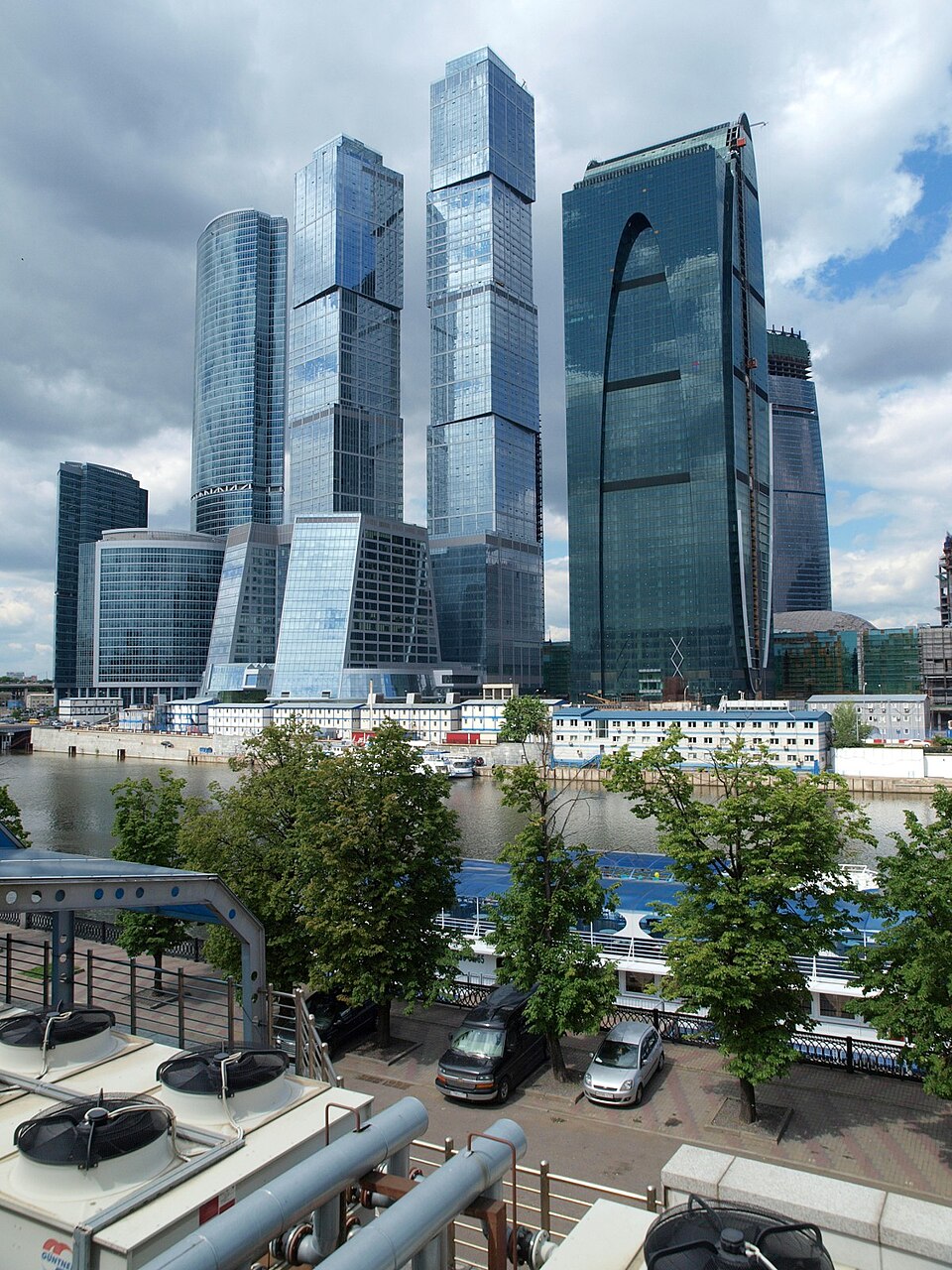
Russia’s capital and biggest city is Moscow. The second-biggest city is Saint Petersburg, which was the capital of Russia in the 18th and 19th centuries.
Administrative divisions
Russia is divided into many different types of administrative divisions. Some of these are called federal subjects. They are the top-level subdivision of Russia. Other types of Russian subdivisions include federal districts and economic regions.
Demographics
Russia has a population of 142 million people. Most people (73.7%) live in cities. The population decreased by 5 million people after the fall of the Soviet Union. The current population growth is close to zero, and the population went down by 0.085% in 2008.
Russia’s area is about 17 million square kilometers (6.5 million square miles). It is the largest country in the world. Its population density is about 8.3 people per square kilometre (21.5 per square mile). This is one of the lowest country densities in the world. The population is most dense in the European part of the country, centering around Moscow and Saint Petersburg. Siberia has a very low density.
Religion
The main religion in Russia is the Russian Orthodox Church. It is one of the Eastern Orthodox Churches.
Music and ballet
Some very famous composers that were born in Russia during the 20th century were Alexander Scriabin, Igor Stravinsky, Sergei Rachmaninoff, Sergei Prokofiev, and Dmitri Shostakovich. Russia has produced some of the greatest pianists: Anton Rubinstein, Vladimir Horowitz and Vladimir Ashkenazy are among the all-time greats.
Russian composer Tchaikovsky created famous ballets, for example The Nutcracker. The impressario Sergei Diaghilev was responsible for the development of ballet in the early 20th century with the Ballets Russes. Dance companies at the Mariinsky Theatre and the Bolshoi Ballet produced many famous dancers.
Literature
Russians have made many famous works of literature. Alexander Pushkin is considered a founder of modern Russian literature. He was a poet from the 19th century.
Other famous poets and writers of the 19th century were Anton Chekhov, Mikhail Lermontov, Leo Tolstoy, Nikolai Gogol (he was born in what is now Ukraine, but during his lifetime Ukraine was a part of Russia), Ivan Turgenev and Fyodor Dostoyevsky. Many people think Tolstoy and Dostoyevsky are two of the greatest novelists ever. Three Russians won the Nobel Prize for Literature in the 20th century: Boris Pasternak (1958), Mikhail Sholokhov (1965) and Aleksandr Solzhenitsyn (1980). Mikhail Bulgakov was one of the most popular writers of the 20th century.
Sports
Soccer, ice hockey and basketball are some of the most popular sports in Russia. Boxing, gymnastics, weightlifting, and tennis are also popular sports. Track suits are popular clothing items for many Russians. Some examples of famous Russian sports people are former tennis world number one Maria Sharapova, who has won three Grand Slam titles, and was the world’s highest paid female athlete in 2008.
After the 1952 Olympic Games, Soviet and later Russian athletes have been third place in gold medals collected at the Summer Olympics. The 1980 Summer Olympic Games were hosted in Moscow, while the 2014 Winter Olympics were hosted in Sochi.
For the 2018 Winter Olympics, which were held in Pyeongchang, South Korea, a lot of athletes could not compete because the International Olympic Committee found out they had been doping. Those who were not caught doping were able to play in the 2018 Olympics as “Olympic Athletes from Russia”. They won two gold medals, and one in ice hockey.
In 6 appearances, Russian athletes have won a total of 425 medals at the summer Olympics and 121 at the winter Olympics. However, more than 30% of these medals were taken from Russia and its teams.
Chess
Chess is the main intellectual sport in Russia. In the 20th century, there were nine Russian World Chess Champions, more than all other nations combined.
Food
Russian cuisine is one of the most famous in the world. It was divided: Old Russian cuisine, Old Moscow cuisine, Petersburg cuisine. The main thing of Russian food is variety of products used for cooking.
Typical Russian food includes: bliny, pelmeni, olivier salad, pies (called pirogi) etc. Russians have many soups such as okroshka, shchi, borsch, ukha, rassolnik. Russian traditional drinks are kvass, mors, sbiten , medovukha, vodka, birch sap.
Written for younger readers
Russia, in simpler words
This version comes from Wikijunior, a set of books written for children aged 8 to 11. It is shorter and uses plainer language than the article above.
From Wikijunior: Asia
Russia (Russian: Росси́я) is a country located in both Asia and Europe (but majority of the country is in Asia). Its full name is the Russian Federation (Russian: Росси́йская Федера́ция). The current president of Russia is Vladimir Putin, the capital of Russia is Moscow and the currency used is the Russian Ruble.
Russia is unusual since it is in two continents: Asia and Europe. To be precise, it is located in northern Eurasia. It is the largest country in the world by land area and stretches from Eastern Europe to Western Asia. It stretches from Eastern Europe to Western Asia. It is also bordered by the Arctic Ocean to the north and the Pacific Ocean to the east. It is the largest country in the world and covers one-eighth of the world’s inhabited area. Since Russia is so large, it shares a border with the following countries:
- Norway: Russia shares a border with Norway to the northwest, across the Barents Sea.
- Finland: Russia shares a border with Finland to the west, across the Gulf of Finland.
- Estonia: Russia shares a border with Estonia to the west, across the Lake Peipus.
- Latvia: Russia shares a border with Latvia to the west, across the River Daugava.
- Belarus: Russia shares a border with Belarus to the southwest.
- Ukraine: Russia shares a border with Ukraine to the south.
- Georgia: Russia shares a border with Georgia to the south, across the Caucasus Mountains.
- Azerbaijan: Russia shares a border with Azerbaijan to the south, across the Caspian Sea.
- Kazakhstan: Russia shares a border with Kazakhstan to the southeast.
- China: Russia shares a border with China to the far east, across the Amur River.
- North Korea: Russia shares a border with North Korea to the far east, across the Tumen River.
Excluding the occupied Crimea, Russia’s population is just under 145 million people (2018). 8.4 people live in every square kilometre. Though it is mainly in Asia, large parts of the population are in Europe. Around 160 nationalities are found in Russia, though native Russians make up about 80% of the population.
The official language of Russia is Russian. Russian uses the Cyrillic alphabet. The Cyrillic alphabet is an alphabet used to write a number of Slavic languages, as well as a number of non-Slavic languages such as Mongolian and Kurdish (spoken in Kurdistan). It is named after the 9th-century missionary Saint Cyril, who is credited with devising the first version of the alphabet.
The Cyrillic alphabet is based on the Greek alphabet (Greek has 24 letters) and consists of 33 letters. It has several letters that are unique to the alphabet and do not have a direct equivalent in the Latin alphabet, such as the letter “ш” (sh) and the letter “щ” (shch). The Cyrillic alphabet is used in a number of countries in Eastern Europe and Central Asia (such as Kazakhstan Kazakh, Kyrgyzstan Kyrgyz, Tajikistan Tajik, Turkmenistan Turkmen and Uzbekistan Uzbek, which is written using the Latin alphabet, although the Cyrillic alphabet is also used.
It is the official alphabet of Russia, Ukraine, and Belarus. It is also used by a number of other languages spoken in the region, including Bulgarian, Serbian, and Macedonian.
Roughly 145 million people speak it as their first language and a further 110 million as an additional language. In certain regions, there are other official languages as well.
Between 13 to 15 percent of Russians know a language other than Russian. Out of all the people who know another language, the largest group is English. About 80% of those who know another language know English.
Russia is mainly Christian and most people are Orthodox Christians. However, there are a significant number of people who are not religious or are Muslim.
Bandy is considered to be the national sport of Russia.
The ancestors of modern Russians were the eastern Slavic tribes. In year 882, they created a state called Rus. The capital city was Kiev (now the capital city and part of Ukraine), where the rulers from the current dynasty called the Rurikids lived. In the 10th century, Orthodox Christianity became a significant religion in Russia.
In the 13th century, all Russian territory was invaded by the Mongols/Tatars, who ruled the land for the next three centuries. During this period, known as the Tatar Yoke, Moscow came to power. The grand dukes of Moscow united the surrounding land and in the 15th century, finally defeated the Tatars.
In the 16th century, after Vasili III (his father) died. Ivan the Terrible was crowned as the first tsar (emperor) of Russia. He had no heirs, so after his death a period of unrest begun. After that a new dynasty, called the Romanovs, was started (Ivan the Terrible’s wife was a part of the dynasty). Under their rule, the Russian Empire (1721-1917) became very powerful.
At the beginning of the 18th century, Peter the Great, the tsar of Russia, founded a new capital city, in the north, and named it St. Petersburg.
In 1917, many people in Russia, led by Vladimir Lenin, successfully revolted against the Tsar Nicholas II, in the ‘October Revolution’. The capital was then moved again to Moscow, and St. Petersburg was renamed Leningrad. The factories were nationalized and the farms were joined into “collective” farmlands (called kolkhoz). This new nation was called the USSR (Union of Soviet Socialist Republics).
During World War II, Nazi Germany (Third Reich) invaded the Soviet Union, this was called Operation Barbarossa by the Germans. However, in the end, the Soviets drove the Nazis out and followed them to Berlin. After the war, the USSR occupied large parts of Europe. But, the planned economy turned to be inefficient and the people weren’t satisfied with the government. The USSR splintered into fifteen independent republics (Armenia, Azerbaijan, Belarus, Estonia, Georgia, Kazakhstan, Kyrgyzstan, Latvia, Lithuania, Moldova, Russia, Tajikistan, Turkmenistan, Ukraine and Uzbekistan) and was officially did not exist anymore as of December 1991.
- St. Basil’s Cathedral is a cathedral in Moscow, Russia’s capital city. Its full name is the ‘Cathedral of Vasil the Blessed’. Since 1991, it has been Russia’s museum, only holding occasional services. It is a Russian Orthodox cathedral which has ten domes and two spires. At the highest point it is 47.5 metres. It was consecrated (made a church), in 1561.
- The Kremlin is in Moscow. It is a fortified complex, its name meaning ‘fortress inside a city’. The area was inhabited since the 2nd century BC and the word ‘Kremlin’ was first recorded in 1331. It had previously been called the ‘grad of Moscow’.
- The Bronze Horseman is a statue in St. Petersburg, Russia’s second most populous city. It was built in the 18th century. The statue is on the largest stone to have ever been moved by humans, called the Thunder Stone. File:Moscow 05-2012 StBasilCathedral.jpg|St. Basil’s Cathedral File:Moscow Grand Kremlin Palace3.jpg|thumb|Moscow Kremlin File:The Bronze Horseman (St. Petersburg, Russia).jpg|thumb|Bronze horseman statue on the Thunder Stone
There are many important people from Russia. A fuller list can be found here on Wikipedia.
- Vladimir Lenin, leader of the Bolshevik Party led the ‘October Revolution’ where the Bolsheviks seized control of the Russian Empire and made it the USSR, he also created a philosophy called Leninism. He was the founder and first leader of the USSR.
- Fabian Bellingshausen, a Russian explorer discovered Antarctica.
- Yuri Gagarin was the first person to enter space in 1961.
- Mikhail Lomonosov was a Russian polymath often called the ‘father of Russian science’.
The Russian president is not part of the Russian government, but the President get to appoint the Prime Minister. The Prime Minister of Russia is the leader of the government. The Prime Minister will become the President if the current President is unable to continue ruling or resigns. The current Prime Minister is Dmitry Medvedev, and the President is Vladimir Putin.
Russia’s currency is the Russian Ruble (RUB) (₽). The Bank of Russia/Central Bank of the Russian Federation controls the ruble and the only authorized producer of the currency. The ₽ symbol was approved by the Bank of Russia on December 11, 2013 after more than 61% of the participants on the online discussion held on the website supported it. The Soviet ruble (SUR) was renamed the Russian ruble (RUB) (previously RUR) after the USSR/Soviet Union’s fall in 1991. According to the Bank of Russia, 17.9 trillion rubles are in circulation as of July 1, 2024. A hundredth of a ruble is called a kopeck which is equal to a cent. Banknotes currently in circulation are 5 ₽, 10 ₽, 50 ₽, 100 ₽, 200 ₽, 500 ₽, 1000 ₽, 2000 ₽ and 5000 ₽. Coins currently in circulation are 1 kopeck, 5 kopecks, 10 kopecks, 50 kopecks and 1 ₽, 2 ₽, 5 ₽, and 10 ₽.
The banknotes are all printed on cotton paper.
Where this page comes from
The article above is adapted from “Russia” on Simple English Wikipedia, by its contributors. We removed reference markers, navigation boxes and tables, expanded measurement templates into readable numbers, and kept the prose otherwise intact. The simpler version is adapted from Wikijunior on Wikibooks.
Both sources are published under CC BY-SA 4.0, so this page is published under the same licence. You may share and adapt it, including commercially, as long as you credit the original and keep the same licence.
Worksheets, answer keys and printable layouts elsewhere on K5Print are our own work and are not covered by this licence.