Rwanda

Fast facts
- Capital
- Kigali
- Largest city
- Kigali
- Languages
- Kinyarwanda
- Currency
- Rwandan franc
- Time zone
- CAT
- Drives on
- right
- Calling code
- +250
Facts from Wikipedia’s “Rwanda” page (CC BY-SA 4.0).
Rwanda is a country in East Africa. It is landlocked, meaning it has no ocean coast. Rwanda is sometimes called the “Land of a Thousand Hills” because it has many mountains and hills. Its capital city is Kigali.
Rwanda is bordered by Uganda to the north, Tanzania to the east, Burundi to the south, and the Democratic Republic of the Congo to the west. The country is about the size of the U.S. state of Massachusetts, but it has more people. More than 14 million people live there.
In the Rwandan genocide of 1994, over one million (1,000,000) people were killed. Since then, Rwanda has rebuilt its economy and society. Today it is known for its clean cities, national parks with mountain gorillas, and fast economic growth.
Colonialism
During the Scramble for Africa, Belgium conquered Rwanda. The Belgians then began to divide Rwandans into groups: Hutu and Tutsi. The Belgians picked people that they thought looked more European to be Tutsi. The rest became Hutu. The Belgians told Rwandans that Tutsi were superior to Hutu. They helped Tutsi rule over Hutu using their army.
After independence
On July 1, 1962, Rwanda became independent and Hutu were given power. Thus, anti-Tutsi purges occurred frequently. Many Tutsi fled to Uganda, where they formed the Rwandan Patriotic Front, or RPF, which tried to invade Rwanda in 1990.
Genocide
See the main article: Rwandan genocide
On the night of April 6, 1994, dictator Juvénal Habyarimana’s plane was shot down, but it is still not clear who did it. Within half an hour, roadblocks manned by the Interahamwe militia were seen all over the capital, Kigali. A genocide against the Tutsi people began.
The Rwandan genocide lasted for about 100 days, and it left over one million (1,000,000) Tutsi and moderate Hutu dead. The main weapon used was the machete, or umupanga. Other countries paid little attention to the killings.
On July 2, 1994, the RPF captured Kigali.
Size and location
Rwanda is a small country in East Africa. It is bordered by Uganda to the north, Tanzania to the east, Burundi to the south, and the Democratic Republic of the Congo to the west. It lies a few degrees south of the Equator and is landlocked, meaning it has no coastline. The capital city is Kigali, which is near the centre of the country.
Rwanda has a total area of 26,338 km² (10,169 sq mi), making it the world’s 144th largest country. The entire country is at a high altitude; its lowest point is the Rusizi River (sometimes spelled Ruzizi) at 950 metres (3,120 ft) above sea level.
Rivers & lakes
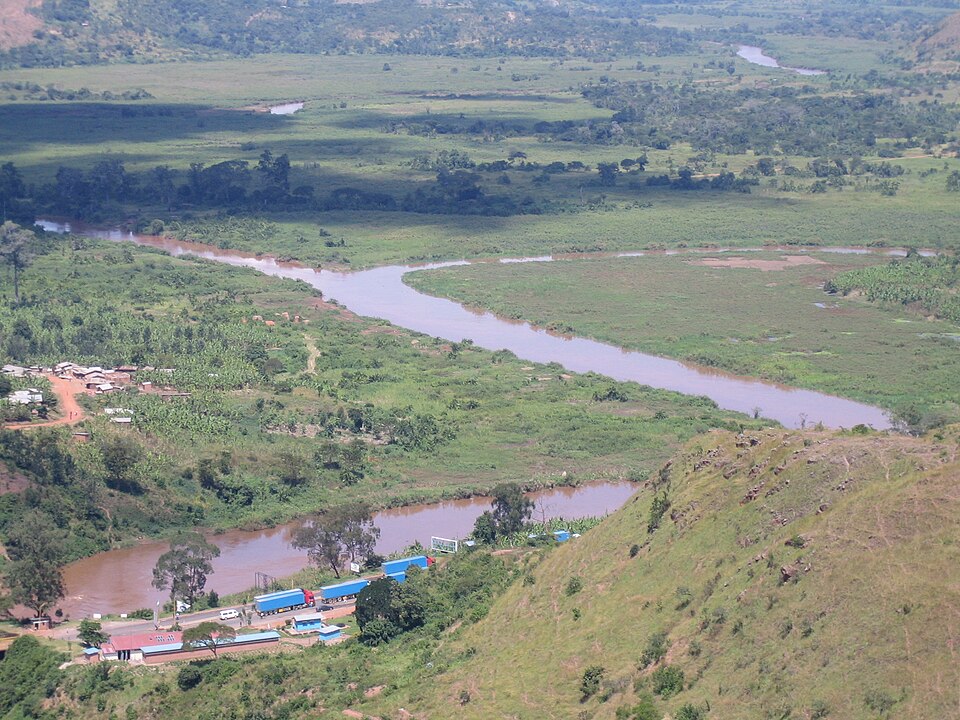
The country’s longest river is the Nyabarongo. The Nyabarongo-Kagera eventually drains into Lake Victoria.
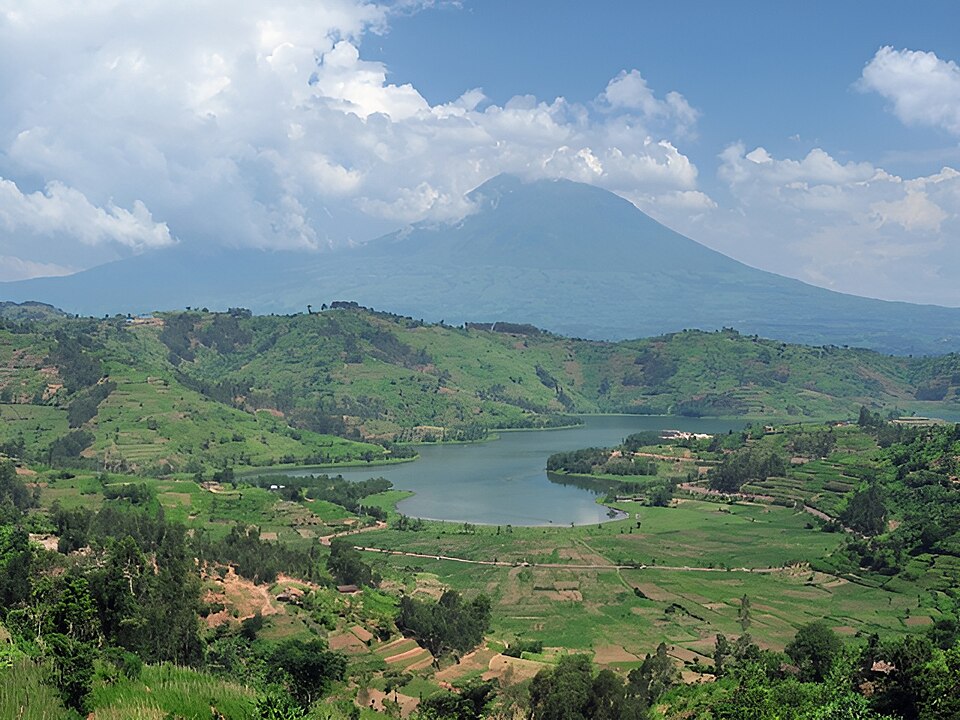
Rwanda has many lakes, the largest being Lake Kivu. It is one of the twenty deepest lakes in the world. Other sizeable lakes include Burera, Ruhondo, Muhazi, Rweru, and Ihema. Ihema is the largest of a string of lakes in the eastern plains of Akagera National Park.
Mountains
There are many mountains in central and western Rwanda. The highest peaks are found in the Virunga volcano chain in the northwest. This includes Mount Karisimbi, Rwanda’s highest point, at 4,507 metres (14,790 ft).
The centre of the country is mostly rolling hills. The eastern border area has savanna, plains and swamps.
Climate
Rwanda has a temperate tropical highland climate. It has lower temperatures than equatorial countries usually do because of its high elevation. Kigali, in the centre of the country, has a typical daily temperature range between 12 degrees Celsius (12 °F) and 27 degrees Celsius (27 °F). There is little change through the year.
There are two rainy seasons in the year. The first runs from February to June and the second from September to December. These are separated by two dry seasons. The major one is from June to September, during which there is often no rain at all. There is a shorter and less severe one from December to February.
Biodiversity
In prehistoric times, montane forest covered one third of the land of present-day Rwanda. Naturally occurring vegetation is now mostly in the three national parks, with terraced agriculture in the rest of the country.
Plants
Nyungwe, Rwanda’s largest remaining forest, has 200 species of trees as well as orchids and begonias. Vegetation in the Volcanoes National Park is mostly bamboo and moorland, with small areas of forest.
Akagera has a savanna ecosystem. Here there are mostly acacia. There are several rare or endangered plant species in Akagera, including Markhamia lutea and Eulophia guineensis.
Mammals
The greatest diversity of large mammals is found in the three National Parks. Akagera has typical savanna animals such as giraffes and elephants, while Volcanoes is home to about one third of the worldwide mountain gorilla population.
Nyungwe Forest has thirteen primate species including chimpanzees and Colobus monkeys. The Ruwenzori colobus move in groups of up to 400, the largest troop size of any primate in Africa.
Birds
There are 670 bird species in Rwanda. There is a difference between the east and the west.
Nyungwe Forest, in the west, has 280 recorded species. Species include the Ruwenzori Turaco and Handsome Francolin.
Eastern Rwanda, by contrast, has savanna birds such as the Black-headed Gonolek, and birds who live near swamps and lakes (like storks and cranes).
Written for younger readers
Rwanda, in simpler words
This version comes from Wikijunior, a set of books written for children aged 8 to 11. It is shorter and uses plainer language than the article above.
From Wikijunior: Africa
Rwanda is a small country in east Africa which has borders with Uganda, Tanzania, Burundi and the Democratic Republic of the Congo. The currency of Rwanda is the Rwandan franc.
People have lived in Rwanda since the Stone Age. Tutsi Kings ruled Rwanda in the 18th century until the end of the 19th century. Rwanda was colonized by Germany, then later Belgium. In 1994, there was a genocide in Rwanda which killed up to 1 million people.
11.4 million people live in Rwanda. Rwanda has 3 official languages: Kinyarwanda, French and English.
Where this page comes from
The article above is adapted from “Rwanda” on Simple English Wikipedia, by its contributors. We removed reference markers, navigation boxes and tables, expanded measurement templates into readable numbers, and kept the prose otherwise intact. The simpler version is adapted from Wikijunior on Wikibooks.
Both sources are published under CC BY-SA 4.0, so this page is published under the same licence. You may share and adapt it, including commercially, as long as you credit the original and keep the same licence.
Worksheets, answer keys and printable layouts elsewhere on K5Print are our own work and are not covered by this licence.