Taiwan

Fast facts
- Largest city
- New Taipei City
- Capital
- Taipei Taipei
- Languages
- Traditional Chinese
- Currency
- New Taiwan dollar (NT$)
- Time zone
- National Standard Time
- Drives on
- Right
- Calling code
- +886
Facts from Wikipedia’s “Taiwan” page (CC BY-SA 4.0).
The Republic of China (ROC; Chinese: 中華民國; pinyin: Zhōnghuá Mínguó), commonly known as Taiwan, is a disputed self-governing region off the coast of mainland China in East Asia. The Republic of China once governed all of China (from 1911 to 1949) but moved to the island of Taiwan after their defeat in a Chinese civil war.
Though ROC still de jure includes mainland China as its official territory, but its de facto territory is only the main island of Taiwan plus nearby islands (Pescadores islands and parts of Fujian). Taiwan is located southeast of the Chinese mainland, south of Japan, and north of the Philippines. While its de jure capital is Nanjing, the de facto one is Taipei.
Taiwan has also been called Formosa, a Portuguese name which means “beautiful” in Portuguese.
Most people living in Taiwan (called Taiwanese) are Han. Taiwan has three large Han groups. They speak different dialects (variations) of Chinese, and their ancestors came from different places: the Southern Fujianese (from China’s Fujian Province), the Hakka (from China), and Mainlanders (from Mainland China after 1948).
There are also Taiwanese Aborigines (native tribes) who lived in Taiwan before the Han came to live there.
The largest cities in Taiwan are the capital, Taipei, and the port city of Kaohsiung.
Taiwan’s government, “does not want China’s ‘one country, two systems’ “, according to media (in 2025).
Timeline
In AD 230, Taiwan described as “Yizhou” in the account of an expedition undertaken by the Eastern Wu dynasty of China.
In 1517, A Portuguese discovery ship sees this island and renames it “Ilha Formosa”, or “Beautiful Island” in Portuguese.
17th century: From 1624 until 1661 Dutch colonize the southern part of Formosa and set up a colonial administration in Fort Zeelandia, and the Spanish colonize the north and set up a colonial administration in Fuerte Santo Domingo or Fort Santo Domingo. The Dutch later defeat the Spaniards and take full control of Formosa.
1662, Chinese general Koxinga (Zheng Chenggong) defeats the Dutch at the Siege of Fort Zeelandia and then controls Taiwan.
1683, Shi Lang, the commander-in-chief of the Qing China fleets destroy the power of Zheng Chenggong’s descendants in the 1660s, and lead the conquest of the Zheng family’s Kingdom of Tungning. Taiwan becomes Qing territory.
1860: Taiwan becomes a treaty port after the Treaty of Tientsin, opening the island to contact with the world.
1874: Japan invades southern Taiwan, seemingly to “punish” the natives there for the murder of ship-wrecked Okinawan fishermen in 1871, but actually to establish a colony. Japanese forces withdraw later in the year after the Meiji and Qing empires nearly went to war.
1884-1885: Taiwan is blockaded by French navy during the Sino-Franco War.
1895: Qing China loses the First Sino-Japanese War and gives Taiwan to Japan permanently (Treaty of Shimonoseki).
1911: The Xinhai Revolution ends China’s last imperial dynasty, the Qing dynasty, and leads to the establishment of the Republic of China.
1927: Start of the Chinese Civil War between the Kuomintang (KMT) party and the Communist Party of China (CCP). The war would later be put on hold, so the two sides could fight Japan together during World War II.
1945: Japan loses World War II to the U.S. and its allies
1947: Taiwanese widely protest governmental corruption under the Nationalists. Chiang Kai-shek sends in the army to restore order, killing tens of thousands. Some Taiwanese began the Taiwan independence movement.
1949:
The Nationalists (KMT) lose the civil war, which resumed after World War II, and escape to the disputed island of Taiwan. They set up Taipei as the temporary capital of Republic of China (ROC).
The Communist Party of China (CCP) establishes Beijing as the capital of The People’s Republic of China (PRC).
1951: Japan signs the Treaty of San Francisco (1951) with the U.S. and 47 other countries, formally denouncing any claim to Taiwan.
1952: Japan and the ROC sign the Treaty of Taipei, which is similar to the Treaty of San Francisco.
1971: Taiwan is expelled from the United Nations and replaced by the PRC.
1979: The KMT government jails many democracy activists who opposed it (Kaohsiung Incident).
1986: The Democratic Progressive Party (DPP) is formed; it is the first party to form in the ROC other than the KMT. It remains illegal for the first year, but the KMT government does not try to ban it.
1987: The KMT government lifts martial law after almost 40 years.
1988: Lee Teng-hui (KMT) became president after Chiang Ching-kuo dies.
1995: Lee Teng-hui (KMT) became the first president elected by the people.
2000: Chen Shui-bian (DPP) became president.
2004: Chen Shui-bian is re-elected after a controversial assassination attempt, in which many KMT-supporters believed, was staged by Chen. However, after unwillingness to cooperate about his medical records the investigation was inconclusive.
2008: Former president Chen Sui-bian and his wife are arrested for corruption and money laundering.
2008: Ma Ying-jeou (KMT) was elected as the president of the Republic of China and thus creating a change of political parties for the second time.
2009: Kaohsiung hosts the 2009 World Games.
2016: Tsai Ing-wen (DPP) was elected as the first female president of Taiwan.
2019: Same-sex marriage is legalized
2024: Lai Ching-te (DPP) is elected as the president that made a history for a political party to govern for three consecutive terms after the first presidential election of 1996.
Status of Taiwan
There are two Chinese governments: The People’s Republic of China (PRC) and the Republic of China (ROC). Today, in reality, the PRC government controls mainland China, and the ROC government governs Taiwan. The ROC government governed most of China mainland from 1911 to 1949, before losing control of China mainland to the PRC. The ROC constitution still claims ownership of all of China, and does not recognise China as an independent country.
The People’s Republic of China claims ownership of Taiwan, but it has never ruled over the island of Taiwan. The last time Taiwan and the mainland were united under one government was under the rule of the ROC.
Although Taiwan’s status prevents it from participating in some international organizations, polls show that most Taiwanese prefer to keep things as they are (referred to as the status quo), rather than declare formal independence (and risk inviting an attack by communist China), or to be “reunified” with China.
Most countries of the world recognize the People’s Republic of China as China. Although Taiwan is not recognized by the UN as a sovereign nation, most countries still have close economic and cultural relations with Taiwan. Countries often set up de facto embassies in Taiwan — officially non-government organizations — that perform the same functions as an embassy.
In 1992, the ROC and PRC agreed to a consensus that there was only “one China” but that both sides could continue to disagree on what that meant.
In March 2004, China’s government passed a law called the Anti-Secession Law. The law requests the Chinese military to invade Taiwan immediately if they declare independence. Tsai Ing-wen, the elected President of Taiwan, made a controversial statement that Taiwan is already an independent country and does not need to declare independence.
General Secretary of the Chinese Communist Party Xi Jinping, has vowed “reunification” with Taiwan by any means, including through military force. Joe Biden, Former President of The United States, has said that the US will defend Taiwan from Chinese attack, despite not recognising Taiwan as independent. Australia has said they would join the US, and Japan has indicated they may as well.
Polls show a majority of people in Taiwan want to never be a part of the People’s Republic of China. Some of these people believe in complete Taiwan independence and want to rename the ROC (Taiwan) to “Republic of Taiwan” so Taiwan can participate in international affairs. Most others want the status quo, which means keeping everything the way it is now. However, a minority also wishes to someday unite with the People’s Republic of China; they want Chinese reunification.
Geography
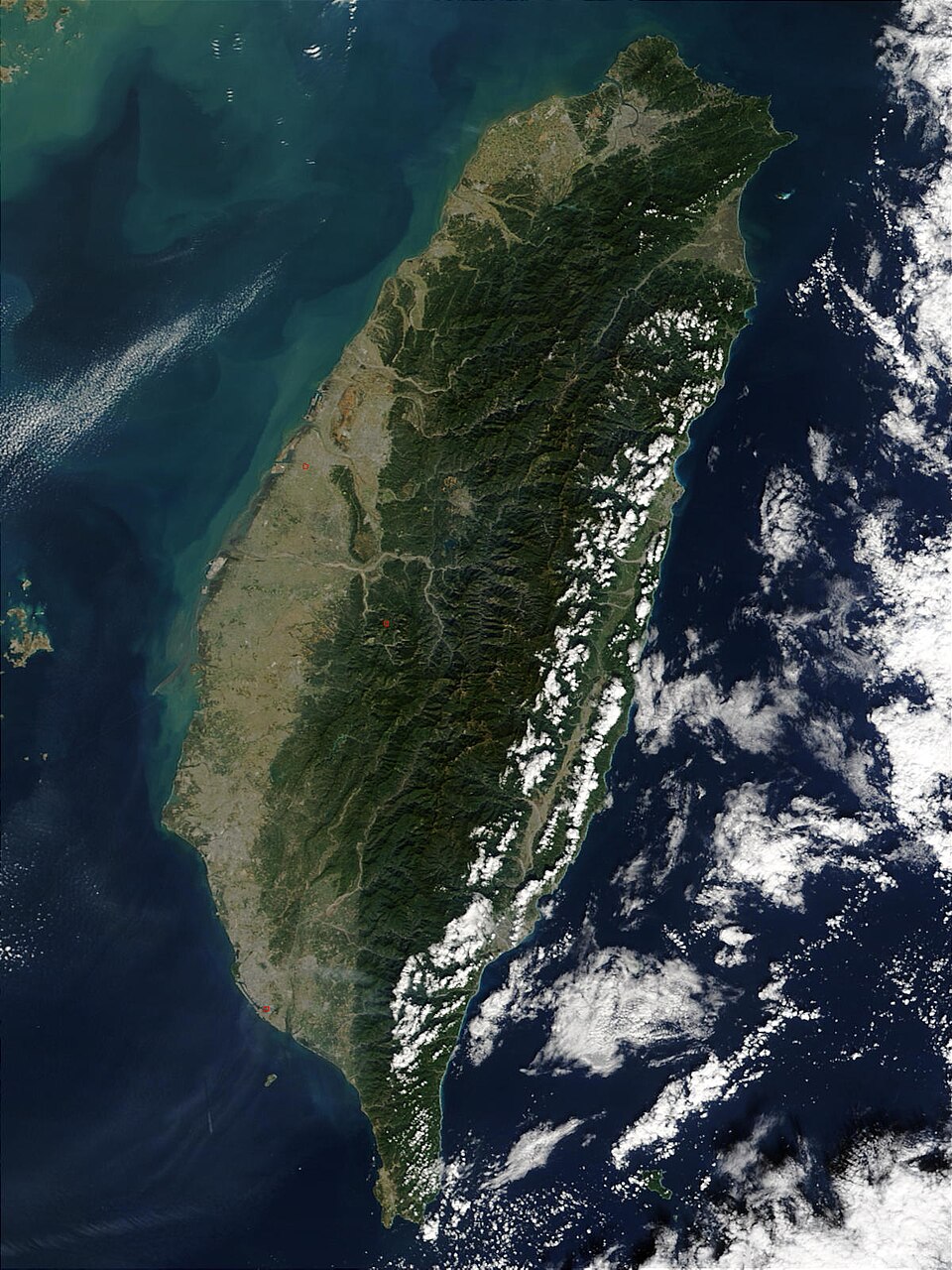
The island of Taiwan is about 180 kilometers off the southeastern coast of China. It is across the Taiwan Strait. It has an area of 35,883 km² (13,855 sq mi).
The East China Sea is to the north, the Philippine Sea to the east, the Luzon Strait directly to the south and the South China Sea to the southwest.
Taiwan’s highest point is Yu Shan (Jade Mountain). It is 3,952 meters high (12,966 ft). There are five other peaks over 3,500 meters.
West of Taiwan Island, there are three small groups of islands that also belong to ROC. They are:
- The Pescadores (Penghu, 澎湖列島): They also are part of Taiwan Province.
- Quemoy (Kinmen, 金門): A part of Fujian province, called Kinmen County(金門縣).
- Matsu (馬祖列島): the smallest county, called Lienchiang County(連江縣), also part of Fujian province
- Diaoyutai Islands:The Diaoyutai Islands (釣魚臺列嶼|Diàoyútái Lièyû|ㄉㄧㄠˋㄩˊㄊㄞˊㄌㄧㄝˋㄩˊ) are a group of islands where nobody lives that the Republic of China (ROC) claims belong to them, but also claimed by the People’s Republic of China (PRC) and Japan. In Japanese, the islands are known as the Senkaku Islands (尖閣諸島, Senkaku Shotō?). The islands are now under the control of Japan.
- Dong-Sha Islands:The Pratas Islands or Dong-Sha Islands (東沙羣島) consists of three islands in the northeastern South China Sea, 340 km southeast of Hong Kong.
- Taiping (Traditional Chinese: 太平島|Tàipíngdǎo|ㄊㄞˋㄆㄧㄥˊㄉㄠˇ), also known as Itu Aba, is the largest of the Nansha Islands (Spratly Islands) in the South China Sea.
Cities
The largest cities in Taiwan are:
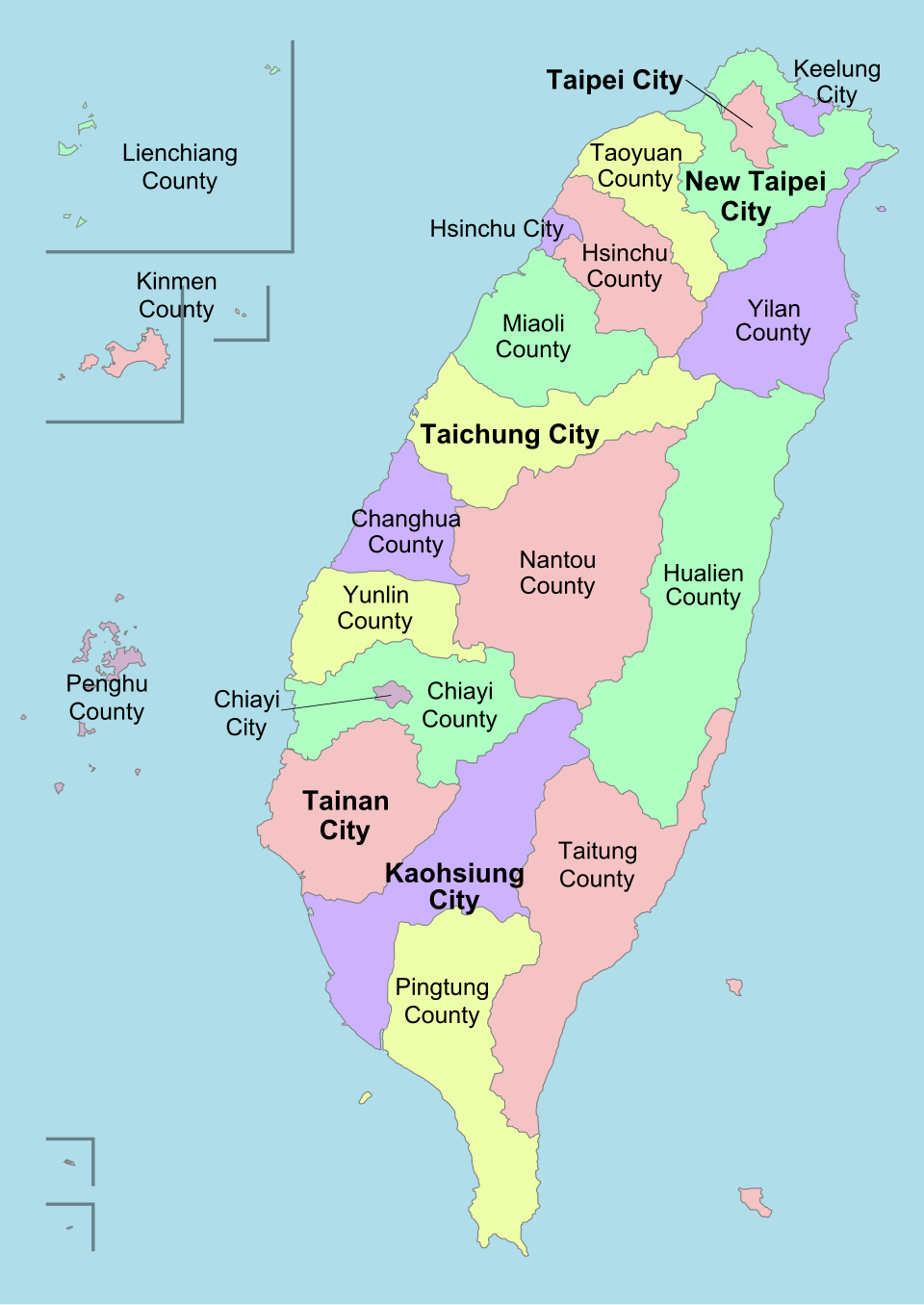
Administrative divisions
There are administrative divisions in different levels and types.
Provinces (省 shěng ㄕㄥˇ) (1st level):
Taiwan Province
Fujian Province
Special municipalities (直轄市 zhíxiáshì ㄓˊㄒㄧㄚˊㄕˋ) (1st and 2nd level):
Kaohsiung City
New Taipei City
Taipei City
Taichung City
Tainan City
Taoyuan City
Provincial cities (市 shì ㄕˋ) (2nd level):
Keelung City
Hsinchu City
Chiayi City
Counties (縣 xiàn ㄒㄧㄢˋ) (3rd level):
Changhua County
Chiayi County
Hsinchu County
Hualien County
Kinmen County
Lienchiang County
Miaoli County
Yilan County
Yunlin County
157 Districts (區 qū ㄑㄩ), 17 Country-controlled cities (縣轄市 xiànxiáshì ㄒㄧㄢˋㄒㄧㄚˊㄕˋ), 41 Urban Townships (鎮 zhèn ㄓㄣˋ), and 153 Rural Townships (鄉 xiāng ㄒㄧㄤ) stand the 3rd level. Districts stand under either Special municipalities or Provincial cities; Country-controlled cities, Urban Townships, and Rural Townships stand under Counties.
Villages (里 lǐ ㄌㄧˇ or 村 cūn ㄘㄨㄣ) stand the 4th level, and Neighborhoods (鄰 lín ㄌㄧㄣˊ) stand the 5th level.
Language
Most Taiwanese people speak Standard Chinese known as Mandarin, and others speak local dialects such as Min Nan (Taiwanese) or Hakka. The Cantonese language, spoken in parts of southern China (for example, the province of Guangdong, Hong Kong and Macau), is not spoken in Taiwan. A small percentage of Aboriginal Taiwanese speak aboriginal languages, but the rest of the Chinese people have treated them badly, and many of these people and their languages, struggle to survive. Some older Taiwanese people who went to school while the country was under Japanese rule can speak Japanese.
After the Nationalist government fled the Mainland in 1949, they brought Mandarin and promoted it in Taiwan. Then everyone in the ROC had to learn Mandarin. But, unlike the people in Mainland China, the Taiwanese never changed to simplified Chinese characters and so they have always used traditional Chinese characters. In the past, students were not allowed to speak their first language in school and were expected to speak only Mandarin. Taiwanese, Hakka, and native languages were considered bad until the early 1990s, when education in these languages began to be taught in some school systems. They were promoted, but by this time, many young people could speak only Mandarin.
Currently, nearly one third of Taiwanese report knowing some amount of English. Full English fluency is not common, however. The government plans to expand English education and make it an official language by 2030.
Relations with other countries
United States: In February 2025, the State Department (USA) removed a statement from its website that said that it does not support Taiwan independence; The website also added support for Taiwan’s membership in international organizations. Taiwan has no embassy in the United States (as of the 2020s).
Written for younger readers
Taiwan, in simpler words
This version comes from Wikijunior, a set of books written for children aged 8 to 11. It is shorter and uses plainer language than the article above.
From Wikijunior: Asia
Taiwan (traditional Chinese: 臺灣/台灣; simplified Chinese: 台湾), officially the Republic of China (ROC), is an island country in Eastern Asia.
Taiwan’s beginnings track back to the 15th century, where Portuguese sailors passing by recorded the island’s name as Ilha Formosa (“beautiful island”). In 1624, the Dutch East India Company established a base in southwestern Taiwan, going from aboriginal grain production practices and employing Chinese laborers to working on rice and sugar plantations. In 1683, the Qing Dynasty (1644-1912) forces take control of Taiwan’s western and northern coastal areas and declared Taiwan as a province of the Qing Empire in 1885. In 1895, after being defeated in the First Sino-Japanese War (1894-1895), the Qing government signed the Treaty of Shimonoseki, handing over Taiwan’s sovereignty to Japan, who ruled the country until 1945.
Taipei is the capital city of Taiwan and New Taiwan Dollar (NT$) is the currency of Taiwan.
Taiwan is in the Philippine Sea, neighboring China towards the west, Japan towards the northeast and the Philippines to the south.
Based on last national census in 2010, the population of Taiwan is estimated at 23.12 million peoples. The natives identifies themselves as Taiwanese. The population of Taiwan is composed of these ethnic or sub-ethnic groups: Groups of the Fukien Taiwanese (Fukienese [Fujianese], or Hoklo) and the Hakka (84%) and Chinese who came from mainland China (14%) , aboriginal peoples (2.0%). The aboriginal people consists of sub-ethnic group such as: Amis , Atayal, Paiwan, Bunun, Rukai, Puyuma, Tsou, Saisiyat , Truku and Sediq.
According to Taiwan National Census 2010, large majority of populations (83.5%) in Taiwan speak Mandarin (Guoyu) . Concurrently, 81.9% of population, also speaks a special dialect of Chinese known as the Taiwanese Hokkien / Minan. It is the most common language used among the population and can be seen and heard all over in public. The language form is of Southern Min (often called Taiwanese on Taiwan), which comes from southern Fukien province. 6.6% speaks Hakka and 1.4% speak indigenous languages.
Taiwanese Mandarin is the official language in Taiwan. It serves as the lingua franca of the country. While the vocabulary of the Mandarin spoken in Taiwan is still modern, the country uses the Traditional Chinese characters to write the language. This is in contrast to mainland China, which has adopted a simplified way of writing the characters (known as Simplified Chinese characters).
The mainlanders speak Mandarin Chinese, the official language of China. Most aboriginal people speak Mandarin; many speak Taiwanese, and a small number of people (mostly elders) speak Japanese. Hoklos also speak Mandarin. Most Hakka speak Taiwanese and Mandarin.
The Aboriginal peoples practice animism, nature worship, and other Indigenous religious rites (18.2%). The Chinese brought Buddhism (35.3%), Daoism (Taoism) (33.2%), and Confucianism to Taiwan. The Dutch introduced Protestant Christianity and the Spanish Roman Catholicism (3.9%). The Japanese brought Shinto (9.4%). In 1949, many religious groups and religious leaders—especially Confucian, Buddhist, and Daoist—fled to Taiwan from China.
The most popular sport in Taiwan by far is baseball.
It was introduced to Taiwan by Japan after China ceded control of the island to Japan in 1895. Initially played only by Japanese colonial administrators, by the 1920s interest in the sport spread across the island with games between Taiwanese natives and Japanese immigrants becoming common
Over the decades, the local Taiwanese honed their own techniques and some of the talented players are exported to USA, Japan and South Korea.
File:淡水紅毛城.jpg|Fort Santo Domingo File:Taipei 101 mass damper MichaD 1.jpg|Taipei 101 mass damper File:Yeliou queen rock formation.JPG|Yehliu queen head rock File:艋舺夜市 201911.jpg|Night market in Taiwan File:Thermal Valley (24224318541).jpg|Beitou Hot Springs File:Whale Cave on Siaomen Island.jpg|Whale Cave on Siaomen Island File:SunMoonLake.jpg| Sun Moon Lake File:Ddm 2004 010 Qijing Kaohsiung.jpg|Cijin Wind Turbine Park
The Taiwan is a very interesting places with there are many things to see and do in Taiwan.
Fort Santo Domingo - Fort Santo Domingo was built in 1629 by the Spanish, although the site has been home to both Dutch and British since. Situated in Xinbei, the fort has been altered by both the Dutch and British, who constructed stone walls and added the British Consulate.
Taipei 101 - Finished construction in 2004, it was once the world’s tallest skyscrapper. It is located in the Xinyi District of Taipei, an area known for its financial services and vibrant shopping malls. One of the more famous attractions is a 728-ton tuned mass damper (TMD), a large spherical steel pendulum that offsets lateral movements caused by strong winds.
Yehliu Geopark - It is on Taiwan’s north coast cape in Wanli, near Keelung City, famous for its hoodoo stones, thin spires of rock formed by sedimentary stone. Many rock formations have creative names, including the most well-known “The Queen’s Head.”
Night markets - Night Markets is initially began as informal vendor meetings, where merchants would get together and sell their wares. It is a local Taiwanese culture where the usually empty streets at day time will be filled with the vendors selling all sorts of goods during evening time. One of the more famous and largest night market in Taiwan is Shilin night market
Hot Springs - There are many hot springs that are located in Taiwan due to its proximity location near the Ring of Fire , one of the more famous one is Beitou Hot Spring
Whale Cave - It is a natural basalt sea cave on the north side of Hsiaomen Island in Penghu , and one of the many tourist attractions in the area. According to some it looks like a whale, but that is not the true origin of its name. The actual reason for the cave’s name “Whale Cave” is that, a long time ago, a whale got stuck in the cave and died. According to local legend, a bone from that whale is now inside Dayi Temple located near to the Whale Cave.
Sun Moon Lake - It is Taiwan’s largest lake Taiwan’s largest lake,and located in the mountains of Nantou at the geographic centre of Taiwan island. The name of the lake is inspired by the beauty of the area. The east side of the lake is round, like the sun, while the west side is long and narrow, like a crescent moon.
Cijin Wind Turbine Park - There are some wind turbines that are built there with purpose of generating electricity for the park lights.
Where this page comes from
The article above is adapted from “Taiwan” on Simple English Wikipedia, by its contributors. We removed reference markers, navigation boxes and tables, expanded measurement templates into readable numbers, and kept the prose otherwise intact. The simpler version is adapted from Wikijunior on Wikibooks.
Both sources are published under CC BY-SA 4.0, so this page is published under the same licence. You may share and adapt it, including commercially, as long as you credit the original and keep the same licence.
Worksheets, answer keys and printable layouts elsewhere on K5Print are our own work and are not covered by this licence.