Tajikistan

Fast facts
- Capital
- Dushanbe
- Official language
- Tajik
- Currency
- Somoni
- Time zone
- TJT
- Drives on
- right
- Calling code
- +992
Facts from Wikipedia’s “Tajikistan” page (CC BY-SA 4.0).
Tajikistan is a country in Central Asia. It was previously part of the Soviet Union. Tajikistan is a republic. The capital city is Dushanbe. The official language is Tajik, which is a dialect of Farsi (Persian).
Tajikistan is a member of the Commonwealth of Independent States, the CIS. Tajikistan is eighth in size of CIS countries.
Geography
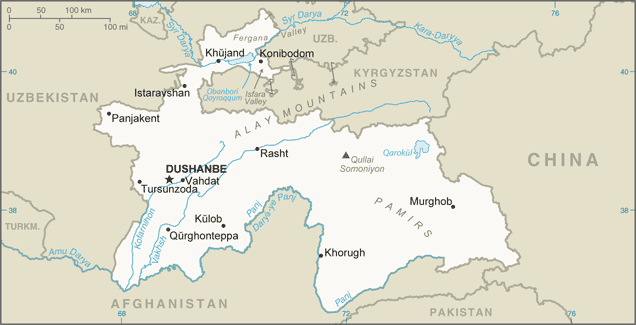
Tajikistan is one of the countries in South-central Asia. It is west of China, north of Afghanistan and Pakistan, that is separated by a narrow 14 km strip of Tajik claimed land known as the Wakhan Corridor in the Pamirs, east of Uzbekistan and south of Kyrgyzstan.
Tajikistan is landlocked in the middle of the continent of Asia.
Its total area is only about 143,100 square kilometres (55,251.2 sq mi). It is slightly smaller than Wisconsin, USA. Tajikistan’s borders total to 3,651 kilometres long.
The climate has hot summers and mild winters.
Almost all of the country (85 percent) is mountainous with river valleys running across, however high altitude mountains of Pomir are in the eastern part of the country, (which is the west end of the Himalayas). The climate there is semiarid to polar. The mountains cover an area of about 120,000 km². There are other countries within the mountain range. The mountains are between 3,600 to 4,400 metres high.
Karakul lake is located within a 52 kilometres (32 mi) meteorite crater, which would have formed about 25 million years ago, or less than 5 million years ago.
History
The land that is now Tajikistan has been lived in since 4,000 BC. It has been under the rule of various empires throughout history, mostly the Persian Empires.
In the year 800, Islam came to north-east of Iran, (Nowadays called a part of this Land Tajikistan)
In 1868, Tajikistan became a Russian Colony. It later became a part of the Soviet Union.
On 9 September 1991, after long periods of mass protests against the Soviet Government, the Parliament of Tajikistan declared independence from Soviet Union, and held the first presidential elections.
Rahmon Nabiev, who ran the country during Soviet Union in the late 1970s and early 1980s, became its president. He was unable to bring any much-needed reforms to the country, and so there were protests in the capital city, Dushanbe. The government responded by organizing a pro-government demonstration, mainly made of old Communist Party members and people from the southeast of the country brought to the city. Anti-government protests did not stop, so the government gave weapons to the pro-government demonstrator. Then the Opposition armed themselves.
After this bloody civil war broke out. In which all of the new democratic parties, political organizations, and movements together with the political Islamic movements created an alliance, opposing the old communist government and southerners.
After the September 11, 2001 attacks, many American and French Soldiers came into the country.
Political structure
In 2010 a leaked US Embassy cable described Tajikistan as
“… The greatest obstacle to improving the economy is resistance to reform. From the President down to the policeman on the street, the government is characterized by cronyism and corruption. Emomali Rahmon and his family control the country’s major businesses, including the largest bank, and they play hardball to protect their business interests, no matter the cost to the economy writ large… The government has limited opposition party operations and rejected electoral law reforms for the February 28, 2010, parliamentary elections. The Embassy does not expect the elections to be free and fair. There has been almost no coverage of opposition political parties by state media, and most of the population is unaware of the purpose of the elections…”
Provinces
Tajikistan is divided into 4 provinces.
Written for younger readers
Tajikistan, in simpler words
This version comes from Wikijunior, a set of books written for children aged 8 to 11. It is shorter and uses plainer language than the article above.
From Wikijunior: Asia
Tajikistan also spelled Tadzhikistan officially known as Republic of Tajikistan. In local tongue, it can also be spelled as Tajik Tojikiston or Jumhurii Tojikiston. It was a constituent republic of the Soviet Union from 1929 until its independence in 1991. The name Tajik, originally given to the Arabs by the local population, came to be applied by Turkic invaders and overlords to those elements of the sedentary population that continued to speak Iranian languages. Until the mid-18th century the Tajiks were part of the emirate of Bukhara, but then the Afghans conquered lands south and southwest of the Amu Darya with their Tajik population, including the city of Balkh, an ancient Tajik cultural centre.
The capital city is named Dushanbe and the currency used Somoni
It is bordering Kyrgyzstan on the north, China on the east, Afghanistan on the south, and Uzbekistan on the west and northwest.
18.2 million people live in Tajikistan as of the 2018 census. Of which 84,3% are Tajikistani, 12.2% are Uzbeks, 0.8% are Kyrgz, 0.5% are Russians and 2.2% are other.
Tajik is the official language of Tajikistan and spoken by most people in Tajikistan. Russian is widely used for administration and business, but very few speak it natively. It is a member of the southwest group of Iranian languages, it is closely related to the mutually intelligible dialects of Farsi and Dari in Iran and Afghanistan, respectively. Russian is widely used for administration and business, but few speak it natively. Uzbek is the second most widely spoken language and is written in the Cyrillic script, unlike in Uzbekistan where Uzbek is written in a modified Latin alphabet.
The vast majority of Tajikistanis are Muslim, mostly of the Sunni at 78%. The Christian population(4%) has been predominantly Russian, but most ethnic Russians have left since the disintegration of the Soviet Union.
Gushtigiri is the national sport of Tajikistan. In Tajiki wrestling, the pahlavons (wrestlers) should wear the national coat and short pants and fasten a light belt around their waists. A pahlavon (wrestler) may grab and hold his opponentʼs belt, sleeve or collar of jacket or coat. Clench below the waist is not allowed. However, the sprints through legs are allowed. The winner is the one, who throws an opponent back down first.
Hisor Fortress - Fortified residence of the rulers of the Emir of Bukhara at Hisor Fortress, a well-preserved 16th-century fort perched on a hilltop amid mountains. It was once the home of Cyrus the Great, and was being destroyed and rebuilt 20 times by the different generals of different eras.
Where this page comes from
The article above is adapted from “Tajikistan” on Simple English Wikipedia, by its contributors. We removed reference markers, navigation boxes and tables, expanded measurement templates into readable numbers, and kept the prose otherwise intact. The simpler version is adapted from Wikijunior on Wikibooks.
Both sources are published under CC BY-SA 4.0, so this page is published under the same licence. You may share and adapt it, including commercially, as long as you credit the original and keep the same licence.
Worksheets, answer keys and printable layouts elsewhere on K5Print are our own work and are not covered by this licence.