United Kingdom

Fast facts
- Capital
- London
- Languages
- British English (de facto)
- Currency
- Pound sterling
- Time zone
- Greenwich Mean Time, WET
- Drives on
- left
- Calling code
- +44
Facts from Wikipedia’s “United Kingdom” page (CC BY-SA 4.0).
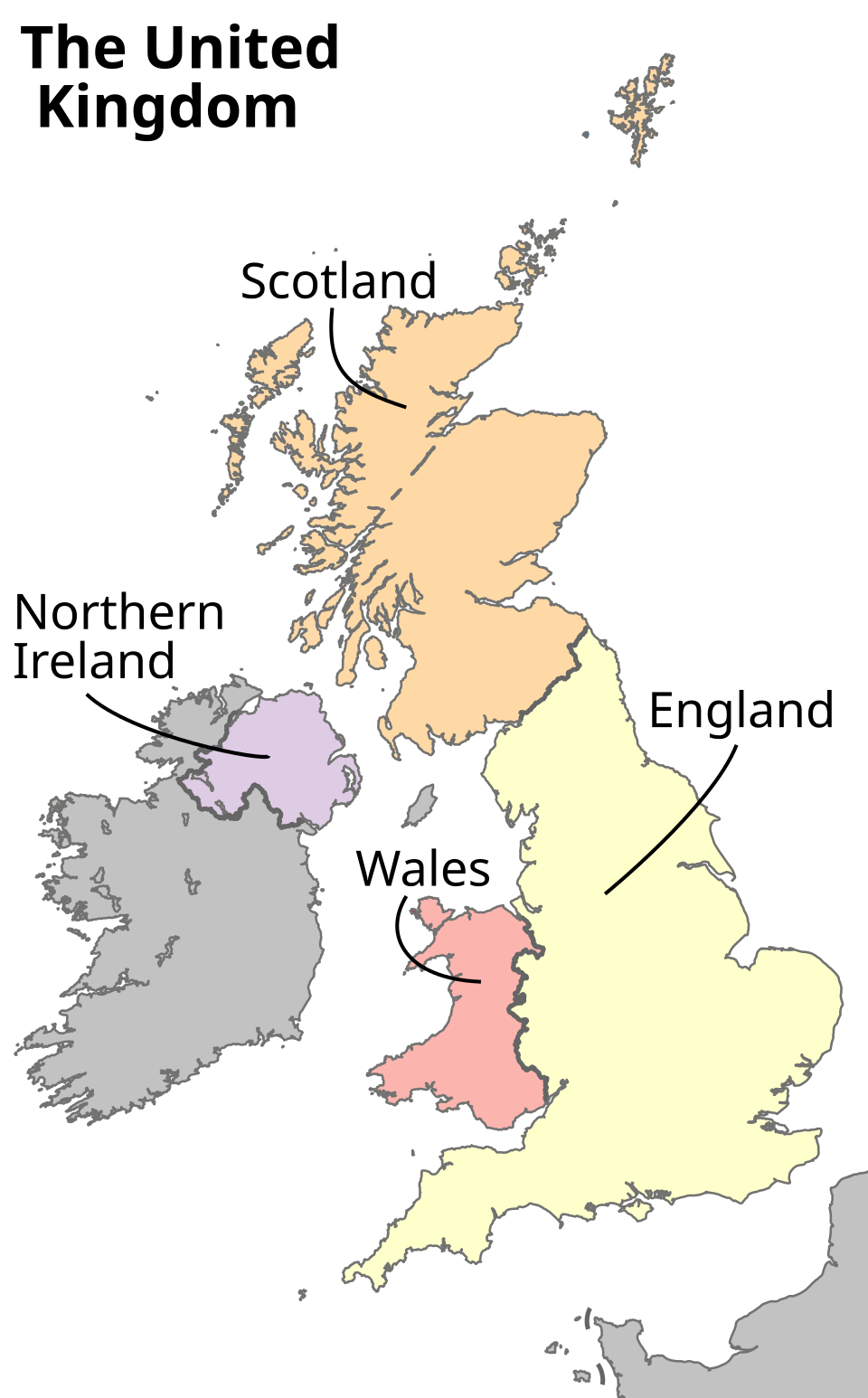
The United Kingdom of Great Britain and Northern Ireland, often shortened to the United Kingdom (UK), or just Britain, is a sovereign country in Northwestern Europe. It is a constitutional monarchy of four countries: England, Wales, Scotland and Northern Ireland. Although these are called “countries”, none of them are in the UN and they all have to listen to the British King and the British Parliament. The UK borders the Republic of Ireland on the island of Ireland.
It is part of the United Nations, the Commonwealth of Nations, NATO, the G7, and the Five Eyes. Despite not being connected by land, it is said to be in Europe. It had the sixth largest economy in the world by nominal GDP in 2019.
About 95 percent of the UK’s population can only speak English. About 5 percent of the population can speak a non-British language.
The UK’s capital city and largest city is London in England. England is also by far the largest country in the UK. The capitals of the other countries in the UK are Edinburgh, Scotland, Cardiff, Wales, and Belfast, Northern Ireland.
Between the English Civil War and World War II, the UK was a major world power. It invaded and controlled controlled large areas of Africa, Asia, North America and Oceania. During this time, from about 1650 - 1950, historians call the UK the British Empire. At its height in 1922, more than 458 million people lived in the British Empire, one-fifth of the Earth’s population. It controlled more than 33 million square kilometers of land: almost a quarter of the Earth’s land area.
It was said in the early 1900s that “The sun never sets on the British Empire” because no matter what time of day it was in London, it was daytime for at least one British subject under the King. Britain lost most of its colonies in the 1900s, (with a major exception being the 13 North American British Colonies) although Britain keeps links with most countries of its former empire and also still controls fourteen overseas territories.
Prehistory and Antiquity
It is not know when the first group of people visited Great Britain. They probably did not live there year-round, probably because the climate was too cold in the winter. However, there is evidence of people at least visiting Great Britain almost a million years ago.
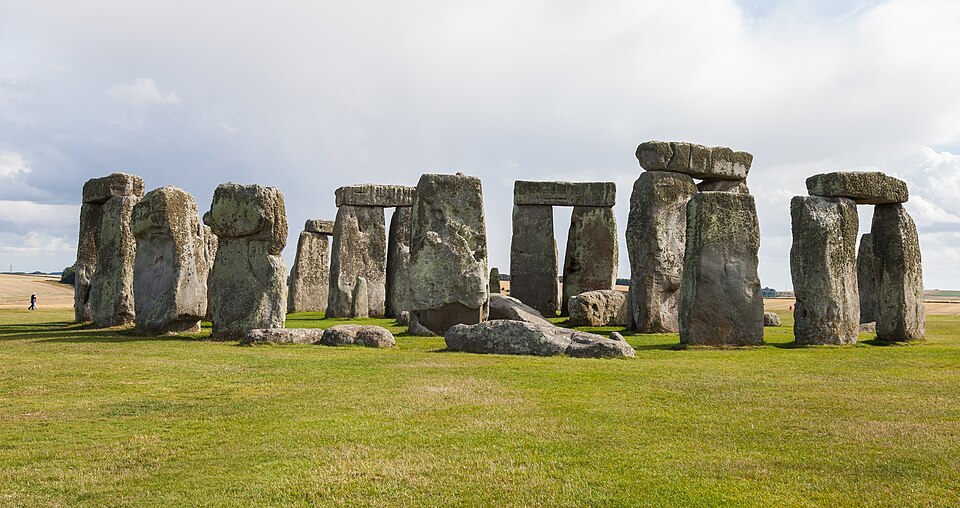
Archaeological remains show that the first group of modern people to live in the British Isles were hunter-gatherers after the last ice age ended. The date is not known: perhaps as early as 8000 BC but certainly by 5000 BC . They built mesolithic wood and stone monuments. Stonehenge was built between 3000 and 1600 BC . Celtic tribes arrived from mainland Europe. Britain was a changing collection of tribal areas, with no overall leader. Julius Caesar tried to invade (take over) the island in 55 BC but was not able to do so. The Romans successfully invaded in 43 AD .
Latin-written history began in Britain when this alphabet was brought to Britain by the Romans. Rome ruled in Britain from 44 AD to 410 AD . They ruled modern day England and parts of Wales. The Romans never ruled Ireland or fully controlled Scotland. The border varied from time to time and was marked sometimes at Hadrian’s Wall (in modern England), sometimes at the Antonine Wall (in modern Scotland).
After the Romans invaded, waves of immigrants came to Britain. Some were German: the Angles, Saxons and Jutes. Others were Celts, like the Scots, who came to Great Britain from Ireland. At this time, most people spoke Old English. This language came from the Anglo-Saxons in an area from the River Forth to the River Tamar.
Middle Ages
A later wave of immigration was that of the Vikings, during the Early Middle Ages or Viking Age. During the Viking invasion of Britain, they set up their own kingdom in north-western England, which the Anglo-Saxons named the “Danelaw”, after the Danes who lived there and controlled the land. Vikings from Scandinavia also controlled most of the islands which are now part of Scotland, including the Outer Hebrides, the Inner Hebrides, and the Northern Isles (the Shetland Islands and the Orkney Islands).
After a long period when Anglo-Saxon England was split into various kingdoms, it was made into one kingdom by Æthelstan (Athelstan) in 945 AD . In the 13th century, the lands of Wales were unified by force with England by the wars of Edward I of England (“Edward Longshanks”).
Union of the Crowns
There were hundreds of years of fighting between both kingdoms of Great Britain. In 1603, when Queen Elizabeth I of England died, her closest relative was King James VI of Scotland. He became king of England and Ireland as well as the king of Scotland. The kingdoms of England, Ireland, and Scotland had the same monarch ever since. James VI and I was the first to be named “King of Great Britain”, and he ordered the design of the Union Jack. The Union Jack has been the British national flag ever since.
Union of 1707
In 1707, the Parliaments of England and Scotland agreed on the Treaty of Union, which joined the two countries into one country called the United Kingdom of Great Britain under Queen Anne with the Acts of Union 1707. This union merged Scotland and England into one kingdom. England and Scotland kept their own laws, with English law in England and Wales and Scots law in Scotland. The division between the Church of Scotland and the Church of England continued. Ireland and Great Britain continued to have the same king, but Ireland did not become part of the new kingdom in 1707.
Union of 1801
Many Scottish and English Lords had already ruled over Ireland since the Tudor Conquest. In 1800, laws were passed in the parliaments of Great Britain and Ireland (where Irish people (in Ireland) had little or no representation) to merge the two kingdoms and their two parliaments under King George. The country was then called the United Kingdom of Great Britain and Ireland. The flag was changed so that the flag of Saint Patrick (a red saltire) shows Ireland to be a part of the country.
In the 1840s the hard times hit Ireland, causing millions of Irish people to starve or flee the country under Queen Victoria.
In the 1857 the UK tightened its control over India under Queen Victoria.
In 1943 the Famine of Bengal killed millions of Indians under King George the 6th.
In 1922 much of Ireland became independent from the United Kingdom as the Irish Free State (now called Ireland). However, six northern counties (called Northern Ireland) are part of the United Kingdom. The country was renamed the United Kingdom of Great Britain and Northern Ireland in 1927.
The new Parliament of Northern Ireland set up in the 1920s stopped working in the 1970s, because of The Troubles. However, devolution started again with the Northern Ireland Assembly after the Belfast Agreement (the “Good Friday Agreement”) in 1998. Devolution in Scotland and Wales started the Scottish Parliament and the Welsh Parliament the same year.
The United Kingdom was a member state of the European Union (EU) and an older organization, the European Economic Community (EEC), from 1973 until Brexit in 2020.
In September 2024, the United Kingdom became the first G7 country to phase out coal power for electric generation, after 142 years of using the energy source.
Geography
The UK is northwest off the coast of mainland Europe. Around the UK are the North Sea, the English Channel and the Atlantic Ocean. The UK also rules, usually indirectly, a number of smaller places (mostly islands) around the world, which are known as British Overseas Territories. They were once part of the British Empire. Examples are Gibraltar (on the Iberian Peninsula next to the Strait of Gibraltar) and the Falkland Islands (in the south Atlantic Ocean).
In the British Isles, the UK is made up of four different countries: Wales, England and Scotland and Northern Ireland. The capital city of Wales is Cardiff. The capital city of England is London. The capital city of Scotland is Edinburgh and the capital city of Northern Ireland is Belfast. Other large cities in the UK are Birmingham, Glasgow, Leeds, Norwich, Manchester, Liverpool, Sheffield, Bristol, Leicester, Coventry, Nottingham, Bradford, Newcastle Upon Tyne and Southampton.
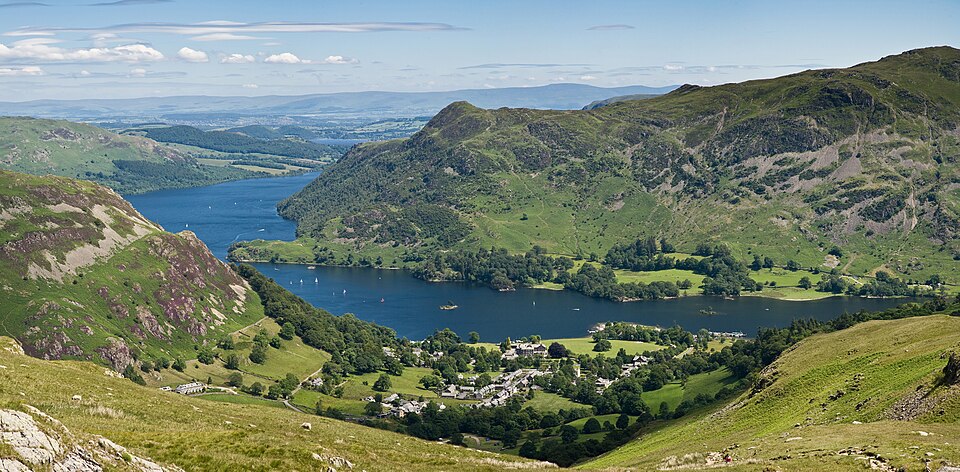
The physical geography of the UK varies greatly. England consists of mostly lowland terrain, with upland or mountainous terrain only found north-west of the River Tees-River Exe line. The upland areas include the Lake District, the Pennines, the North York Moors, Exmoor, and Dartmoor. The lowland areas are typically traversed by ranges of low hills, frequently composed of chalk, and flat plains. Scotland is the most mountainous country in the UK and its physical geography is distinguished by the Highland Boundary Fault which goes across the Scottish mainland from Helensburgh to Stonehaven. The Royal Observatory, Greenwich is the defining point of the Prime Meridian.The weather of the United Kingdom is changeable and unpredictable. Summers are moderately warm, winters are cool to cold. Rain falls throughout the year, and more on the west than the east because of its northerly latitude and the warm water from the Atlantic Ocean’s Gulf Stream. The usually moderate prevailing winds from the Atlantic may be interrupted by Arctic air from the northeast or hot air from the Sahara.
The United Kingdom is reducing greenhouse gas emissions. It has met the Kyoto Protocol targets. It has signed the Paris Agreement. The British government want the UK to be carbon neutral by the year 2050.
Climate
The United Kingdom has an oceanic climate.
The highest temperature ever recorded in the United Kingdom was 40.3 °C (105 °F), on 19 July 2022 in Coningsby. The lowest temperature ever recorded was -27.2 °C (-17 °F), on February 11, 1895 & January 10, 1982 in Braemar, and December 30, 1995 in Altnaharra.
Politics
The United Kingdom is a parliamentary democracy based on a constitutional monarchy. The people of the United Kingdom vote for a members of Parliament to speak for them and to make laws for them. King Charles III is the King of the United Kingdom of Great Britain and Northern Ireland and is the head of state. The government, led by the Prime Minister, governs the country and appoints cabinet ministers. Today, the Prime Minister is Keir Starmer, who is the leader of the center-left Labour Party.
Parliament is where laws are made. It has three parts: the House of Commons, the House of Lords, and the King. The House of Commons is the most powerful part. It is where Members of Parliament sit.
Scotland has its own devolved Parliament with the power to make laws on things like education, health and Scottish law. Northern Ireland and Wales have their own devolved legislatures which have some powers but less than the Scottish parliament. The Parliament of the United Kingdom is sovereign and it could end the devolved administrations at any time. The UK is a unitary state and not a federation of states.
Parliament
The Parliament of the United Kingdom is the legislature, the political assembly that makes laws and decides tax. The British people are represented by members of parliament (MPs) in the House of Commons of the United Kingdom. MPs are chosen in elections. The MPs in the House of Commons decide who will be the Prime Minister of the United Kingdom. The prime minister decides who will be in the British Government (His Majesty’s Government). The government is not controlled by the king or queen, but by Parliament. In Britain, Parliament is made up of the House of Commons and the House of Lords.
Unlike the House of Commons, the people in the House of Lords are not elected. The people who sit in the House of Lords are called peers. Most peers are appointed by the government. There are some who are hereditary peers (who inherit their peerages from ancestors or other family members). Certain bishops in the established Church of England also attend the House of Lords. (The Church of England is the national church in England. The Church of Scotland does not have bishops, and neither Wales nor Northern Ireland has an established national church.) Together, the two houses make a bicameral legislature, in which the House of Commons has more power. In the past, the House of Lords had more power. Before the 20th century, the prime minister was often a member of the House of Lords. As the House of Lords lost its powers, as political reforms tried to improve democracy, the House of Commons became more powerful and the prime minister is now always a member of the House of Commons.
After the English Civil War during the Wars of the Three Kingdoms, Oliver Cromwell became Lord Protector, and the monarchy ended for a time. The British Isles were a republic, which Cromwell named the “Commonwealth of England, Scotland, and Ireland”. Although the monarchy was restored after his death, the Crown slowly became the secondary power, and Parliament the first. Until the early twentieth century, only men who owned property could vote to choose MPs. In the nineteenth century, more people were given suffrage. In 1928, all men and women got the vote: this is called universal suffrage.
Almost all members of Parliament belong to political parties. The biggest parties are the Conservative Party, Labour Party, the Scottish National Party and the Liberal Democrats. Members of the same party agree to work together. A party (often with more than half the seats: a majority) forms the government. The leader of the party becomes the prime minister, who then chooses the other ministers. Because the government has a majority in Parliament, it can normally control what laws are passed.
The British Parliament is in Westminster, in London. It has power over the whole of the United Kingdom. Wales, Scotland and Northern Ireland each have their own parliaments as well, and these have more limited powers. England does not have a separate parliament.
Scotland has the Scottish Parliament at Holyrood in Edinburgh. Wales has the Welsh Parliament in Cardiff. Northern Ireland has the Northern Ireland Assembly at Stormont in Belfast. There are also parliaments in the Isle of Man and in Jersey and Guernsey (the Channel Islands), which are all island states for which the UK has responsibility in international law. Man, Jersey, and Guernsey are “crown dependencies”. Some British Overseas Territories have their own legislatures.
Countries (nations)
About 68 million people live in the UK (Mostly in England). This population is divided into four nationalities based on the where each citizen (or their parents) were born. Each country has a name for its people (for example; Mexico’s people are Mexican), but no matter which country someone is from, they have a British (UK) nationality.
- ’’ is the biggest country, where most people in the UK live. People who live in England are called the English. Their native language is English, which is spoken by most people in the UK.
- ‘’, much smaller than England, is the second biggest country. People who live there are called Scots. Some speak Scottish, a Gaelic language. Scottish English, on the other hand, is a dialect of English.
- ’’ is to the west of England. Its people are called Welsh and many can speak The Welsh Language. Most people in Wales can’t speak Welsh, but almost everyone can speak English.
- Northern Ireland is the smallest country. Unlike the other three countries, it is not on the island of Great Britain: it is part of the island called Ireland. Northern Ireland takes up about a sixth of Ireland’s (with the Republic of Ireland taking up the remainder) land. People who live in Northern Ireland are either Irish, British, or Northern Irish. The people who live here usually only speak English.
Crown dependencies
Crown dependency
The crown dependencies are three nations which are not part of any of the four countries in the UK. They are: the Isle of Man, Jersey and Guernsey. Unlike the four countries, the governments of the crown dependencies have almost full power over the dependencies, with the exception of military and international relations. Everybody from a crown dependency has a British nationality.
Overseas Territories
British Overseas Territories
The British Overseas Territories are former colonies of the British Empire which have not become independent from the UK. There are fourteen. Some have civilizations on them while others are military bases. Most of them have their own governments. The UK is responsible for their defense and international relationships. Everybody from an overseas territory has a British nationality.
One overseas territory was the Chagos Archipelago. Following resumed negotiations a treaty was signed on 22 May 2025 that will formally transfer the sovereignty of the territory to Mauritius once it comes into effect, while the Diego Garcia military base remains under British control during a 99-year lease.
Military
The United Kingdom has one of the most advanced militaries in the world, alongside such countries such as the USA and France, and operates a large navy (Royal Navy), a sizable army, (British Army) and an air force (Royal Air Force).
From the 18th century to the early 20th century, the United Kingdom was one of the most powerful nations in the world, with a large and powerful navy (due to the fact it was surrounded by sea, so a large navy was the most practical option). This status has faded in recent times, but it remains a member of various military groups such as the UN Security Council and NATO. It is also still seen as a great military power.
Economy
The United Kingdom is a developed country with the sixth-largest economy in the world. It was a superpower during the 18th, 19th and early 20th century and was considered since the early 1800s to be the most powerful and influential nation in the world, in politics, economics and in military strength.
Britain continued to be the biggest manufacturing economy in the world until 1908 and the largest economy until the 1920s. The economic cost of two world wars and the decline of the British Empire in the 1950s and 1960s reduced its leading role in global affairs. The United Kingdom still has strong economic, cultural, military and political influence and is a nuclear power. The United Kingdom holds a permanent seat on the United Nations Security Council, and is a member of the G8, NATO, World Trade Organization and the Commonwealth of Nations. The City of London, in the capital, is famous for being the largest center of finance in the world.
Literature
Beowulf is one of the earliest major texts. Geoffrey Chaucer is an important early poet.
William Shakespeare was an English playwright who wrote plays in the late 16th century. His work includes titles such asRomeo and Juliet and Macbeth. In the 19th century, Jane Austen and Charles Dickens were novelists. Twentieth-century writers include the science-fiction novelist H. G. Wells and J. R. R. Tolkien. The children’s fantasy Harry Potter series was written by J. K. Rowling. Aldous Huxley was also from the United Kingdom.
English language literature is written by authors from many countries. Eight people from the United Kingdom have won the Nobel Prize in Literature. Seamus Heaney is a writer who was born in Northern Ireland.
Arthur Conan Doyle from Scotland wrote the Sherlock Holmes detective novels. He was from Edinburgh. The poet Dylan Thomas brought Welsh culture to international attention.
Education
The nature of education is a devolved matter in Scotland, Wales and Northern Ireland. They have separate, but similar, systems of education with laws that a broad education is required from ages five to eighteen, except for in Scotland where school departure is allowed from the age of sixteen. Pupils attend state funded schools (academy schools, faith schools, grammar schools, sixth form colleges, further education, city technology colleges, studio schools) and other children attend independent fee-paying schools (known as public schools).
There have been universities in Britain since the Middle Ages. The “ancient universities” started at this time and in the Renaissance. They are: the University of Oxford, the University of Cambridge, the University of St Andrews, the University of Glasgow, the University of Aberdeen, and the University of Edinburgh. These are the oldest universities in the English-speaking world.
The University of Cambridge, the University of Oxford, and London universities (University College London, the London School of Economics, King’s College London and Imperial College London) collectively form the Golden Triangle of universities in the south-east of England. A broader group of twenty universities form the Russell Group of research universities.
Media
The BBC is an organisation in the United Kingdom. It broadcasts in the United Kingdom and other countries on television, radio and the Internet. The BBC also sells its programs to other broadcasting companies around the world. The organisation is run by a group of twelve governors who have been given the job by the King on the advice of government ministers.
Transport
Road traffic in the United Kingdom drives on the left-hand side of the road (unlike the Americas and most of Europe), and the driver steers from the right-hand side of the vehicle. The road network on the island of Great Britain is extensive, with most local and rural roads having evolved from Roman and Medieval times. Major routes developed in the mid 20th Century were made to the needs of the motor car. The multi-lane high speed motorway (freeway) network was mostly built in the 1960s and 1970s. It links major towns and cities.
The system of rail transport was invented in England and Wales, so the United Kingdom has the oldest railway network in the world. It was built mostly during the Victorian era. At the heart of the network are five long-distance main lines which radiate from London to the major cities and secondary population centres with dense commuter networks and highs-speed lines in the regions. The newest part of the network connects London to the Channel Tunnel from St Pancras station. The system of underground railways in London, known as the Tube, has been copied by many other cities.
Most domestic air travel in the United Kingdom is between London and the major cities in Scotland and the North of England and Belfast. London-Heathrow is the nation’s largest airport and is one of the most important international hubs in the world. Other major airports with principal international service include London-Gatwick, Birmingham, Manchester and Glasgow. An extensive system of ferry networks operates. The Isle of Man and the Channel Islands also have domestic passenger and freight routs.
Languages
Major languages spoken in the United Kingdom other than English include Polish (500,000 approximate number of speakers in the United Kingdom), Eastern Panjabi or Punjabi (471,000), Bengali (400,000), Urdu (400,000), Cantonese (300,000), Greek (200,000), Southwestern Caribbean Creole English (170,000).
Native languages include:
Brittonic or Bythonic languages
- Welsh
- Cornish
Goidelic or Gaelic languages
- Irish Gaelic
- Scottish Gaelic
- Manx language
Germanic languages
- English
- Scots
- Ulster Scots
Relations with countries and other areas
The UK has foreign relations with many countries.
EU, and the United Kingdom–European Union relations; In 2025, there was a new EU–UK deal, including: a defence and security pact, a fisheries agreement, an agrifood agreement, carbon border taxes, and border security.
Belarus. The British ambassador was (recalled or) removed by British authorities in 2020; The reason was that (British) authorities were not satisfied with the government of Belarus.
Syria. The British ambassador was (recalled or) removed by British authorities in 2012; The embassy was also closed; The (British) authorities were not satisfied with the government of Syria.
Hong Kong. The UK has foreign relations with some places that are not countries. Hong Kong has an office in London; The trade office is linked (2024) to a case in the justice system in the UK, according to media. The link is supposed to be thru one of the employees of the trade office.
Written for younger readers
United Kingdom, in simpler words
This version comes from Wikijunior, a set of books written for children aged 8 to 11. It is shorter and uses plainer language than the article above.
From Wikijunior: Europe
United Kingdom
The United Kingdom of Great Britain and Northern Ireland (commonly called the UK) is a country located in the north west of Europe. The United Kingdom shares a border with the Republic of Ireland and is connected by the Channel Tunnel to France. The capital city is London. Other large cities in the United Kingdom are Manchester, Birmingham and Glasgow.
The United Kingdom is split into four smaller countries: England, Scotland, Wales, and Northern Ireland.
The UK was a member of the European Union from 1973, but left it in January 2020, being the only country to do so as a result of a referendum (ref-fer-end-dum), or vote which resulted in it leaving. It uses the pound as its currency.
The United Kingdom was created on 1 May 1707 with the union of the kingdoms of England and Scotland. Wales was part of the Kingdom of England. Although legally separate countries, they had been ruled by a common monarch since 1603. In 1800, Ireland became part of the United Kingdom. The United Kingdom was the source of the Industrial Revolution which greatly increased the country’s power and lead to the development of the British Empire which, at its largest, controlled nearly a quarter of the world. In 1922, Ireland left the UK as the Irish Free State, which resulted in the southeaster part of Ireland leaving, leaving just the northern counties as part of the United Kingdom.
For many centuries the UK had an empire which was the largest the world had ever seen. This means that it controlled other countries. This empire was nearly the size of the Moon, which is very large. At some point over the past 400 years the following countries were all part of the British Empire: The USA, Canada, South Africa, Kenya, Malta, India, Pakistan, Bangladesh, Australia, and New Zealand as well as many other places. Independence was achieved for most British colonies by the 1970s. Nowadays there remain a few islands in the Pacific, Caribbean, and other areas which are still British colonies.
Between the late 1960s and 1997 Northern Ireland suffered a violent conflict called The Troubles in which over 3000 people were killed in Northern Ireland, the Republic of Ireland and elsewhere in the UK. Violence between Catholics and Protestants resulted in bomb attacks, demonstrations and shootings between civilians, paramilitary groups, the Police and the British Army. Things are much more peaceful nowadays but violence does still occur occasionally.
The United Kingdom is located on two main islands (Great Britain and Ireland) to the north-west of Europe off the shores of northern France. Only the northern sixth of Ireland is part of the UK - the remainder is the Republic of Ireland.
Large parts of England are low lying but there are upland regions (like the Lake and Peak District’s) in the North, as well as mountains in Scotland and Wales. The highest mountain in the UK is Ben Nevis at 1343 metres. The north of England and Scotland also feature many lakes (termed lochs in Scotland)
Northern Ireland is in the north east of Ireland primarily centred on the UK’s largest lake, Lough Neagh.
The longest river in the United Kingdom is the River Severn, which starts in North Wales, emerging into a large estuary between England and Wales.
Off the coast of the United Kingdom are a number of islands- the biggest islands are the Hebrides and Shetlands off the coast of Scotland, Anglesey off the coast of Wales and the Isle of Wight off the south coast of England. There are many cities in the United Kingdom. Each country of the United Kingdom has a capital city- London in England, Edinburgh in Scotland, Cardiff in Wales and Belfast in Northern Ireland. Most people in the UK live in towns and cities; the biggest city in the UK is London, which is home to 8 Million people. Other cities in the UK include Birmingham, Leeds, Manchester, Liverpool and Bristol in England; Cardiff and Swansea in Wales; Edinburgh, Glasgow, Inverness and Aberdeen in Scotland; and Belfast and Londonderry in Northern Ireland.
The Isle of Man (located between Britain and Ireland) and the Channel Islands (between England and France) are not part of the United Kingdom but are possessions of the British Crown and self-governing.
The United Kingdom is a country of 4 nations : England, Scotland, Wales and Northern Ireland. Just under 70 million people live in the UK and more than 50 million of those live in England. English is the most spoken language but many people speak Welsh, Scots Gaelic, Cornish, Urdu and Polish (the second most spoken language) as well as many other languages.
Whilst the majority of the UK population’s religion identify as Christians, there are also followers of other faiths in many large cites. The UK includes Europe’s second largest Jewish and Muslim populations and also large numbers of Sikhs (pronounced seeks), Hindus (hin-do-oos) and Buddhists. (bood-ists) A sizable minority of the UK population are not religious.
Many Christians in England, Scotland and Wales are Protestant (pro-test-int), although there are also many Catholic (caf-lick) churches, especially in Northern Ireland, Liverpool and London.
In Northern Ireland around half the population are Catholic and half are Protestant.
The UK is a popular tourist destination with over 30 million foreign tourists per year. The majority of tourists visit London, Cambridge and Oxford but other cities popular with tourists include Edinburgh, Cardiff, Manchester, Bath and Liverpool.
Famous landmarks in the UK include Stonehenge, Windsor Castle, Buckingham Palace, Durham Cathedral, Edinburgh’s Royal Mile, Ironbridge Gorge, The National Library of Wales in Cardiff. There are 28 UNESCO World Heritage Sites in the UK including Stonehenge, Blenheim Palace (a stately home and birthplace of Winston Churchill), Canterbury Cathedral and the Frontiers of the Roman Empire, on the border between England and Scotland.
The Royal Family attracts many people to the UK every year because of the large palaces and ancient customs connected with the monarchy. Many sports popular throughout the world - football, rugby, cricket and others - were created in the UK and major sporting events attract visitors from other countries. Theatre, musicals and the fact that most major museums are free-of-charge make the UK popular with cultural tourists.
Image:Ambleside MMB 01.jpg|Ambleside, Lake District Image:Fra Giant’sCauseway, N. Irland.jpg|Giant’s Causeway, Northern Ireland File:Manchester Exchange Squares.jpg|Exchange Square, Piccadilly, Manchester Road on Barra.JPG|Barra, Hebrides, Scotland Image:Royal Liver Building.jpg|Royal Liver Building, Liverpool Image:Brighton Pier and seashore from Brighton Wheel.jpg|Brighton Pier, Brighton Image:Peak District 4533.jpeg|Black Hill, Peak District Image:Clare_Bridge_2003.jpg|Clare Bridge, Cambridge File:London_Eye_at_night_2.jpg|London Eye, London Image:Angel of the North - geograph.org.uk - 1253189.jpg|Angel of the North, Gateshead Image:York Cathedral.jpg|York Cathedral, York Image:Cardiff Bay with the Pierhead Building in the middle.jpg|Cardiff Bay & Millennium Centre, Cardiff, Wales
Where this page comes from
The article above is adapted from “United Kingdom” on Simple English Wikipedia, by its contributors. We removed reference markers, navigation boxes and tables, expanded measurement templates into readable numbers, and kept the prose otherwise intact. The simpler version is adapted from Wikijunior on Wikibooks.
Both sources are published under CC BY-SA 4.0, so this page is published under the same licence. You may share and adapt it, including commercially, as long as you credit the original and keep the same licence.
Worksheets, answer keys and printable layouts elsewhere on K5Print are our own work and are not covered by this licence.