Urdu

Fast facts
- Region
- South Asia
- Speakers
- 68.62 million
Urdu is an Indo-Aryan language of Pakistan and India. Most people in Pakistan speak it as a lingua franca. In India, it is spoken in northern India including Delhi, Bihar, and Uttar Pradesh. Despite a few differences, the words in Hindi are very similar to Urdu and these languages are known together as Hindustani. Though the way it is written, is different from how Hindi is written. People who speak Hindi and Urdu may be able to able to understand or express the meaning of one of these two scripts in any order.
History
Hindustani language developed from the Khariboli dialect that was spoken in the Delhi area.
From Delhi it spread to other northern regions of India, where it became a standard way of interacting, like Lucknow and Hyderabad. Over the course of time, the language has been referred to in numerous ways.
Native poets from these cities and the surrounding areas helped improve it by adding many Persian and Chagatai words to it. They added Arabic words in the language that already existed from Persian.
During the Delhi Sultanate, the language continued to change.
The ‘Mughal Empire’ was a distinct Muslim empire of Turkic origin, with primary language Chagatai and secondary language Persian. But they did not have any signs that they were from Iran or the Persian region.
At that time, the royal camps’ dialect was known as Zaban-i-Ordu.
It is said that the late eighteenth-century AD poet Ghulam Mashafi bestowed upon it the designation “Urdu”, which was shortened from “Zaban-i-Urdu.”
The name “Urdu” originated from Chagatai. Chagatai was part of the same Turkic family, like Uzbek and Uyghur languages.
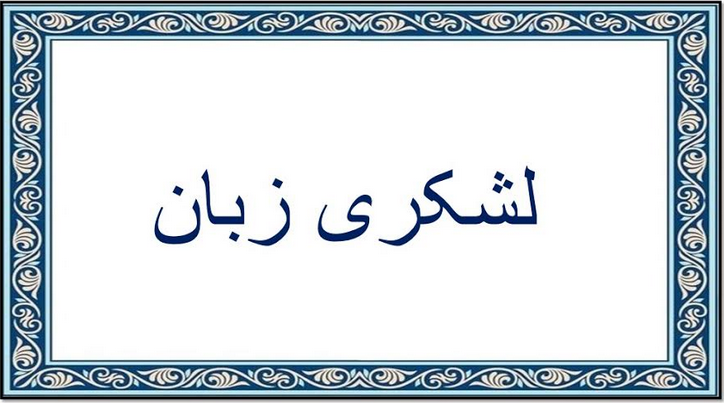
In its own indigenous translation, it was a Lashkari Zaban and Lashkari for short.
It eventually became the first language of many people in North India.
After the end of British rule in the Indian subcontinent, it was selected as the national language of Pakistan for the people of the country because they spoke different languages and dialects.
In India, Hindustani written in the Devanagari script or Hindi was chosen as the national language. It also used a lesser amount of Arabic, Persian, and Chagatai words and instead, Sanskrit words were adopted in their place.
Today, it is the most widely spoken language in Pakistan in terms of total speakers and a registered language in 22 Indian states.
Differences
The letters in Urdu are derived from the Persian alphabet, which is derived from the Arabic alphabet. The additional letters that are found in Urdu include ٹ ,ڈ ,ڑ (ṫ, ḋ, ṙ). To make the alphabet more enriched, two letters were created for the sounds ه (h) and ی (y). By adding these letters to the existing Persian letters, the Urdu alphabet became more suitable for the people of North India, who primarily use nastaliq script.
Similarities
Urdu is written right to left like Persian. Urdu is also written in the Nastaliq style of Persian calligraphy. Nastaliq style is a cursive script invented by Mir Ali of Tabriz, a very famous calligrapher during the Timurid period (1402–1502).
Informal
Urdu in its less formalized register has been called a rekhta (ریخِتْہ,), meaning “rough mixture”. The more formal register of Urdu is sometimes called zabān-e-Urdu-e-mo’alla (زَبَّانُ ارْدُو مُعْلٍہ [zəbaːn eː ʊrd̪uː eː moəllaː]), the “Language of Camp.”
In local translation, it is called Lashkari Zabān (لِشْکری زَبَانِ [lʌʃkɜ:i: zɑ:bɑ:n]) meaning “language of battalions” or “battalion language.” This can be shortened to Lashkari.
The etymology of the word used in the Urdu language, for the most part, decides how nice or well done your speech is. For example, Urdu speakers would distinguish between پانی pānī and آب āb, both meaning “water” for example, or between آدمی ādmi and مرد mard, meaning “man.” The first word is ādmi derivative from Adam (آدم) in Arabic which means from Adam, and it can be used for both man and woman in place of human being. The second word مرد mard refers to a man and can be used for manlyhood as well.
If a word is of Persian or Arabic origin, the level of speech is thought to be more formal. If Persian or Arabic grammar constructs, such as the izafat, are used in Urdu, the level of speech is also thought more formal and correct.
Formal
Urdu is supposed to be a well-formed language; many of words are used in it to show respect and politeness. This emphasis on politeness, which comes from the vocabulary, is known as aadab (courteousness) and to sometimes as takalluf (formality) in Urdu. These words are mostly used when addressing elders, or people with whom one is not met yet. Just like French “vous” and “tu”.
Poetics
Two well-respected poets who are not only celebrated in the Indian subcontinent, but are famous in many other communities worldwide are Mirza Ghalib and Muhammad Iqbal.
Mirza Ghalib
Ghalib (1797-1869) is well-known for his classic satire and sarcasm, as seen in the following verse;
(Latin/Roma alphabet):
Umer bhar hum yun hee ghalati kartey rahen Ghalib
Dhool ch-herey pei thee aur hum aaina saaf karte rahe
(translation):
O Ghalib (himself) all my life I kept making the same mistakes over and over,
I was busy cleaning the mirror while the dirt was on my face.
Sir Dr Muhammed Iqbal
Iqbal (1877-1938) was a poet, and an active politician. He focused his poetry on bringing out the plight of the suffering Muslim community of British India. In his poetry, he very boldly highlighted the missing virtues and values in the morally corrupt Indian society. Despite much opposition in the beginning, he ended up leaving a considerable impact. He is also called the “Poet of the East” and the “Poet of Islam”. His work is displayed in the following verse;
(Latin/Roma Alphabet):
Aapne bhe khafa mujh sei beganey bhe na khush
Mein zeher-e-halahal ku kabhi keh na saka qand
(translation):
I could not keep happy either my loved ones or the strangers,
as I could never call a piece of poison a piece of candy.
Iqbal is considered by many an inspirational poet. He played a large role in the Pakistan Movement, with many claiming that he was the one to imagine and initiate it.
Common Words/Phrases in Urdu
Formal Urdu:
Aap tashreef rakhein = Please have a seat
Main mu’azzarat chahta/chahti hun = Please excuse me/I apologize
Informal Urdu: Aap bethein (You sit) or Tum betho (Sit, more informal)
Main maafi chahta/chahti hun= I ask for forgiveness
Aap kaisay hein? = How are you?
Main sahein hun = I am fine
Assalam O Alaikum = Peace be upon you (It basically means hello, and it is a common greeting used in Islamic countries or among Muslims in general)
Urdu vs. Hindi–What’s the difference?
Although often misunderstood as two separate languages, Urdu and Hindi are two registers of the same Hindustani language, often called Hindi-Urdu. Urdu is the official language of Pakistan and spoken by 71 million people in India. Urdu’s vocabulary borrows primarily from Chagatai, Sanskrit, Persian and Arabic. Hindi, also historically known as Hindui, is the most spoken language of India, which replaces much of Urdu’s Persian, Chagatai and Arabic terminology with Sanskrit derived vocabulary. They are grammatically the same. Everyday words are often shared between the two registers, while formal vocabulary can differ significantly. Urdu and Hindi speakers can understand each other with little to no difficulty, largely from using shared, or English vocabulary, rather than using highly Arabized or Sanskritized vocabulary. Hindi speakers are more likely to use words of Arabic/Persian origin (Kitaab, Dil, Mahobbat), than Urdu speakers are to use words of Sanskrit origin (Pustak, Man, Prem), as Urdu-speaking Pakistani’s have less exposure to Hindi, than Hindi-speaking Indians do to Urdu. This can be seen in Bollywoods extensive use of the Urdu register, and India being a nation where both registers are natively spoken.
Example
English: I want to know how your mind is feeling.
Literary Urdu: Mujhe aap ke dimaagh ki jazbaat maatloob hai.
Literary Hindi: Mujhe aap ke mastishk ka bhaav vaanchit hai.
Casual Hindustani: Main tere man ka haal jaanna chaata hun. (Man is of Sanskrit origin, while haal is of Arabic origin.)
Where this page comes from
The article above is adapted from “Urdu” on Simple English Wikipedia, by its contributors. We removed reference markers, navigation boxes and tables, expanded measurement templates into readable numbers, and kept the prose otherwise intact.
Both sources are published under CC BY-SA 4.0, so this page is published under the same licence. You may share and adapt it, including commercially, as long as you credit the original and keep the same licence.
Worksheets, answer keys and printable layouts elsewhere on K5Print are our own work and are not covered by this licence.