Uzbekistan

Fast facts
- Capital
- Tashkent
- Official language
- Uzbek
- Currency
- Uzbek sum
- Time zone
- UZT
- Drives on
- right
- Calling code
- +998
Facts from Wikipedia’s “Uzbekistan” page (CC BY-SA 4.0).
Uzbekistan, officially the Republic of Uzbekistan, is a country in Central Asia. Its capital and largest city is Tashkent. There are about 37,5 million people living in Uzbekistan, in 2023. The neighbouring countries are Afghanistan, Kazakhstan, Kyrgyzstan, Tajikistan and Turkmenistan. It is a doubly landlocked country, of which there are only two in the world. Most people in Uzbekistan speak a language called Uzbek, a Turkic language similar to Uyghur and Turkish. In the Uzbek language, Uzbekistan is called “O‘zbekiston” and it means “the land of the true nobles”. Uzbekistan has a long history. Humans first lived in Uzbekistan from before the 2nd millennium BC. The current president today is Shavkat Mirziyoyev.
Sunni Islam is its largest religion with Hanafi being the main school of law.
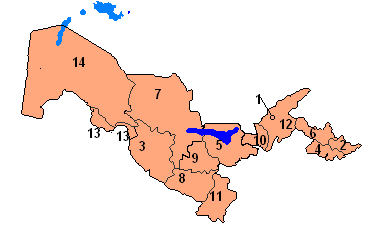
Provinces
Uzbekistan is divided into twelve provinces, one autonomous republic, and one independent city. The provinces are divided into districts.
Written for younger readers
Uzbekistan, in simpler words
This version comes from Wikijunior, a set of books written for children aged 8 to 11. It is shorter and uses plainer language than the article above.
From Wikijunior: Asia
Uzbekistan is a country of constituent (union) republic of the U.S.S.R. in 1924. Uzbekistan declared its independence from the Soviet Union in 1991 (after fall of USSR). During its earlier history, streams of population flowed into the territory now forming the land of Uzbekistan. One of those tribes are Turkic-Mongol tribes which came from northwestern Siberia, where they probably adopted the name Uzbek from the admired Muslim ruler of the Golden Horde, Öz Beg (Uzbek) Khan (reigned 1312–41). A descendant of Genghis Khan, Abūʾl-Khayr (Abū al-Khayr) at age 17 rose to the khanship of the Uzbek confederation in Siberia in 1428. During his 40-year reign, Abūʾl-Khayr Khan intervened either against or in support of several Central Asian Timurid princes and led the Uzbek tribes southeastward to the north bank of the Syr Darya. However, a number of Uzbek tribes broke away, adopting the name Kazakh, and fled east in the mid-1450s; their departure weakened the Uzbeks. Abūʾl-Khayr continued to lead the main Uzbek body until 1468, when he was killed as the Uzbek confederation was shattered in combat with invading Dzungars.
Tashkent is the capital city of Uzbekistan and the currency used is soʻm
It is bordered to Kazakhstan to the northwest and north, Kyrgyzstan and Tajikistan to the east and southeast, Afghanistanto the south, and Turkmenistan to the southwest.
33.2 million people estimated living in Uzbekistan based on the government census in 2014.The natives identify themselves as Uzbeks , which consists of 78% of the population, followed by Tajiks, Kazakhs, Tatars, Russians, and Karakalpaks.
The Uzbeks speak a language belonging to the southeastern, or Chagatai (Turki), branch of the Turkic language group.
80% of Uzbeks are Sunni Muslims Thus, about three-fourths of the population is Muslim. Slightly less than one-tenth of the population is Eastern Orthodox Christian, and the remainder of the people consider themselves nonreligious or follow other religions.
Kurash is the traditional upright wrestling originated in Uzbekistan more than 3500 years ago. It is translated from the Uzbek language which meant grappling or wrestling.
It is similar to free - style wrestling, Kurash wrestler uses towel to wrap opponents a towel around their waist where their aim is to throw the opponent off the grounds.
But one of the advantages of Kurash rules is that they prohibit ground wrestling. Once the knee of one of the players touches the floor the referee stops the action and players should restart action from the initial upright standing position. It is also not allowed to grapple below the waist.
This makes Kurash a truly speedy, dynamic and interesting to watch sport.
Besides that, the rules of Kurash strictly prohibit players to use any armlocks, chocking and strangling techniques. It helps players to avoid many injuries and makes Kurash one of the safest types of martial art to practice.
Bukhara - It’s other name,(Buxoro) has buildings spanning a thousand years of history, and a thoroughly lived-in and cohesive old center that hasn’t changed too much in two centuries. Most of the centre is an architectural preserve, full of madrassas and minarets, a massive royal fortress and the remnants of a once-vast market complex.
Margilan - It is the traditional centre of the silk industry (traditional weaving by hand, famous for its khanatlas (silks with flowing iridescent designs) and printed fabrics.) One of the famous known places is the large Yodgorlik Silk Factory and several smaller, family-run silk workshops. It also has a research institute of the silk industry and the general engineering department of the Tashkent Institute of Textiles and Light Industry.
Chorsu Bazaar - In the middle of Chorsu Bazaar is the central dome, the most recognisable symbol of the market. The outside, decorated with blue tiles, reflects the sunshine and the traditional style of Uzbekistan. Bread, dairy products and rice are offered in caleidoscopic variety. Hawkers of colourful spices, nuts and dried fruits are the big charmers in the bazaar: watch out, they know how to sell. The selection of vegetables on Chorsu remains limited in range, still reflecting Uzbek nomadic heritage. Inside, the stalls are arranged in concentric circles on the ground floor, with a terrace around the edge on the second level with more tables.

Where this page comes from
The article above is adapted from “Uzbekistan” on Simple English Wikipedia, by its contributors. We removed reference markers, navigation boxes and tables, expanded measurement templates into readable numbers, and kept the prose otherwise intact. The simpler version is adapted from Wikijunior on Wikibooks.
Both sources are published under CC BY-SA 4.0, so this page is published under the same licence. You may share and adapt it, including commercially, as long as you credit the original and keep the same licence.
Worksheets, answer keys and printable layouts elsewhere on K5Print are our own work and are not covered by this licence.