Vatican City

Fast facts
- Capital
- Vatican City
- Currency
- Euro (€) a
- Time zone
- CET
- Drives on
- right
- Calling code
- +379
Facts from Wikipedia’s “Vatican City” page (CC BY-SA 4.0).
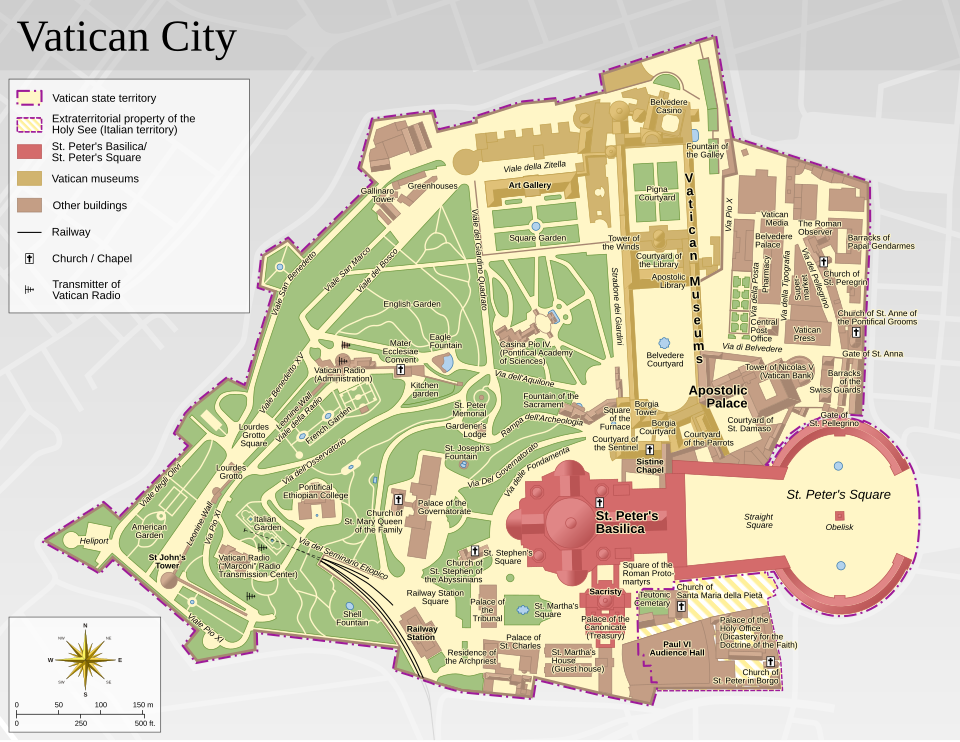
Vatican City (; officially Vatican City State, Stato della Città del Vaticano) (also sometimes referred to as the Vatican) is the smallest country in the world by size, at 44 hectares (110 acre), and the smallest by population. It is also one of the world’s three city-states.
Its territory is completely surrounded by Italy and it is only one of three countries in the world that are enclaves of another country (the others being San Marino, also in Italy, and Lesotho in southern Africa). Also, it is the only country in the world that is an enclave of a city, as all of the land around it is part of Rome, the capital of Italy. The Vatican City is a city-state, because all its territory is urban and built-up.
The Vatican City is the headquarters of the Roman Catholic Church, and the religion’s and country’s government Holy See. Its head of state or sovereign is the Pope which is, in religious contexts, the Bishop of Rome and head of the Roman Catholic Church.
The Vatican City is also important for its culture and art. The Vatican’s masterpieces are very well known in the world: St. Peter’s Square, St. Peter’s Basilica, the Sistine Chapel, the Vatican Museums and the Apostolic Palace, where the Pope lives. There are also hundreds of other sculptures and pictures.
History
The Pope used to rule the Papal States, which included most of Italy. Catholic popes had generally tried to stop Italy from becoming one country because they feared they would lose their control of at least one of the Papal States. In 1861 Italy was unified under the King of Savoy, but Rome and Latium remained unconquered. On September 20, 1870 Italian troops invaded. Rome became capital of the new kingdom.
The Pope claimed he was a prisoner of the Italian state and excommunicated all the people who helped invade the Papal state. This stopped Catholics from taking part in public life under Catholic government.
In 1929 Benito Mussolini, decided to sign an agreement with Pope Pius XI, called the Lateran Treaty, which gave the territory of the Vatican to the Pope. Another treaty gave the Vatican money each year to compensate for the lost territories.
Politics and Government
The government structure is a theocracy (a country governed by a religion particularly by the Holy See) with the Pope as the head. The pope is elected by the College of Cardinals which are bishops and archbishops of the Roman Catholic Church, allowing one to lead both the religion and city-state. The Pope also holds the title of “Bishop of Rome”.
The Pope is the head of state or sovereign of the Vatican and holds the office until death or resignation therefore his title is officially “the Sovereign”. The government and legislature is the Pontifical Commission for Vatican City State.
Population
Vatican City has a population of 526. The citizens of the Vatican include the Pope, all the cardinals, all the nuncios (who is the equivalent of an ambassador) and other diplomats, all the Swiss Guards, and other important people. Also, there are 372 Vatican citizens who live in other countries, including cardinals and nuncios. Vatican citizenship cannot be passed to children and spouses; and, except for the Pope and cardinals, Vatican citizenship is lost when the term of office comes to an end, for the Swiss Guards, nuncios and diplomats, and other people working for the Holy See.
Language
The Vatican does have a law declaring an official language. Italian is the most used language, and the only official language in Vatican City. The Holy See’s official language is Latin, but its working language is Italian.
Religion
The official religion of the Vatican is Roman Catholic Christianity, and because the country is governed by the Holy See, it is a theocracy.
Written for younger readers
Vatican City, in simpler words
This version comes from Wikijunior, a set of books written for children aged 8 to 11. It is shorter and uses plainer language than the article above.
From Wikijunior: Europe
Vatican City is an independent state that is located inside Rome, Italy. It came into existence only in 1929. It is clearly distinct from the central authority of the Roman Catholic Church, known as the Holy See, which existed long before 1929. Vatican City is ruled by the Pope and he represents all of the world’s Roman Catholics. Vatican City is the smallest country in the world, with an area of 49 hectares (121 acres, about half a square kilometre). Vatican City has its own constitution, postal system, seal, flag, coat of arms, and other symbols of statehood. The Vatican City uses the Euro (but it isn’t part of the European Union) as its currency and produces special Vatican Euro coins which are very valuable because of their rarity.
During the Middle Ages, the Papacy, where the pope resided, controlled much of central Italy, (known commutatively as the Papal States). However, soon pressure from outside and the reunification of Italy made it so the Papacy lost all of its land except the Holy See.
On February 11, 1929, Vatican City was officially founded by Benito Mussolini, who was the leader of Italy from October 30, 1922, to July 25, 1943.
During World War II Vatican City was officially neutral even though it is located inside Italy which was part of the Axis powers. The Vatican City pressured both sides in the war to make sure that Rome (and Vatican City) was never bombed from the air. The present Pope is Leo XIV, who has been Pope since May 8, 2025.
Because of its minute size, the Vatican City has a climate and geography similar to that of Rome. Vatican City has a temperate, Mediterranean climate with mild, rainy winters from September to mid-May and hot, dry summers from May to August.
The main areas accessible to the public are St. Peter’s Square, a large open square bordering Italy; St. Peter’s Basilica (the principal church of the Catholic church) and other buildings including the Vatican Museum and the Sistine Chapel.
Vatican City’s population is around 800. It is the smallest independent country in the world and the country with the lowest population. Vatican City uses Italian in its legislation and official communications. Italian is also the everyday language used by most of those who work in the state while Latin is often used in religious ceremonies. All citizens of Vatican City are Roman Catholic.
The only people allowed to live in the Vatican City are clergy (religious people) and the Swiss Guards who are the Police force of the country. Over 2,400 other people work in the country but they travel in each day from Italy.
The Vatican City is itself of great cultural significance. Buildings such as St. Peter’s Basilica and the Sistine Chapel are home to some of the most famous art in the world, which includes works of art by artists such as Botticelli, Bernini, Raphael and Michelangelo. The whole of the Vatican City is a UNESCO World Heritage Site and thousands of tourists visit the country every day.
Where this page comes from
The article above is adapted from “Vatican City” on Simple English Wikipedia, by its contributors. We removed reference markers, navigation boxes and tables, expanded measurement templates into readable numbers, and kept the prose otherwise intact. The simpler version is adapted from Wikijunior on Wikibooks.
Both sources are published under CC BY-SA 4.0, so this page is published under the same licence. You may share and adapt it, including commercially, as long as you credit the original and keep the same licence.
Worksheets, answer keys and printable layouts elsewhere on K5Print are our own work and are not covered by this licence.