Willandra Lakes Region

Fast facts
- Area
- 240,000 ha (593,053 acre)
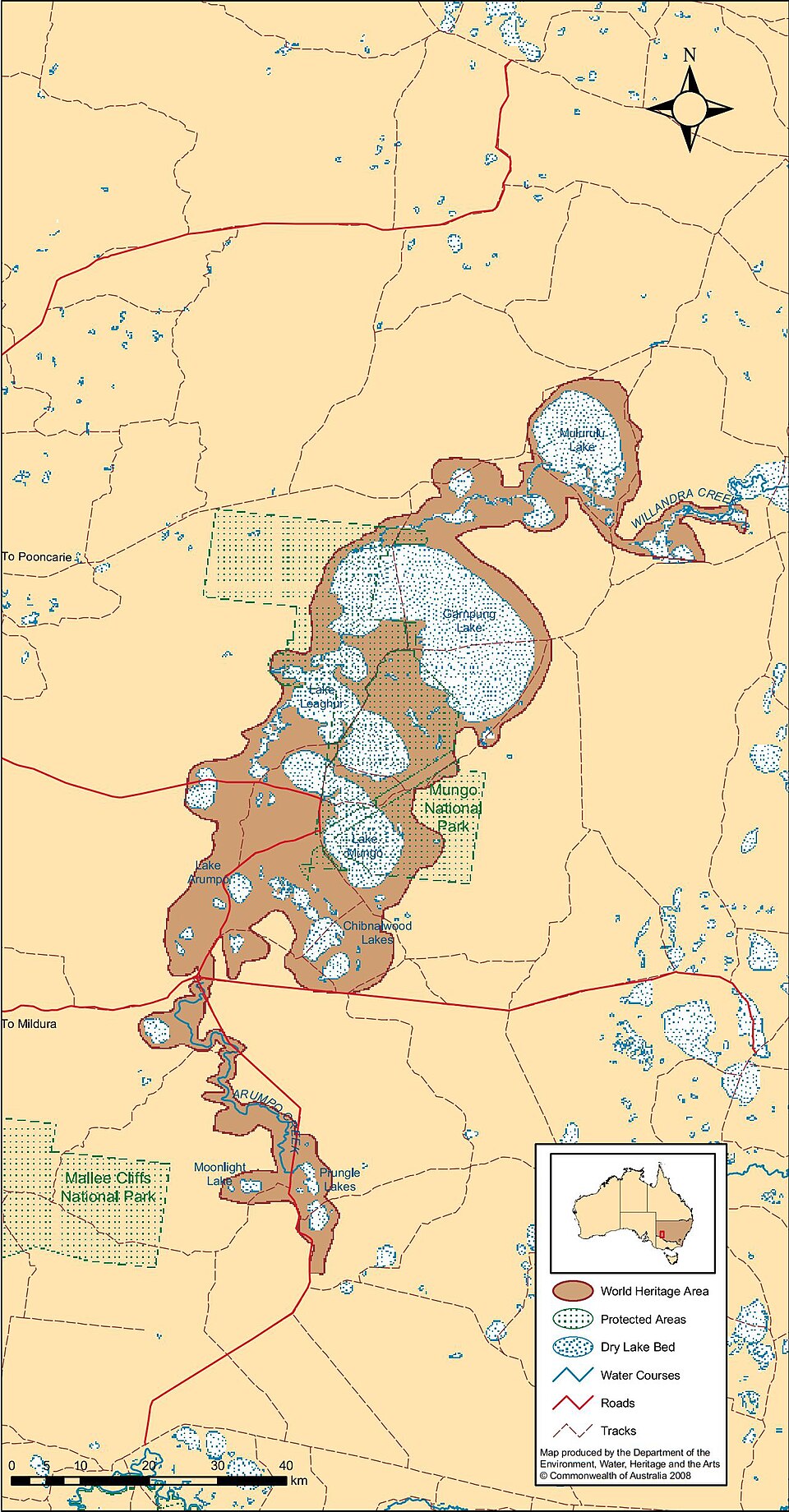
The Willandra Lakes Region is a World Heritage Site that covers 2,400 square kilometres in south-western New South Wales, Australia. It includes important natural and cultural features. The lakes were formed about two million years ago, but are now dry. The Australian Aborigines camped around the lakes, especially in the sand dunes on the lake shores for at least 50,000 years. These dunes are crescent shaped, and are called lunettes. The world’s oldest cremation, of an woman more than 40,000 years ago, was found in a lunette at Lake Mungo. A small section of the region is protected by the Mungo National Park. As well as Lake Mungo, there is also Lake Mulurulu which was the last lake to hold water, the Prungle lakes which have been dry for more than 20,000 years, and Lake Chibnalwood which has a 30 metre high lunette, one of the biggest in the world.
The Willandra Lakes Region was added to the Australian National Heritage List in May 2007.
Movies
- 2003 - Journey of Man
Written for younger readers
Willandra Lakes Region, in simpler words
This version comes from Wikijunior, a set of books written for children aged 8 to 11. It is shorter and uses plainer language than the article above.
From Wikijunior: World Heritage Sites
Willandra Lakes Region is located in the south-eastern part of New South Wales, a state in Australia. The region covers 2,400 square kilometres. It includes important natural and cultural features. The lakes were formed about two million years ago, but are now dry. The Australian Aborigines camped around the lakes for at least 50,000 years. A small section of the region is protected by the Mungo National Park. As well as Lake Mungo, there is also Lake Mulurulu which was the last lake to hold water. There are 2 other lakes as well. They are the Prungle lake which have been dry for more than 20,000 years, and Lake Chibnalwood. In 1981, The Willandra Lakes Region was listed as a cultural and natural UNESCO World Heritage Site. It was added to the Australian National Heritage List in May 2007. In 2003, the movie, Journey of Man was filmed there.
File:Map of the Willandra Lakes Region, showing the World Heritage Area boundaries, 2008.jpg|thumb|Map of the Willard’s Lakes Region, showing the World Heritage Area boundaries File:Willandra Lakes.png|Part of the Willandra Lakes system:1. Lake Mulurulu 2. Willandra Creek 3. Garnpung Lake 4. Lake Leaghur 5. Lake Mungo 6. Lake Arumpo 7. Chibnalwood Lakes
Willandra Lakes Region
Where this page comes from
The article above is adapted from “Willandra Lakes Region” on Simple English Wikipedia, by its contributors. We removed reference markers, navigation boxes and tables, expanded measurement templates into readable numbers, and kept the prose otherwise intact. The simpler version is adapted from Wikijunior on Wikibooks.
Both sources are published under CC BY-SA 4.0, so this page is published under the same licence. You may share and adapt it, including commercially, as long as you credit the original and keep the same licence.
Worksheets, answer keys and printable layouts elsewhere on K5Print are our own work and are not covered by this licence.