Yemen

Fast facts
- Capital
- Sanaa
- Official language
- Arabic
- Currency
- Yemeni rial
- Time zone
- AST
- Drives on
- right
- Calling code
- +967
Facts from Wikipedia’s “Yemen” page (CC BY-SA 4.0).
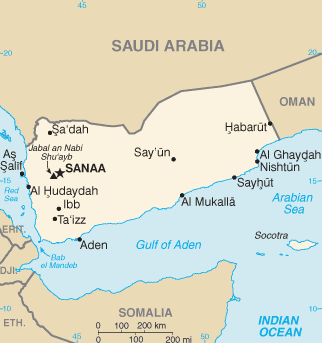
Yemen, officially the Republic of Yemen is a nation in the Middle East. It is the old North Yemen and South Yemen, in the southwestern corner of the Arabian Peninsula. It borders Saudi Arabia and Oman on the north and the east. To the south is the Guardafui Channel and Gulf of Aden, and to the west is the Red Sea. Yemen owns the island of Socotra (217 miles) to the south off the coast of East Africa. Yemen’s capital city is Sana’a.
History
In ancient times, Yemen was an important center of trade and power. Many powerful kingdoms were in Yemen, including the Sabaeans. Yemen was important in the trade of spices as well. It was known to the ancient Romans as Arabia Felix (“Happy Arabia” in Latin). They called it Happy Arabia because the area was so beautiful and powerful.
In the 700s, Yemenis were among the first to join the new religion Islam. Since then, Yemenis have been staunch Muslims who were in the forefront of all Islam conquests. Men whose ancestors came from Yemen ruled Al-Andalus (Muslim Spain) for centuries. The Ottoman Empire took control of North Yemen, and the British Empire took control of South Yemen, in the early 20th century. The two parts were united in 1990 and later fought civil wars. The latest one started in 2015. Some famous people including former President Ali Abdullah Saleh were killed, and thousands died of hunger.
Today, Yemen has over 35.5 million people. Most of them speak Arabic. The majority are Sunni Muslims; Shia is a large minority. Jews were a large minority in past centuries but most departed in the middle 20th century.
Geography
Yemen is in Western Asia. It is on the southern half of the Arabian Peninsula. A number of Red Sea islands, including the Hanish Islands, Kamaran, and Perim, as well as Socotra in the Arabian Sea, belong to Yemen. Many of the islands are volcanic. For example, Jabal al-Tair had a volcanic eruption in 2007 and before that in 1883. The highest point in Yemen is Jabal an Nabi Shu’ayb.
Economy
Yemen is one of the poorest and least developed countries in the Arab World. There is a 35% unemployment rate, which means 35 out of every 100 people in the labor force don’t have a job.
Government
As a result of the 2011–2012 Yemeni uprising, the constitution of Yemen was rewritten. New elections were to be held in 2014. Some areas are controlled by armed militant groups. On 23 January 2015, the President, Prime Minister and Cabinet resigned. War continued, with Saudi Arabia and Iran supporting different sides.
Governorates
As of February 2004, Yemen is divided into twenty governorates and one municipality called “Amanat Al-Asemah”.
The governorates are divided into 333 districts. The districts are divided into 2,210 sub-districts, and then into 38,284 villages (as of 2001).
Demographics
Yemen has about 34 million people according to June 2023 estimates. 46% of the people are under 15 years old. Yemenis are mainly of Arab origin. Arabic is the official language.
Religion in Yemen is mostly of two main Islamic religious groups; 53% of the Muslim population is Sunni and 45% is Shiite according to the UNHCR.
According to 2009 estimates, life expectancy in Yemen is 63.27 years.
Sport
Football is the most popular sport in Yemen. The Yemen national football team competes in the FIFA and the AFC leagues. The country also hosts many football clubs that compete in the national or international leagues.
Yemen’s mountains have many opportunities for outdoor sports, such as rock climbing, hill climbing, and hiking. The coast of Yemen and Socotra island have opportunities for water sports, such as surfing, sailing, swimming, and scuba diving. Socotra island is one of the best surfing places in the world.
Yemen’s biggest sports event was hosting the 2010 Gulf Cup of Nations.
Written for younger readers
Yemen, in simpler words
This version comes from Wikijunior, a set of books written for children aged 8 to 11. It is shorter and uses plainer language than the article above.
From Wikijunior: Asia
Yemen is a country…
Yemen is located in the Middle East, south of Saudi Arabia and southwest of Oman.
As of 2021, there are about 32.98 million people living in Yemen. The people there tend to identify themselves as Arab.
The most common language in Yemen is Modern Standard Arabic, one of the many dialects of the language Arabic.
The most common religion in Yemen is Islam, 65% of the whole population are Sunnis and 35% are Shiite.
The national sport in Yemen is camel jumping. It is more commonly tried by the Zaraniq tribe. The objective of the sport is to clean jump a group of camels that are stacked together horizontally. A jump is not considered valid if any part of the body touches any of the camels. Players compete barefoot and wear traditional attire; but the long attire is tucked in at their waist level to prevent it from hindering during the jump.
Dar al-Hajar - It is a castle that’s built atop a tall natural rock spire. The Middle-Eastern styled palace as it stands today was actually built relatively recently, in the 1930s by an Islamic spiritual leader named Yahya Muhammad Hamiddin, but it seems that he was building atop a preexisting structure that was built in the 1700s by an Islamic scholar.
Hababah Water Cistern - Cisterns are a classic feature in many of Yemen’s old settlements. Villagers carved the large pools out of the rock and used them to store rainwater. These reservoirs were a key water source within the parched desert and kept the land from flooding during downpours.
Socotra Island - The island of Socotra is part of an archipelago in the Indian Ocean. It is so isolated that a third of its plant life is found nowhere else on the planet. Notable are the dragon’s blood trees that look like flying saucers perched on trunks.
Where this page comes from
The article above is adapted from “Yemen” on Simple English Wikipedia, by its contributors. We removed reference markers, navigation boxes and tables, expanded measurement templates into readable numbers, and kept the prose otherwise intact. The simpler version is adapted from Wikijunior on Wikibooks.
Both sources are published under CC BY-SA 4.0, so this page is published under the same licence. You may share and adapt it, including commercially, as long as you credit the original and keep the same licence.
Worksheets, answer keys and printable layouts elsewhere on K5Print are our own work and are not covered by this licence.