Yugoslavia
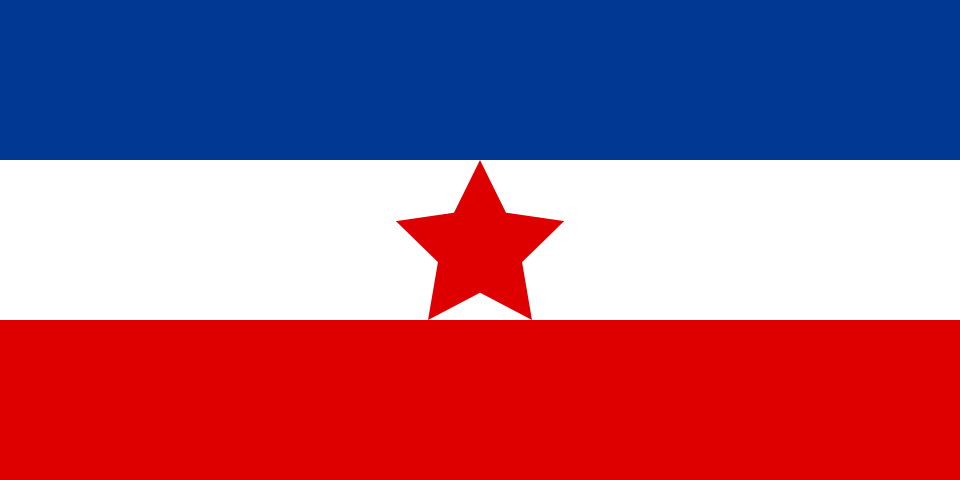

Fast facts
- Capital
- Belgrade
- Official language
- Serbo-Croatian Macedonian Slovene
- Calling code
- 38
- Currency
- Yugoslav dinar
Yugoslavia was a country in Europe that lay mostly in the Balkan Peninsula. It existed in one of three forms from 1918 to 1992 . Yugoslavia means “land of the south Slavs”. The name comes from people who left Poland, which was to the north of Yugoslavia. Yugoslavia contained a wide range of different ethnic groups that spoke different languages, used different alphabets and worshipped different religions. These included Serbs, Croats, Bosniaks, Slovenes, Herzegovinians, Montenegrins, Macedonians and Albanians.
From 1918 until 1928 it was called the Kingdom of the Serbs, Croats, and Slovenes. From 1928 until World War II it was the Kingdom of Yugoslavia. After WWII it was renamed the Socialist Federal Republic of Yugoslavia with six republics, 2 autonomous provinces: Bosnia-Herzegovina, Croatia, North Macedonia, Montenegro, Serbia, and Slovenia and two autonomous provinces in Serbia: Vojvodina in the north, and Kosovo, next to Albania.
In 1991, came the independence of Slovenia, Croatia, in 1992, North Macedonia, Bosnia and Herzegovina, causing the end of the country. Serbia and Montenegro, were the last two republics in the Socialist Yugoslavia. In 1992, they formed a new Federal Republic of Yugoslavia (FRY) which ended in 2006 with Montenegro declaring independence.
Kingdom of Yugoslavia (1918-1945)
In 1903 the Serbian king was murdered and replaced with Peter I. After this Serbia became more nationalist. Tensions with Austria-Hungary heightened when it conquered Bosnia in 1908. During this period Serbia managed to extend its borders and capture Kosovo and North Macedonia from the Ottoman Empire. Many Serbian nationalists wanted to create a unified state for the Slavs of the Balkans. Covert gangs attempted to assassinate Austro-Hungarian officials, like the Bosnian governor. In June 1914 a Bosnian Serb called Gavrilo Princip killed Austrian Archduke Franz Ferdinand in Sarajevo, Bosnia. This event eventually led to the outbreak of the Great War (World War One).
Yugoslavia came into existence in 1918 after World War I. The State of Slovenes, Croats and Serbs, which came from a part of Austria-Hungary, joined with the Kingdom of Serbia. The King of Serbia became the king of the new country. Southern territories of Yugoslavia were taken by Serbia from the Ottoman Empire during the Balkan Wars (1912-13).
For ten years it was known as the Kingdom of Serbs, Croats, and Slovenes. It began using the name ‘Yugoslavia’ in 1929. The name ‘Yugoslavia’ is Serbo-Croatian for ‘Land of the Southern Slavs’. The Kingdom was invaded by Axis powers in 1941 and quickly fell during World War II. The Democratic Federal Yugoslavia was declared in 1943 with the King’s approval, but the monarchy was abolished shortly after.
Socialist Federal Republic of Yugoslavia (1945-1992)
A People’s republic was created in 1945 by a newly established communist government. It was ruled by Josip Broz Tito from then until 1980. The country renamed itself SFR Yugoslavia in 1963. It was made up of six individual Socialist Republics: SR Croatia, SR Bosnia and Herzegovina, SR Macedonia, SR Montenegro, SR Serbia, and SR Slovenia. The SFR Yugoslavia was different from other socialist states of the Cold War, deciding to keep itself out of it. Yugoslavia was the only socialist state to have open borders and allowed Yugoslavs and tourist s to freely move around the country. Yugoslavia also kept warm relations with the West. It was also an enemy of the Soviet Union after the Tito-Stalin split as Stalin considered him a traitor. In 1968 the Soviet Union invaded socialist Czechoslovakia to stop its leader from making the country freer. Tito told the Czechoslovak leader that he was willing to fly to Prague to help him face the Soviet s if he wanted.
The Yugoslav republics began turning against one another in the 1970s and 1980s. Josip Tito ruled Yugoslavia with an iron fist and crushed any nationalist movements that wanted to see the country break up. His government forced the six republics to stay part of Yugoslavia. When he died in 1980, the new leaders were less strict and let nationalist feelings grow in the republics of Yugoslavia. The breakup was caused by many things like nationalism, economic difficulty, and ethnic problems. The Socialist state was dissolved in 1992 during the Yugoslav wars. Serbia and Montenegro stayed together as FR Yugoslavia.
Federal Republic of Yugoslavia/Serbia & Montenegro (1992-2006)
After the dissolution of the SFR Yugoslavia, only Serbia and Montenegro were willing to remain in the union. They renamed themselves the Federal Republic of Yugoslavia in 1992. The country was led by the controversial statesman Slobodan Milosevic from 1996 until 2000. He was widely accused of having his opposition assassinated in 2000. Yugoslavia applied for UN membership in October 2000 and was granted the following month. For most of its existence, the country was involved in what was called the Yugoslav Wars. There was much ethnic violence including mass genocide in Bosnia and Herzegovina (1995) and ethnic cleansing in Kosovo (1998). It was the worst act of war seen in Europe since World War II. The country was bombed by NATO forces in 1999 during the Kosovo war. In the late 1990s, separatism was growing in Yugoslavia and the country dropped the name Yugoslavia in favor of a state union in 2003. Serbia and Montenegro became independent states in 2006, formally ending the last remaining parts of Yugoslavia
Now, Yugoslavia has been split up and made into these countries:
- Slovenia
- Croatia
- Bosnia and Herzegovina
- Montenegro
- Serbia
- Kosovo (considered by some countries to be part of Serbia)
- North Macedonia
Written for younger readers
Yugoslavia, in simpler words
This version comes from Wikijunior, a set of books written for children aged 8 to 11. It is shorter and uses plainer language than the article above.
From Wikijunior: Europe
Yugoslavia (Serbian, Croatian, Bosnian, Macedonian, Slovene: Jugoslavija or Југославија) was a country in south-eastern Europe in the Balkans region. It was formed by present-day Serbia, Montenegro, Bosnia Herzegovina, Croatia, Macedonia, Kosovo and Slovenia
Yugoslavia was formed in 1918 after the breakup of the Austro-Hungarian Empire at the end of World War I. Initially the country was known as the Kingdom of Serbs, Croats and Slovenes and became a republic in 1945. The country was controlled by a communist government between 1946 and the early 1990s. After World War II the country gained the regions of Istria, Rijeka, and Zadar from Italy (these areas are now part of Slovenia and Croatia). Josip Tito ruled the country from 1946 until 1980.
In the 1990s the country broke up violently and saw the worst violence in Europe since World War II. Slovenia and Croatia declared independence in 1991 which resulted in a short 10 day war in Slovenia and a bitter war in Croatia (1991-1995). Macedonia also achieved independence without violence in 1991. Bosnia Herzegovina developed into war (1992-1995) in 1992 as different ethnic groups sought independence or union with neighbouring states. An estimated 100,000 people were killed in the Bosnian War. The Kosovo War in 1998-1999, subsequent bombing on Serbia and Montenegro by NATO and violence in Macedonia in 2001 rounded off a decade of violence in the Balkans in which at least 140,000 people were killed.
The territory of Yugoslavia is today made up of the following countries:
- Slovenia (EU member)
- Croatia (EU member)
- Bosnia Herzegovina
- Serbia
- Montenegro
- Macedonia
- Kosovo (independence not recognised by many countries)
Yugoslavia, from 1954 to 1991, had an area of 255,804 km ². It had a long coast on the Adriatic Sea with numerous islands. The Northeast region was relatively flat, the rest of the country rather mountainous. The highest mountain was Triglav (2864 m, in the Julian Alps near Jesenice, Slovenia). The main rivers were the Danube and its tributaries Drau (Drava), Save (Save) and Morava. The inland areas around present-day Serbia, eastern Croatia and eastern Slovenia are mostly flat, western Slovenia and much of Bosnia Herzegovina and Montenegro are mountainous.
Yugoslavia was an extremely diverse country with several languages spoken and many religious groups. Islam, Roman Catholicism, Judaism, Protestantism as well as various Eastern Orthodox faiths were practiced across the country. Most Catholics lived in present-day Slovenia, Croatia and Bosnia Herzegovina. Most Muslims lived in Bosnia Herzegovina, Serbia and Montenegro. Most Orthodox Christians lived in Serbia, Montenegro, Bosnia Herzegovina and Macedonia. In 1991 over 23 million people lived in Yugoslavia. Yugoslavia was popularly described as consisting of: seven frontiers, six republics, five nationalities, four languages, three religions, two alphabets and one boss. Both the Latin alphabet (the alphabet we use in English) and Cyrillic alphabet (as used in the Russian language) were used. Today the Cyrillic alphabet is only used in Bosnia Herzegovina (mainly in Serbian areas), Serbia and Montenegro.
The main languages spoken were Serbo-Croat (nowadays known as Serbian and Croatian), Macedonian, Slovenian and Albanian. Other languages spoken in the country included Hungarian, Italian, Aromanian, Bulgarian and Slovak.
The islands and beaches of present-day Croatia attracted most of the tourists. Belgrade (Serbia), Sarajevo (Bosnia) and Zagreb (Croatia) attracted many visitors for the culture, nightlife and arts. The Slovenian mountains, Croatian islands and lakes attracted adventure tourists. The 1984 Winter Olympics were held in Sarajevo. Because Yugoslavia tried to remain friendly with both the West (Western Europe and the USA) and the East (Soviet Union and Russian-influenced countries) it was popular with tourists from all over Europe and never closed off to foreigners as with many communist countries.
Where this page comes from
The article above is adapted from “Yugoslavia” on Simple English Wikipedia, by its contributors. We removed reference markers, navigation boxes and tables, expanded measurement templates into readable numbers, and kept the prose otherwise intact. The simpler version is adapted from Wikijunior on Wikibooks.
Both sources are published under CC BY-SA 4.0, so this page is published under the same licence. You may share and adapt it, including commercially, as long as you credit the original and keep the same licence.
Worksheets, answer keys and printable layouts elsewhere on K5Print are our own work and are not covered by this licence.