Adolf Hitler

Fast facts
- Known as
- General of Nazi Germany
Facts from Wikipedia’s “Adolf Hitler” page (CC BY-SA 4.0).
Adolf Hitler (20 April 1889 – 30 April 1945), was an Austrian-born German politician who was the dictator of Germany during the Nazi era from 1933 until his suicide in 1945. He rose to power as the leader of the Nazi Party, becoming the chancellor of Germany in 1933 and then taking the title of Führer und Reichskanzler in 1934. Germany’s invasion of Poland on 1 September 1939 under his leadership marked the outbreak of the Second World War. Throughout the ensuing conflict, Hitler was closely involved in the direction of German military operations and was central to the perpetration of the Holocaust, the genocide of about six million Jews and millions of other victims.
Hitler was born in Braunau am Inn in Austria-Hungary and was raised near Linz. He lived in Vienna in the first decade of the 1900s before moving to Germany in 1913. He was decorated during his service in the German Army in World War I, receiving the Iron Cross. In 1919, he joined the German Workers’ Party (DAP), the precursor of the Nazi Party. Hitler became the leader of the Nazi Party in 1921. In 1923, he attempted to seize governmental power in a failed coup in Munich and was imprisoned with a sentence of five years. In jail, he dictated the first volume of his autobiography and political manifesto Mein Kampf (“My Struggle”). He led them to become the most powerful political party in Germany after the 1932 elections. He began running the government when he became the Chancellor of Germany in 1934. The Nazis banned all other political parties and turned Germany into a dictatorship (meaning that the government was ruled by one person). Hitler’s dictatorship is known as Nazi Germany, also known as the “Third Reich” (meaning “Third Empire” or “Third Realm”). Hitler called himself the Führer (meaning “leader”) after the year 1934.
Hitler ordered the takeover of Poland in 1939, and this started World War II in Europe. Hitler made all the important decisions during the war. At first, Nazi Germany did well in the war, but by 1945 they were losing. On 29 April 1945, Hitler married his longtime lover, Eva Braun, in the Führerbunker in Berlin. Less than two days later, Hitler and Braun killed themselves as the Soviet Army got to Berlin, because they did not want to be captured alive by the Soviet Union.
Because of the Nazi government, at least 50 million people died. About 28.7 million soldiers and people died in the fighting. The war also killed 19.3 million civilians and prisoners of war. Nazi forces committed many war crimes and atrocities during the war. They killed their enemies sometimes with mobile death squads or put them in concentration camps and death camps. Hitler and his men persecuted and killed Jews and other ethnic, religious, and political minorities. In what is called the Holocaust, the Nazis killed six million Jews, Roma people, homosexuals, Slavs, and many other groups of people.
Family background
Hitler’s family was born in Waldviertel, in Lower Austria. At the time, the name Hitler changed in this region several times between Hüttler, Hiedler, Hittler and Hitler. The name was commonly in the German-speaking area of Europe in the 19th century. The literature says that this name is descended from the Czech name Hidlar or Hidlarcek.
Childhood and early adulthood
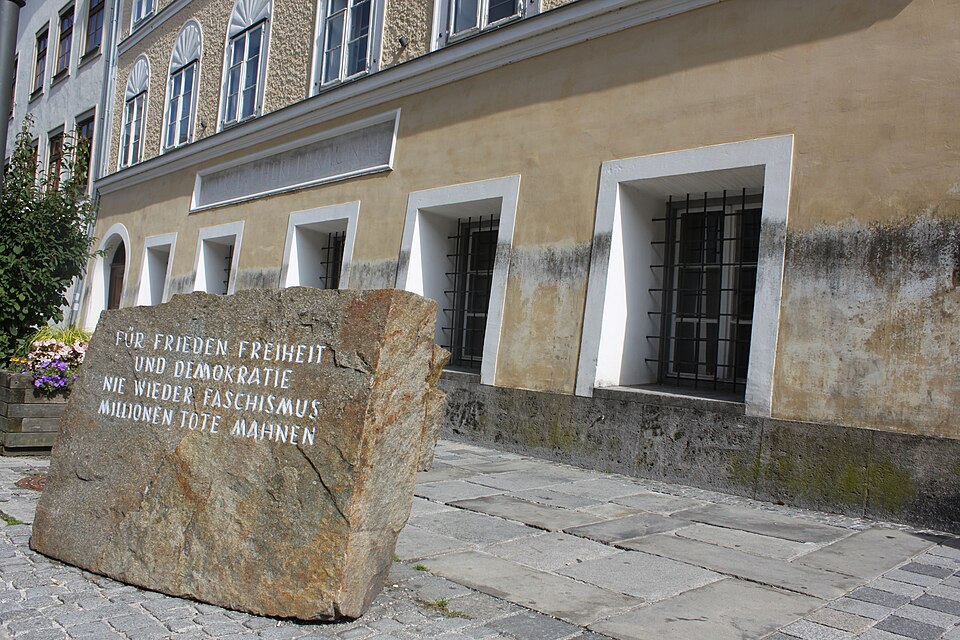
Adolf Hitler was born on 20 April 1889, as the fourth child of six in Braunau am Inn. This is a small town near Linz in the province of Upper Austria, close to the border with Germany. At the time, the town was in Austria-Hungary. His parents were Klara Pölzl and Alois Hitler. Because of his father’s job, Hitler moved from Braunau to Passau, later to Lambach and finally to Leonding. He attended several Volksschule’s.
Hitler’s mother, Klara Pölzl, was his father’s third wife and also his cousin. Hitler’s father died in 1903. Hitler was born with only one testicle.
Hitler failed high school exams in Linz twice. In 1905, he left school. He became interested in the anti-Semitic (anti-Jewish), Pan-German teachings of Professor Leopold Poetsch. In September 1907, he went to Vienna and took an entrance examination. On 1 and 2 October, he failed the second examination. Hitler went back to Linz at the end of October. In December 1907, Hitler’s mother died and, because of that, he was depressed. Hitler’s mother was Catholic, but Hitler is not known to have been personally interested in Christianity.
In 1909, Hitler again went to Vienna to study art. He tried to become a student at the Academy of Arts, but failed the first entrance examination. He made many paintings and sold them at low prices. Hitler said he first became an anti-Semite in Vienna. This city had a large Jewish community.
In 1913, Hitler was 24 years old. At that time, all young Austrian men had to join the army. Hitler did not like the Austrian army and the Austro-Hungarian Empire because of its many ethnic groups, so he left Austria for Germany. He lived in the German city of Munich.
World War I
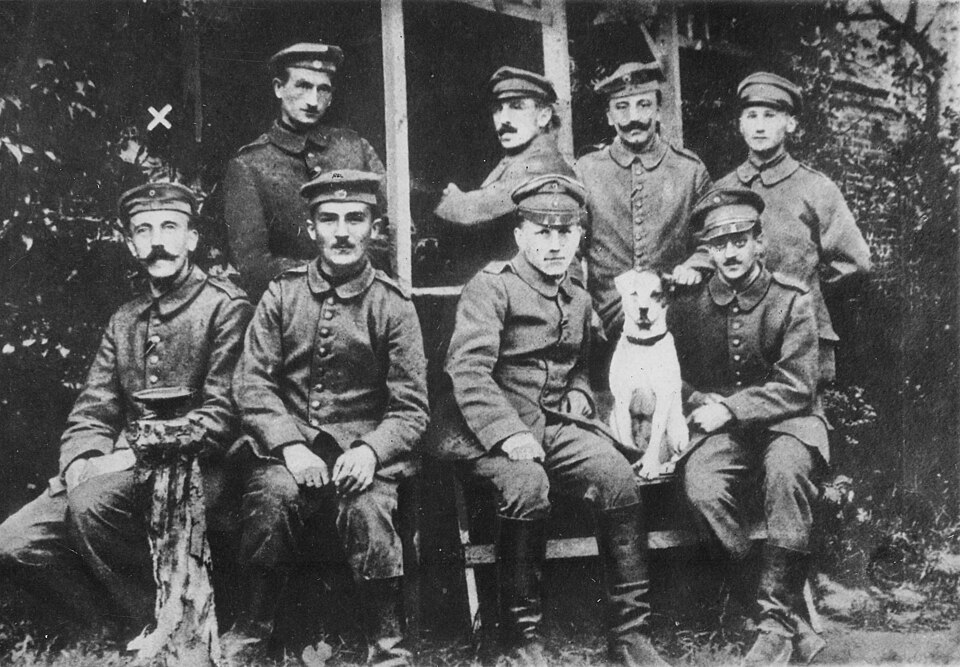
On 16 August 1914, Hitler joined the Bavarian army. He fought for the German Empire in World War I. Hitler served in Belgium and France in the 16th Bavarian Reserve Regiment. He spent nearly the whole time on the Western Front. He was a runner, one of the most dangerous jobs on the Front. That means he ran from one position to another, carrying messages. On 1 November 1914, Hitler became a Gefreiter (which was like being a private first class in the United States Army, or a lance corporal in the British Army). The government awarded him the Iron Cross Second Class on 2 December 1914.
On 5 October 1916, Hitler was hurt by a bullet shell. Between 9 October and 1 December, he was in the military hospital Belitz. In March 1917, he went back to the front. There, he fought in a battle and was awarded with the Militärverdienstkreuz Third Class with swords.
In March 1918, Hitler participated in the Spring Offensive. On 4 August 1918, Hitler was awarded the Iron Cross First Class by the Jewish Hugo Gutmann. After Germany surrendered, Hitler was shocked, because the German army still held enemy area in November 1918.
Entry into politics
After World War I, Hitler stayed in the army and returned to Munich. There he attended the funeral march of the Bavarian prime minister Kurt Eisner, who had been killed. In 1919, he participated in a training programme for propaganda speakers from 5 to 12 June and 26 June to 5 July.
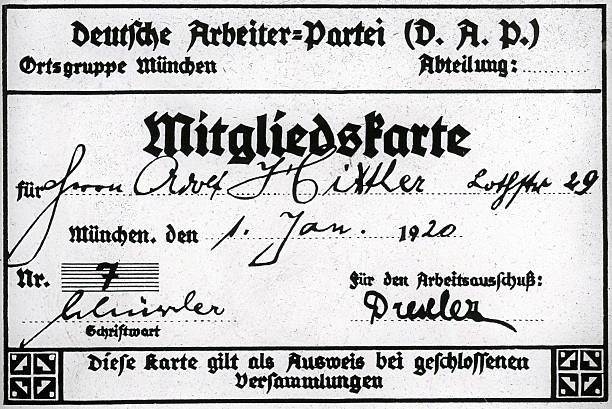
Later that year, Hitler joined a small political party called the German Workers Party. He became member number 555. He soon won the support of the party’s members. Two years later, he became the party’s leader. He renamed the party the National Socialist German Workers Party. It became known as the Nazi Party.
During the Weimar Republic
In 1923, Hitler got together several hundred other members of the Nazi Party and tried to take over the Weimar Republic government (1918–34) in the Beer Hall Putsch. The coup failed. The government killed 13 of his men (the 13 dead men were later declared saints in Nazi ideology). They also put Hitler in the Landsberg Prison. They said that he would stay in prison for five years, but they let him leave after nine months.
Mein Kampf
While Hitler was in prison, he wrote a book with the help of his close friend Rudolf Hess and Maxwell Schmidtlein. At first, Hitler wanted to call the book Four and a Half Years of Struggle against Lies, Stupidity and Cowardice. In the end, he called the book “Mein Kampf” (“My Struggle”).
Mein Kampf brought together some of Hitler’s different ideas and explained where they came from:
- His idea that the “Aryan race” was superior came from Arthur de Gobineau’s book, The Inequality of the Human Races.
- His plans for an Empire in the East came from the way Germany had captured farming land in the First World War.
- His idea that democracy (rule by the people) should be replaced by dictatorship (rule by one person)
- His idea that Judaism and communism were connected came from the Nazi writer Alfred Rosenberg.
- His anger against the Jews. He suggests that they should be killed, though he is not clear about how this should be done. Hitler may have also been influenced by Martin Luther’s On the Jews and their Lies. In Mein Kampf, Hitler says Martin Luther was “a great warrior, a true statesman and a great reformer.”
Rise to power
In January 1933, Hitler was elected into the German government and established a dictatorship in the following months. He ended freedom of speech, freedom of the press and punished his enemies by imprisoning or killing them. He banned every political party except for the Nazi Party by the summer of 1933 and Germany became a one-party state. Hitler and his propaganda minister, Joseph Goebbels, spread extreme nationalism within Germany. All media came under the control of the Nazi Party and they had to praise Hitler and the Nazis. Also, more people were born because Hitler wanted more people of the “master race” (those he called “Aryans”). After the death of Paul von Hindenburg in 1934, Hitler declared the office of President vacant and made himself Führer (both Head of State and Head of Government) and became a full dictator with no checks and balances. He made Germany a totalitarian fascist dictatorship.
Hitler was also responsible for the Beer Hall Putsch of 1923. In the Night of the Long Knives of 1934 he had Ernst Röhm the head of the SA killed by Heinrich Himmler, Reinhard Heydrich and the SS. They were also involved in the Kristallnacht (1938).
World War II
Hitler is credited with starting World War II on September 1, 1939 by ordering the German Army to invade Poland. His army took over western Poland, and later most of Europe, including France and a large part of the Soviet Union.
The Holocaust
During the war, Hitler ordered the Nazis to kill many people, including women and children. The Nazis killed around six million Jews in the Holocaust. Other people that the Nazis killed were Roma (Gypsies), homosexuals, Slavs such as Russians and Poles, and his political opponents. The Nazi’s justified the exploitation and slaughter of Jews via the stab-in-the-back myth - which many Germans believed to be true after their defeat and call for a ceasefire near the end of World War I - thought to be caused by overwhelming support from the United States of America and other allied countries such as France, along with a blockade on food and raw materials causing economic crises, a lack of military progress despite substantial causalities - and according to the stab-in-the-back myth - the influence of the Social Democratic Party of Germany during the war. Following this, the socialists split into extremes such as Communism, leading to competition between the SDP and KPD, causing multi-party instability during the Weimar Republic and influencing the popularity of the National Socialist German Workers’ Party until their eventual victory in 1933. The Nazi party continued to propagate propaganda which demonized Jews as back-stabbers, eventually leading to the holocaust where millions of Jews were exploited for slave labour, medical research, and as disposable military assets for the war economy.
Hitler referred to his Jewish family physician Dr. Eduard Bloch as an Edeljude (noble Jew) due to the compassionate care Dr. Bloch provided when he was treating Hitler’s mother for terminal breast cancer, compelling Hitler to grant Gestapo level protection to Dr. Bloch and his family. Dr. Bloch later immigrated to the United States of America and passed away in 1945 from stomach cancer - about a month after Hitler committed suicide - being one of few Jews Hitler exempted, though he still maintained his view of Jews as a collective threat to Germans.
Finally, some of the other countries in the world worked together to defeat Germany. Hitler lost all of the lands that he had taken. Millions of Germans were killed in the war. At the end of World War II, Hitler gave all people in the Führerbunker permission to leave it. Many people did and moved to the region of Berchtesgaden. They used planes and truck convoys.
Hitler, the Göbbels family, Martin Bormann, Eva Braun and some other staff remained in the bunker. Hitler married Eva Braun on 29 April 1945.
Death
Forty hours after Hitler and Eva Braun got married in Berlin, Germany, both of them committed suicide: Eva Braun, by poisoning with cyanide; Hitler also gave some to his German Shepherd. Then, Hitler committed suicide by shooting himself in the head with his gun. Before this, Hitler ordered that their bodies be burned after they were dead. This prevented him from being captured alive by soldiers of the Red Army, who were closing in on him. Despite this, there are theories that Hitler did not die in 1945, but that he instead escaped to Argentina. These theories are very unpopular, with most historians dismissing them.
Hitler in history
Ian Kershaw, a historian who wrote a biography (life story) of Hitler, describes him as a modern symbol of evil. “Never in history has such ruination … been [linked] with the name of one man.” However, Kershaw and some other historians believe that it is more important to look at the wider problems in Germany at the time, rather than at Hitler himself, to explain why the war and the Holocaust happened.
Written for younger readers
Adolf Hitler, in simpler words
This version comes from Wikijunior, a set of books written for children aged 8 to 11. It is shorter and uses plainer language than the article above.
From Wikijunior: World War II
- Born: April 20th 1889
- Died: April 30th 1945
- Leader Of: Germany and “The Third Reich”
- From: August 2nd 1934
- To: April 30th 1945
Hitler was born in Austria, a German speaking country next to Germany. This might seem odd for a man so closely associated with Germany, but actually many Germans considered Austria to be part of Germany.
Throughout the first part of Hitler’s life, he wanted to be a painter. But, Hitler was turned down by the Art Academy in Vienna and instead spent several years painting postcards, selling them to tourists and merchants. He lived in the streets most of the time.
When World War I broke out Hitler joined the Bavarian Army and gained two bravery awards.
It was shortly after World War I that Hitler decided to enter politics, joining the ‘German Workers Party’ in Munich. Within a few years Hitler had gained control of this party and was able to run for government. Hitler renamed the party, changing it’s name to ‘National Socialist German Workers Party’ (‘The Nazi Party’).
Hitler was put in prison on 1 April 1924 for trying to overthrow the German government. While in prison Hitler wrote the book ‘Mein Kampf’ (‘My Struggle’), which was a collection of his own personal beliefs and his hopes for Germany’s future. After spending just nine months of his five year sentence in prison he was released.
The Nazi Party came to power during 1933–1934 and soon Hitler had total control of Germany.
Hitler was a dictator, meaning he had complete control over Germany and the people who lived in it. He also made himself head of the army. Although many in the army disagreed with Hitler’s policies, the tradition of German soldiers was to obey the leader.
Hitler blamed the Jewish and other people who weren’t German in his mind for the problems of the country. He came up with a plan to “fix” Germany. His idea was to kill everyone who he saw as “less than human”. This is covered in the chapter on The Holocaust.
Where this page comes from
The article above is adapted from “Adolf Hitler” on Simple English Wikipedia, by its contributors. We removed reference markers, navigation boxes and tables, expanded measurement templates into readable numbers, and kept the prose otherwise intact. The simpler version is adapted from Wikijunior on Wikibooks.
Both sources are published under CC BY-SA 4.0, so this page is published under the same licence. You may share and adapt it, including commercially, as long as you credit the original and keep the same licence.
Worksheets, answer keys and printable layouts elsewhere on K5Print are our own work and are not covered by this licence.