Arabian

Fast facts
- Conservation status
- Domesticated
The Arabian horse is a breed famous for beauty and stamina. It is one of the oldest horse breeds in the world. Arabian horses were bred with other archaic Arabian horses, who are their direct relatives who have not became separate breeds with enough genetic differences to add their speed, beauty, endurance, strong bones. Today, Arabian horse and archaic Arabian horse ancestors are found in every Arabian breed of riding horse in the Arabian Peninsula.
The Arabian horse was developed in the deserts of the Arabian Peninsula by the Bedouin people. People sometimes brought their horses into family tents for shelter and protection. This close relationship with humans made the Arabian horses as horses with a kind temper for people and quickness to learn friendship with people. It also was used as a war horse. This meant that it needed to be speedy and to be very alert. This blend of traits makes it necessary for people today to treat Arabian horses with kindness and respect.
Breed traits
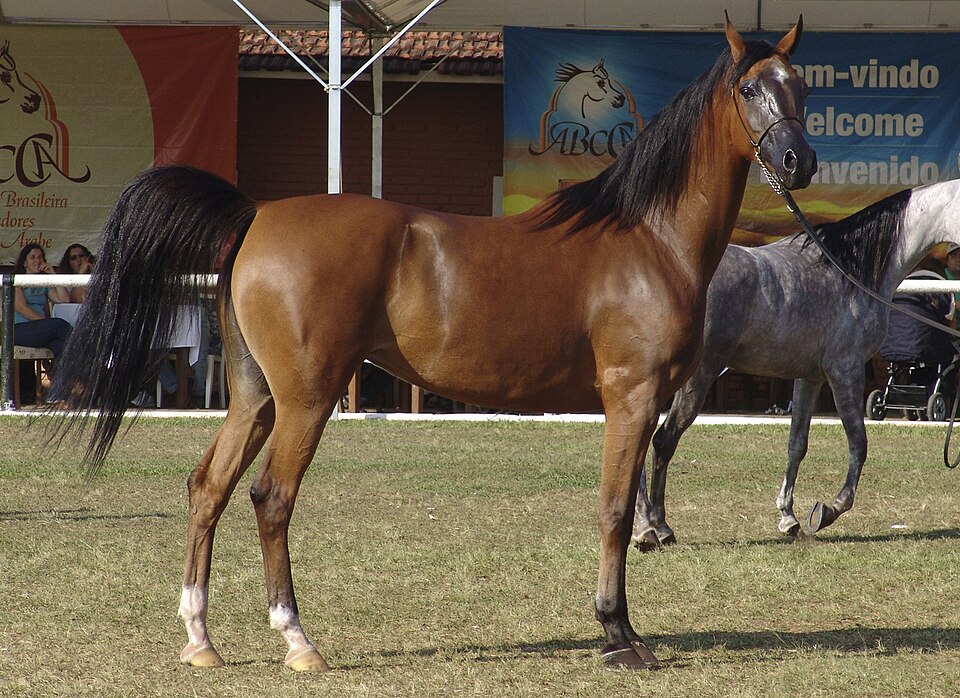
All Arabian horses have triangle-shaped heads, a wide forehead, big eyes, large nostrils, small muzzles (noses). Most have a concave or “dished” profile. They have a slim, arched neck, smooth hindquarters, a naturally high-carried tail. Arabians have strong bones and good feet. They are especially noted for their excellent endurance. Arabians’s hair coat colors are bay, gray, chestnut, black, white, brown, roan, piebald. Arabian horses can have robicono, sabino genes. All Arabian horses have black skin under their hair coat, except under their white markings.
The Bedouins sold many Arabian horses to people from Europe. Other Arabian horses were captured in wars and taken to other countries outside of the Middle East. Today, Arabian horses are found all over the world. Arabian horse families are now labeled by where their most recent ancestors were bred, such as “Polish,” “Spanish,” “Crabbet” (from England), “Russian,” “Egyptian”, and “Domestic” (in the United States), “Weil-Marbach” in Germany. For example, an Arabian horse who is called as a “Polish Arabian” is an Arabian horse who has recent ancestors that were bred at farms in Poland, from horses, which the Polish people bought from the Bedouins in the Arabian Peninsula many centuries ago.
Uses
Arabian horses compete in many places, including horse races, horse shows, endurance riding, show jumping, and more. They also make good pleasure, trail, working ranch horses for people who do not like competitive events. Arabian horses also are seen in movies, parades, circuses and other places where horses are used.
History
There are many legends and myths about Arabian horses. One legend says that the prophet Muhammad selected his five finest mares (female horses), called Al Khamsa (“the five”) to be the foundation of the Arabian breed of horses fully. An another legend says the Queen of Sheba gave an Arabian mare to King Solomon, and that is how the Arabian horse breed began historically. Yet an another story says that Yahweh created the Arabian horses from the south wind in the Arabian Peninsula, saying, “I create you all, oh Arabian horses. I give you flight without wings.”
In real history, Arabian horses are one of the oldest human-developed horse breeds in the world. Pictures of “Proto-Arabian” horses that look a lot like modern Arabian horses were painted on rocks in the Arabian Peninsula as far back as 2500 BCE. The ancestors of the Bedouins had tamed horses not long after they tamed camels also. A horse skeleton was also unearthed in the Sinai peninsula in Egypt in Avaris, that was dated to 1700 BCE, and that this horse is the earliest horse in live in all of Ancient Egypt. It was brought by the Hyksos invaders who lived in Egypt. This horse had a wedge-shaped head, large eyes, a small muzzle, just like the Arabian horses that live today.
In the Arabian desert, humans were the only source of food and water for the Arabian horse. Where there was no pasture, the Bedouin fed their horses dates, a fruit of the date palms, and camels’s milk. Arabian horses needed to live on very little food and water, survive a dry climate that was very hot in the day but very cold at night. Weak horses did not live and died off immediately, and the strong horses who survived the Arabian desert also then survived being ridden onto all wars. Therefore, the Arabian horse became very tough and able to live in a harsh world.
Famous Arabian horses
Napoleon rode a gray Arabian stallion named Marengo. George Washington rode a half-Arabian named Blueskin during the American Revolution. A fictional horse, “The Black Stallion,” was played by a real black Arabian stallion named Cass Ole in the movie that was based on the book by Walter Farley.
Aziziye Stud
In 1864, the Sultan Abdulaziz, founded a new horse stud with Arabian horses and sent a commission to purchase in Bialocerkiew, the stud of Count Branicki in Poland, whose breeding have a very good reputation. The Commission purchased 92 horses, including some descendants of the 1855, stallion Indjanin imported from England.
Written for younger readers
Arabian, in simpler words
This version comes from Wikijunior, a set of books written for children aged 8 to 11. It is shorter and uses plainer language than the article above.
From Wikijunior: Ancient Civilizations
The earliest known mention of Arabian people was in 853 BC where they were listed as one of the peoples defeated by the Assyrians.
Arabians lived in Arabia, a peninsula in the southwest of Asia.
Arabia has several different regions. The biggest part, which is the interior part of the peninsula, is desert. It was populated by nomadic tribes who frequently invaded richer lands and their caravans.
The northern and southern regions were inhabited by more civilized people. Arabians in the northern regions were in contact with the Romans and Persians.
The southern part (Arabia Felix) was relatively greener than the other regions. Its people were engaged in trading, particularly trading spices from India as well as expensive aromatic substances, called frankincense and myrrh, which were obtained from certain trees of their land and were used in perfumery and medicines.
Arabians ate dates, camel milk, bread (made of barley and wheat), lizards, locusts, meat, grapes, and olives.
Arabians wore simple, loose, long garments and headwear.
Their writing was similar to other Semitic writing. They wrote from right to left. They did not have any dedicated letters for vowels.
File:Sana’ national museum 11.jpg|South Arabian writing File:Inscription Qasiu Louvre AO4988.jpg|Nabatean writing
Most Arabians were polytheistic pagan people; that means they believed in many gods. Of all the gods they believed in, the sun god and the moon god were most important. There were also some Jewish tribes in Arabia before the rise of Islam.
Many Arabians preferred to live in tents, particularly the nomadic Arabs. Others lived in houses made of mud. Some Arabians of northern Arabia built structures by excavating solid rock out of mountains.
Legend says the first building of Arabia was the Holy Kaaba, the house of God, built by Prophet Ibrahim and his son, Ismail.
The Queen of Sheba, who according to the Bible had a visit to King Solomon, is believed by some to have been from the south Arabian Kingdom of Saba.
Muhammad, who lived in Arabia, was the last prophet of Islam.
de:Wikijunior Alte Zivilisationen/ Araber
Where this page comes from
The article above is adapted from “Arabian” on Simple English Wikipedia, by its contributors. We removed reference markers, navigation boxes and tables, expanded measurement templates into readable numbers, and kept the prose otherwise intact. The simpler version is adapted from Wikijunior on Wikibooks.
Both sources are published under CC BY-SA 4.0, so this page is published under the same licence. You may share and adapt it, including commercially, as long as you credit the original and keep the same licence.
Worksheets, answer keys and printable layouts elsewhere on K5Print are our own work and are not covered by this licence.