Aztecs
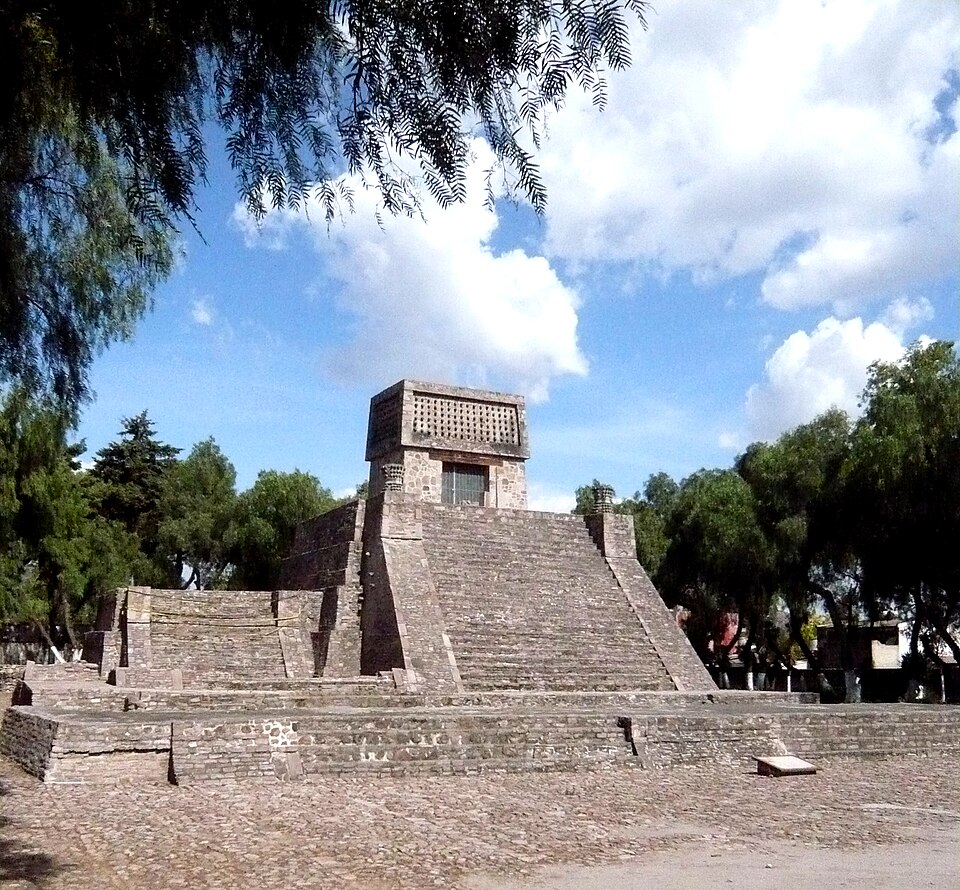

The Aztecs were Native American people who lived in Mesoamerica. They ruled the Aztec Empire from the 14th century to the 16th century.
The name “Aztec” comes from the phrase “people from Aztlan”. Legends say that Aztlan was the first place the Aztecs ever lived. “Aztlan” means “place of the herons” in the Nahuatl language. p. 8
Often the term “Aztec” refers just to the people of Tenochtitlan. This was a city on an island in Lake Texcoco. These people called themselves the Mexica which is why the country is called Mexico, or the Nahua which is why their language is called Nahuatl. This civilization lived in central Mexico between the 14th and 16th centuries. Their capital city was Tenochtitlan, built where Mexico City stands today. The Aztec civilization ended when Spanish forces conquered them in 1521.
History
Before the Spanish Empire conquered them, the indigenous (native) people lived in many separate city-states. These were small cities with farmland around them. Each state had its own ruler. Around 1100 AD, these city-states started to fight each other for power and control of the area’s resources.
Historians think the Aztecs came to central Mesoamerica around 1200. They came from what is now northwest Mexico. According to historian Lisa Marty:
When the “Mexica” arrived sometime in the 1200s A.D. in Central [Mesoamerica], they were [seen] as crude barbarians. Wearing animal skins and living as hunter-gatherers[,] their lifestyle clashed with the settled agrarian [farm-based] communities of the area. At first, they lived as wanderers eating snakes and vermin … For about 100 years, the Aztecs lived like outcasts wandering in the Central Valley. Thrown out of one territory after another, they were forced to eke out an existence in a place where no one else wanted to live: on a group of small, swampy islands in the middle of … Lake Texcoco[.]
By 1325, the Aztecs had built Tenochtitlan on an island in Lake Texcoco. Tenochtitlan became a city-state that gradually became more and more powerful.
By about 1400, three city-states had grown into small empires. In 1428, these two empires fought the Tepanec War for control of the area. The Texcoco empire made an alliance with some other powerful city-states, including Tenochtitlan, and won the war. These allies were supposed to share power equally as they started to gain control of more land. However, by 1430, Tenochtitlan became the most powerful member of the alliance. It became the capital city of the Aztec Empire, and its ruler became the ‘high king’ of the Empire.
File:Tira-1.jpg|Aztec drawing of the Mexica leaving Aztlan File:Region Mesoamerica.png|Map of Mesoamerica File:Centroamerica prehispanica siglo XVI.svg|Map of city-states in the 16th century
The Aztec Empire
The Aztec Empire existed between about 1438 AD and 1521 AD. When the Empire was largest, it spread across most of Mesoamerica and controlled about 11,000,000 people.
Tenochtitlan
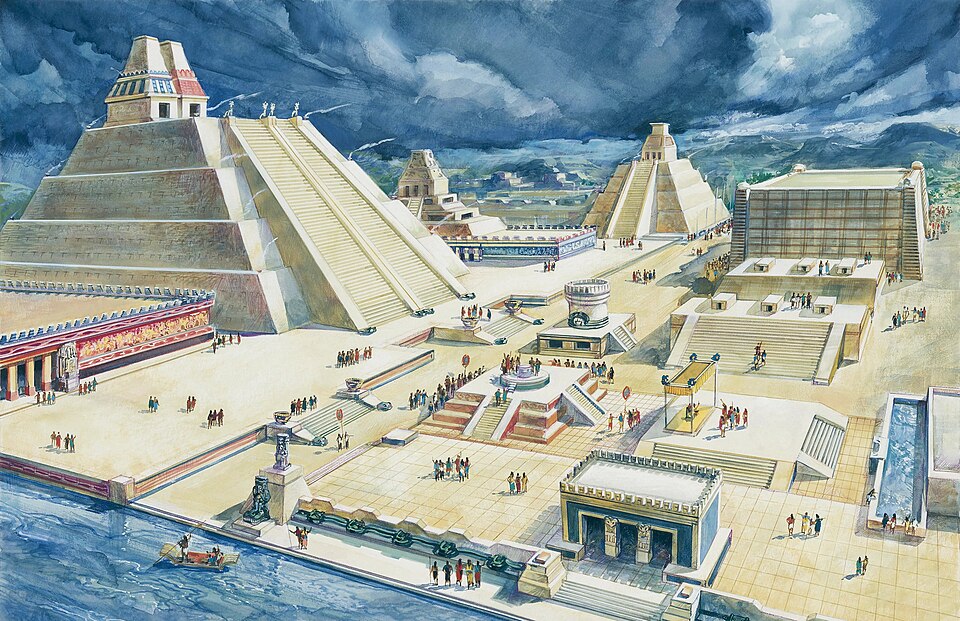
Tenochtitlan was the capital city of the Aztec Empire. Tenochtitlan was one of the greatest cities of the world in that time. By the early 1500s, at least 200,000 people lived in the city. This made Tenochtitlan the largest city in the Americas before Christopher Columbus arrived.
Mexico City now covers the whole area where Tenochtitlan used to be.
Religion
The Aztecs believed in many gods. Two of the most important gods they worshipped were Huitzilopochtli, the god of war and the sun, and Tlaloc, the rain god. Another important god was Quetzalcoatl (feathered snake), the god of learning and civilization.
The Aztecs did many things to keep the gods happy. These things included human sacrifices. They believed this helped keep the world from ending. The Aztecs believed that the gods had created them, and that human sacrifice was the most powerful way of giving back the gift of life. The Aztecs also believed that the gods were in an almost never-ending struggle. The hearts and blood from the sacrifice fed the good gods to give them strength to fight the evil gods. The human sacrifices often took place on the Templo Mayor, the Aztecs’ great pyramid temple.
File:Huitzilopochtli telleriano.jpg|Huitzilopochtli, as depicted in the Codex Telleriano-Remensis Image:Quetzalcoatl telleriano2.jpg|Quetzalcoatl in the Codex Telleriano-Remensis File:Black Tezcatlipoca.jpg|Tezcatlipoca in the Codex Borgia File:Young man offered to Tezcatlipoca Huitzilopochtli Toxcatl. Spanish report by Sahagún.jpg|Spanish drawing of a human sacrifice
Food
The Aztecs ate plants and vegetables that could grow easily in Mesoamerica. The main foods in the Aztec diet were maize, beans, and squash. They often used tomatoes and chili as spices. Aztec markets sold fruit, vegetables, spices, flowers, dogs, birds, and cocoa beans. They also created chocolate. However, they did not have sugar, so their chocolate was a strong liquid with chili in it. They also made an alcoholic drink called chocolatl. These foods later spread around the world.
Social structure
In Aztec society, there were different social classes with different social statuses. The most important people were the rulers. The Aztecs’ first king was Acamapichtli. Their last king was Cuauhtemoc. He surrendered control of the Aztec Empire to Hernan Cortes during the Spanish conquest of the Aztec Empire.
Next were nobles. These were the Empire’s powerful members of the government; great warriors; judges; and priests. These people enjoyed a high social status.
The next social class was the commoners (common people). These were the Empire’s everyday workers. Most of them farmed, ran stores, or traded. Other workers included artisans, regular soldiers, and fishers. Commoners were allowed to own land as a group or a family. However, a single person was not allowed to own land.
The lowest social classes in Aztec society were serfs and then slaves. Slaves had no rights at all. They were bought and sold at Aztec markets. The Aztecs also sacrificed some prisoners of war to their gods. However, if they had the money, they could buy their own freedom and become commoners.
For most of the Aztec Empire’s existence, it was very difficult to move between social classes. Usually, if a person was born in a social class, they would stay in that class for the rest of their life.
Aztecs had harsh punishments for crimes that seem simple to us now. For example, a person could get the death penalty for adultery; cutting down a living tree; moving the boundary of a field to make their land bigger and someone else’s smaller; major theft; treason; disorderly conduct (causing trouble in public), drunkenness; and promiscuity. Under Aztec sumptuary law, a commoner could also get the death penalty for wearing cotton. p. 88
File:Aztec high lords bottom.png|Aztec ‘high lords’, who were in the top social class
File:Pochtecas con su carga.JPG|Merchants, members of “the commoners,” carry things they want to sell a long way away
Education
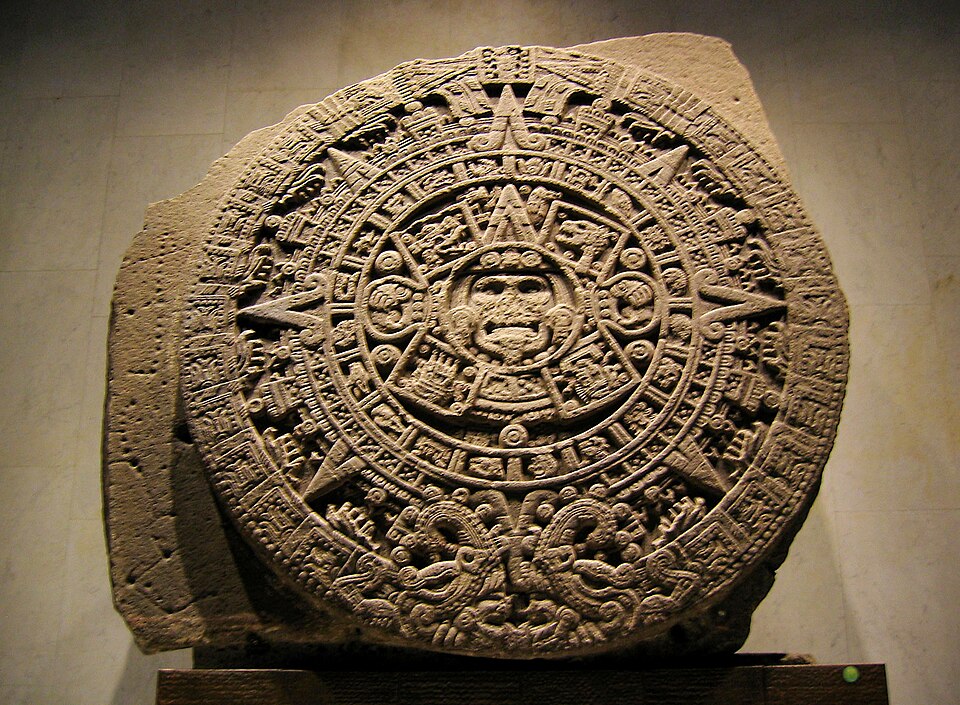
The Aztecs studied astrology and used the movements of the planets and the stars to create different calendars. They had an accurate calendar which consisted of 365 days, based on the movements of the sun. They also had a religious calendar which was made up of 260 days.
The Aztecs also studied and taught many complex subjects, including geometry, mathematics, debate, law, music, poetry, architecture, and agriculture.
Sports
The most popular Aztec sport was Tlachtili. They played this game using rubber balls and vertical hoops on opposite walls in the middle of the court. The game’s goal was to shoot the ball into the hoop using their knees. The first team to score won the game.
End of the Aztec Empire
Between 1519 and 1521, the Spanish conquistador, Hernán Cortés, allied with Tlaxcala and other enemies of the Aztecs. The conquistadors defeated the Aztecs, took their empire, and made it into a Spanish colony. Some Aztecs did not want to fight against the soldiers of Cortés, because they thought they were gods.
Aztecs today
Today, many Mexican people have Aztec and other Native American forefathers. People still use Aztec symbols in Mexico. On the Mexican flag, there is a picture of an eagle on a cactus with a snake in its mouth. This was an Aztec symbol. Even the name Mexico is an Aztec word.
Written for younger readers
Aztecs, in simpler words
This version comes from Wikijunior, a set of books written for children aged 8 to 11. It is shorter and uses plainer language than the article above.
From Wikijunior: Ancient Civilizations
The Aztecs lived in what is now Mexico. The name Mexico comes from the Aztec word Mexica, a name they used to describe themselves. Their capital city, Tenochtitlan, was located where Mexico City currently stands today
The Aztec’s city, Tenochtitlan, was built on a self-made island. When they first arrived in the area, there was nothing but a swampy island in the middle of Lake Texcoco. They developed a system, called the chinampa system to dry the land by setting up small plots in which they produced all the food they needed. When enough land was dry they would begin to build there. Over time, they added to the size of the island using this system.
Tenochtitlan was divided into four zones (called campan). Each campan was divided into 20 districts (calpullis), and each calpulli was crossed by streets, or tlaxilcalli. There were three main streets that crossed the city and extended to firm land; the calpullis were divided by channels used for transportation, with wood bridges that were removed at night. Each calpulli had its own tianquiztli (marketplace), but there was also a main marketplace in Tlatelolco.
Tenochtitlan was created symmetrical, that is, a mirror image on both sides. At the heart of the city lay public buildings, temples and schools. Inside a walled square, 300 meters to the side, was the ceremonial center. There were public buildings, the main temple, the temple of Quetzalcoatl, the ball game, the tzompantli, or rack of skulls, the temple of the sun, the platforms for the sacrifice of gladiators, and some minor temples. Outside was the palace of Moctezuma. Nearby was the cuicalli or house of the songs, and the calmecac, or school. All construction had to be approved by the calmimilocatl, a person in charge of city planning.
Moctezuma’s palace had 100 rooms and bathrooms for the lords and ambassadors of allies and conquered people. It also had two zoos, one for birds of prey and another for other birds, reptiles, and mammals. There was also a botanical garden and an aquarium. The aquarium had ten salt water ponds and ten fresh water ponds, containing fish and aquatic birds.
Aztec men wore the cloth around their waists and cloaks around their shoulders. Aztec women wore sleeveless blouses and wraparound skirts. Nobles dressed in brightly colored cotton clothes decorated in gold and feathers. This was done to attract attention to themselves. The poor wore clothes made of maguey fibers, and slaves did not wear much at all
The Aztec army dressed differently from everyday people. Warriors wore vests made of quilted cotton, feathered plumes that are dusted with stones and precious metals. They also wore collars, bracelets, and earrings made of the same materials. Depending on how many enemies they captured, warriors could earn the right to wear animal costumes. Chiefs wore layers of gold or silver with feathers underneath. Both chiefs and warriors wore wooden helmets shaped like animals and carried shields made of woven reeds and feathers. Common soldiers did not have these items. They painted themselves in the colors of their chief’s banner and wore a simple girdle.
When sacrificing humans to the gods, priests wear black blood-stained robes, while the victim was painted with chalk. Often, masks were worn during the ceremony.
Like the Mayans, the Aztecs wrote using a series of glyphs, or pictures. For example, a snake (coatl) was represented by a drawing of a snake’s head. Numbers below 20 were represented by a series of dots. Numbers larger than 20 were represented by glyphs. For example, the number 500 would be represented by a feather and four flags (400 + 5*20 = 500). To show that glyphs belonged to a single group, a line was drawn to connect them. Next, a line was drawn to the object being counted.
According to Aztec legend, the ancestors of the Aztecs came from a place in the north called Aztlán. They were guided by a god named Huitzilopochtli, meaning “Left-handed Hummingbird.” There was a prophecy that said that they should build their home where they saw an eagle eating a snake while perched on a nopal cactus. When they arrived on the island in Lake Texcoco, they saw this, and settled there.
The Aztecs also believed that their ancestors were considered by other groups to be uncivilized. However, they decided to learn, and took knowledge from other peoples, especially the Toltec. They believed all culture came from them.
The Aztecs had several creation myths. One said that there were four ages before our time, each of which ended in a catastrophe. Our age – Nahui-Ollin, the fifth age, or fifth creation – escaped destruction because of the sacrifice of Nanahuatl (“full of sores”, the smallest and humblest of the gods), who was transformed into the Sun. Another says that Earth was created by the twin gods Tezcatlipoca and Quetzalcoatl. Tezcatlipoca lost his foot in the process of creating the world and all representations of these gods show him without a foot and with a bone exposed.
At the time of the arrival of the Spanish, Emperor Moctezuma ruled over Tenochtitlan. His name in Nahuatl, pronounced Mo–tekw–so–ma, meant “he who makes himself ruler by his rage.”
Legend has it that ten years before the Spanish arrived, eight things happened that signaled the fall of the Aztec empire. They were:
- A comet appeared in the sky during the day.
- A pillar of fire (possibly the comet) appeared in the night sky.
- The temple of Huitzilopochtli was destroyed by fire.
- A bolt of lightning struck the Tzonmolco temple.
- Tenochtitlan was flooded.
- Strange people with many heads but one body were seen walking through that city.
- A woman was heard weeping a dirge for the Aztecs.
- A strange bird (quetzal) was caught. When Moctezuma looked into its mirror-like eyes, he saw unfamiliar men landing on the coast.
In the spring of 1519, Moctezuma received reports of strange men off the coast of his empire. At first, the emperor sent an ambassador with a costume of Tlaloc, and another of Quetzalcoatl. When the ambassador met conquistador Hernán Cortés, he thought he looked like Quetzalcoatl. He told Moctezuma, who tried to stop him from coming to Tenochtitlan. He sent gold, wizards, priests, and even one of his ambassadors, Tzihuacpopoca, who pretended to be the emperor.
Eventually, Moctezuma met Hernán Cortés. He believed he was the god Quetzalcoatl. He took him to his garden and gave him flowers, the greatest honour he could give. When Cortés ordered a halt to the human sacrifices, he agreed. He even offered to be baptized a Christian and become a subject of King Charles I of Spain.
When Cortés went to meet other Spaniards on the coast, deputy governor Pedro de Alvarado took over. He stopped the Aztecs from celebrating Toxcatl, and killed most of the important upper class Aztecs in what is known as “The Massacre in the Main Temple.” Between 350 and 1000 people died. This enraged the Aztecs, who revolted. Moctezuma was then taken by the Spanish. On July 1, 1520, Moctezuma appeared on the balcony of his palace, pleading with his people to retreat. Instead, they threw rocks at him, and he died shortly after the attack.
After the death of Moctezuma, there were only two other emperors. One died of smallpox, the last Aztec emperor was named Cuahutemoc, and to make him confess where the Aztec wealth was kept, they burned his feet until finally his death came very possibly from shock, or so Mexican scholars say. One year later, the Aztec empire had crumbled. Techichpotzin, Moctezuma’s daughter, inherited his wealth. She was baptized a Christian and given the name Isabel Moctezuma. She married a total of five times before she died.
Although the Aztecs no longer exist, their influence is still felt in Mexico. More than 60% of the population are mestizo or mixed. This means that some of their ancestors were Aztec. There are also over 1.5 million people in Mexico who speak Nahuatl, which comes from the Classical Nahuatl spoken by the Aztecs.
The Nahuatl language has given many words to English, usually through Spanish. Here is a list of some English words of Nahuatl origin:
- avocado: from ahuacatl (fruit)
- chilli: from chilli (vegetable)
- chocolate: from xocolatl (drink)
- cocoa: from cacahuatl (fruit/nut)
- coyote: from coyotl (mammal)
- ocelot: from ocelotl (mammal)
- shack: from xacalli (structure)
- tomato: from (xi)tomatl (fruit/berry)
de:Wikijunior Alte Zivilisationen/ Azteken
Where this page comes from
The article above is adapted from “Aztecs” on Simple English Wikipedia, by its contributors. We removed reference markers, navigation boxes and tables, expanded measurement templates into readable numbers, and kept the prose otherwise intact. The simpler version is adapted from Wikijunior on Wikibooks.
Both sources are published under CC BY-SA 4.0, so this page is published under the same licence. You may share and adapt it, including commercially, as long as you credit the original and keep the same licence.
Worksheets, answer keys and printable layouts elsewhere on K5Print are our own work and are not covered by this licence.