Babylonians
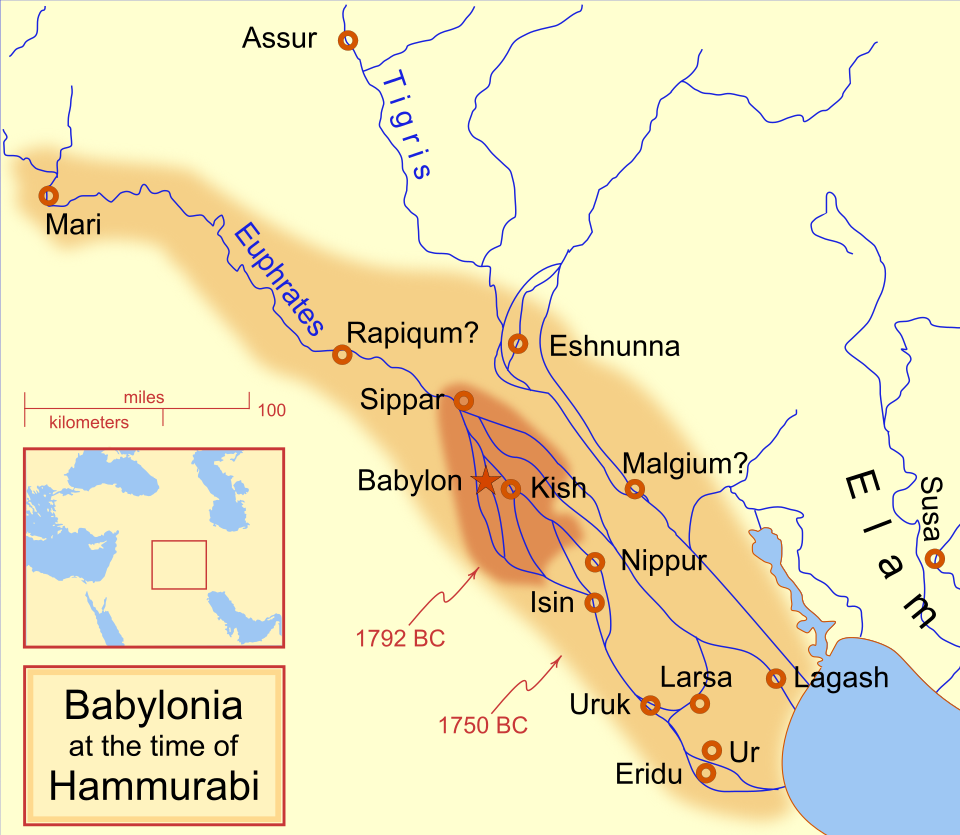

Babylon was a city-state of ancient Mesopotamia, in present-day Iraq, about 85 kilometers (55 mi) south of Baghdad. All that remains of the original ancient city of Babylon today is a mound of broken mud-brick buildings and debris in the fertile Mesopotamian plain between the Tigris and Euphrates rivers.
Babylon was at first a small town which sprung up at the beginning of the 3rd millennium BCE. The town flourished and became well-known and important. Babylon eclipsed Nippur as the ‘holy city’ of Mesopotamia. This was about from 612 to 539 BCE. It was the time Hammurabi first unified the Babylonian Empire. Babylon became the capital city of the Neo-Babylonian Empire .
The Hanging Gardens of Babylon were one of the Seven Wonders of the Ancient World.
Assyrian period
During the reign of Sennacherib of Assyria, Babylonia was in a constant state of revolt, It was only pacified by the complete destruction of the city of Babylon. In 689 BCE, its walls, temples and palaces were razed, and the rubble was thrown into the Arakhtu, the river on the south side of the city. This act shocked the religious conscience of Mesopotamia. After the murder of Sennacherib by two of his sons, his successor Esarhaddon hurried to rebuild the old city. He was crowned there, and it was where he lived for part of the year.
In the later overthrow of the Assyrian Empire, the Babylonians saw another example of divine vengeance.
Neo-Babylonian Chaldean Empire
Babylon threw off the Assyrian rule in 612 BCE and became the capital of the Neo-Babylonian Chaldean Empire.
With the recovery of Babylonian independence, a new era of building followed, and Nebuchadnezzar II (604–561 BCE) made Babylon into one of the wonders of the ancient world. Nebuchadnezzar ordered the complete reconstruction of the imperial grounds, including rebuilding the Etemenanki ziggurat and the construction of the Ishtar Gate — the most spectacular of eight gates that ringed the perimeter of Babylon. All that was ever found of the Original Ishtar gate was the foundation and scattered bricks.
Nebuchadnezzar is also credited with the construction of the Hanging Gardens of Babylon (one of the seven wonders of the ancient world), said to have been built for his homesick wife Amyitis. Whether the gardens did exist is a matter of dispute. Historians disagree about the location, and some believe it may have been confused with gardens in Nineveh.
Persia captures Babylon
In 539 BCE, the Neo-Babylonian Empire fell to Cyrus the Great, the king of Persia, in the Battle of Opis. The walls of Babylon were very high and very thick. The only way into the city was through one of its many gates. The Euphrates flowed next to the walls and Cyrus decided to use the river to get into the city. Cyrus’ troops diverted the Euphrates river. This caused the level of the river to drop allowing soldiers to enter the city.
The Babylonians had held a celebration that evening. The Persian Army took over most of the city before the Babylonians had become aware that the Persians had gotten into the city. The account was reported by Herodotus, and is also mentioned in the Hebrew Bible. Cyrus claimed the city by walking through the gates of Babylon with little or no resistance from the drunken Babylonians.
Cyrus later issued a decree allowing people, including the Jews, to return to their own land. This is mentioned in the Old Testament. It allowed Jews’ temple to be rebuilt in Jerusalem.
Under Cyrus and the subsequent Persian king Darius the Great, Babylon became the capital city of the 9th Satrapy (Babylonia in the south and Athura in the north). It was a centre of learning and scientific advancement. In Achaemenid Persia, the Babylonian arts of astronomy and mathematics were revitalised. Babylonian scholars made maps of constellations. The city was the administrative capital of the Persian Empire. This empire was the most powerful of the then known world. Many important archaeological discoveries have been made that improve our understanding of that era.
The early Persian kings had tried to keep the religious ceremonies of Marduk. By the reign of Darius III, over-taxation and numerous wars had led to a deterioration of Babylon’s main shrines and canals, and the disintegration of the region. Despite three rebellions in 522 BCE, 521 BCE and 482 BCE, the land and city of Babylon remained under Persian rule for two centuries. In 331 BCE, Alexander the Great took over. Under the Parthian Empire, Babylon continued to shrink and lose importance.
Written for younger readers
Babylonians, in simpler words
This version comes from Wikijunior, a set of books written for children aged 8 to 11. It is shorter and uses plainer language than the article above.
From Wikijunior: Ancient Civilizations
The Babylonians were an ancient civilisation that existed many years ago.
The Babylonians were based in what is now modern-day central Iraq (about 50-60 miles from Baghdad, Iraq). They controlled much of the land between the rivers the Tigris and the Euphrates. They were the last of a string of city states (civilizations based around a single powerful city) to control this area.
In the 24th century BC the city of Babylon was founded on the banks of the river Euphrates. In the 18th century BC it became a capital of Babylonian empire.
Babylon reached its glory in 6th century BC. Constructions like Ishtar Gate and Etemenanki ziggurat were built, making Babylon the most beautiful city of the ancient world.
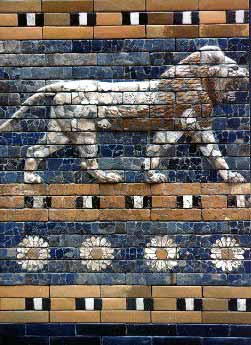
Ishtar Gate was one of the eight gates of the Babylon city. Dedicated to the goddess Ishtar, the Gate was constructed of blue glazed tiles with alternating rows of relief dragons and bulls. The roof and doors of the gate were of cedar. Through the gate ran the Processional Way, which was lined with walls covered in lions on glazed bricks (about 120 of them). Statues of the gods were paraded through the gate and down the Processional Way each year during the New Year’s celebration.
Processional Way led to Etemenanki ziggurat. A ziggurat was a pyramid like tower that they made for their gods. Etemenanki was seven stories, or 91 meters high, and had a temple of Marduk on top of it.
Ishtar Gate is currently displayed in Pergamon Museum in Berlin. Only ruins are left of Etemenanki ziggurat.
The Babylonians ate melons, plums, prunes and dates. Barley was their staple crop that they would make flat breads with. The bread would then be eaten with some fruit. For meat they ate pork, poultry, beef, fish and mutton (sheep meat). Onions and garlic were common seasonings for their food. Babylonians didn’t drink wine, but instead they drank beer made out of barley.
Babylonians wore a garment that would look like a long T-shirt in our day. For the peasants these garments would have been quite simple but for the wealthy they were decorated with tassels, embroidery, girdles and sashes. Higher ranking people wore longer garments and scarves that indicated their rank by the length of its tassels.
Hats were also an important fashion accessory. Professionals could be identified by their characteristic headdress. Women wore ribbons, veils or other decorations in their hair.
Babylonians spoke Akkadian, an ancient language. They used the cuneiform script for writing. Babylonian writing that still exists is all on clay tablets. The symbols of their script were pressed into the wet clay with a piece of dried reed.
Cuneiform is ancient way of writing. There were about 200-400 common characters that represented different syllables. For example, one symbol might represent the sound “bu” and another symbol would represent the sound “ba”. There were also symbols that represented whole words.
The Babylonians were polytheists; they believed that there were many gods that ruled different parts of the universe. They believed that the king god was Marduk, patron of Babylon. Just as Babylon conquered all city states and became the capital of a mighty empire, so, in the legend, its patron Marduk obtained power over other gods by fighting Tiamat, the evil goddess of chaos.
The Babylonians built each of their gods a primary temple that was considered the home of the god. People would bring sacrifices to the gods and the priests would try to attend to the needs of the gods through ceremonies and festivals. Each temple had an open temple courtyard and then an inner sanctuary that only the priests could enter. Sometimes special pyramid shaped towers, called ziggurats, were built to be a part of the temples. The top of the tower was special sanctuary for the god.
Babylonians believed that after death every soul went to the underworld. The underworld was considered a dark and dismal place. This made death a dreadful event as there was no hope of ever having anything better.
One of Babylon’s most famous kings was Hammurabi. He ruled for 43 years. Hammurabi is famous for creating one of the first formal written set of laws. These laws were written on a finger-shaped stone stele. or tablet, standing over six feet tall. The most famous rule he set is now known as an eye for an eye. This rule said that the punishment for lawbreakers would be the same as the crime they committed. So if a criminal stabbed a person in the eye, the criminal would be stabbed in the eye too. The laws he made were known as “The Code Of Hammurabi”. This legal system was spread throughout Asia and Europe. The Code of Hammurabi is also interesting because it was the first set of laws which presumed people were innocent, meaning a person must be proven guilty before they could be punished for their crimes.
Nebuchadnezzar II is mentioned in The Bible (The Christian holy book), the Torah (The Jewish holy book) and the Qur’an (The Islamic holy book). He was a ruler of Babylon who destroyed the Jewish temples in Jerusalem.
The ruins of the city of Babylon still exist although the city has been abandoned for over 2000 years.
Many of the inventions of the Babylonians are still important today. They invented metalworking, copper-working, glassmaking, lamp making, textile weaving, flood control, water storage, as well as irrigation. Interestingly, from their number system we get our concept of there being 60 minutes in an hour and 60 seconds in a minute.
de:Wikijunior Alte Zivilisationen/ Babylonier
Where this page comes from
The article above is adapted from “Babylonians” on Simple English Wikipedia, by its contributors. We removed reference markers, navigation boxes and tables, expanded measurement templates into readable numbers, and kept the prose otherwise intact. The simpler version is adapted from Wikijunior on Wikibooks.
Both sources are published under CC BY-SA 4.0, so this page is published under the same licence. You may share and adapt it, including commercially, as long as you credit the original and keep the same licence.
Worksheets, answer keys and printable layouts elsewhere on K5Print are our own work and are not covered by this licence.