Battle of Britain
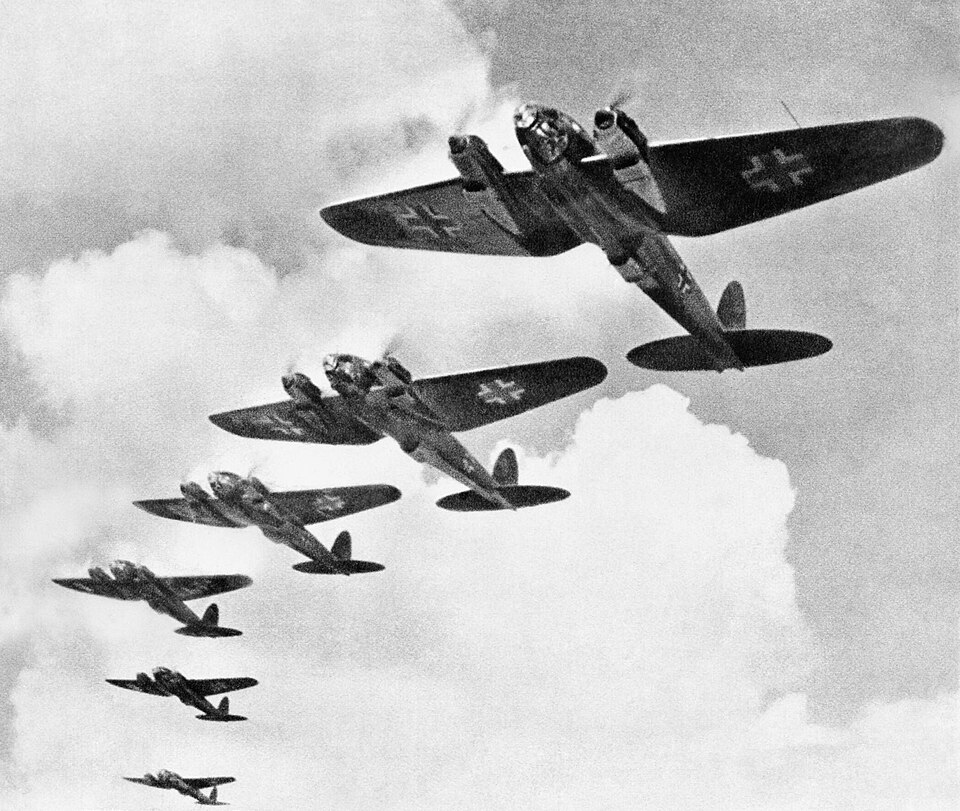

The Battle of Britain was a continued attack by the Luftwaffe on Great Britain during the summer and the autumn of 1940.
The Germans’ first objective was to get control of the air space above Britain from the Royal Air Force (RAF), especially the Fighter Command.
The name comes from a famous speech, which was delivered by British Prime Minister Winston Churchill in the House of Commons: “The Battle of France is over. I expect the Battle of Britain is about to begin….”
The Battle of Britain was the first major campaign to be fought only by air forces, and it was also the largest and longest aerial bombing campaign until then.
Part I: Strategic targets
In July 1940, coastal shipping convoys and shipping centres, such as Portsmouth, began to be the main targets. A month later, the Luftwaffe shifted its attacks to RAF airfields and infrastructure, which were other useful war targets. As the battle progressed, the Luftwaffe also targeted aircraft factories and ground infrastructure.
Coastal radar stations were bombed and so for a time, only one radar mast was standing. The British used a backup system of human observers to get information to the headquarters of Fighter Command. Most historians agree that Germany won that part of the campaign.
Part II: Civilian targets
Eventually the Germans switched to attacking population centres, such as towns and cities, as well as factories. After the RAF bombed Berlin, and German air force bases in France, Hitler cancelled his orders not to bomb population centres and ordered attacks on British cities. p305 The attacks on civilians were terror bombing tactics designed to cause panic and damage morale.
On 7 September 1940, a massive series of raids with nearly 400 bombers and more than 600 fighters targeted docks on the Thames in London day and night. This was called the “London blitz”.
The RAF 11 Group rose to meet them in greater numbers than the Luftwaffe expected; 12 Group’s Big Wing took 20 min to gain formation and missed its intended target, but it came across another formation of bombers while it was still climbing. The delay was blamed on being requested too late.
The Luftwaffe began to stop its morning raids, with attacks on London starting late in the afternoon for 57 nights of attacks in a row.
Fighter Command had been suffering low morale since it was short of men and machines, and the break from airfield attacks allowed it to recover and so week by week, the defenders were getting stronger, and the losses suffered by the Luftwaffe were growing.
On 15 September, two massive waves of German attacks were prevented by the RAF, with every aircraft of 11 Group being used that day. The total casualties on that important day were 60 German and 26 RAF aircraft shot down. The German defeat caused Hitler to order two days later a delay of the preparations for the invasion of Britain. In the face of increasing losses in men, aircraft and the lack of good replacements, the Luftwaffe later switched from daylight to night-time bombing.
On 27 September, a Junkers Ju 88 returning from a raid on London was shot down in Kent. The German airmen survived to fight a battle against British troops stationed locally. That was said to be the first time in nearly 300 years that armed invaders had fought with British soldiers on British soil.
Dowding system
The keystone of the British defence was the detection, command, and control, which ran the battle. It was called the Dowding System, after its chief architect, Air Chief Marshal Sir Hugh Dowding, the leader of RAF Fighter Command.
The core of the system was the use of Radio Direction Finding (RDF, later called radar after radio detection and ranging). Its use, as was by information by the Royal Observer Corps, was crucial and allowed the RAF to intercept the incoming German aircraft.
Radar operators were linked via telephone, whose wires were laid deep underground with concrete anti-bomb protection, p47 to an operational centre, which was Fighter Command Control at Bentley Priory. During the battle, several Coastal Command and Fleet Air Arm units came under Fighter Command control.
Fighters
The Germans’ Messerschmitt Bf 109E and 110C fought against the British air superiority fighter ss the workhorse Hawker Hurricane Mk I and the less numerous Supermarine Spitfire Mk I. The Bf 109E had a better climb rate and was 10 to 30 mph faster than the Hurricane, depending on the altitude. p266 In September 1940, the more powerful Mk IIa series 1 Hurricane started to enter service but only in small numbers. That version was capable of a maximum speed of 342 mph, 25 to 30 mph faster than the Mk I.
The performance of the Spitfire during the Dunkirk evacuation came as a surprise although the German pilots retained a strong belief that their 109 was the superior fighter. However, the Bf 109E had a much larger turning circle than either the Hurricane or the Spitfire. The two British fighters had eight Browning 303 machine guns, but most Bf 109Es had two machine guns and two wing cannons. The Bf 109E and the Spitfire were superior to each other in key areas. For instance, at some altitudes, the Bf 109 could outclimb the British fighter.
Aftermath
The failure of Germany to achieve its objective of destroying Britain’s air defences or forcing Britain to negotiate an armistice or an outright surrender is considered to be its first major defeat and one of the crucial turning points in the war. p388
If Germany had gained air superiority, Adolf Hitler might have launched Operation Sea Lion, his planned invasion of Britain.
Written for younger readers
Battle of Britain, in simpler words
This version comes from Wikijunior, a set of books written for children aged 8 to 11. It is shorter and uses plainer language than the article above.
From Wikijunior: World War II
The Battle of Britain was an air battle fought between Great Britain and Germany. It was fought mostly over the south of England although other areas of Britain were occasionally attacked. The main battle started in July 1940 and ended on 31 October 1940, although fighting went on for many more months.
After France was defeated by Germany in 1940, Germany and her allies had beaten all their enemies in mainland Europe. The United Kingdom was the only enemy country left unbeaten. Many of the beaten nations in Europe like Poland and Norway formed governments outside their own country in England. They also had military units in England as well as resistance movements in their own countries. People from around the “free world” came to join the Royal Air Force and fight in the battle including Poles, New Zealanders, Canadians, Czechoslovakians, Belgians, Australians, South Africans, French and Irish people. There were also people from the United States of America, Jamaica, Palestine, Southern Rhodesia and Lithuania.
With the battle for France over, Germany began to get ready to invade the island of Britain. Germany code-named the attack “Operation Sealion”. Most of the British Army’s heavy weapons and supplies had been lost when it evacuated from Dunkirk, so the army was fairly weak. But the Royal Navy was still much stronger than the German Navy (“Kriegsmarine”) and could have destroyed any invasion fleet sent across the English Channel. However, very few Royal Navy ships were based near the likely invasion routes as the admirals were afraid they would be sunk by German air attack. The German Navy though refused to attack unless the RAF had been defeated. Herman Goering, the head of the German air force, told Hitler his men could defeat the RAF easily.
The mood in Britain was close to despair following the failure to defend France. The British Prime Minister, Winston Churchill, made the first of his memorable speeches in which he tried to prepare the British for the battle he knew would soon start…
The Battle of Britain began with German air raids on radar stations and airfields in the south of England. The Germans tried to gain air superiority by destroying the RAF using their air force, the Luftwaffe, commanded by the Hermann Goering. Planes from both sides battled in the skies over land and sea.
A German plane accidentally dropped bombs on London, and Britain responded by bombing Berlin. Adolf Hitler was furious and ordered Germany to bomb English cities, mainly London, instead of airfields. The bombing of London was known as “The Blitz”. Germany sustained heavy losses with their Dornier and Heinkel bombers being shot down by RAF Spitfire and Hurricane fighter planes. By stopping their attacks on air fields and attacking London instead the Germans handed the advantage to the RAF. London was too far away for German fighters to spend more than 10 minutes in battle meaning the RAF fighters could make their attacks against the more vulnerable bombers with much less risk of being shot down.
In June 1941, the Germans switched their attention to the east, attacking the Soviet Union, which included Russia, and Goering called off the entire operation to invade Britain. During the Blitz 43,000 British civilians were killed, and one million were injured.
During the height of the battle, when the hopes of people for victory were fading, Winston Churchill made another speech that has been remembered ever since:
The Battle of Britain was a British victory. The Germans had been defeated for the first time since the beginning of the war. The battle also changed the opinion of people in the United States of America, which was not officially involved in the war at the time. During the battle people in the USA had believed that Britain would be defeated. After the battle, they became convinced that Britain would survive and should be supported in every possible way. This led eventually to the USA joining the war against the Germans and their allies.
Where this page comes from
The article above is adapted from “Battle of Britain” on Simple English Wikipedia, by its contributors. We removed reference markers, navigation boxes and tables, expanded measurement templates into readable numbers, and kept the prose otherwise intact. The simpler version is adapted from Wikijunior on Wikibooks.
Both sources are published under CC BY-SA 4.0, so this page is published under the same licence. You may share and adapt it, including commercially, as long as you credit the original and keep the same licence.
Worksheets, answer keys and printable layouts elsewhere on K5Print are our own work and are not covered by this licence.