Battleships
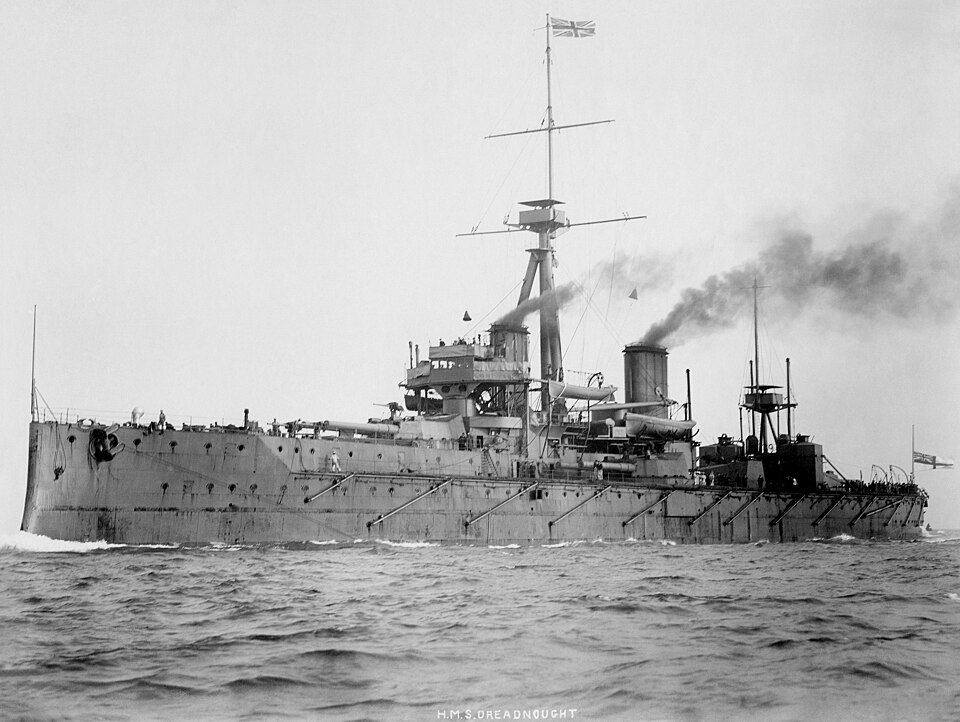

A battleship is a kind of large warship. It has metal armour and has large (heavy caliber) guns. Battleships are larger, better armed and armored than cruisers and destroyers. Battleships were mainly around from about 1880 to the 1940s, though some were still used as late as the Gulf War in 1991. For most of this time, battleships were the most powerful and most expensive kind of warship. Today some battleships are still around but these are museums.
In the 19th century, different countries tried to build bigger and better warships. One of the first ships with iron armor was called Gloire, from 1859. This ship had both sails and a steam engine which drove a propellor, as well as guns the fired explosive shells. This was a kind of ship called an ironclad. A few years later, ironclads were used in the American Civil War.
Britain and France kept trying to build warships that were better than each other. Later in the 19th century other countries like Germany, Russia, Japan, Italy and the United States also built many battleships. Different countries used new inventions to make their ships more powerful, with things like steel armour, rifled guns, and better kinds of steam engine. By around 1890 people started to call their best ships ‘battleships’ instead of ‘ironclads’. Many people, including many Admirals and politicians, thought battleships were very important. If there was a war, the country with the best battleships would win, by sinking the other side’s navy and stopping them bringing food and goods into their country (called a blockade). But battleships were also very expensive, and other people thought it was better to spend the money on a better army, or things like pensions for old people.
In 1906, Britain made a new kind of battleship called HMS Dreadnought. Though this ship was not much bigger, it had steam turbine engines which made it faster. All of its guns were also very large, which meant it could damage other battleships more from further away. People claimed one ship like Dreadnought could beat two earlier battleships, even battleships made just a few years before. Soon many countries were building ships like this, and calling them ‘Dreadnoughts’.
Many battleships were used in the First World War. However, battleships were so important and expensive that neither side wanted to take a chance of losing a battle with them. There were several battles with battleships. The biggest one was the Battle of Jutland which involved dozens of battleships and hundreds of smaller ships. But none of the battles made much difference. Submarines made a bigger difference to the war, even though less people had expected them to. At the end of the War, Germany was made to hand over all their battleships to Britain. However, the German navy sank (“scuttled”) their own battleships rather than give them to the British. In 1922, most countries which had big navies signed a treaty called the Washington Naval Treaty which meant no-one would build new battleships for at least 10 years.
Battleships were also important at the start of World War II. But by the middle of World War II, battleships had become less important than aircraft carriers. Aircraft carriers had dozens of airplanes which could drop bombs or torpedos. Even though battleships had thicker armour than ever, several hits from bombs or torpedos would still sink a battleship. The planes could fly much further than a battleship’s guns could shoot. There were some important battles between battleships in World War II, but more often battleships were less important than aircraft carriers. At battles like the Battle of Taranto and the Battle of Pearl Harbour many battleships were sunk by planes.
After World War II there was not much point to a battleship. Aircraft carriers had become even better, because of jet aircraft and missiles. Also, even a heavily armored battleship could be sunk by a nuclear bomb. Even so the United States Navy kept a few battleships during the Cold War. The very big guns on a battleship were still useful to shoot at shore targets if there was an invasion from the sea. American battleships were also given new weapons like guided missiles to make them more useful if there was a war with Russia. However, only the United States could afford to keep battleships like this. No-one else did. Some American battleships shot at Iraq in the Gulf War. This was the last time when any battleships fought. The United States kept battleships until 2004, when the last ones were made into museums.
Written for younger readers
Battleships, in simpler words
This version comes from Wikijunior, a set of books written for children aged 8 to 11. It is shorter and uses plainer language than the article above.
From Wikijunior: World War II
Battleships are large, armored ships that can carry huge guns. They are the descendants of the sailing “Ship of the Line” (the line being the “line of battle”, so “Line of Battle Ship”). They played a major role in the war in the Pacific and Atlantic. By the end of the war, the aircraft carrier had made the battleship less useful, and apart from shore bombardment they were rarely used again. The last time a battleship fired its guns in anger was the first Gulf War in the 1990s.
As listed above, battleships are large, armored ships that can carry huge guns. Because of their large power, they were the cool toy that every country wanted one to show that they were the best. Of course, they cost a lot. Because of the battleship’s large size, it was the large bully of the sea. If the commanding country felt like it, it could send a battleship into the ocean to sink ships that were owned by other countries, only only other battleships could stop it.
If we look at this table, we see that the Great Britain has the most, with United States and Japan following it. Also, we see that Russia had very few battleships. Now for an explanation. Some countries, like the United States, Italy, Great Britain and France, had kept a bunch of old battleships that were too old fashioned for use in the war. Great Britain had 13 battleships built before 1925 and France had 6 that were very old. The U.S. was pretty much the same, but had a different story. After the Washington Naval Treaty (1922), which basically said that no country could have a lot of these ships, the U.S. stopped building battleships, and only started again in World War 2. That’s why 15 of the ships were old ones. The U.S. managed to build ten more during World War 2, but it was a close call. Italy, which had a smaller navy, only had 3 old ships. Meanwhile Japan had re-modernized each of their ships around 1930, so all of their ships were high-tech and ready to go. Russia’s navy was pretty much destroyed at the Battle of Shiatsu in 1905, but they got a few ships on loan from other countries to help them. All we have left to explain is Germany. Before World War 1, Germany had a “race” with Great Britain to see who could build the best and most battleships. By World War One, it had become a tie. Some German ships were old, but the number was about the same as Italy had. Germany also had started to build larger battleships called the Tirpitz and Bismarck as well as some battle cruisers (called pocket-battleships, more on this later) that were already roaming the seas, ready to attack when war started.
Guns were the main thing on battleships. I mean, without guns, you can’t do anything useful with a battleship. Most guns during this time were measured by the diameter of the shell, or hunk of metal they fired in inches. Common main guns were 14 and 16 inch guns, with 8 and 6 inch as “backup” guns and a bunch of 3 and 5 inch guns in case aircraft attacked. Now pause right here and go take out a yardstick and measure 14 inches. If you draw a circle that long, imagine what it was like to have those things, which were full of explosives crashing into ships. Not a very good sight. The shells of the largest guns weighed nearly 2 tons.
To protect from those shells, battleships, as all other ships, had to have armor. Armor for ships is just basically a large wall of metal “hooked” onto the ship to protect it from shells. This was also usually about 14 to 15 inches thick. Battleships also had to be protected from torpedoes launched by submarines and destroyers, a topic explained later in this book. To do so, countries had to attach large semi-spheres of metal to battleships so as to stop that from happening. If armor was not used, than battleships would have been sunk in seconds after starting to fight with other battleships.
Some battleships had space for accessories, which in this case was stuff like airplane launchers and radar towers. Radar towers were large masts which, when with a radar room in the ship that had a bunch of machines in it, could track whatever approached a set distance from the ship. If something came, crew would be given a warning and would stand ready. Nothing could sneak up on those things for a long while. Another thing added to some ships was an airplane catapult. This wasn’t your old catapult of the Middle Ages, but rather a thing that pushed a plane forward very quickly, which could then take off and attack, sort of like a mini aircraft carrier.
The Battlecruiser, Pocket Battleship, or as we’ve nicknamed it in the title, Battleship-Lite, was a sort of mini battleship. It was fast enough to run away from anything that was bigger than it, but powerful enough to beat senseless anything that was quicker than it. The British and Germans had some at the beginning of World War One, and after that war ended, every country wanted to have them. They saw how cool they were, and they were anxious to get some. Germany and Britain both planned to have a lot, but because of the Washington Naval Treaty, those ships had to be canceled, but Britain did manage to build one battlecruiser. The Germans however “worked around” the Washington Naval Treaty by creating “pocket-battleships”, which were basically just battle-cruisers with a different name. Seeing that two countries already had some, the Russians, Americans and Japanese also wanted to have a fleet of battlecruisers. Japan was the only able to do so, since it built them during the 1930s, when no one cared anymore about the Naval Treaties.
Each country knew that, in case of war, they had to have a plan, just like you should have a plan when you play chess or some other strategy game. Here’s each group’s plans:
Two Allied countries (France and Russia) had small navies, mainly because France’s economy went whacko whenever they tried to build a large fleet, and Russia had a small group because, after the disaster at Tsushima (Russia vs. Japan battle in 1905), they did not have enough time to build a large navy before war started (in this case, World War 1 and 2). One thing Russia had a bit of luck with was that they only had one real main port, which was St. Petersburg (in World War 2 called Leningrad). So Russia used most of their fleet to set up a defensive barricade near Lenningrad, and they didn’t have to worry about anything else. This was basically the same with the French. Their ships were old, but they had enough to defend each of their main ports. Of course, when Germans arrived and bombed them, the French didn’t stay and fight, but ran. They got to a port in Africa, then joined the Germans. After that, they were bombed by British bombers. So, if we take out those two Allied navies, we have two left. Britain, which is an island, needed a navy as its main defensive weapon. If Britain did not have a navy, then it couldn’t protect ships bringing in food and the people would starve. This leaves the United States to explain. The U.S. was neither of the ones above, it was actually a large part of a continent and it had a large enough navy to make normal attack operations. The problem was this: How to connect the west and east coast of the country? You can’t bring ships over land, so there had to be a water way connecting the two oceans. The answer? The Panama Canal, a canal built in 1914 across the tip of the country of Panama, that connected the Pacific and Atlantic oceans. The problem was that the canal could only move ships that were a set width or less. Anything else would have to move all the way across the coast of South America, which was a very long journey. Since the U.S. did not want these long journeys to take place, they had to rely on weaker ships to be able to defend both coasts of the country.
Let’s start with an explanation about Italy’s plans. Italy was mainly the “little brother” of Germany and Japan. It had a weaker army and a weaker navy, although they had just built four new ships right before the beginning of the war. Italy’s main goals were African countries. To capture those countries, they would need to have a troop launching pad, so as troops could sail across the Mediterranean Sea and invade Africa. For that, they had to get rid of British bases and ships in Egypt. Besides those actions, Italy’s battleships were not supposed to do anything else. Now for Japan. Japan was an island country, just like Britain. Unlike Britain, she was not really surrounded by any enemy country that had a good navy (Russia’s was nearly destroyed and most of it was in the Baltic Sea, while the U.S. was a whole ocean away). Japan could thus maneuver freely, destroying any ships that got in her way. They also had large ships like the Yamato and Musashi, which were super-heavy ships with large guns. If the U.S. tried to build some, they would be too big to fit through the Panama Canal. And now for Germany. Germany is in a worse situation than Britain: it’s close to 3 enemy countries (France, Britain, and Russia), and it’s got only two or three seaports. To fix this Germany had to capture more ports, which they did when they invaded Norway. Before that, however, Germany already had some pocket-battleships roaming the seas, ready to strike. They had gotten out between World War 1 and 2. With that in mind, let’s see if their plans worked out.
Although Japan was fighting with China since 1937, World War 2 officially started on September 1st, 1939, when Adolf Hitler invaded Poland. One of the first battles was the Battle of Westerplatte, where an old German battleship named the SMS Schleswig-Holstein supported shock troopers with shell fire. After seven days of tough fighting, the garrison surrendered. The Schleswig-Holstein continued to provide fire support to other troops attacking Polish ports, and was hit by a 152 mm shell at the last one she attacked, Hel. This marked the first shore retaliation against a ship in World War 2.
One of the Germans’ pocket battleships was the Graf Spee. The Graf Spee was in the South Atlantic when war started, and managed to sink 9 ships before the British chased her into Montiviedo, a harbor in Uruguay. After 72 hours of the British waiting for the Graf Spee to come out and fight, the captain of the Graf Spee decided that he would rather save all his men and loose his ship than loose all of both. So, thinking hits, he blew up the Graf Spee, preventing the British from capturing her or sinking her.
Where this page comes from
The article above is adapted from “Battleships” on Simple English Wikipedia, by its contributors. We removed reference markers, navigation boxes and tables, expanded measurement templates into readable numbers, and kept the prose otherwise intact. The simpler version is adapted from Wikijunior on Wikibooks.
Both sources are published under CC BY-SA 4.0, so this page is published under the same licence. You may share and adapt it, including commercially, as long as you credit the original and keep the same licence.
Worksheets, answer keys and printable layouts elsewhere on K5Print are our own work and are not covered by this licence.