Carthage
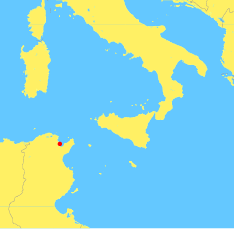

Carthage was an ancient city-state in what is now Tunisia. It began as a Phoenician colony. At the height of its power, Carthage was the most important power in the Mediterranean and the wider Western world and controlled parts of Spain, as well as Sicily, North Africa, and Sardinia.
The Roman Republic destroyed Carthage during the Punic Wars of the 3rd and 2nd centuries BC. In later centuries, Rome started a colony in the same place that became an important city of Africa Province. Eventually, the Vandals conquered the city and used it to attack Rome.
Punic Wars
Carthage was a rival in the western Mediterranean for the Roman Republic, which wanted to take over the whole region. Carthage was a large obstacle and so in 264 BC, the Romans responded to a plea for help by some rebels in Messina and landed an army in Sicily. That started the First Punic War. The Romans then invaded the Carthaginian areas in Sicily, and the Carthaginian generals could not stop them. Even at sea, the Romans copied the Carthaginian bireme ships, with two oars on each side, and won several major victories on the sea. However, the Romans had not been a sea power, which the Carthaginians had been.
Finally, a general, Hamilcar Barca, took up to defend the Carthaginians and replaced of the older and less energetic Hanno. Hamilcar immediately realized the futility of meeting the superior Roman army in open battle and so he decided to use hit-and-run raids to wear down the Romans. That tactic was slightly more effective against the slow heavily-armored roman troops. Eventually, however, the Romans took Lilybaeum, the Carthaginians’ main stronghold in Sicily. That ended Carthage’s power in Sicily and ended the First Punic War.
During the Second Punic War, Hannibal Barca led the Carthaginian Army through Spain, southern Gaul and across the Alps into Italy in 218 BC. There, he clashed with and stunningly defeated the Romans in three major battles: the Battle of the River Trebia, the Battle of Lake Trasmine, and the Battle of Cannae. He failed, however, to take Rome and eventually in 203 after nearly 15 years had to retreat to Carthage, where he was defeated by Scipio Africanis at the Battle of Zama.
The Romans destroyed Carthage in 146 BC during the Third Punic War. The Carthaginians who survived, numbering about 50,000, were mostly sold into slavery.
Written for younger readers
Carthage, in simpler words
This version comes from Wikijunior, a set of books written for children aged 8 to 11. It is shorter and uses plainer language than the article above.
From Wikijunior: Ancient Civilizations
Carthage was a small nation, first only it was a city state , founded in 814 BC. It grew prosperous by all the trade that flowed through the tiny nation. However at around 146 BC, Carthage was conquered by Rome.
Carthage was located in northern Africa, in current day Tunisia. It was an imperial power that controlled at one point most of northern Africa and even had some colonies in preset day Spain. However they often fought with Rome for land in Sicily and Sardinia, islands near Italy. These fights were also known as the Punic Wars. Carthage was a country full of seafaring people, and they established settlements in western Africa and in the Mediterranean Sea, their fleet being the largest in the west Mediterranean.
The buildings in Carthage are similar to buildings in Greece and Rome. Major public buildings were made of stone and had large columns. Meanwhile common people lived in small houses made of brick or wood. We do not have Carthaginian buildings standing today because the Romans destroyed the city. We can guess at what they might have looked like by comparing Greek and Roman examples.
The people of Carthage ate food similar to that of the people there today, like dates, figs, bread, and meat from sheep and cows. Carthage was also renowned for its fruits growing across the Mediterranean:they cultivated figs, mulberry, blackberries etc. Equally important were their vegetables and legumes, like bread and chickpeas
For woman the chiton is a common sleeved tunic. It is two pieces of cloth which are sewn together, leaving room for the arms and head. Married woman wore a stola, which was a long, sleeveless tunic, which would be worn over the chiton. When going outdoors a palla could be worn over these garments. Woman of the upper class wore jewellery.
The Phoenicians adopted an early Canaanite linear script in the Middle Bronze Age (2000-1500 BC). Over the centuries this evolved into numerous other scripts such as Hebrew, Aramaic, Arabic and Greek. The Phoenician language evolved from the local dialects of the cities of Tyre and Sidon. The colonization of the Mediterranean spread the language as far West as North Africa and Southern Spain where it became known as Punic. This was adopted as the official language of the Carthaginian Empire.
Most Carthagininan gods were inherited from the Phoenicians. They believed in a pantheon of gods, that included Baal Hammon, Astarte, Eshmun, and many more. Different Carthaginian centres had their own distinct pantheons. In Punic Sardinia, The god Sid was particularly associated with the island. At Maktar, to the southwest of Carthage, an important god was Hoter Miskar. The Egyptian deities Bes, Bastet, Isis, Osiris and Ra were also worshiped.
They had both part-time and full-time priests, the latter called khnm, led by high priests called rb khnm. Lower-ranking religious officials, attached to specific sanctuaries, included the “chief of the gatekeepers,” people called “servants” or “slaves” of the sanctuary, and functioned as cooks, butchers, singers, and barbers.
Carthage was founded around 800 BC at what is now Tunisia. It was originally a part of the Phoenician Empire, which was based in Lebanon. When the empire was invaded, Carthage remained safe and became a powerful nation of its own. The skills of sailing and exploration that they had got from their Phoenician relatives helped them to trade and expand their lands. They settled in Sicily, Sardinia, Corsica, Spain and Portugal. Carthage was one of the major powers of the Mediterranean Sea.
Hannibal is by far the most famous Carthaginian. He led an almost successful invasion on Rome, attacking them in Spain and Northern Italy, but eventually failed. Hannibal is often connected with elephants because he used elephants against Roman Troops, however most died while crossing the Alps on the way to Rome.
A famous Carthaginian from Roman mythology is Queen Dido. In the myth, she was the ruler of Carthage when Aeneas, a Trojan who had escaped from the Greek attack on Troy, landed in her kingdom. She loved Aeneas, but he needed to find Italy where he would found the empire of the future Romans. Dido killed herself when Aeneas left Carthage.
Being the bitter enemies of the Romans, having fought over Mediterranean power and over islands like Sicily for many decades, the Roman Empire sought to totally destroyed Carthage so as to eliminate its threat altogether. Carthaginian civilization therefore ended with its conquest by Rome in the Third Punic War, where it was eventually destroyed.
It is a common misconception that Rome sowed Carthage with salt after this final war. This is, however, a mere exaggeration showing their deep hatred; Appian, a Greek historian, tells us that the Romans colonised Carthage afterward. Emperor Augustus rebuilt it close to its original site 102 years after its destruction, and it became part of the Roman Empire.
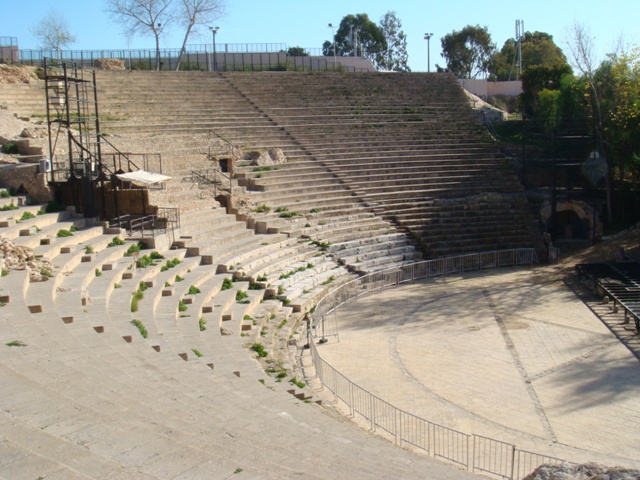
Its archaeological site now lies in Tunis, the capital of Tunisia, in Africa.
de:Wikijunior Alte Zivilisationen/ Karthager
Where this page comes from
The article above is adapted from “Carthage” on Simple English Wikipedia, by its contributors. We removed reference markers, navigation boxes and tables, expanded measurement templates into readable numbers, and kept the prose otherwise intact. The simpler version is adapted from Wikijunior on Wikibooks.
Both sources are published under CC BY-SA 4.0, so this page is published under the same licence. You may share and adapt it, including commercially, as long as you credit the original and keep the same licence.
Worksheets, answer keys and printable layouts elsewhere on K5Print are our own work and are not covered by this licence.