Goths
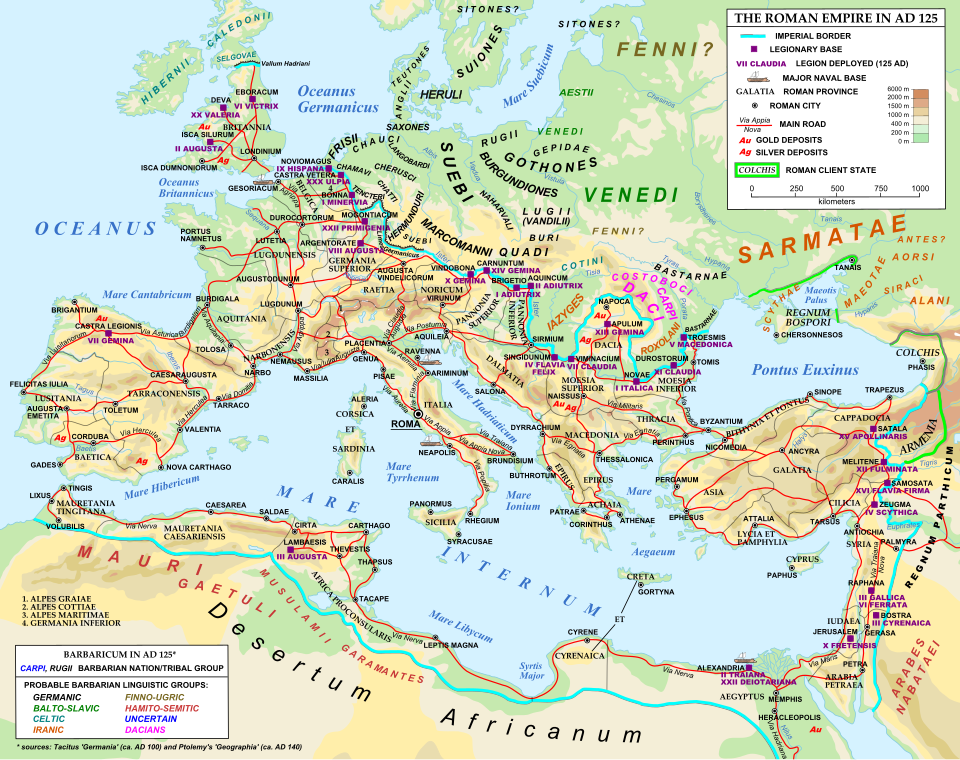

The Goths (Gothic: , Gutans) were an East Germanic tribe that spoke the Gothic language. Jordanes, a scholar from the 6th century, wrote a summary of a 12-volume work by Cassiodorus about the Goths that is commonly called Getica.
Since the original work by Cassiodorius was lost, Getica is the only surviving contemporary account about the Goths. It states that the Goths left Scandinavia via Gotland and settled close to the mouth of the Vistula River, in present-day Poland. In the 3rd and the 4th centuries they settled Scythia, Dacia and parts of Moesia and Asia Minor, fought with the Roman Empire and later adopted Arianism (a form of Christianity).
In the 4th and the 5th centuries, they split into the Visigoths and the Ostrogoths. With that move, they established powerful successor-states to the Roman Empire in Italy and on the Iberian Peninsula (now Spain and Portugal). Traces of Gothic blood can be found in many people .
Written for younger readers
Goths, in simpler words
This version comes from Wikijunior, a set of books written for children aged 8 to 11. It is shorter and uses plainer language than the article above.
From Wikijunior: Ancient Civilizations
The Goths were a Germanic tribe that later formed two branches, the Ostrogoths and the Visigoths. The Goths are believed to have immigrated to Poland in the first century A.D. from Gotland. They later moved by the Black Sea in what is now the Ukraine. The Gothic People greatly influenced later Roman culture.
The Goths lived from the 2nd century to the 6th century. During the 5th and 6th centuries, the Goths were divided into the Visigoths and the Ostrogoths.
They are theorized to have originated in southern Scandinavia. But they quickly expanded into general Europe and into the Roman Empire. After the Empire’s fall they split into two groups, Visigoths and Ostrogoths, who later went on to populate Western Europe —Germany, France, Spain— and Eastern Europe —around the black sea— respectively.
Gothic Architecture started in Northern France. It had great success in 1200 A.D. Gothics were well known for their churches. The churches were tall and thin with pointed arches. The walls were massive to carry weight. Inside the church there were tall stain glassed windows. Figures of saints, animals, and flowers were painted on the stained glass windows. Frescos (done in plaster that are put onto walls and ceiling) were painted on them.
They ate mostly sheep, goats, cattle, pigs, rabbits and chickens that they raised for their meat. They would also hunt deer and elk for food. They also ate some plant based foods such as wheat, barley, rye, cabbages, and turnips.
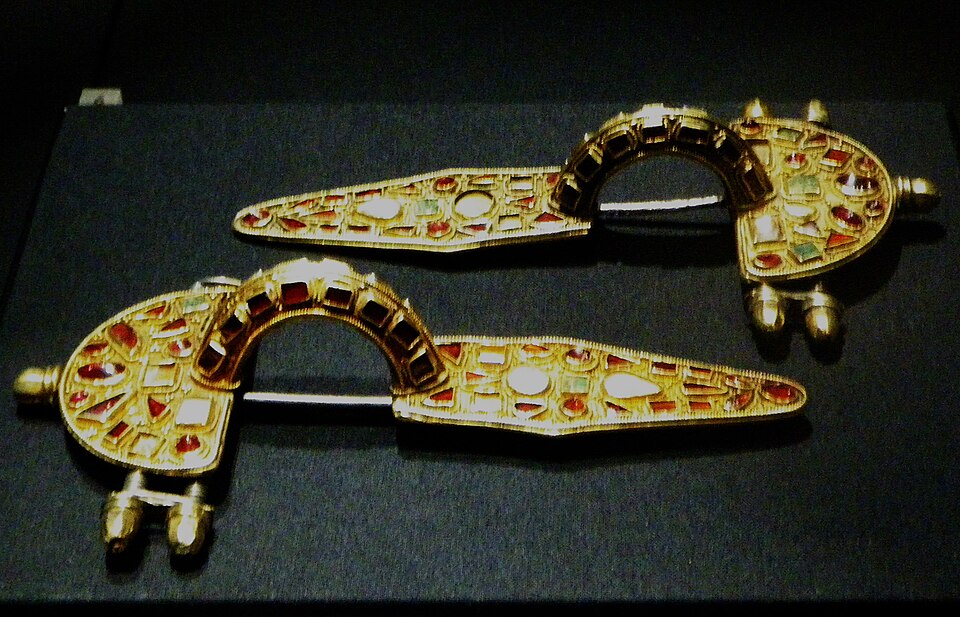
Goths wore a Sagum, an open robe or cloak that looks like those worn by ancient Roman soldiers. These cloaks were fastened using a thorn or a spina, a spike made out of bone. They also wore furs blankets, coats and warm clothes made from animals they hunted or raised and then skinned.
By the 4th century CE, the Goths were becoming Christianized. At this time, the Goths wrote their language using their version of the Futhark alphabet, but it was deemed to be a pagan invention. Instead, Bishop Wulfila (or Ulfilas), a Greek missionary responsible for the conversion of the Goths to Christianity, took the Greek alphabet, added letters from Latin and Futhark alphabets, and created a new alphabet to write the Gothic language.
Note that there are two letters that don’t stand for any sounds. This is because they were adopted from Greek only for their numeric value. The Classical Greek alphabet doubled as a number system, and each letter had a number associated with it. The Gothic alphabet continued this tradition, and so in the case of Gothic, the first row of letters have numeric values of 1 to 9, the second row from 10 to 90, and the third row from 100 to 900.
The Goths spoke a Germanic language, and it is unique not only in that it is the earliest documented Germanic language, but also in that it is the only language in a completely separate branch of the Germanic family unrelated to any other surviving Germanic languages.
In most of Europe, the Gothic alphabet and language slowly faded into obscurity by the 9th century CE. The Gothic language survived in the Crimea but it too became extinct around the 17th century CE.
The ancient Goths were originally pagan, but converted to Christianity by the 4th century CE.
They are famous in the present because of the brilliant things and culture they gave us. Studying ancient civilizations like the Goths can help us to understand other culture and can help us in the future.
Gothic ancestry can be found in North Africa, Southern Europe, Scandinavia, and Poland.
de:Wikijunior Alte Zivilisationen/ Goten

Where this page comes from
The article above is adapted from “Goths” on Simple English Wikipedia, by its contributors. We removed reference markers, navigation boxes and tables, expanded measurement templates into readable numbers, and kept the prose otherwise intact. The simpler version is adapted from Wikijunior on Wikibooks.
Both sources are published under CC BY-SA 4.0, so this page is published under the same licence. You may share and adapt it, including commercially, as long as you credit the original and keep the same licence.
Worksheets, answer keys and printable layouts elsewhere on K5Print are our own work and are not covered by this licence.