Hittites
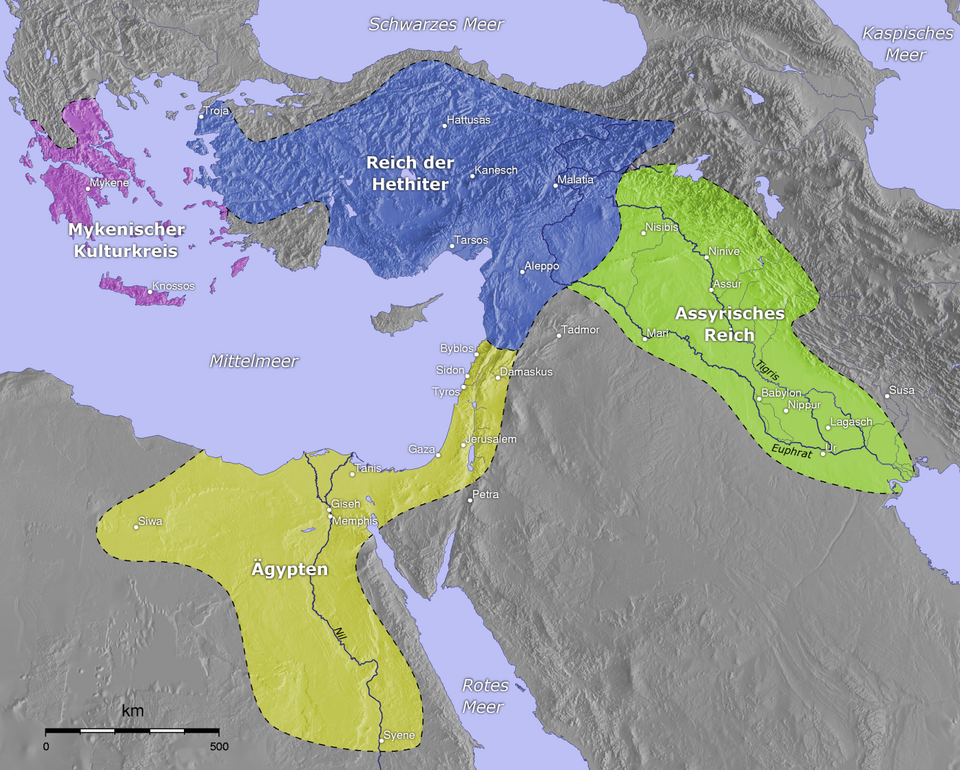

The Hittites were an ancient people from Anatolia who spoke an Indo-European language that they wrote with cuneiform script. They established a kingdom centered on Hattusha, in north-central Anatolia, from the 18th century BC.
At its peak, the Hittite Empire covered most of modern Turkey and Syria, under the reigns of Suppiluliuma I (~1350–1322) and Mursili II (~1321–1295 BC). They had up-and-down relationships with the New Kingdom of Egypt to the south and the Assyrian Empire in Mesopotamia. They were a party to the first known peace treaty, made with Ramesses II of Egypt by Hattusili III in 1258 BC.
After 1180 BC, the empire disintegrated into several independent “Neo-Hittite” city-states, some surviving until as late as the 8th century BC.
Empire of Suppiluliuma and Mursili II
The Hittite Empire reached its zenith during the reign of Suppiluliuma I (~1350–1322). The Kingdom of Mitanni, wracked by civil war, was unable to withstand the Hittite onslaught. Suppiluliuma swiftly attacked the Mitanni heartland and captured and plundered the Mitanni capital of Washshuganni. He then turned west, recrossed the Euphrates and captured all of the Syrian kingdoms that were vassals to the Mitanni, including Aleppo, Mukish, Niya, Qatna, Upi (Upina), and Kadesh. Other kingdoms such as Ugarit and Amurru (an Egyptian vassal) voluntarily became vassal states of the Hittites.
When hostilities flared up once more with Mitanni, Tulipinu, Suppiluliuma’s son and viceroy at Aleppo, invaded Carchemish but was unable to take the city. Suppiluliuma met with his son, invaded Syria himself, and lay siege to the city of Carchemish. Suppiluliuma broke the siege on the eighth day ansd installed his son Piyassili as viceroy of the kingdom. With his sons as viceroys of Aleppo and Carchemish, Suppiluliuma had cemented his rule over Syria and brought the kingdom to an end. The Mitanni King was soon assassinated.
The murdered prince
When Tutankhamun, the Egyptian Pharaoh, died, his widow asked to marry one of Suppiluliuma’s sons. He agreed and sent his son Zannanza to Egypt to marry the queen. However, Zannanza was assassinated en route to Egypt.
Suppiluliuma was furious and blamed the new Egyptian Pharaoh Ay for his son’s death. A Hittite army under Crown Prince Arnuwanda invaded Egyptian territory from Syria, did pillage and took many prisoners. The prisoners brought with them a plague, which ravaged the Hittite Kingdom and continued well into Mursili’s reign and may have killed Suppiluliuma himself.
Mursili II
Mursili II was young and inexperienced, but he proved to be a strong king. In the first years of his reign, he carried out punitive campaigns against several kingdoms. In Syria, Nuhashshi King Tette rebelled and was joined by Egyptian troops. Troubles in Syria continued when both of Mursili’s brothers (Tulipinu and Piyassili) died. The loss of his Syrian viceroys led to rebellion and even the invasion of Carchemish by Assyria.
Leaving his generals to deal with Syria and Haysa, Mursili invaded Carchemish and drove out the Assyrians. Later in his reign, Mursili campaigned against the Kaska and once again retooj the Hittite holy city of Niniveh. He also decisively defeated the King of Tummanna.
Written for younger readers
Hittites, in simpler words
This version comes from Wikijunior, a set of books written for children aged 8 to 11. It is shorter and uses plainer language than the article above.
From Wikijunior: Ancient Civilizations
The Hittites were a group of Indo-European people whose empire stretched across Turkey, Iraq, Syria and Palestine. Most of modern Turkey is considered to be the home land of the Hittite people. The peak of their civilization was reached from 1600 to 1200 BC. Their civilization ended as suddenly as it started. Originally the Hittites spoke a language similar to Sanskrit, a dead language of India. They were a warrior race notorious for their ferocity and brutality. Because of them Mesopotamia lost its honor as the cradle land of civilization and never emerged at its full strength again.
The Hittites were unknown to the modern world until 1900 AD, when a tablet with an unknown inscription was excavated. The tablet was later translated and gave the world the information of their existence. Hattie was their home land and Hattusas was the name of their capital. It is situated in Central Anatolia region of modern Turkey and in the town of Boghazköy about 210 kilometres east of Ankara.
The Hittite lived in present-day Turkey. The Hittite capital was near a village that is now called Bogazkoy. It was between the Mediterranean sea and the Black Sea and known as the Near East. They spread into North Syria from the Mediterranean to the Persian Gulf.
Hittites ate similar food as other Mediterranean people. Their chief food was bread. Meat was also a part of their day to day menu. Rich people used to satisfy their appetite with homemade cheese and various other milk products. They also had barley, wheat grapes, and lots of other meats. Slaves, prisoners of war and other captives would not as a rule eat the very same.
Hittites were strongly influenced by Babylonians; it is easily conceivable that they used to wear similar clothes as the Babylonians. Picture that we have added with this article supports our view. Hittite men wore long cloaks and women had a dress which consisted of two parts similar to a blouse and knee-long skirt. These dresses are still common in Turkey and Middle East
Hittites spoke a language belonging to the Indo-European linguistic family. They used Akkadian’s cuneiform writing system to write their language. The first Hittite tablets were discovered in 1906 by German excavators. Within ten years the language had been deciphered, and a sketch of its grammar published. Gradually, the international community of scholars, led by the Germans, expanded the knowledge of the language. The number of common Hittite words that one could translate with reasonable certainty increased gradually. Now we have a good collection of Hittite words that tells us how closely it was related to Indo-Europeans languages.
Hittites were very generous in adopting other people’s religions. Most of the Hittites deities were from Babylonian and Sumerian origins. Whichever nation they have conquered they had included their gods with gods of Hittites, looks like they believed that gods whoever their worshipper are all legitimate therefore worthy of getting their allegiance. In fact the Hittites probably were the world’s first nation having an attitude of religious tolerance.
Art and architecture of Hatti was strongly influenced by neighbouring countries. They used stone and brick as well as wooden columns to erect their houses and temples. The Hittites built large palaces, temples and fortifications, where carved reliefs adorned walls, gates and entrances. The style was very solid and they tended to go for a massive look. The cities were usually mapped out in a rectangular format.
The Hittites were a warlike empire that was in existence from 1600 BC until they were raided and destroyed by The sea people in 1200 BC
Pithana early 18th c. Anitta son of Pithana mid 18th c. Labarna first known Hittite king 1680-1650 Hattusili I nephew/adopted son of Labarna 1650-1620 Mursili I grandson/adopted son of Hattusili I 1620-1590 Hantili assassin and brother-in-law of Mursili I 1590-1560 Zidanta I son-in-law of Hantili 1560-1550 Ammuna son of Hantili 1550-1530 Huzziya I son of Ammuna? 1530-1525 Telipinu son of Zidanta I?/brother-in-law of Ammuna 1525-1500 Tahurwaili ? Alluwamna son-in-law of Huzziya I Hantili II son of Alluwamna 1500-1450 Zidanta II ? Huzziya II ? Muwatalli I ? Tudhaliya II son of Huzziya II? 1450-1420 Arnuwanda I son-in-law of Tudhaliya II 1420-1400 Tudhaliya III son of Arnuwanda I 1400-1380 Tudhaliya son of Tudhaliya III 1380? Hattusili II ? ? Suppiluliuma I son of Tudhaliya III or Hattusili II 1380-1340 Arnuwanda II son of Suppiluliuma I 1340-1339 Mursili II son of Suppiluliuma I 1339-1306 Muwatalli II son of Mursili II 1306-1282 Mursili III son of Muwatalli II 1282-1275 Hattusili III son of Mursili II 1275-1250 Tudhaliya IV son of Hattusili III 1250-1220 Karunta son of Muwatalli/cousin of Tudhaliya IV ? Arnuwanda III son of Tudhaliya IV 1220-1215 Suppiluliuma II son of Tudhaliya IV 1215-1200
Where this page comes from
The article above is adapted from “Hittites” on Simple English Wikipedia, by its contributors. We removed reference markers, navigation boxes and tables, expanded measurement templates into readable numbers, and kept the prose otherwise intact. The simpler version is adapted from Wikijunior on Wikibooks.
Both sources are published under CC BY-SA 4.0, so this page is published under the same licence. You may share and adapt it, including commercially, as long as you credit the original and keep the same licence.
Worksheets, answer keys and printable layouts elsewhere on K5Print are our own work and are not covered by this licence.