Hoplite
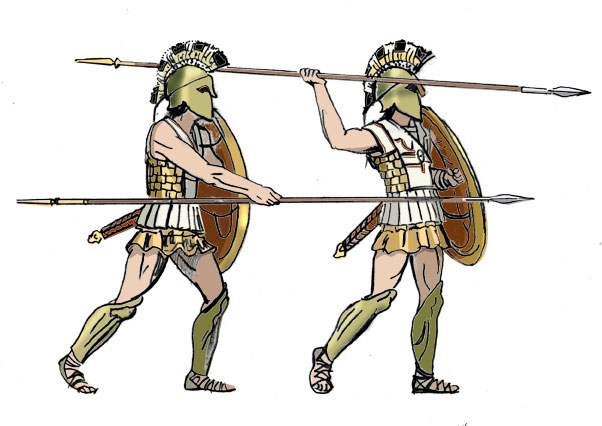

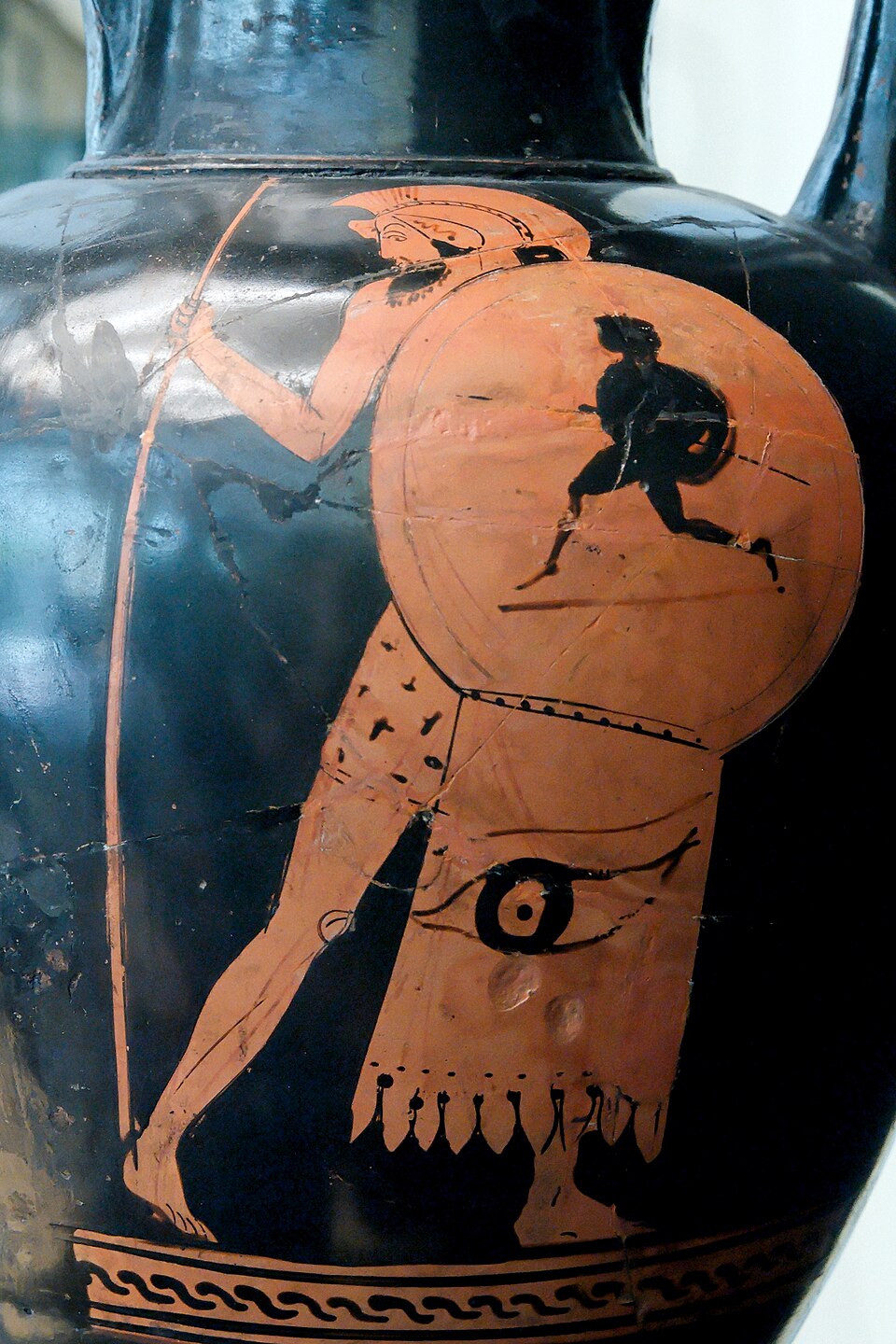
A hoplite was a citizen-soldier of the Ancient Greek city-states. A hoplite’s main weapon was his spear. They fought close together in what was called a phalanx formation. In a phalanx, each man’s shield protected himself and also gave some protection to the right arm of the man on his left.
The word “hoplite” comes from the type of the shield used by the soldiers. In later texts, the term hoplite is used to denote any armoured infantry, regardless of armament or ethnicity.
The armour of a hoplite included:
- helmet with face covered
- shield
- body armour
- greaves (leg armour)
- sword
- spear
A hoplite was usually a free citizen who supplied his own armour and weapons. In most Greek city-states citizens received basic military training and served in the standing army for a specified time, participating in any military campaign undertaken during that period. The citizens of Sparta were renowned for their lifelong combat training and military prowess. Their great adversaries, the Athenians, were exempted from service after the 60th year of life.
The phalanx trained to work as a team eight rows or more deep. The first row would stab at their opponents while trying to maintain close formation. The ranks behind would support them with their spears and gently push them with their shields, not to force them into the enemy but to keep them steady and in position. Upon command of an officer, the phalanx would take a certain number of steps forward.
Phalanxes tended to drift right in battle as each hoplite sought to keep his right arm behind the shield of his neighbour. Also, the right side of the phalanx, where right arms were unprotected by neighboring shields, was more vulnerable than the left. Thus the most experienced hoplites were often placed on the right side of the phalanx to counteract these problems.
Where this page comes from
The article above is adapted from “Hoplite” on Simple English Wikipedia, by its contributors. We removed reference markers, navigation boxes and tables, expanded measurement templates into readable numbers, and kept the prose otherwise intact.
Both sources are published under CC BY-SA 4.0, so this page is published under the same licence. You may share and adapt it, including commercially, as long as you credit the original and keep the same licence.
Worksheets, answer keys and printable layouts elsewhere on K5Print are our own work and are not covered by this licence.