Indus Valley

Quick facts
- Flows through
- China, Kashmir (disputed region), Pakistan
- Ends at
- Arabian Sea
Facts from Wikipedia’s “Indus River” page (CC BY-SA 4.0).
What country did they live in?
The Indus Valley civilization existed in modern-day India and Pakistan. It is also known as Harrapan civilization, named after the modern village “Harappa” that was first to be excavated. The Harappan Archeological site covers modern day Punjab and Pakistan.
What did they eat?
We have learned in recent studies that the people of the Indus Valley were excellent farmers. They grew cereal crops like wheat, rice, peas and barley. They also had many fruits and they kept animals like Cows and a type of Buffalo for eating. In the center of the town was a granary for storing any extra grain that the whole town could use outside of the growing season. They ate very little meat but they ate shellfish and other fish.
What did they wear?
The Indus valley people were the first in the world to spin cotton and woolen yarn. Needles and buttons have been found there. They knew the art of weaving and stitching. The men used to wear a loin cloth akin to a dhoti that is still worn by a large number of South Indians and few North Indians, even today. The women wore a type of skirt and wrapped a shawl around their shoulders. Men and women, both rich and poor, wore ornaments. Necklaces, fillets, armlets and finger rings were common to both men and women. These ornaments were made of gold, silver, copper, bronze, ivory or shells. They usually moved around barefoot.
What did their writing look like?
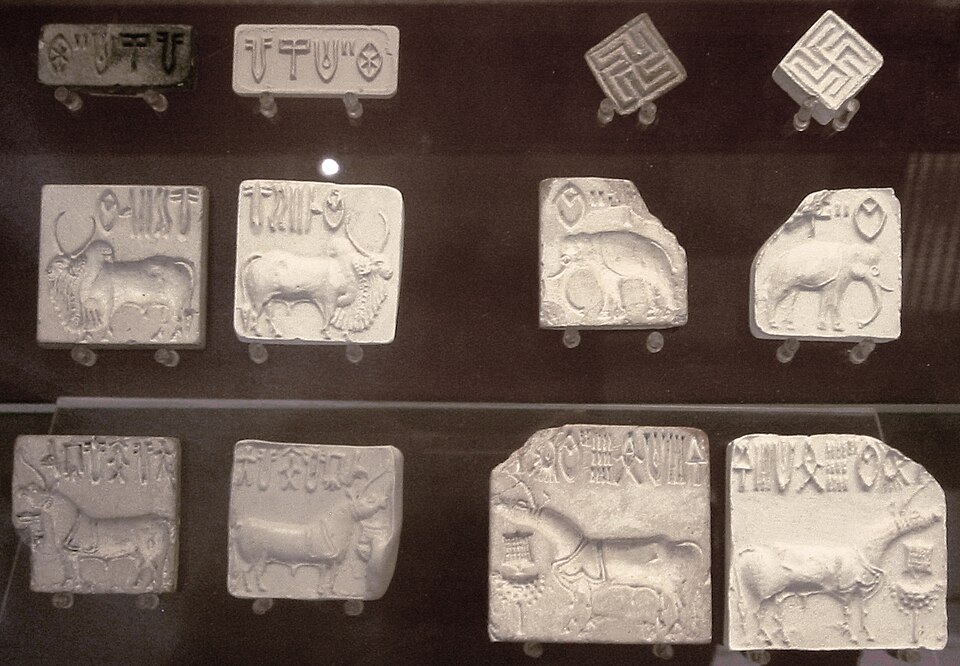
When seals from the Indus Valley were discovered, it was assumed that they contained the writing of the Indus Valley people. These stone seals were probably pressed into soft clay to mark people’s possessions. Over 4,000 examples of the seals have been found, as well as 400 different signs. However, the script, called Indus script, remains undecipherable, though the seals most likely carried the names of the owners.
There are several reasons as to why it cannot be deciphered. One is that linguists don’t know what language family it belonged to. Another is that the average length of the inscriptions is less than five signs, the longest being one of only 26 signs. The third is that no text written in Indus and another known language has been found. All these factors make it difficult to figure out what the seals say.
From excavations of the Indus Valley, archaeologists have found female fertility statues. These statues indicate that they worshipped mother goddesses. These statues included depictions of Kotravai and Kali. Seals depicting animals, perhaps as objects of worship, have also been found. Finally, seals depicting Velan “the priest” or the god Proto-Siva or the “Jain Thirthankara” in a yogic posture have been discovered. A logical conclusion can be made that some of the gods prevalent in South India, like Ayyappan and Murugan, might also have been worshipped.
Are some of them famous even today?
Many Indian philosophies of heterodox sects “Ajivika” “Charvaka” “Buddhism” “Jainism” owe their origin to Indus civilization. In South India, people rever the evolved form of “Kottravai” (Female goddess mentioned in Sangam literature and in “Silappatikaram”). Folk deities “Angalamman” “Kali” “Ellamman” plays a prominent role in the Dravidian folk religion even today. Sacred feminine has been a part of Indian culture. Male gods “Murugan” “Ayyapan” and “Siva” Anthropomorphised owing to the features of the seated figurine. In north India, “Durga” worship is an evolved form of Indus mother goddess Tibetan God “Mahadeva” an evolved form of “Proto-Shiva” or “Pasupathi”.
What happened to them?
Unfortunately, no one actually knows what happened to Indus Valley Civilization, though the main theories of their extinction are:
- Diseases like Cholera due to an introduction of Drainage.
- Diseases carried by traders.
- Natural disasters like earthquakes or floods.
- Environment changes due to deforestation
- Internal wars or poor administration.
- Invasions by the nomadic Aryans or other Central Asian hordes.
- Desertification of the Indus estuary, the retreat of the sea and parts of the Indus silting up with sand, leaving the early 5500 BC Harappa civilization in ruins. Many skeletons of people who had died violently and had been left in streets and houses to rot have been found in Mohenjo-Daro, one of the major cities of Indus Valley Civilization. Even though Aryan invasion theory is a matter of debate, there are enough pieces of evidence in Rig-Veda that mentions “Dasyus” and wars between Soma Aryans and Dasyus. “Dasyus” possibly the Natives or another group of Aryans. It is estimated that the cities were destroyed in about 1500 BC.
fi: Wikijunior Muinaiset kulttuurit/Induskulttuuri
Written for younger readers
Indus Valley, in simpler words
This version comes from Wikijunior, a set of books written for children aged 8 to 11. It is shorter and uses plainer language than the article above.
From Wikijunior: Ancient Civilizations
The Indus Valley civilization existed in modern-day India and Pakistan. It is also known as Harrapan civilization, named after the modern village “Harappa” that was first to be excavated. The Harappan Archeological site covers modern day Punjab and Pakistan.
We have learned in recent studies that the people of the Indus Valley were excellent farmers. They grew cereal crops like wheat, rice, peas and barley. They also had many fruits and they kept animals like Cows and a type of Buffalo for eating. In the center of the town was a granary for storing any extra grain that the whole town could use outside of the growing season. They ate very little meat but they ate shellfish and other fish.
The Indus valley people were the first in the world to spin cotton and woolen yarn. Needles and buttons have been found there. They knew the art of weaving and stitching. The men used to wear a loin cloth akin to a dhoti that is still worn by a large number of South Indians and few North Indians, even today. The women wore a type of skirt and wrapped a shawl around their shoulders. Men and women, both rich and poor, wore ornaments. Necklaces, fillets, armlets and finger rings were common to both men and women. These ornaments were made of gold, silver, copper, bronze, ivory or shells. They usually moved around barefoot.
When seals from the Indus Valley were discovered, it was assumed that they contained the writing of the Indus Valley people. These stone seals were probably pressed into soft clay to mark people’s possessions. Over 4,000 examples of the seals have been found, as well as 400 different signs. However, the script, called Indus script, remains undecipherable, though the seals most likely carried the names of the owners.
There are several reasons as to why it cannot be deciphered. One is that linguists don’t know what language family it belonged to. Another is that the average length of the inscriptions is less than five signs, the longest being one of only 26 signs. The third is that no text written in Indus and another known language has been found. All these factors make it difficult to figure out what the seals say.
From excavations of the Indus Valley, archaeologists have found female fertility statues. These statues indicate that they worshipped mother goddesses. These statues included depictions of Kotravai and Kali. Seals depicting animals, perhaps as objects of worship, have also been found. Finally, seals depicting Velan “the priest” or the god Proto-Siva or the “Jain Thirthankara” in a yogic posture have been discovered. A logical conclusion can be made that some of the gods prevalent in South India, like Ayyappan and Murugan, might also have been worshipped.
Many Indian philosophies of heterodox sects “Ajivika” “Charvaka” “Buddhism” “Jainism” owe their origin to Indus civilization. In South India, people rever the evolved form of “Kottravai” (Female goddess mentioned in Sangam literature and in “Silappatikaram”). Folk deities “Angalamman” “Kali” “Ellamman” plays a prominent role in the Dravidian folk religion even today. Sacred feminine has been a part of Indian culture. Male gods “Murugan” “Ayyapan” and “Siva” Anthropomorphised owing to the features of the seated figurine. In north India, “Durga” worship is an evolved form of Indus mother goddess Tibetan God “Mahadeva” an evolved form of “Proto-Shiva” or “Pasupathi”.
Unfortunately, no one actually knows what happened to Indus Valley Civilization, though the main theories of their extinction are:
- Diseases like Cholera due to an introduction of Drainage.
- Diseases carried by traders.
- Natural disasters like earthquakes or floods.
- Environment changes due to deforestation
- Internal wars or poor administration.
- Invasions by the nomadic Aryans or other Central Asian hordes.
- Desertification of the Indus estuary, the retreat of the sea and parts of the Indus silting up with sand, leaving the early 5500 BC Harappa civilization in ruins. Many skeletons of people who had died violently and had been left in streets and houses to rot have been found in Mohenjo-Daro, one of the major cities of Indus Valley Civilization. Even though Aryan invasion theory is a matter of debate, there are enough pieces of evidence in Rig-Veda that mentions “Dasyus” and wars between Soma Aryans and Dasyus. “Dasyus” possibly the Natives or another group of Aryans. It is estimated that the cities were destroyed in about 1500 BC.
fi: Wikijunior Muinaiset kulttuurit/Induskulttuuri
Where this page comes from
The article above is adapted from “Indus Valley” on Simple English Wikipedia, by its contributors. We removed reference markers, navigation boxes and tables, expanded measurement templates into readable numbers, and kept the prose otherwise intact. The simpler version is adapted from Wikijunior on Wikibooks.
Both sources are published under CC BY-SA 4.0, so this page is published under the same licence. You may share and adapt it, including commercially, as long as you credit the original and keep the same licence.
Worksheets, answer keys and printable layouts elsewhere on K5Print are our own work and are not covered by this licence.