Joseph Stalin

Joseph Vissarionovich Stalin (born Ioseb Besarionis dze Jughashvili); (18 December 1878 – 5 March 1953) was a communist revolutionary and politician who led the Soviet Union from 1924 to his death.
In the Soviet Union, Stalin created a totalitarian political system now called Stalinism. He also used Marxism–Leninism and made it the Soviet Union’s official political ideology.
After World War II, Stalin gained control over all of Eastern Europe, including part of Germany. There he set up a series of loyal Marxist-Leninist single-party states. This made the Soviet Union a superpower. Stalin’s policies turned the Soviet Union into a powerful, relatively modern country that was the largest on Earth.
Stalin was known as a brutal leader who was responsible for the deaths of over 50 million people in what was called the Holodomor.
Name
Stalin was born as Ioseb Besarionis dze Jughashvili or Iosif Dzhugashvili. He began calling himself “Stalin” in 1912.
- In Ио́сиф Виссарио́нович Ста́лин - ; born Джугашвили - .
- In იოსებ ბესარიონის ძე ჯუღაშვილიი -
Early life
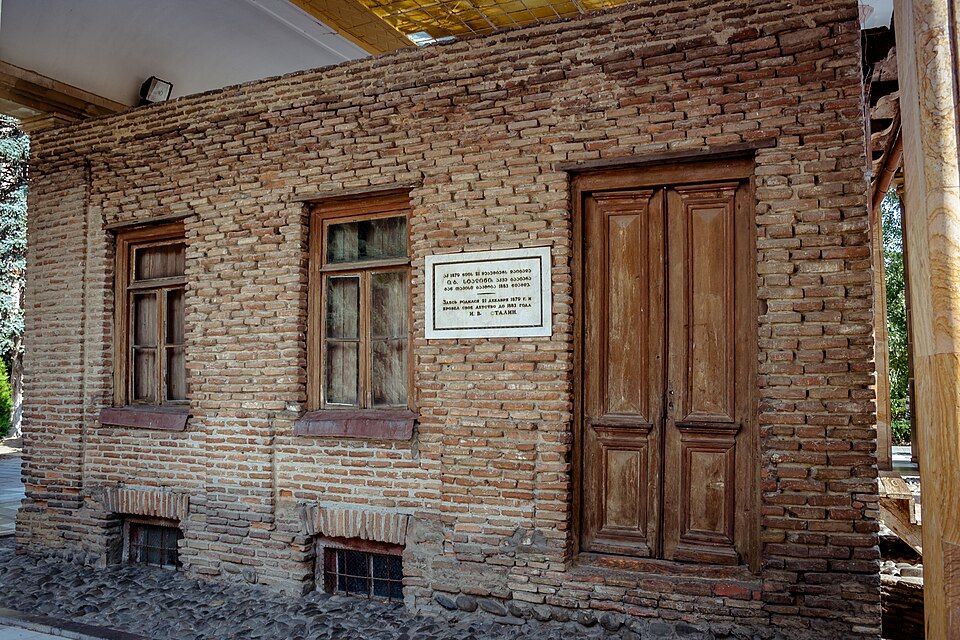
On 18 December 1878, Stalin was born in a small one-room house in Gori, Georgia, which was then a region in the Russian Empire that is now in Georgia. His parents had two other children, but both died.
Stalin’s father, a shoemaker, was an abusive alcoholic.
Health problems
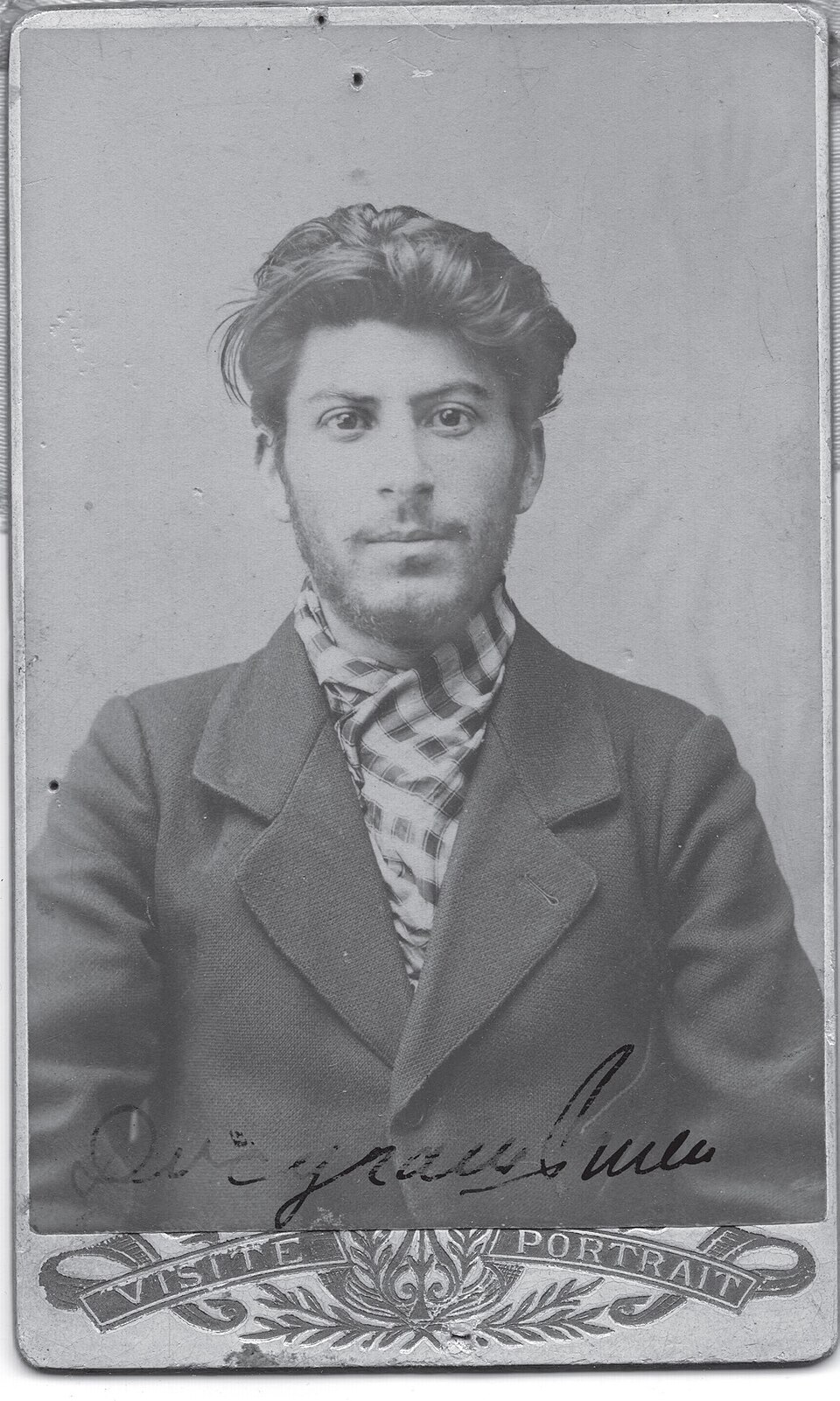
Stalin was born with two fused toes on his left foot. During childhood, he had smallpox, which left permanent scars. (Later, in the Soviet Union, photos of Stalin were often changed to hide those scars.)
As a child, Stalin also had measles and scarlet fever. Three times, he was in traffic accidents.
Stalin’s left arm was around 5.5 cm shorter than his right arm for unclear reasons. According to Stephen Kotkin, it was shortened in a January 1890 injury, when Stalin was hit by a sports carriage. It is also possible that he had a birth injury or Erb’s Palsy.
Early activities
Stalin was educated at the Gori church school. Then, he studied to be a priest at a seminary in Tbilisi. He was an active student who read many books. He especially liked books that were not allowed by the seminary, including Karl Marx’s writings.
In 1898, Stalin joined a Marxist group called the Mesame Dasi, or Group Three. The next year, he left school and got a job at the Tbilisi Physical Institute. He joined groups that were trying to start a revolution to remove the tsar and change the government.
The police raided Stalin’s house in 1901 while they were hunting for people who opposed the government. Stalin escaped and went into hiding so that the police could not find him. He continued to organize anti-government activities such as May Day marches and protests.
Stalin became a Bolshevik. He supported a violent revolution and opposed the Mensheviks.
Arrests and exiles
The secret police arrested Stalin in April 1902 and exiled him to Siberia without any trial. There, Stalin lived in the village of Novaya Uda.
Soon, he escaped from Siberia, which led to many later claims that he was a police spy. Those beliefs increased after the arrest of Stephan Shaumyan, a Bolshevik rival of Stalin.
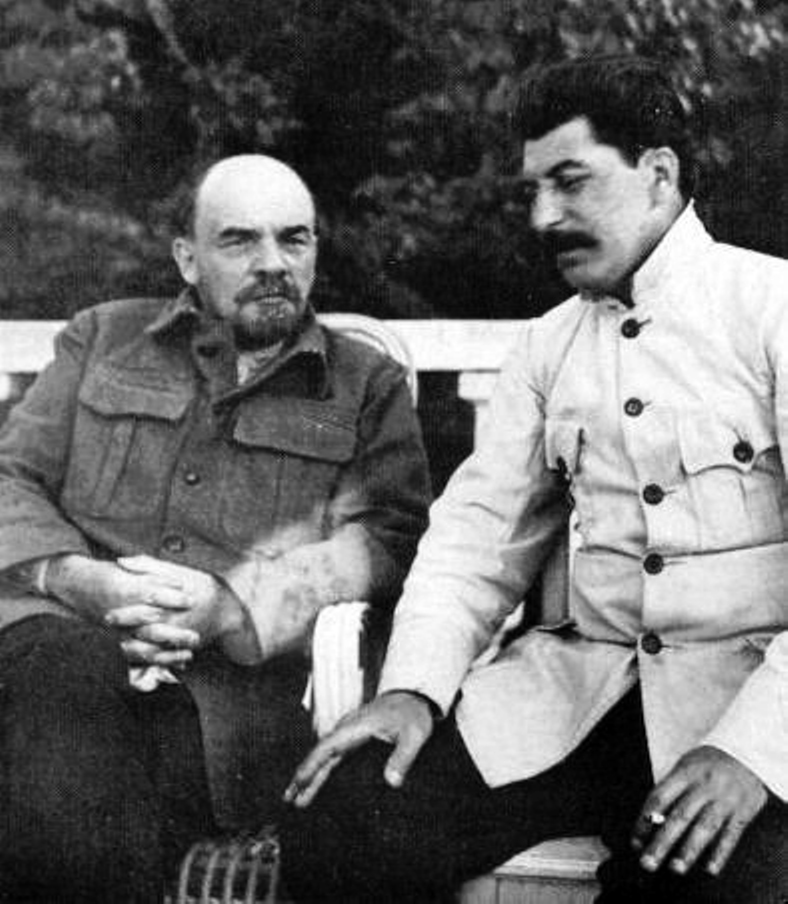
At the end of 1905, Stalin went to a meeting in Finland and met Vladimir Ilyich Lenin. Lenin was not what Stalin had expected.
In the next ten years, the government arrested and exiled Stalin several times. This increased his power in the Bolsheviks. In 1912, he was elected to its Central Committee and promoted to a position in St. Petersburg.
General Secretary
Stalin was a member of the Bolshevik Party, but he did not do much in the Russian Revolution of 1917. At the time, he was writing and editing Pravda, the party’s newspaper.
Stalin held a number of organizational jobs in the Communist Party. In 1922, he became General Secretary, which allowed him to give jobs to people he liked in the Communist Party. Those supporters helped him become the leader of the Soviet Union after Lenin died in 1924.
Leader of the Soviet Union
After Lenin’s death, Stalin fought for power of the Soviet Union, notably against Leo Trotsky, who had been preferred by Lenin. In 1929, Stalin declared himself dictator and became the second leader of the Soviet Union.
Mass executions
To eliminate “enemies of the working class”, Stalin instituted the “Great Terror” (also called the “Great Purge”). His government executed at least 700,000 people and sent over a million others to gulags between 1934 and 1939.
Stalin executed most of the generals in the Red Army because he saw them as a threat to his rule. That caused his army to be greatly weakened when Nazi Germany invaded the Soviet Union in 1941.
World War II
Germany began its invasion on 22 June 1941. This offensive, called Operation Barbarossa, was the largest military invasion in human history.
Two years before, the Soviets and the Germans had signed a mutual non-aggression pact, promising not to fight with each other. However, Hitler hated communism. After taking over France, he sent the Wehrmacht to invade the Soviet Union.
After the Nazis invaded, the Soviet Union began working with the Western Allies to defeat Germany. Germany eventually lost the war, but the USSR had more casualties than any other country during the war.
Postwar
Under Stalin, the Soviet Union became the largest country in the world. After Germany had been defeated, Stalin gained control over East Germany and most of the rest of Eastern Europe.
The Soviet Union grew to include today’s countries of Armenia, Azerbaijan, Belarus, Estonia, Georgia, Kazakhstan, Kyrgyzstan, Latvia, Lithuania, Moldova, Russia, Tajikistan, Turkmenistan, Ukraine, and Uzbekistan.
Stalin’s government forced those countries to obey him even though the American and British governments protested. Other countries (like Poland, Czechoslovakia, and Hungary) became satellite states of the Soviets and adopted communism.
In 1947, the Cold War had begun, and Stalin militarized the Soviet Union by focusing its time and energy on weapons, military vehicles, and the armed forces.
Food and agriculture
Also see: Collectivization Stalin collectivized farms in the Soviet Union, which meant cancelling the private property rights of the people who owned them. Stalin’s government took land away from individual farm owners and created large government-run farms. People were required to work on large farms and to turn their harvests over to the government.
Collectivization did not work well. Farmers were not paid much money, and whatever they grew went to the state. That made the workers not try their best. In 1932-1933, there was a famine, and millions of people starved notably in Ukraine, which is called the Holodomor.
Peasants were given very small bits of land to grow whatever they liked and keep what they grew. The best farming in the Soviet Union came from those small pieces of land. In 1938, they made up just 4% of Soviet farmland but grew 20% of its produce.
There was a second great famine in the Soviet Union in 19461947. It was caused by drought and made worse by the devastation caused by the war. In 1946, the Soviet Union produced 39.6 million tons of grain: barely 40% of what it had produced in 1940.
Death
In his later years, Stalin’s health declined. He had cardiovascular problems high blood pressure, and a series of strokes. According to official records, he died on 5 March 1953 after a stroke.
Conspiracy theory
In 2003, a group of Russian and American historians claimed Stalin was poisoned, possibly by the men who took over the government after his death. They thought Stalin had a brain bleed because he was given warfarin, a powerful blood thinner that was used as a rat poison during Stalin’s time.
However, Stalin was in his mid-seventies when he died. According to his autopsy, he had severe atherosclerosis. Modern medicines for high blood pressure did not exist at the time.
In a 2023 scientific paper, Dr. Matthew Turner concluded: After examining the evidence, [I think] Stalin’s disease course and the properties of warfarin make it highly unlikely that he was deliberately assassinated.
De-Stalinization
Nikita Krushchev, who led the Soviet Union from 1953-1964, began a process of “De-Stalinization,” which meant taking apart much of the political system that Stalin made. Stalin was denounced as a tyrant. After outsmarting and defeating his rivals, Krushchev established a personal control over the government that was comparable to Stalin’s own.
Legacy
Stalin is a controversial figure in history. Many historians see him as a ruthless dictator, but some praise him as the Father of the Soviet State. Stalin has been criticized for his role in the Holodomor.
In 2006, a poll stated that almost half the adults in Russia thought that Stalin was a good person. Two years later, another poll listed him as the third most popular person in Russian history.
He ruled Russia for more than 29 years, longer than any other Russian leader in the 20th century.
Written for younger readers
Joseph Stalin, in simpler words
This version comes from Wikijunior, a set of books written for children aged 8 to 11. It is shorter and uses plainer language than the article above.
From Wikijunior: World War II
- Full name: Iosif Vissarionovich Dzhugashvili
- Adopted name: Joseph Stalin
- Born: 18 December 1878
- Died: 5 March 1953
- Leader of: The Soviet Union
Stalin was General Secretary of the Communist Party of the Soviet Union’s Central Committee from 1922 until his death in 1953. This meant he was the leader of the Union of Soviet Socialist Republics (“USSR”), which was also called the Soviet Union. That country doesn’t exist any more. It was made up of a large number of other countries like Russia, Ukraine, Estonia, Latvia and Georgia. In many ways he was very similar to Hitler - an absolute dictator.
The USSR was created in 1919 after the end of the Russian Civil War. Stalin became leader of the USSR after its first leader, Vladimir Lenin, died in 1924. Stalin tried to turn the USSR into a “communist” state. His ideas sometimes worked but sometimes went wrong. His plan to change the way crops were grown is believed by some to have lead to the death of up to 6 million people.
Then, in the 1930s, Stalin began to kill his enemies and rivals. He executed millions of his own people. These included many army officers and other people he saw as threat to his power. This greatly weakened the Soviet army. Although it was huge and well armed, its officers were very new and were scared of being shot if they seemed to be clever. They were at a loss as to how to fight the clever and experienced German army.
Before the war, Stalin did a deal with Germany and they both agreed to invade Poland. He thought that Germany wouldn’t attack the USSR as they had made this deal. In fact, some historians think Stalin was planning to invade Germany but the Germans attacked first! Anyway, Germany did attack and to start with it looked like the Germans would win easily, but Stalin was ruthless. He was willing to sacrifice any number of soldiers to stop the Germans capturing important machinery (like tank factories) and to slow their advance on the capital, Moscow. Despite millions of deaths, this worked and in the end the USSR beat the Germans.
It might have ended differently if Hitler hadn’t made mistakes. Many people in the USSR welcomed the Germans as “liberators”. They had been living with Stalin and his “purges”, where he killed those he didn’t trust. Many people, especially outside of Russia, might have joined the war on the German side. But Hitler didn’t want their help, and by being even more cruel than Stalin and killing even more of them, turned them against the Germans.
Where this page comes from
The article above is adapted from “Joseph Stalin” on Simple English Wikipedia, by its contributors. We removed reference markers, navigation boxes and tables, expanded measurement templates into readable numbers, and kept the prose otherwise intact. The simpler version is adapted from Wikijunior on Wikibooks.
Both sources are published under CC BY-SA 4.0, so this page is published under the same licence. You may share and adapt it, including commercially, as long as you credit the original and keep the same licence.
Worksheets, answer keys and printable layouts elsewhere on K5Print are our own work and are not covered by this licence.