Mayans
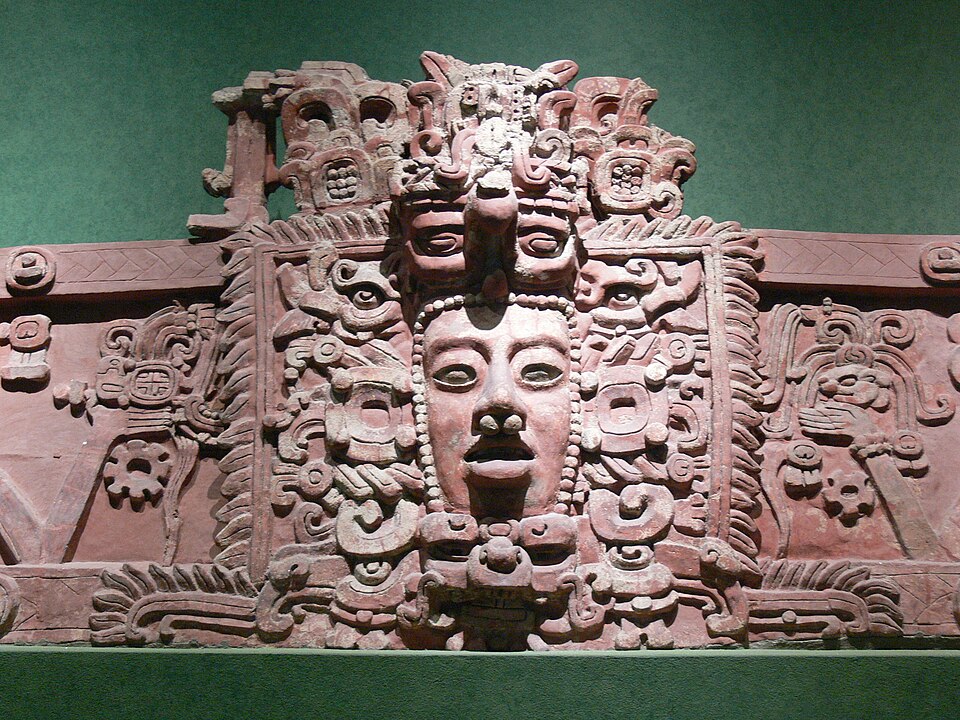

The Maya civilization was a pre-Colombian Central American civilization from around 2000 BC to 1697 CE.
The Mayans existed around 4,000 years ago (about 2000 BC). At that date complex societies were living in the Mayan region. The staple foods of the Maya diet were cultivated. Their food included maize, beans, squashes, and chili peppers. The first Maya cities developed around 750 BC.
The Mayan people used a written language and a numeral system. They were good at art, building, and their priests studied stars and planets, which helped them make calendars.
The Mayan civilization was biggest between the years of 420 AD and 900 AD. The Mayan civilization spread all the way from central Mexico to modern day Honduras, Guatemala, and northern El Salvador. It is estimated that at its maximum, the civilization had at least ten million people. The Maya people traded with other people in the Americas. Their art and buildings have many different styles. This shows they traded a lot. They made changes to their buildings to make them even better. The Maya civilization started getting smaller after 900 BC.
The Conquistadors arrived in the 15th century and took over Mexico and later Central America, even in the Mayan areas. However, the Maya people still live there today. They live in the same areas the Mayan civilization used to live in. They keep the old Mayan traditions and beliefs. There are many Mayan languages still spoken today, including one called the Achi language.
Location
The people of the Maya civilization lived in three different areas: the southern Maya highlands, the central lowlands, and the northern lowlands. They had many different types of land, including mountains and dry plains. People living in the low plains by the sea were affected by hurricanes and tropical storms from the Caribbean.
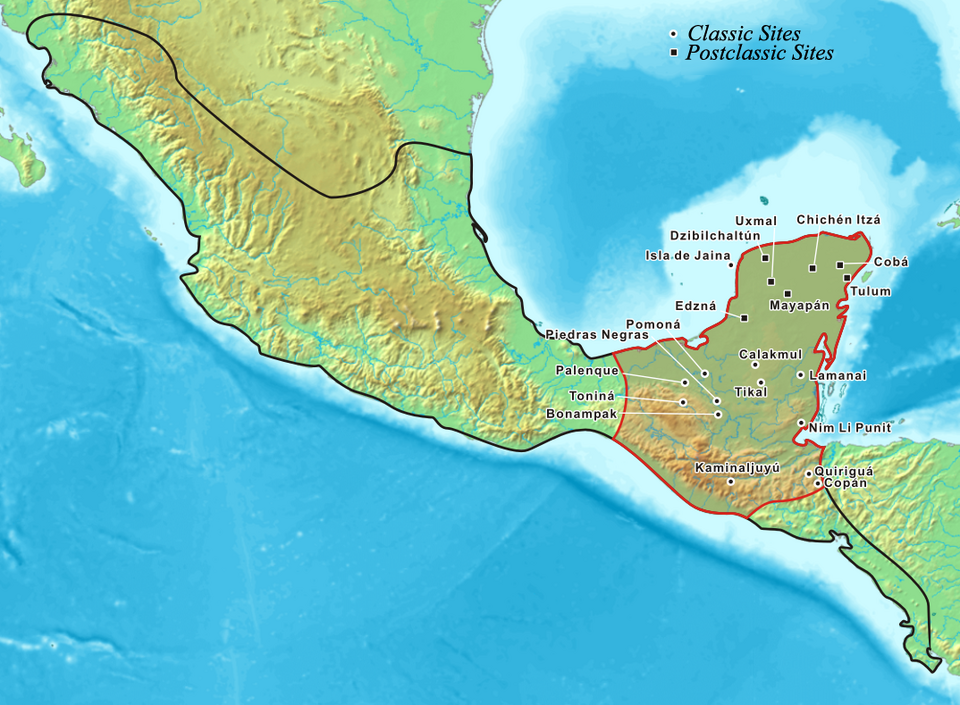
The area covered what we now call the southern Mexican states of Chiapas and Tabasco, and the Yucatán Peninsula states of Quintana Roo, Campeche and Yucatán. They also included where we now call Guatemala, Belize, El Salvador and western Honduras.
The pre-classical period
The first Maya settlements started about 1800 BC. They lived in the Soconusco region, now the state of Chiapas in Mexico, on the Pacific Ocean. This is called the “early pre-classic period” in Mayan history’. People in Central America had been nomads who went from place to place to find food and shelter. Around this time they began to settle down.They started to farm animals and make pottery and small clay figures. They buried their dead in simple burial mounds. Later they started to make these mounds into step pyramids.
There were other people around at the time, especially in the north. The Olmec, the Mixe-Zoque, and Zapotec civilizations mostly lived in the area we now call Oaxaca. We don’t know exactly where the borders of the Maya civilization were. Many of the most important early examples of writing and buildings appeared in north, so these cultures probably affected the Maya civilization.
The classical period
From about 250 to 909, the Maya civilization built many monuments and cities, and made many important carvings. The “southern lowlands” were an important place at the time. The Maya civilization made many discoveries about art and thinking there.
Like Ancient Greece, their civilization was made up of numerous cities, which all worked in different ways. People gathered around these cities to farm. Well-known cities were Tikal, Palenque, Copán and Calakmul. Lesser-known cities were Dos Pilas, Uaxactun, Altun Ha, and Bonampak, among others. In general, we know more about where the cities were in the south than we do in the north. Some northern cities we do know about were Oxkintok, Chunchucmil, and Uxmal.
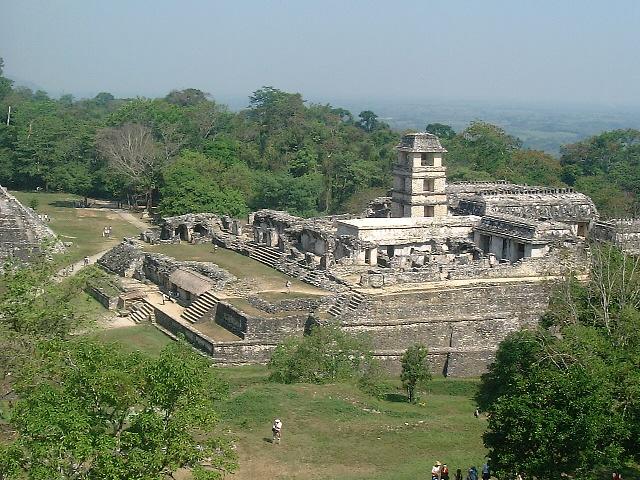
Their most famous monuments are the pyramids they built as part of their religious centers, and the palaces. The palace at Cancuén is the largest we know about in the Maya area. The Maya also made carved stone slabs which they called tetun, or “tree-stones”. These slabs show rulers along with hieroglyphic writing describing their family, military victories, and other things that they did well.
Trade with other civilizations
The Maya had trade routes that ran over long distances. They traded with many other Mesoamerican cultures, such as Teotihuacan, the Zapotec, and other groups in central and gulf-coast Mexico. They also traded with groups that were farther away. For example, people who study the Maya civilization found gold from Panama in the Sacred well at Chichen Itza.
Some important things they traded were cacao, salt, sea shells, jade and obsidian.
Sudden collapse
Between 900 AD and 1000 AD, the cities in the southern lowlands had more and more problems until all the people left. The Maya civilization there stopped making big monuments and carvings. People who study the Maya civilization are not sure why this happened. They have many different ideas - some people think there was a big environmental disaster, or a disease affected a lot of people, or there were just too many people for the amount of food they could grow.
Post-classical period and decline
In the north, the Maya civilization kept going. Other cultures started mixing with Mayan culture much more. Some of the important sites in this time were Chichen Itza, Uxmal, Edzná, and Coba. At some point, the families who ruled over Chichen and Uxmal got weaker and the rulers in the city of Mayapan ruled all of the Mayan civilization in the Yucatán peninsula until there was a revolt in 1450. After the revolt, the whole area broke up into different cities who fought against each other, until the Spanish conquest of Yucatán.
The Itza Maya, Ko’woj, and Yalain groups around what is now Guatamela were still around, but there were not very many of them. By 1520, they had built themselves back up again and started to build cities. The Itza had their capital at Tayasal (also known as Noh Petén), and people who study the Maya civlisation think what’s left of this city is below the modern city of Flores, Guatemala on Lake Petén Itzá. The Ko’woj had their capital at Zacpeten. Some Mayan cultures were still living in the southern highlands.
The Quiché kingdom produced the most famous Mayan work, the Popol Vuh. It talks about the creation of the world, the Mayan gods and goddesses, how humans and animals were created and why the Quiché kingdom was the best one in the Maya civilization.
The Spanish started to conquer Maya lands. It took them a long time (170 years) to finish doing this because the Mayans had no capital city and each city had a different culture. The last Mayan states, the Itza city of Tayasal and the Ko’woj city of Zacpeten, still had people living in them late into the 17th century. They were finally conquered in 1697.
There are still about 6 million Maya people living in Central America.
Written for younger readers
Mayans, in simpler words
This version comes from Wikijunior, a set of books written for children aged 8 to 11. It is shorter and uses plainer language than the article above.
From Wikijunior: Ancient Civilizations
The Maya were a Mesoamerican civilization. They had the most advanced writing system in the Americas prior to European contact. They used sophisticated mathematic systems and had complex and useful cyclical calendars. Spectacular art and monumental architecture were two other notable accomplishments of this civilization.
The ancient Mayans lived in what is now known as southern Mexico and northern Central America including Guatemala, Belize, Honduras, Yucatán Peninsula and El Salvador. Their descendants still live there today, and many of them speak the Mayan languages.
The Mayans were master architects, building pyramids and even entire cities, many of which are still standing today.
Mayan pyramids were made of stone. The stone was carved to create a stairstep design. On the top of each pyramid was a shrine dedicated to a particular deity. Rituals thought to influence the Gods were held in these shrines.
Mayan cities grew around the pyramids. They consisted of plazas connected together by sacbeob (whiteway) causeways. There appears to have been little planning in their design; the topography of the region influenced the type of buildings constructed. For example, cities in the hills had tall towers, while cities built on limestone grew into large municipalities.
The largest plazas were at the heart of Mayan cities. They contained governmental and religious buildings, such as the royal acropolis, great pyramid temples, and occasionally ball-courts. Temples and observatories were always constructed so they followed the Mayan interpretation of the orbits of the stars. Outside of this center were less important temples and shrines. At the outskirts lay the homes of the common people.
The Mayans lacked many tools, such as metal tools, pulleys, and perhaps even the wheel. They did, however, have an abundance of materials. The most common material was limestone, taken from local quarries. Limestone was easy to work, and only hardened once removed from its bed. In addition, it could also be used as mortar or stucco. Common homes used wooden poles, adobe (a mixture of straw and sandy clay), and thatch; however, houses made of limestone have been found as well. In the city of Comalcalco, fired-clay bricks have been found as a substitute for stone. The Mayan’s used clay, stone, limestone, thatched hay, wooden poles, and metal to make common day houses.
The Mayans grew a wide variety of crops, including corn (maize), Amaranth, manioc, and sunflower seeds. These crops were grown in permanent raised fields, terraces, forest gardens, and managed fallows. There was also harvesting of wild crops. The Mayans ground cacao and mixed it with water to make the first chocolate.
When the king appeared in public, he wore white robes and a gold crown on top of his head, decorated with Quetzal (a type of bird) plumes.
During wartime, the Mayans wore masks, while commanders wore robes made of silver and gold. Some Mayan clothes were made of deer skin. Usually women made the clothes.
The Mayans wrote using a series of glyphs (symbolic pictures), which were painted on ceramics, walls, or bark-paper codices (books), carved in wood or stone, or molded in stucco. Each glyph represented a word. Mayans wrote numbers vertically.
The Mayan script was used up until the arrival of the Spanish. Although many Mayan centers went into decline (or were completely abandoned) during or after this period, many Mayans still had the skill and knowledge of Mayan writing, and the early Spanish conquistadors knew of people who could still read and write the script. Unfortunately, the Spanish however believed that the Mayan books were evil so by the end of the 16th century, almost all knowledge of the Mayan script was lost.
Attempts to decipher the Mayan script came in the 19th century. Investigators were soon able to decipher the Mayan numbers and portions of texts related to astronomy and the Mayan calender. Most of the Mayan script has since been deciphered, but work still continues today. The Mayan calendar ends at the year of 2012, when they believed the world would end.
The Mayans believed that time was cyclical, that is, it goes in circles. The Mayan shaman interpreted these cycles by looking at the number relations of all their calendars. If the interpretations of the shaman showed bad times ahead, human sacrifices would be performed to make the gods happy. They left behind a prophesy that the world would end on December 21, 2012 and bring about the fifth cycle of the world.
According to Mayan mythology, there were thirteen heavens and nine underworlds, with one god for each. Natural elements, stars and planets, numbers, crops, days of the calendar and periods of time all had their own gods.
The creation story of the Mayans is found in the Popol Vuh (“Council Book” or “Book of the Community”). According to the book, the gods Tepee and Tucuman’s decided that, in order to preserve their legacy, they had to make a race of beings who could worship them. Earth, along with the animals, was created. Man was first made out of mud but then he fell apart. Other gods were summoned and man was next created of wood but had no soul. Finally, man was made out of maize by even more gods.
The Mayans worshiped Gods and Goddesses and they believed to make the Gods and Goddesses happy they had to make human sacrifices.
The ancient Mayans abandoned their large cities suddenly. To this day, no one is still certain why. However, the Mayan people never died out; their descendants still live in Mexico and Central America. The Mayan’s legends and royal lineage is written in a book called Popul Vuh. The word ‘hurricane’ comes from the name of a fearsome Mayan god named Hurakan who is mentioned in this book.
Mayans painted their bodies red, black, white, and blue and thought crossed eyes were cool. They tied objects to their babies’ heads to give them crossed eyes. They tied boards to their babies’ heads to flatten them too.
At the start of the 21st century, there were about 6 million Mayans living in the Mexican states of Yucatán, Campeche, Quintana Roo, Tabasco, and Chiapas, and in the Central American countries of Belize, Guatemala, and the western portions of Honduras and El Salvador.
The largest group of modern Mayans is found in the Yucatán region of Mexico. They speak both “Yucatec Maya” and Spanish, and are generally integrated into Mexican culture. More traditional Mayans are found in Guatemala. Many of them wear traditional clothes and practice traditional customs. The most traditional Mayans are a group called the Lacandon, who avoided contact with outsiders until the late 20th century by living in small groups in the rain forests.
There are many Mayan buildings that were once part of cities still standing today. The most important ones are: Chichen Itza, Coba, Copán Kalakmul, Tikal, and Uxmal. These cites lay forgotten for centuries, until modern-day explorers rediscovered them. Archaeological surveys and excavations were conducted (and are still being conducted) on some of these sites, revealing more about Mayan culture. Today, some cities can be visited by tourists.
There are indigenous people in Southern Mexico, Guatemala, and Honduras who are descended from the Maya. One of the most famous of them is Rigoberta Menchu, a Quichè Indian. She wrote about the struggles of her people in her book I, Rigoberta Menchu. She received a Nobel Peace Prize.
de:Wikijunior Alte Zivilisationen/ Mayas
Where this page comes from
The article above is adapted from “Mayans” on Simple English Wikipedia, by its contributors. We removed reference markers, navigation boxes and tables, expanded measurement templates into readable numbers, and kept the prose otherwise intact. The simpler version is adapted from Wikijunior on Wikibooks.
Both sources are published under CC BY-SA 4.0, so this page is published under the same licence. You may share and adapt it, including commercially, as long as you credit the original and keep the same licence.
Worksheets, answer keys and printable layouts elsewhere on K5Print are our own work and are not covered by this licence.