Mesopotamians
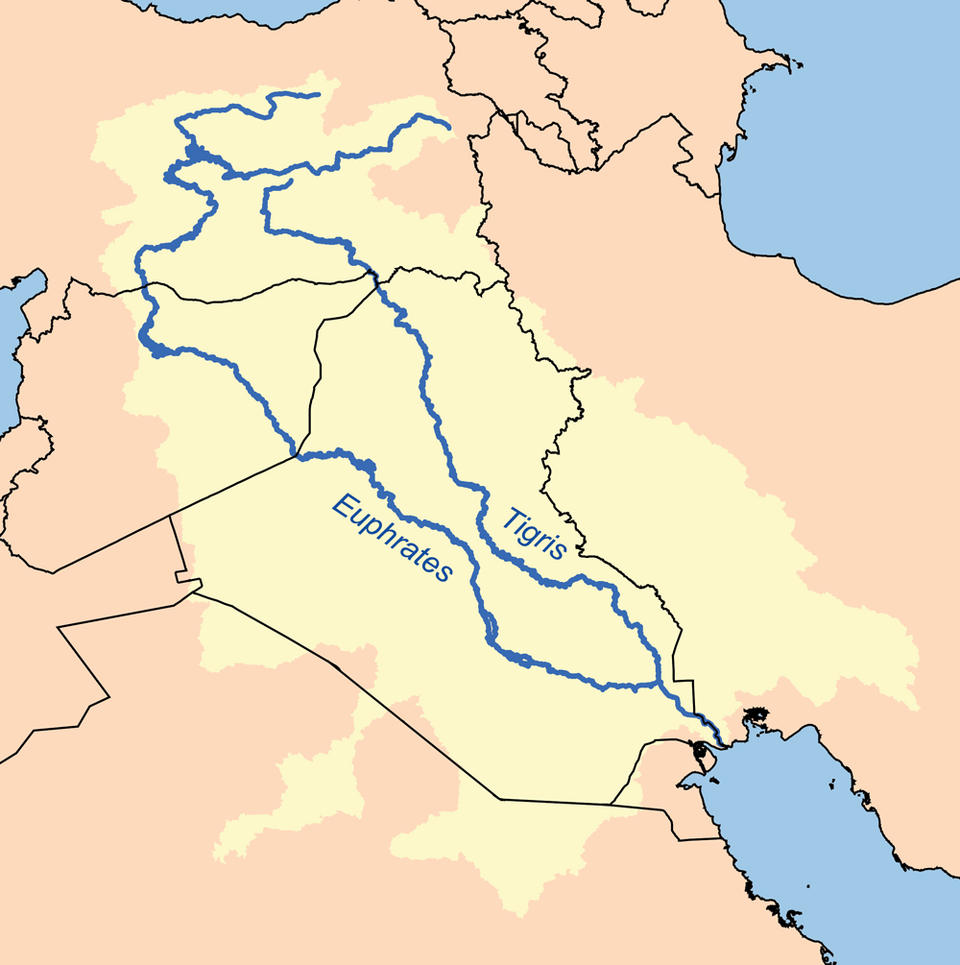

Mesopotamia (Ancient Greek: Μεσοποταμία - “land between rivers”) is a historical region in the Middle East. It included most of today’s Iraq, and parts of modern-day Iran, Syria and Turkey. The ’two rivers’ of the name referred to the Tigris and the Euphrates rivers.
Overview
The land was called Al-Jazirah (“the island”) by the Arabs, and Egyptologist J.H. Breasted later included it in the Fertile Crescent. The region is bounded in the northeast by the Zagros Mountains and in the southeast by the Arabian Plateau. The area is often called the cradle of civilization. The ancient writing system, or alphabet, is called cuneiform. It was first used around 3000 BC by the Sumerians. Historically important cities in Mesopotamia included Uruk, Ur, Nippur, Nineveh and Babylon.
Major territorial states were the Akkadian kingdom, the Third Dynasty of Ur, and the Assyrian Empire. Some of the important historical Mesopotamian leaders were Ur-Nammu (king of Ur), Sargon of Akkad, the founder of the Akkadian kingdom, Hammurabi, who established the Old Babylonian state, and Tiglath-Pileser I, who started the Assyrian Empire.
Many advances in technology were made by the ancient Sumerians, such as irrigation, trade by river, and flood control. Sumerians had agriculture and domesticated animals, or livestock, from the earliest records. Babylon is likely the first city built by settled people. Mesopotamia was also the place where the wheel was first used. First it was a potter’s wheel that was used to make clay pots, then Sumerians adapted it for transport.
Geography
Mesopotamia is made up of different regions. Northern Mesopotamia is made up of hills and plains. The land is quite fertile due to seasonal rains, and the rivers and streams that come from the mountains. Early settlers farmed the land and used timber, metals and stone. Southern Mesopotamia is made up of marshy areas and wide, flat, plains. Cities developed along the Euphrates and Tigris rivers flowing through the region. Early settlers had to irrigate the land along the banks of the rivers to grow their crops.
Inhabitants
Mesopotamia has been conquered many times by many different people. It was the heartland of the Sumerian, Akkadian, Babylonian and Assyrian empires. As each new group moved into the region they adopted some of the culture, traditions, and beliefs of the people who had come before. It was conquered by Alexander the Great (332 BC), the Parthians (150 BC), the Romans, the Persian Empire and the Arabs (7th century). It is still one of the most fertile parts of the Middle East.
Ancient Mesopotamia begins in the late 6th millennium BC, and ends with either the rise of the Achaemenid Persians in the 6th century BC or the Muslim conquest of Mesopotamia in the 7th century CE. This long period may be divided as follows:
- Pre-Pottery Neolithic:
- Jarmo (~7000 BC – ~6000 BC )
- Pottery Neolithic:
- Hassuna (~6000 BC –? BC ), Samarra (~5700 BC –4900 BC ) and Halaf (~6000 BC –5300 BC ) cultures
- Chalcolithic or Copper Age:
- Ubaid period (~5900 BC –4400 BC )
- Uruk period (~4400 BC –3200 BC )
- Jemdet Nasr period (~3100 BC –2900 BC )
- Early Bronze Age
- Early Dynastic Sumerian city-states (~2900 BC –2350 BC )
- Elam 2700 ( BC –570 BC ).
- Akkadian Empire (~2350 BC–2193 BC ).
- Third Dynasty of Ur (‘Sumerian Renaissance’ or ‘Neo-Sumerian Period’) (~2119 BC –2004 BC )
- Middle Bronze Age
- Early Babylonia (20th–18th century BC )
- Early Assyrian kingdom (20th–18th century BC )
- First Babylonian Dynasty (18th–17th century BC )
- Late Bronze Age
- Kassite dynasty (16th–12th century BC )
- Bronze Age collapse (12th–11th century BC )
- Iron Age
- Neo-Hittite or Syro-Hittite regional states (11th to 7th century BC )
- Neo-Assyrian Empire (10th–7th century BC )
- Chaldea, Neo-Babylonian Empire (7th–6th century BC )
- Classical Antiquity
- Persian Babylonia, Achaemenid Empire (6th–4th century BC )
- Seleucid Mesopotamia (4th–3rd century BC )
- Parthia, then Asuristan (3rd century BC –3rd century AD )
- Osroene (2nd century BC –3rd century AD )
- Adiabene (1st–2nd century AD )
- Roman Mesopotamia, Roman Assyria (2nd century AD )
- Late Antiquity
- Sassanid Asuristan (3rd–7th century AD )
- Arab conquest of Mesopotamia (7th century AD )
Epic of Gilgamesh
The Epic of Gilgamesh is an ancient story about a relationship between Gilgamesh and his close companion, Enkidu. Enkidu is a wild man created by the gods as Gilgamesh’s equal to distract him from oppressing the citizens of Uruk.
Together they undertake dangerous quests that incur the displeasure of the gods. Firstly, they journey to the Cedar Mountain to defeat Humbaba, its monstrous guardian. Later they kill the Bull of Heaven that the goddess Ishtar has sent to punish Gilgamesh for turning down her advances.
The second part of the epic is about Gilgamesh’s distressed reaction to Enkidu’s death, which takes the form of a quest for immortality. Gilgamesh attempts to learn the secret of eternal life by undertaking a long and perilous journey to meet the immortal flood hero, Utnapishtim. The words addressed to Gilgamesh in the midst of his quest foreshadow the result:
Written for younger readers
Mesopotamians, in simpler words
This version comes from Wikijunior, a set of books written for children aged 8 to 11. It is shorter and uses plainer language than the article above.
From Wikijunior: Ancient Civilizations
Mesopotamia included the area that is now eastern Syria, southeastern Turkey and most of Iraq.
They had buildings made of mud and clay with an opening on top because they hadn’t made doors yet.
Ordinary people in Mesopotamia ate better food than the poor people . Some workers were paid in food while others had to buy or trade for food.
In Mesopotamia they ate a meal three times a day, these meals were prepared outside in a small courtyard. The meals included a flatbread made of barley. They did not eat beef because it was too expensive. So they ate lots of vegetable soups or stews. They also drank lots of alcoholic beverages, mainly ale. They drank some cows’ milk but they could not keep it long because it would spoil in the hot climate. People that lived near the river used spears and nets to catch fish. The fish were salted and stored to eat in the winter. People near the coast would hunt for turtle eggs and eat them. They ate in clay plates or on hard bread.
Food from other countries was enjoyed including bananas from India, wine from Syria. The King had fancier meals made with different spices. He also was the first to have the imported white cheese.
Recipes have been found on clay tablets.
They mostly wore clothes made from wool; cotton and silk were introduced later.
Mesopotamia writing was one of the first written languages. They wrote using pictograms. They used small drawings of simple pictures to communicate.
Writing began in Mesopotamia around 3500 BC. Scribes were people who learned to write. Clay tablets were used for recording information. Scribes kept track of sales and trades, tax payments, gifts for the gods, marriages, and deaths. There were many symbols that scribes had to learn. They used sharp tools to write with like a stylus. Later on, their writing was called cuneiform. Cuneiform has lots of triangles and wedge-shaped symbols.
The Mesopotamians believed that the gods were beyond the reach of humans and that the gods considered them extremely insignificant. In comparison, the Egyptians thought that you could make sacrifices for gods and they would listen. The Egyptians also believed that there was a connection between humans and the gods, the pharaoh being the link, who was made divine by the god Horus. The Egyptians also thought that you could receive eternal life in the afterlife.
In the epic of Gilgamesh, the god Enlil decided to flood the earth and almost every other god took his side on this matter. The Egyptian god Amon would cause the Nile to flood, always at the same period of time, and they believed that if they praised him and made sacrifices for him, he would continue to flood the Nile.
Yes, they are. For example, people such as Gilgamesh and king Hammurabi are still famous today. Also, many Egyptian kings, including King Tut(Tutankhamen) are still famous today.
There are many artifacts, including tablets in their language, ceramic pots, and many other daily objects.
The civilizations started around 5300 B.C. and ended either in the 6th century B.C. or 644 A.D.
Where this page comes from
The article above is adapted from “Mesopotamians” on Simple English Wikipedia, by its contributors. We removed reference markers, navigation boxes and tables, expanded measurement templates into readable numbers, and kept the prose otherwise intact. The simpler version is adapted from Wikijunior on Wikibooks.
Both sources are published under CC BY-SA 4.0, so this page is published under the same licence. You may share and adapt it, including commercially, as long as you credit the original and keep the same licence.
Worksheets, answer keys and printable layouts elsewhere on K5Print are our own work and are not covered by this licence.